
| 1 | Ethiopian mountain adder |
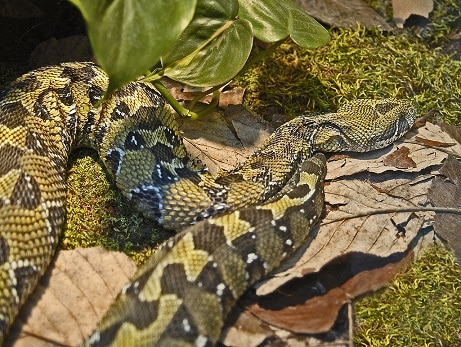
Maximum length: 130cm.
A dangerously venomous Ethiopian snake which is poorly researched. The Ethiopian mountain adder (Bitis parvicola) frequents hills and wooded areas in the Ethiopian countryside, sometimes bordering forests or old coffee plantations. It’s especially common in western Ethiopia, and occupies high altitudes of 1700-2800 metres.
This species is found only in Ethiopia, not quite reaching the South Sudan border. Its venom is moderately lethal, with especially powerful haemorrhagic abilities. According to the few people who have studied them, the Ethiopian mountain adder is relatively docile, yet reacts with aggressive fury if touched.
This is not a snake you’d want to become bedfellows with, yet if you visit western Ethiopia, there’s a high chance of that happening. This species is both long and relatively lazy, and there’s a strong chance of them installing themselves on a hiking trail and doing absolutely nothing.
If you get unlucky, this species could completely block your path, forcing you to either turn back or take a risky leap of faith and jump over them. If you accidentally nudge one with your foot, then their usual inertia will turn to blindingly fast action in mere milliseconds. In the lowlands of Ethiopia, meanwhile, you’re more likely to meet their cousin the puff adder (Bitis arietans).
| 2 | Bothrops monsignifer |
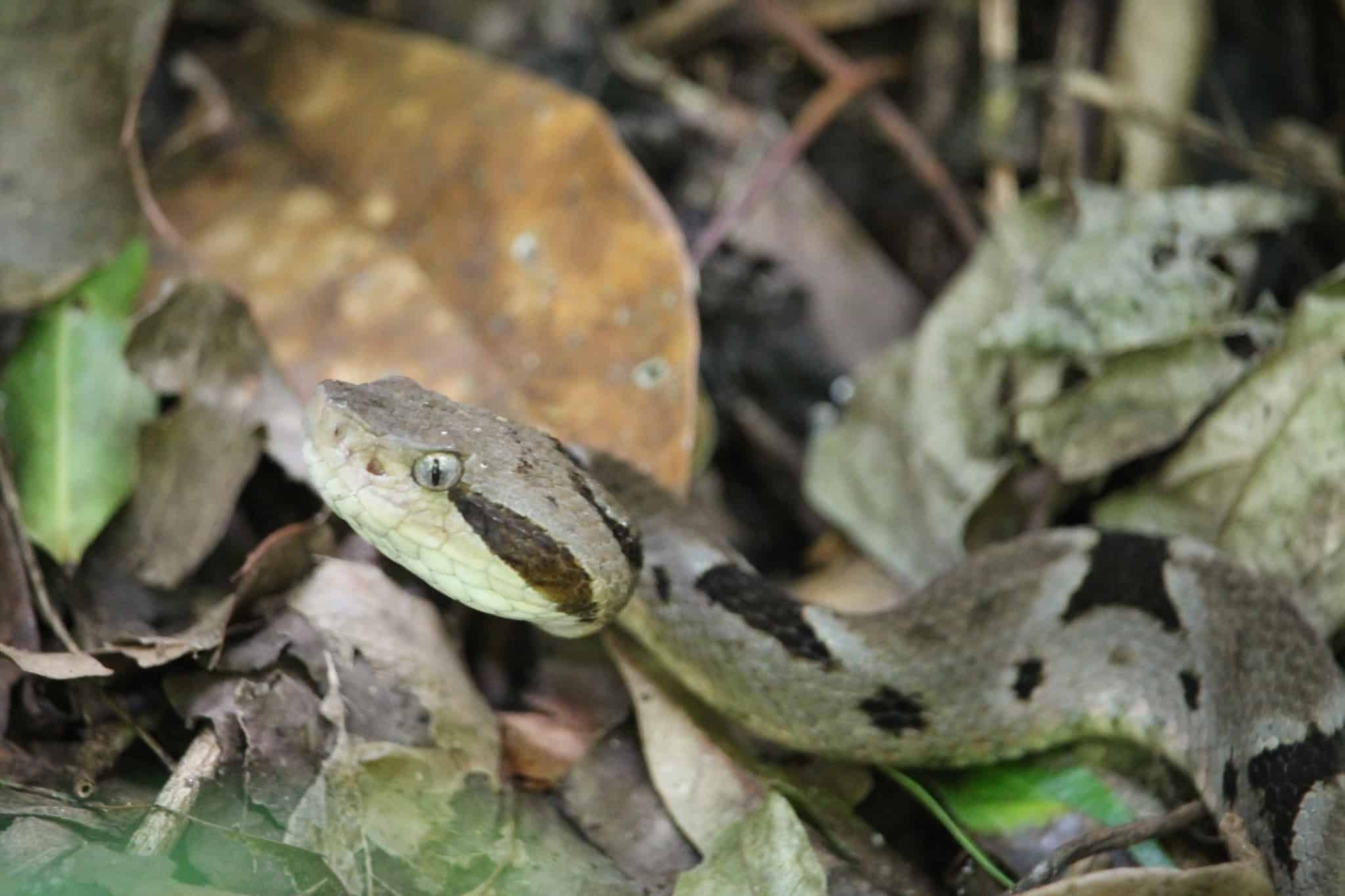
Maximum length: 164cm.
This dangerously venomous snake inhabits the eastern slopes of the Andes in Peru and Bolivia, at altitudes of 890–2133 metres, potentially higher. This remote species lives so far from towns and villages that it doesn’t have a common name, only its Latin title of Bothrops monsignifer.
If you stay in the safety of La Paz or Cochabamba, you won’t meet this menacing species. But if you park your car and venture into Bolivia’s endless humid mountain forests, there’s a strong possibility that you will. Encountering one on trails within forests is a high possibility, due to their need for thermal regulation, when they bask in the sun to soak up valuable rays of warmth.
Rather than the darkest, thickest areas, this species tends to be found in slightly sparser forests with some sunlight exposure. At first glance, this is a fairly generic pitviper, yet their bodies are mainly a stony grey rather than yellow or beige.
This species was only discovered in 2019, in the Refugio Los Volcanes of Bolivia. If you get really unlucky, then your path could not only be blocked by this pitviper, but a volcano might erupt while you’re deciding what to do.
| 3 | Northeastern hill krait |
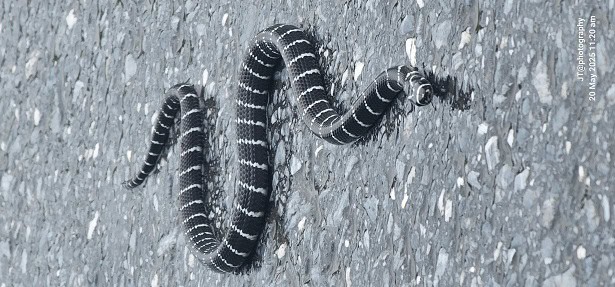
Maximum length: 140cm.
A neurotoxic snake which inhabits northeast India, eastern Nepal and Bhutan. If there’s any snake which blocks mountain trails out of pure maliciousness, then it’s the northeastern hill krait (Bungarus bungaroides). This is a venomous species which thankfully can’t spit venom, but has a powerful neurotoxic bite.
Though poorly researched, this species probably causes gradual body paralysis and laboured breathing. Northeastern hill kraits reach 1.4 metres, and inhabit low forests in the foothills of the Himalaya. A trail through a national park certainly isn’t out of bounds, and having your way blocked is no joke, as all Bungarus members are more than capable of killing.
This species is recognisable by a purely black body, and razor thin, extremely faint white bands, which differ from the thicker white bands of other kraits. So far, they’re confirmed to reach up to 2400 metres above sea level.
This species is believed to inhabit most of Bhutan, but there’s catch, as Bhutan’s mountains are some of the most poorly mapped on Earth. Because of strong Buddhist beliefs among the population, even its highest mountain remains unclimbed – Gangkhar Puensum at 7570 metres. In fact, this is the highest unclimbed mountain in the world.
Therefore, photos and documentation of this species are sparser than others. As far as we know, northeastern hill kraits are missing from most of Nepal, and won’t ambush you on the way to Mount Everest or Kangchenjunga (the world’s third highest peak). Here, you’re more likely to be assaulted by the Himalayan pitviper, which reaches 4900 metres, making it the highest altitude pitviper in the world.
| 4 | Large-eyed bamboo snake |
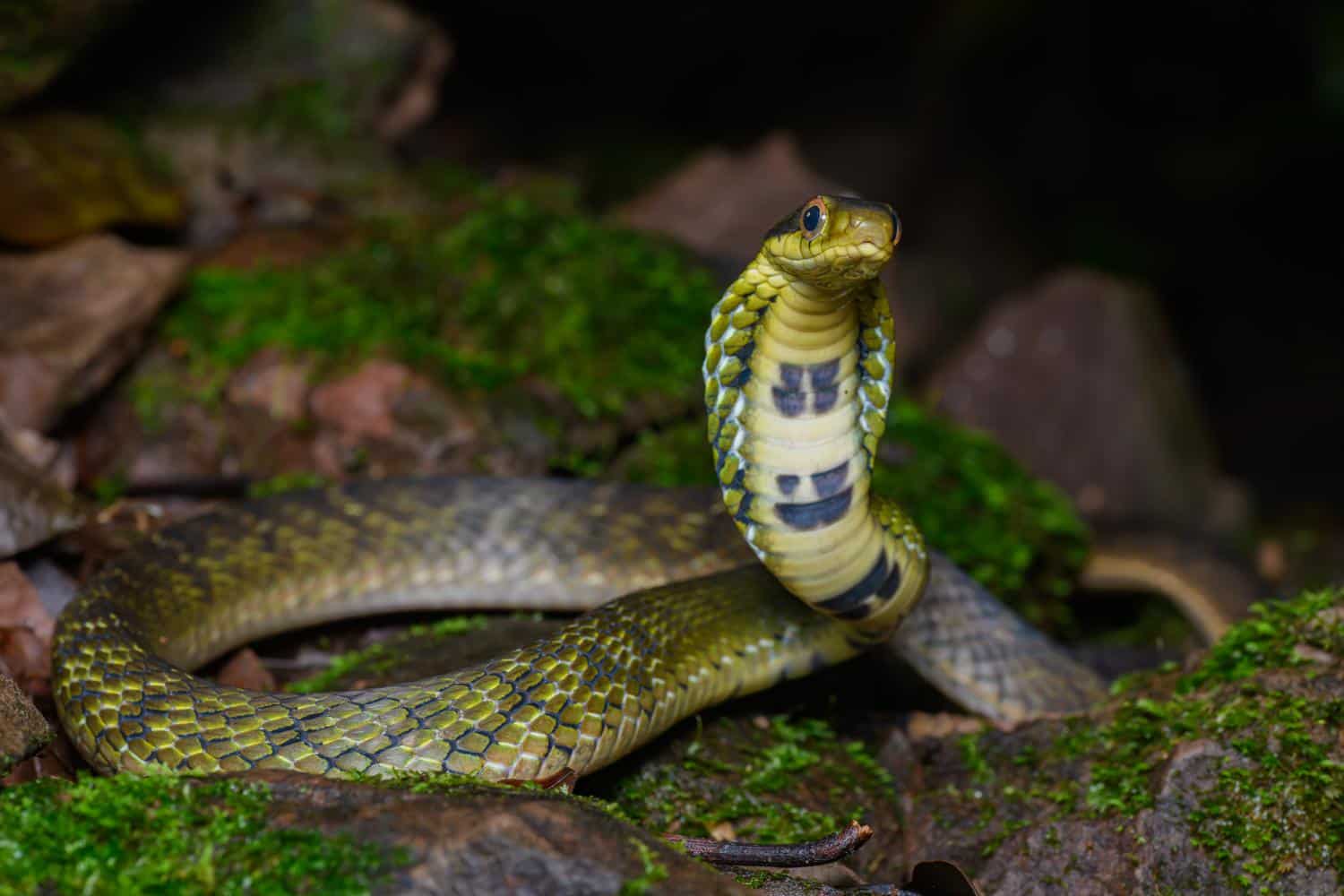
Maximum length: 140cm.
The large-eyed bamboo snake (Pseudoxenodon macrops) is a species of Thailand, Laos and southern China, where it inhabits forested hills with cool temperatures, usually at altitudes of 1200 metres and higher. This species is one of the main cobra mimics of southeast Asia. While lacking any close relation to their deadly neighbors, they’re able to spread a very similar neck hood, fooling passers-by, even terrifying them.
This could have strong consequences in the forested mountains they inhabit. If the large-eyed bamboo snake coils up on a mountain path to relax, and gets disturbed by a loud, chattering group of hikers, it will spin around, rear up and display this warning sign. Only a true snake expert would think they haven’t encountered a genuine cobra. Most people would turn around and flee on the spot, perhaps dropping their backpack and car keys in the process.
This species is widespread, covering not just most of Thailand, but reaching as far west as Nepal, even past the territory of Mount Everest and Cho Oyu (the world’s 6th highest mountain). While sparser in Nepal, there’s a legitimate chance of meeting one in the forested foothills on the trek to Everest base camp.
In Thailand, this species could be encountered by weekend hikers with ease, as they appear in relatively low, hilly mountains, as long as they’re covered with forest. The truth is that this species has a mild venom, whose exact potency is unresearched, but certainly isn’t deadly like a genuine cobra’s.
| 5 | Forest cobra |
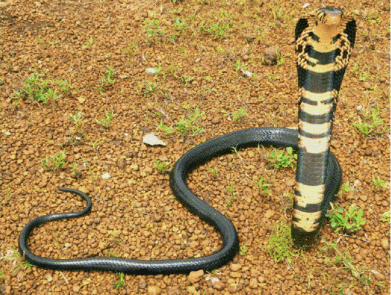
Maximum length: 320cm.
A dangerously venomous snake of central Africa, which reaches the highest altitudes of any African cobra (2800 metres). Forest cobras eat mammals, and also fish, and stay well away from towns and cities. They subdue their prey with a paralysing neurotoxic venom, and the yield per bite is huge, at up to 571mg.
Forest cobras are abundant in high altitude forest reserves, and can be locally common, making it inevitable that they block people’s way forward on hiking trails. When they raise their chest and hiss with an unbroken stare, it’s like they know exactly what they’re doing. The forest cobra has taken control of the path, and it won’t let anyone walk down it as long as they live.
The one advantage with this species, and all cobras, is that they’re so restless and energetic. Unlike an Ethiopian mountain adder, the forest cobra probably won’t settle down in one place for hours. They’re more likely to lose patience and blast off into the undergrowth again, allowing you safe passage down your scenic hiking path.
This species ranges from Ghana in the west to DRC in the east. One place they inhabit is Nigeria’s Gashaka Gumti National Park, home to Chappal Waddi, the country’s highest mountain (2419 metres).
| 6 | Andean pitviper |
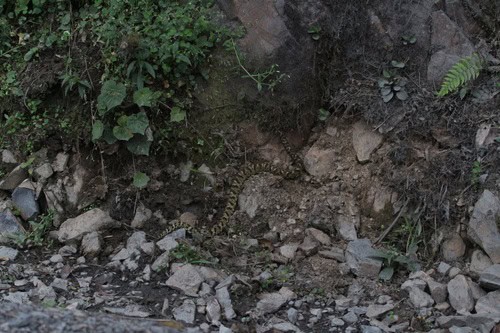
Maximum length: 125.8cm.
It’s a path you’ve enjoyed many times before, but this time there’s a difference: an immobile serpent blocking the way. The Andean pitviper (Bothrocophias andianus) lives in Peru and Bolivia, lurking in dark forests across a large stretch of the Andes. They have an elevational range of 1800 – 3300 metres, and they rarely climb trees, usually sticking the ground.
The Andean pitviper is poorly researched, and little is known of its venom. What we know is that their camouflage is superb, rendering them so invisible that you may not notice them until your feet are just inches away.
The Andean pitviper has a very real chance of blocking forested mountain trails in Peru. It’s possible that your day could go from thrilling to terrifying in 30 seconds because of this snake. This species actually shares terrain with Bothrops monsignifer covered earlier on this list, but tends to inhabit darker, much more tangled forests.
Andean pitvipers are confirmed to be present on the trail to Machu Pichu, the famous Inca ruins visited by hundreds of western tourists each year. There’s a real risk of being bitten by an Andean pitviper on the way up (or down) this famous trail. Alternatively, you might wander right past the snake obliviously, walk away, and never realise that you met an Andean pitviper to your dying day.
| 7 | Adder |
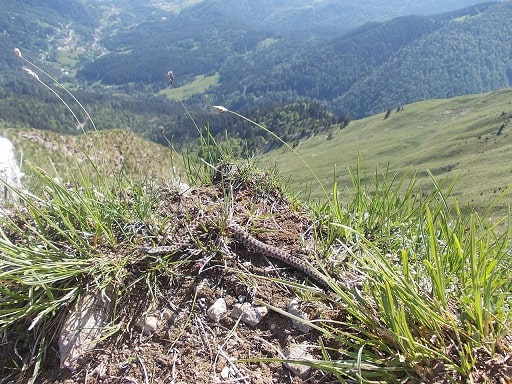
Maximum length: 93.5cm.
The adder is the most widespread venomous snake in the world, ranging from Cornwall in the UK to Mongolia. They also reach extremely far north, with frosty outposts in arctic Sweden. Finally, the adder is known to reach up to 2000 metres in the scenic Swiss or Austrian alps, and this gives them a strong chance of blocking a path during the your scenic summer holiday.
Adders at high altitudes are often much darker than in the valleys, allowing them to absorb sunlight. Somehow, they survive at these high altitudes when the winter snowpack reaches depths of 1-2 metres, burying themselves in underground chambers for months after months. Many people disembarking chairlifts and skiing down red runs don’t realise that far below their feet, there may be chambers of hibernating adders.
When mid-spring arrives, and the snow pack has mostly melted, the adder leaves its hidey holes and prepares for the long summer. Adders are common in shrubby fields as well as thick forests, with decent habitat flexibility.
Whether it’s a hiking trail to the top of the Grossglockner (Austria’s highest mountain), or a simple family route through a mountainous sheep field, there’s a decent chance that an adder will suddenly block your path. They don’t intend to cause harm or panic, but nor do they care. Mountains are still chilly during summer, and their goal is most likely to bask in the sun.
Countries like Austria and Switzerland also contain the grass snake, but if you find a snake at 2000 metres on a mountain, blocking your way, it’s far more likely to be an adder.
| 8 | Mangshan pitviper |
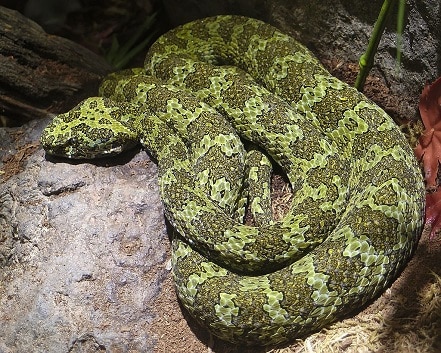
Maximum length: 203cm.
This is such an odd snake that it might be hard to recognise what you’re seeing at first. Mangshan pitvipers inhabit the mountains of southern China exclusively, and can exceed 2 metres. Their patterns are a lime green overlaid on mossy green, giving them the appearance of a slimy forest boulder come to life.
Mangshan pitvipers love to lurk in crevices in jumbled rock piles, but become more adventurous at night, venturing closer to the trails frequented by tourists or maybe hikers. Mangshan pitvipers are a very obscure species, and anyone who skipped their research before setting out that morning could be confused. It’s a green, mossy serpent just lying there on the path. It doesn’t seem too energetic, but is it venomous or not?
The reality is that this mountainous pitviper is moderately venomous, albeit not too aggressive. So far, there have been two detailed case studies of Mangshan pitviper bites. Both involved reptile keepers, one of whom sustained a bite to the abdomen and the other to the elbow. In both cases, levels of the blood clotting agent fibrinogen plummeted, meaning that this is a heavily haemotoxic venom.
Thankfully, this species is probably unable to bite through a pair of heavy hiking boots. Mangshan pitvipers prey on mammals and frogs, and are born with a brighter tail tip, which they waggle rhythmically to lure in curious prey, before swallowing them whole. One downside is that they’re relatively lazy, and may settle down on a hilly forest path for a long time.
| 9 | Godman’s montane pitviper |
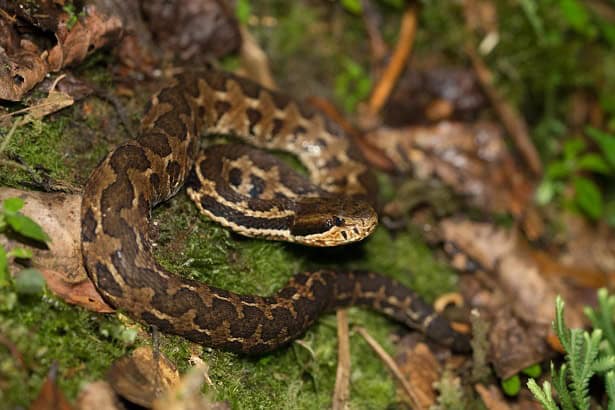
Maximum length: 82.2cm.
A venomous snake of southern Mexico and Guatemala, which produces a powerful anticoagulant venom, cleaving directly through fibrinogen. This species reaches up to 3491 metres above sea level, and mainly inhabits the ground rather than clinging to branches.
Godman’s montane pitvipers (Cerrophidion godmani) prey on a mixture of brush mice and spiny lizards, and are closely related to the Wilson’s montane pitviper of Costa Rica. While a few have brighter orange colours, this species is generally a murky forest grey, which blends perfectly with soil.
This might be a problem during your weekend hiking excursion. If a Godman’s montane pitviper blocked a paved road in Guatemala, then you’d have no issue at all. They’d easily stand out against the grey, uniform tarmac. But if one decided to bask in the sun, and slithered onto a rough hiking path moments before you arrived, then you’d be in big trouble. This species blends superbly with a mixture of soil, gnarly tree roots and fallen leaves. Only an eagle-eyed tourist could spot them, and even then, it’s hard to keep up such watchfulness for an entire walk.
Gofman’s montane pitvipers only inhabit southern Mexico and Guatemala, yet where they do live, they’re not rare. There’s a real chance of meeting this dangerously venomous snake in a scenic hilly forest. Fortunately, deaths are very rare, particularly compared to the neighbouring fer-de-lance.
| 10 | Sri Lankan hump-nosed pitviper |
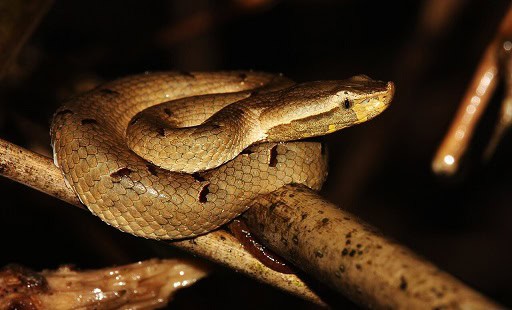
Maximum length: 38.7cm.
A forest snake which is always prowling around hills and rocky slopes, but sometimes settles down on one spot for hours. The Sri Lankan hump-nosed pitviper (Hypnale nepa) lives exclusively on its namesake island, favouring high altitude areas in central Sri Lanka above 1250 metres. They have no desire to block long, winding hiking paths, yet because of their lazy nature, that’s exactly what they end up doing.
Hypnale nepa is recognisable by its upwards-tilted snout, and splits its time between the ground and branches. Sri Lanka actually has 3 hump-nosed pitviper species, but the other two are more common in the lowlands. Hypnale nepa is the king of the forested mountainous interior, and all the winding hiking trails that run through it.
Sri Lanka has over 40 endemic snake species, and no matter how much humanity thinks they’re in control, nature will always bite back occasionally. Hypnale nepa is unpredictable, as it may flee at high speeds, but could stay put on a hiking path for hours.
This species is moderately venomous, with no deaths occurring in a study where 14 people were bitten. The symptoms mainly included local pain and swelling. But if in doubt, then it’s smartest just to turn back and find a new route, rather than running and jumping over, praying that they don’t snap and land their fangs on your ankle.