
| 1 | Elephant trunk snake |
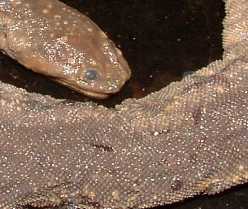
Maximum length: 2.9 metres.
A strong candidate for the weirdest-looking snake on Earth. Elephant trunk snakes are found in coastal areas of Indonesia and Malaysia, and are distinguished by their baggy skin which hangs off their body like they’ve just been on a wildly successful diet. This snake looks like it needs to tie a belt around itself, and is so baggy that when it swallows large prey, you can barely see the usual bulge. Combined with their grey scales, the elephant trunk image is complete.
Rather than deep oceans, this species always appears in areas close to coasts, including mangroves and estuaries. Elephant trunk snakes are harmless to humans, and prey entirely on fish such as swordfish and minnows. They look relatively normal when they’re younger, as they begin life with white patches, and sleeker, tighter scales which allow them to move on land.
But a few months in, the transformation starts. The bagginess rises exponentially, and the elephant trunk snake suddenly becomes stranded in the water. The bagginess allows them to float with ease, but makes shuffling on land extremely difficult.
Elephant trunk snakes are also weird for having a far thicker body than head. They reproduce at a snail’s pace, producing one clutch of hatchlings (averaging at 30 newborns) every eight years. Females can reproduce up to 7 years after their last contact with a male.
| 2 | Arabian sand boa |
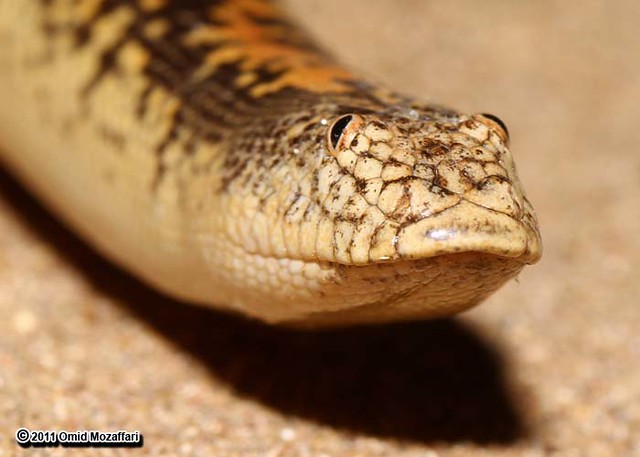
Maximum length: 40cm.
The Arabian sand boa (Eryx jayakari) averages at 30cm, and is a non-venomous constrictor. This species lives in Saudi Arabia, Oman and the UAE, and inhabits the harshest deserts, including fully-fledged sand dunes.
Despite these extreme environments, the Arabian sand boa might well be the least scary snake on Earth. This species looks more like a Saturday morning cartoon come to life than a normal snake. It looks like its eyes have been knitted on with a grandma’s sowing box, and its pupils are a weird triangular shape.
The final piece of the weirdness puzzle is the orientation. Because the Arabian sand boa buries itself in sand dunes in order to hunt passing lizards, its eyes have evolved to angle upwards. Pointing downwards into the Earth’s core would do it no good at all. As a result, this species’ eyes are located on top of its head rather than facing forward.
The Arabian sand boa looks permanently dazed and confused, a far cry from the boa constrictor it is distantly related to. Its red and black colours are also striking, contrasting with a pale yellow belly, and its smooth body looks like a wooden carving.
Your best chance of seeing this wacky snake is to park your car and walk into the Saudi Arabian desert. However, bear in mind that Arabian sand boas are great diggers, and often bury themselves so deep that all you can see is a single, solitary eyeball.
| 3 | Tentacled snake (Erpeton tentaculatum) |
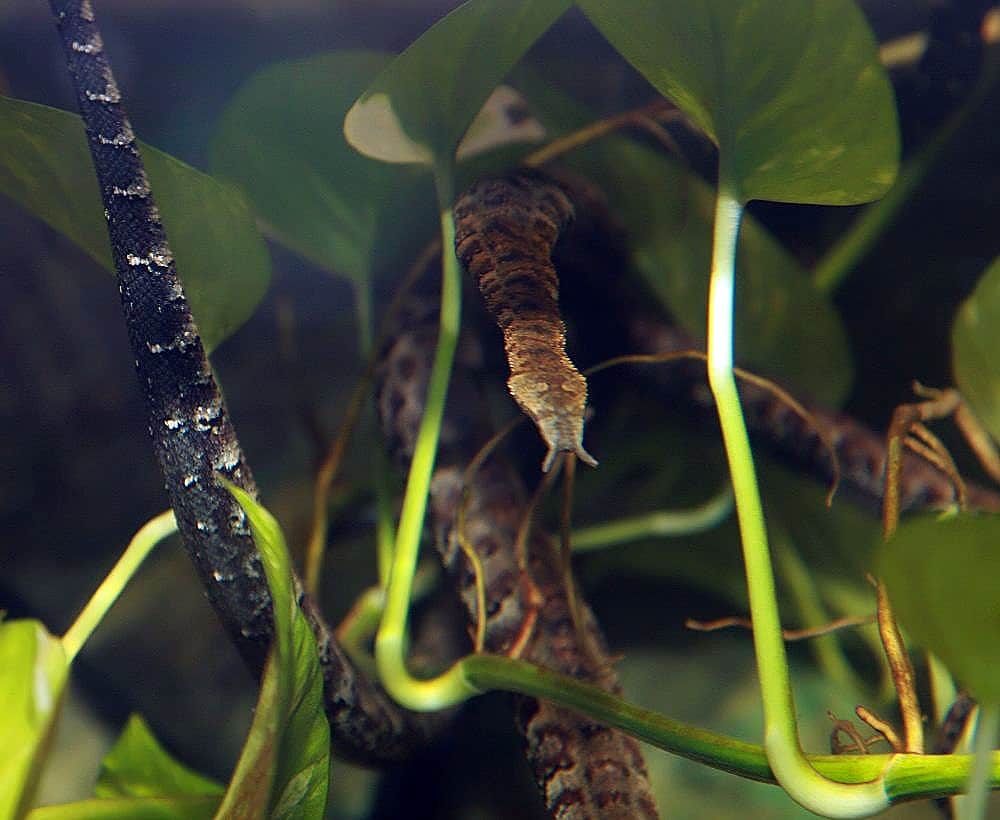
Maximum length: 73.5cm.
The sole member of the Erpeton snake genus worldwide. These freaky snakes are found exclusively in the lakes and slow-moving rivers of Thailand, Cambodia and Vietnam.
The tentacled snake (Erpeton tentaculatum) is the only snake worldwide to have these blobby-looking tentacle appendages sprouting from its face. These tentacles aren’t just to frighten confused fishermen, as both are dense with mechanoreceptors which sense water movements, allowing them to anticipate the arrival of fish. A study found that their keen eyesight was sufficient to grab fish, but that when their vision was impaired, they were still accurate hunters.
Tentacled snakes are ambush predators, which stay motionless in a specific J-shape, with their head curled at the neck. When a fish strays within range, Erpeton tentaculatum will detect its movements with its tentacles, and suddenly pounce.
Fish comprise virtually all of this harmless snake’s diet. Tentacled snakes do possess a mild venom, but this is harmless to humans, and the toxins are geared specifically towards fish. The tentacled snake spends its entire life in murky, silty water, preferring these disguising conditions to clear water bodies such as lakes.
| 4 | Hairy bush viper |
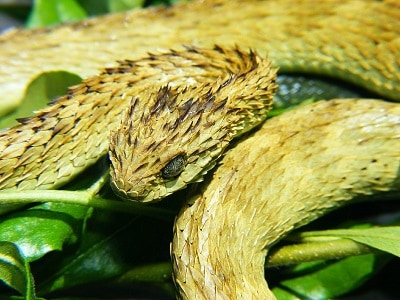
Maximum length: 75cm.
The hairy bush viper is what happens when a regular viper gets lonely and breeds with a pineapple. This rarely-observed species lives in Tanzania, Kenya, DRC and Uganda, where it dwells exclusively in forests well away from humanity. Hairy bush vipers are extremely difficult to find, and are easily one of the wackiest-looking serpents on earth.
This species looks like a tropical fruit, down to each individual scale being extremely long. Its massive eyes are another factor in the weirdness. In the obscure forest habitats that hairy bush vipers inhabit, these eyes miss nothing, and they’re also extremely colourful.
Their pupils are vertical, with about the width of Sauron’s flaming eye, surrounding by a thin yellow line. The iris is a mixture of many colours, with strong hints of blue, contrasting against the usual yellow-green scales. Two scales stand between the huge, crystal balls of eyes and their slit-like nostrils.
These eyes are designed for scanning, while the jagged scales have their own purpose of effortlessly climbing trees. The hairy bush viper (Atheris hispida) has a neurotoxic venom, which is more dangerous than originally believed. There’s around 15 other Atheris viper members in Africa, yet none can compete with the hairy bush viper for its razor-sharp scales, and sheer overall weirdness.
| 5 | Malagasy leaf nosed snake |
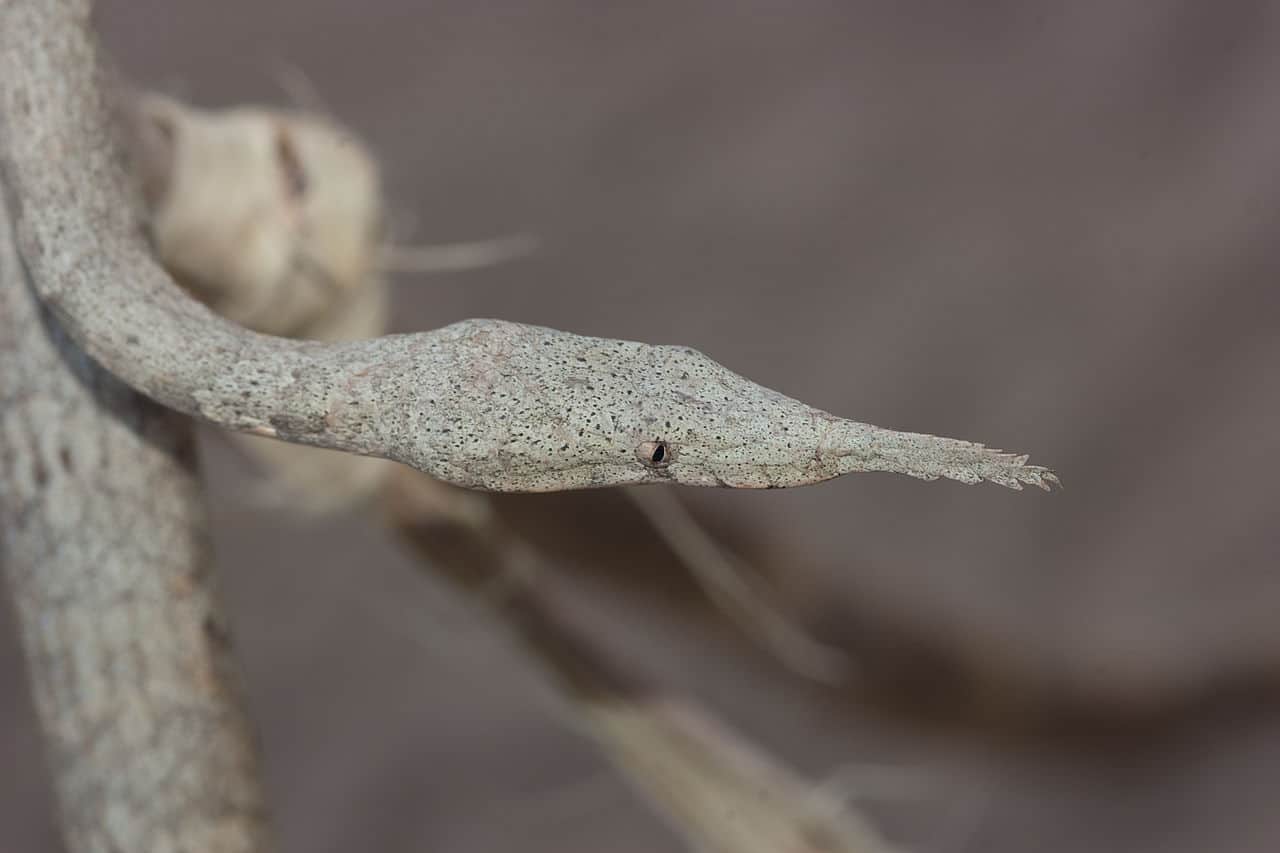
Maximum length: just over 1 metre.
Being isolated and cut off has turned Madagascar into a red hot pressure cooker of weird evolutionary spirals. There’s no better example of this than the harmless Malagasy leaf-nosed snake (Langaha madagascariensis). This snake lives in forests, and looks weirder than all the snakes of western Europe combined.
While rattlesnakes grew rattles and pythons learnt to constrict, Langaha madagascariensis spent millions of years on Madagascar slowly becoming more and more leaf-like. This takes the form of a leafy nose appendage, whose exact purpose is unknown to this day. It could be designed for camouflage, to funnel water off their scales, for hunting, or for anything. This leafy nose looks like it could snap off with the slightest pressure, but is actually made from hard scale extensions.
Both males and females have this wacky appendage, but with females (pictured above), it’s even more elaborate, while in males, it’s usually pointier. Malagasy leaf-nosed snakes aren’t born with this leafy appearance, but they only take 36 hours to assume their lifelong shape. They’re born from eggs, and the appendage is folded down initially so that they can use an egg tooth to hack their way free.
While Langaha madagascariensis is the main species of the leaf-nosed clan, Madagascar also hosts two others: L. alluaudi and L. pseudoalluaudi. These are very poorly documented.
| 6 | Brongersma’s worm snake |
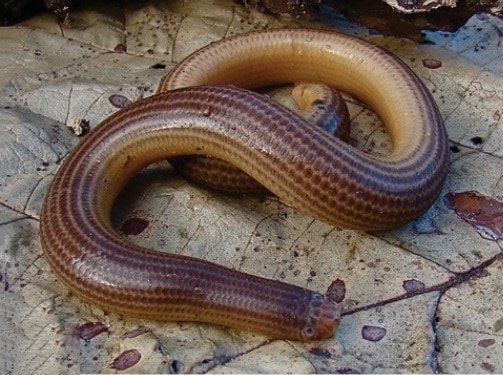
Maximum length: 32.5cm.
This Brazilian snake shares the silliness of the Arabian sand boa, with seemingly glued on eyes right on top of its head. Amerotyphlops brongersmianus is a burrower, and evolution has somehow decided that the best thing is for its eyeballs to shift upwards millimetres by millimetres over the ages, until they’re permanently angled upwards, and therefore optimised for spotting birds.
Brongersma’s worm snake is a very small snake, with a head to tail tip record of just 32.5cm. They live in a world infinitely smaller than our own, of hidden soil tunnels, rotting leaves and twisting underground root channels. Though rarely seen, they’re abundant from central Brazil to northern Argentina (plus Paraguay and Bolivia), and they cope far better with deforestation than other snakes.
The worm snake genus was barely researched well into the 2000s, the main reason being that nobody could find them. However, we know that their main prey is ants and termites. They eat ants at all stages of development, as one study on 14 Brongersma’s worm snakes found that 90.84% of their stomach contents were ant larvea and pupae.
| 7 | Blunt-headed tree snake |
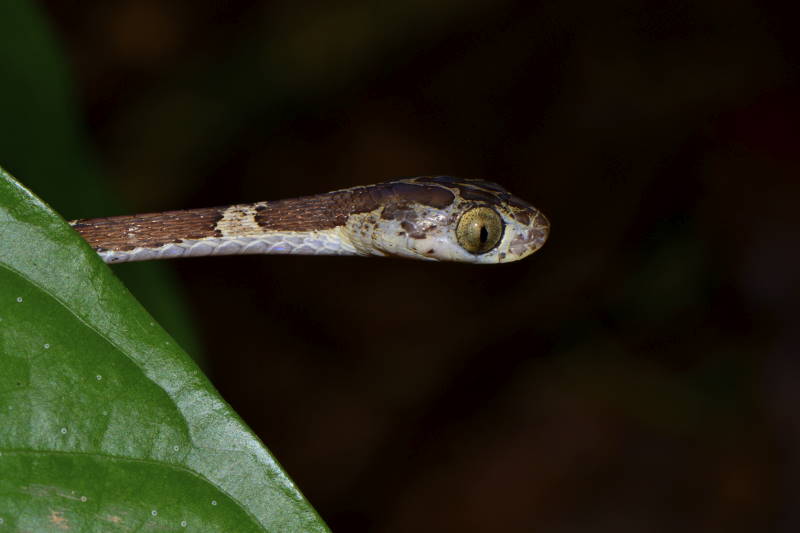
A super-common species of the Americas, ranging from southern Mexico all the way to central Brazil. The blunt-headed tree snake lives in humid rainforests, and is famed for its giant eyes contrasting against an extremely slender body.
This a brown and beige wire of a snake, which is so thin that you could whip someone with it (but don’t). Its head is far larger than its neck, and its eyes are larger still, seemingly wider than the thickest point of the neck. According to a 1982 study, the blunt-headed tree snake’s eyes make up 19-34% of its head.
The colour is mesmerizing as well, with a boggy, swampy quality. The iris is usually pale green-brown, but occasionally orange or red-speckled, and some even have a brown stripe running through their pupils. The blunt-headed tree snake is another tree-branch dweller, and these bulbous eyes enable them to see in all directions.
This amazing eyesight also comes into play when hunting. Like a tiger, most snakes require a flicker of movement to set them off, regardless of whether they’re ambushers or prowling snakes that actively hunt. But the blunt-headed tree snake can spot stationary, sleeping prey, including one anole that hadn’t moved for 93 minutes.
| 8 | Spider tailed horned viper |
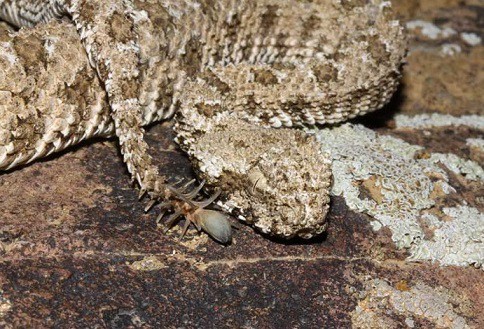
Maximum length: 86cm.
This menacing viper lives solely in extreme western Iran, and far eastern Iraq just over the border. Despite its murderous expressions, the spider-tailed horned viper (Pseudocerastes urarachnoides) is just trying to survive, and its solution is an unusual tail that mimics the appearance of spiders.
All the ingredients are in place, as there’s a bulbous blob for its arachnoid body, and 8 super-thin spindly scales for its legs. To complete the deception, Pseudocerastes urarachnoides moves this tail rhythmically in a figure of eight pattern. It’s believed to use this spider tail to lure in birds, as a lark found in its stomach is one of its few confirmed prey species (research is currently very scarce).
Complimenting this spider tail is an extremely craggy desert face, with jagged, sandy scales that look like the snake is locked in a perpetual sandstorm. Pseudocerastes urarachnoides was only discovered in 2006, after being mistaken for the closely related Persian horned viper for decades. They have the corrosive venom of all vipers, and should not be touched in any circumstances.
This species is a horror taking inspiration from other horrors, a meeting of the nightmares, but fortunately, their territory is very small. Even dedicated herpetologists struggle to locate the spider-tailed horned viper.
| 9 | Rhinocerous ratsnake |
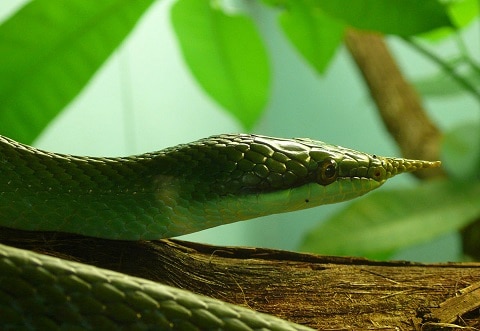
Maximum length: 163cm.
A mostly harmless species of southern Chinese and Vietnamese forests. The rhinocerous ratsnake is the luckiest snake in the world, as it was born with its own constant poking device to unleash upon anyone who annoys it.
It’s no secret how this snake got its name, with both juveniles and adults having hardened, pointy scales protruding from their face. Nobody has a clue what this horn is really for, although mating displays are one unproven theory.
This is mostly an arboreal (tree-dwelling) species, which uses its immense greenness to blend into the forest. Rhinocerous ratsnakes (Gonyosoma boulengeri) were first discovered in 1897, and gravitate towards subtropical rainforests, particularly areas near flowing streams in deep rainforest valleys. They appear at altitudes of 300 to 1100 metres.
Rhinocerous ratsnakes undergo many shapeshifting changes as they age, as they begin life as a brown-grey colour. At 12 months old, they morph into a hard steel grey. It takes until 24 months before they reach the usual adult green, with some adults having tinges of bright blue. However, there’s one thing that never changes: the horn.
| 10 | Blunt-headed slug snake |
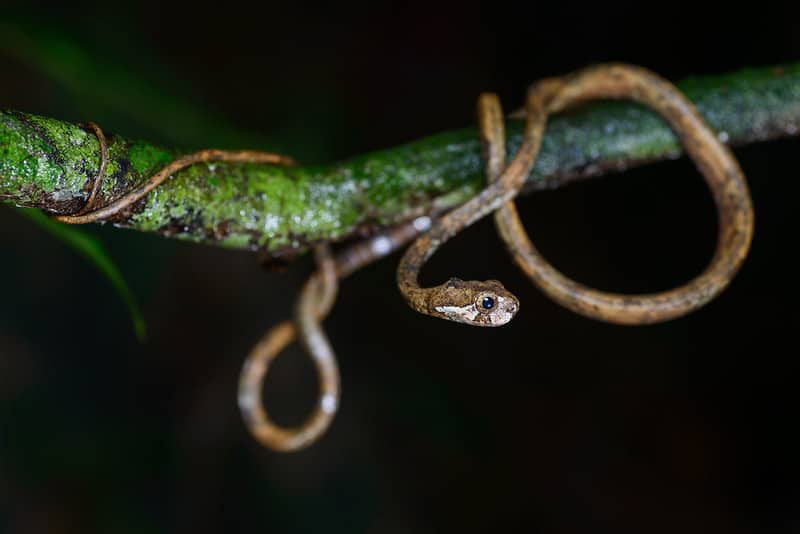
Maximum length: 85cm.
A copycat of the blunt-headed tree snake 10,000 miles away. The blunt-headed slug snake (Aplopeltura boa) lives in southeast Asia, and has embarked upon convergent evolution: when two unrelated species look nearly identical because of occupying a similar ecological niche.
Aplopeltura boa also lives on branches, has an equally twig-like body with an equally long tail, and has equally massive eyes. Its body is a baked brown, as are its irises. The pupils are jet black and round rather than vertical. This snake mainly preys on slugs and snails, meaning that its massive eyes may have evolved to detect these small, inconspicuous grubs.
This snake has a wide range in southeast Asia, but is consistently elusive and difficult to find within that range. You can find Aplopeltura boa in southern Thailand, peninsular Malaysia, Java, Sumatra, and Borneo, if you search hard enough.
This big-eyed snake has a special grinding jaw, adapted to the hardest of snails: those with a hard operculum in addition to their regular shell. Aplopeltura boa rearranges these snails in its mouth, then severs the operculum from the soft body by sawing like a knife and fork. This hard operculum is indigestible even for snakes that specialise in snails.
The blunt-headed slug snake also has a rarity in the snake kingdom: an asymmetrical mouth, with larger teeth on its right side than the left.