
| 1 | Amazon tree boa |
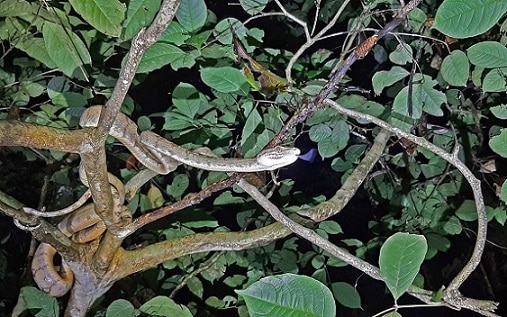
Maximum length: 188cm.
If there are genes specifically responsible for snake aggression, then the Amazon tree boa probably has at least 90% of them. This is a common South American species, which occupies French Guiana, Suriname, Colombia, Venezuela, and a swathe of Brazil. The Amazon tree boa spends much of its life on branches, but is more comfortable on the ground than the immensely lazy emerald tree boa.
Amazon tree boas are completely non-venomous, and rely on constriction for hunting. Nevertheless, they’ve long had a fearsome reputation among reptile keepers. Some are calmer, but others can bite their keepers for no reason whatsoever, at the slightest imagined provocation.
This species can be so aggressive that changing its water bowl becomes a stealth mission worthy of MI6. Bites are no joke, as the Amazon tree boa has long, curved fangs designed for chewing through bird feathers.
People disagree on whether this snake can be tamed. Some say that it’s possible with great effort, while others believe it to be impossible. The only saving grace for a keeper is its diet. The Amazon tree boa is extremely non-fussy, and will eat almost anything in nature, including standard pinkie mice from a pet shop.
| 2 | Caspian whipsnake |
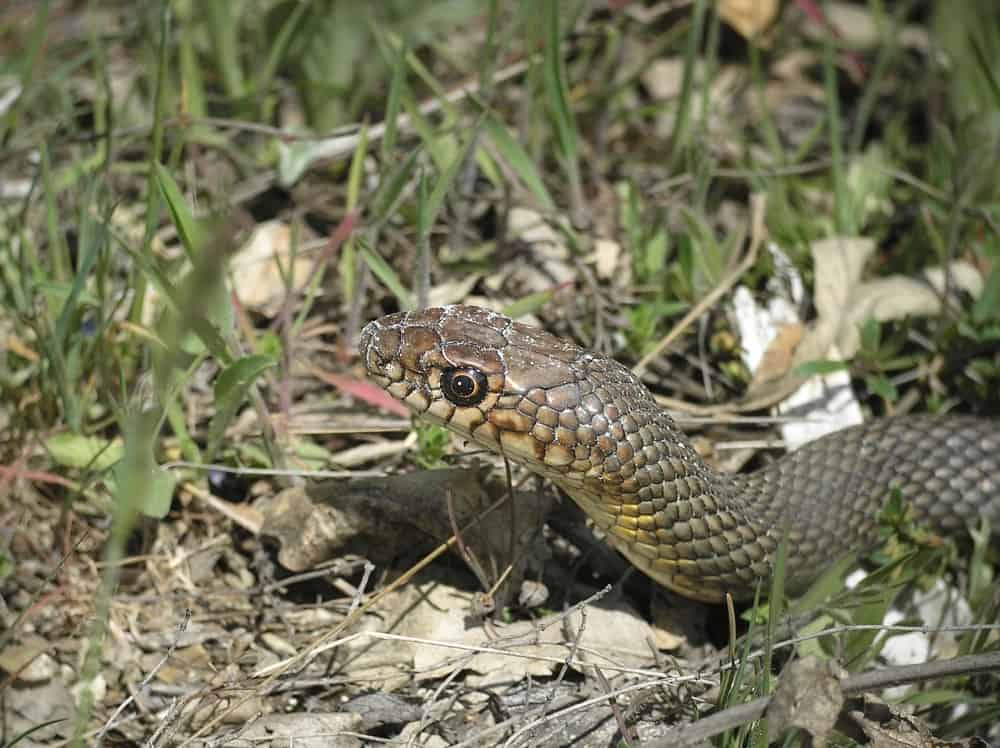
Maximum length: 208cm.
This southern European snake is said to unleash sheer terror upon those encounter it. Caspian whipsnakes are non-venomous, and feed on a mixture of reptiles and mammals, with the little ground squirrel (Spermophilus pygmaeus) being one favourite. They’re one of Europe’s fastest snakes, as well as one of the longest, with 1.5-2 metres being common.
All this adds to the intimidation factor when they unleash their notoriously foul temperament on innocent people. Caspian whipsnakes bite readily and without warning, while hissing extremely loudly. They’re even known to jump at people, reaching heights of up to 50% of their own body length.
The German name of this snake is “Springnatter”, which translates to jumping snake. Caspian whipsnakes are said to jump so aggressively that they cause horses to flee.
The Caspian whipsnake is common in Greece and Bulgaria, yet much sparser in other regions. In Moldova in eastern Romania, it hadn’t been seen since 1937, and the locals breathed a sigh of relief. But three individuals showed up in 2007, looking as mean as ever, finally ending the 70 year drought.
| 3 | Trinket snake |

Maximum length: 168cm.
The trinket snake (Coelognathus helena) is a common Indian serpent, which lacks any venom, and often lives in agricultural fields alongside Russell’s vipers and radiated ratsnakes. This species is found across virtually the entire country, as well as Sri Lanka and Bangladesh. Trinket snakes have the crafty trick of disguising themselves as bamboo, yet they’re equally likely to defend themselves using all-out aggression.
If you’re lucky, the trinket snake will completely ignore you. If you’re unlucky, it’ll treat you to its vicious, inward-pointing fangs, lunging savagely from a tree branch or wooden fence. This species even wiggles its head back and forth while biting, in order to tear its enemies’ skin open.
The trinket snake lacks venom, yet possesses the gift of massive confidence. In 2017, one was observed wrapping its entire jaw around a cobra’s face, forcing the frightened predator to slither off into the bushes.
Trinket snakes have flexible habitats, yet generally require at least 2000mm of rainfall per year. Meadow clearings, rainforests and sparser forests are all spots where they might be watching and waiting. Their closest evolutionary relative is the radiated ratsnake (Coelognathus radiatus), which has an aggression problem of its own.
| 4 | Ladder snake |
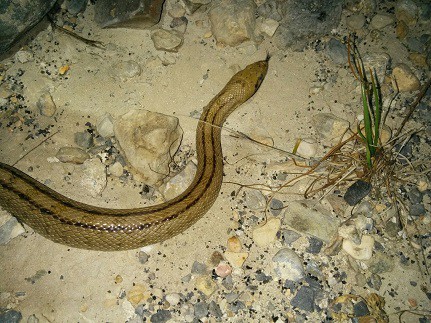
Maximum length: 165cm.
The ladder snake is a Spanish species named for its striking square patterns as a juvenile, which slowly fade in adulthood. It’s not named for the ability to angrily pursue you up a ladder, but we wouldn’t be surprised if that happened, for this non-venomous snake is known to be extremely aggressive.
The ladder snake is found across 90% of Spain, as well as Portugal. It lacks any form of venom, but will hiss and bite savagely if you invade its personal space. It has a number of defensive tricks, including twisting, thrashing, releasing a foul serpent smell, and wrestling in the palm of your hand. This aggression only rises with age, as young ladder snakes are more likely to flee.
Ladder snakes eat a diet of over 85% mammals. They mainly live in countryside areas, with crumbling walls, hot dirt tracks and dry hedgerows. Rather than charging after prey, they use the sneaky tactic of invading underground mammal burrows, and swallowing up entire families of voles while they sleep.
That said, ladder snakes get their comeuppance in the form of the short-toed eagle, a large bird of prey, which was found in a 2020 study to have a particular taste for ladder snakes, as well as Montpellier snakes, ignoring other Spanish natives such as false smooth snakes. This bird threat might be why the ladder snake’s aggression levels have cranked up so high.
| 5 | Beauty ratsnake |
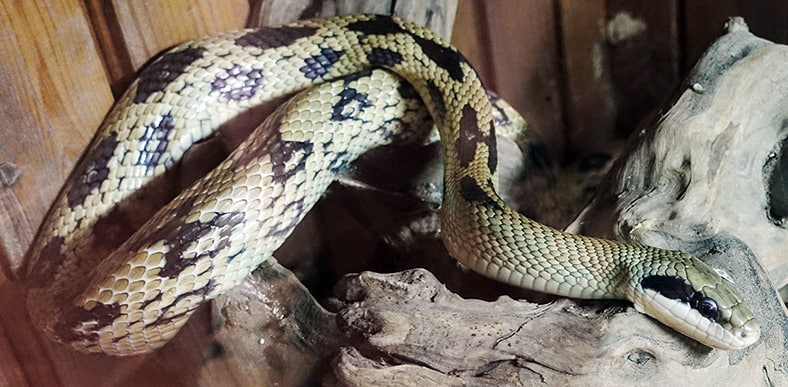
Maximum length: 280cm.
The beauty ratsnake (Elaphe taeniura) is an extremely widespread species in southeast Asia, appearing in southern China, Thailand, Malaysia and Indonesia alike. This is a non-venomous constrictor, which lives in peaceful environments such as farms and villages, yet doesn’t hesitate to break the calm with a savage, lunging bite if anybody gets in its way.
The beauty ratsnake begins its attack phase with an S-shaped coil, with its body raised 20-30cm off the ground and mouth bared wide. Supposedly, its lunge is faster than an arrow from a bow.
Beauty ratsnakes are also notorious for climbing roofs, putting repairmen at severe risk. As they typically hunt during the day, encounters with villagers are common. They also appear in cities occasionally, where they snap at innocent people hurrying across roads.
Beauty ratsnakes are unpredictable, as they’ll sometimes stay still like a statue while you clean their cage, while in other cases, they’ll bite in a wide-eyed frenzy. Keepers report that you can only reduce the quantity of bites, not eliminate them altogether. This bitey species relies on mice for its calories, sometimes swallowing 3-5 in one meal.
| 6 | Northern watersnake |
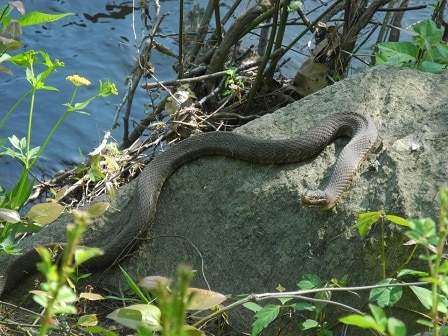
Maximum length: 149.9cm.
An extremely common aquatic species of Ohio, New York, Pennsylvania and Ontario. The northern watersnake (Nerodia sipedon) is the northerly relative of the brown watersnake (Nerodia taxispilota) found in Florida. There’s subtle differences between the two in patterns, but another is in their personalities, as northern watersnakes are far more aggressive.
The northern watersnake loves nothing more than to rest on a tree branch overhanging a river, watching the world go by. In fact, it loves its riverside life so much that it will react with extreme ferocity, rage and aggression when disturbed. Northern watersnakes will defend their resting areas with a passion, and they don’t see humans as an insurmountable obstacle.
When hunting for fish, northern watersnakes will swim right past boats, with no fear of humans. They might even change direction and start heading towards you. This species lacks any real weapons except for sharp front fangs, but pick one up, and there’s a strong chance of feeling extreme pain.
Northern watersnakes have more powerful jaws than the average snake, and can clamp down hard. While they lack a traditional venom, their saliva does contain a mild anticoagulant toxin. This is capable of making a wound bleed far more profusely than usual.
| 7 | Blood python |
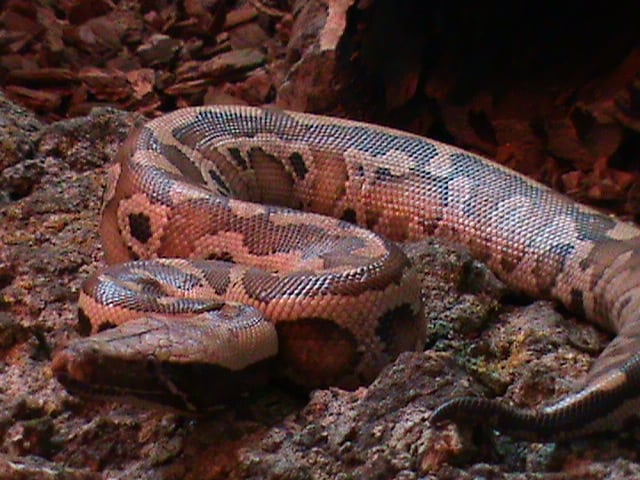
Maximum length: 260cm.
A thick-bodied species of swamp forests, found in southern Thailand, peninsular Malaysia, and eastern Sumatra. The blood python is closely related to the Sumatran short-tailed python (a very long-lived snake), but has vivid red scales instead of rich brown and black.
The mere mention of a blood python can inspire a shudder of fear in some reptile enthusiasts. This is a popular snake in the international pet trade, yet the species has severe anger management issues, often refusing to calm down no matter how nicely you treat them. Blood pythons hiss and snap at their owners, even delivering savage bites as their keepers helpfully bring them food.
In the wild, the blood python (Python brongersmai) is a constrictor like all of its family. It’s common on the shores of humid, disease-infested swamps, and it’s estimated that from 1996 to 2015, 900,000 were exported from Indonesia alone.
This is the first angry snake of our list to have a plot twist, as it turns out blood pythons from peninsular Malaysia are far more aggressive. Decades ago, Malaysia was the main source of exports, creating the terrifying reputation among keepers, but these days, most exports are sourced from Indonesia (eastern Sumatra), where they’re significantly calmer. That said, this species is rarely a loveable pussycat, and should always be treated with caution.
| 8 | Pine snake |
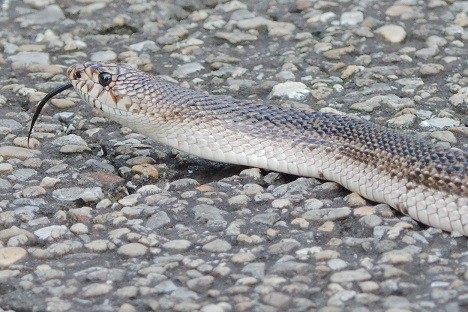
Maximum length: 228.6cm.
This large, thuggish snake resides in the eastern USA, from Florida and Georgia to Virginia and Delaware. The pine snake (Pituophis melanoleucus) is a non-venomous constrictor, yet has an irritable personality. It’s not exactly looking for a fight, but won’t hesitate to push its snapping jaws into your face if you get on its nerves.
Victims of the pine snake testify that its bite is particularly strong. Experts strongly recommend acquiring this snake as a hatchling, in order to desensitise it to your presence, and even then to always be on your guard. Some pine snakes will hiss and perform bluff strikes in their enclosure, without actually biting.
There’s no obvious reason for this species’ aggression. In the wild, pine snakes inhabit pine flatwoods, sandy pine-oak woodlands and other forests, where they enjoy dry soils which are easy to forge burrows in. Pine snakes not only dig their own tunnels, but invade the burrows of rodents and squeeze them to death after pinning them against the underground walls. They’re seldom seen, even in rural neighbourhoods where their presence is confirmed, so it’s possible that their viciousness stems from a lack of contact.
Pine snakes also produce an unusually loud hiss, due to a cartilaginous keel in their throats, adding to the intimidation. Mammals on their menu include the striped skunk and northern short-tailed shrew.
| 9 | Black racer |
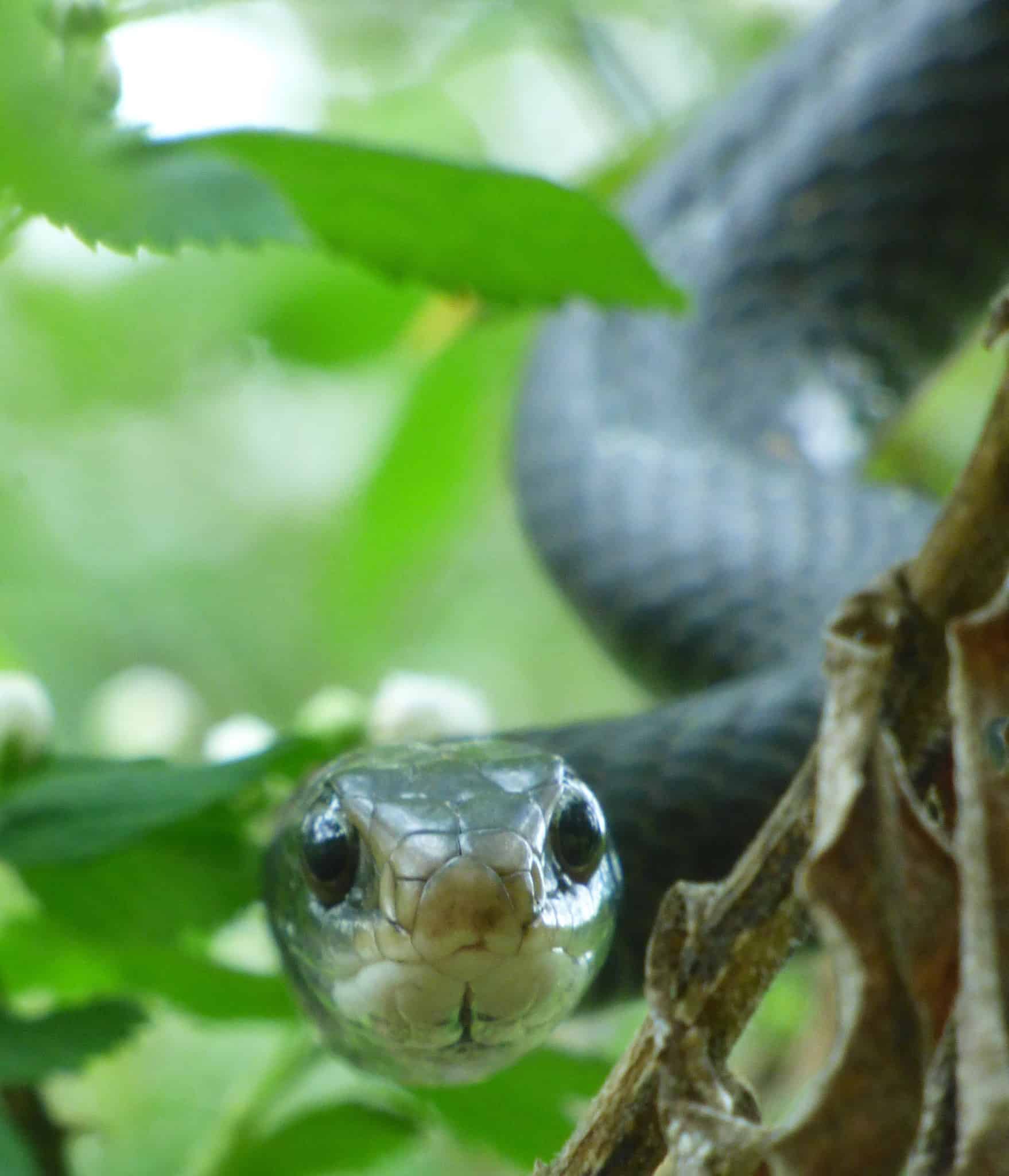
Maximum length: 190.5cm.
A very dark snake with almost no patterns, which inhabits 47 out of 48 lower states of the USA. The black racer looks similar to a ratsnake from a distance, but has a significantly thinner body, as well as faster movements.
Another difference is its extra vicious temperament. Black racers have a nervous appearance, and an equally nervous mind. They’re always on the move, slithering around all over the place, and can unleash a painful bite whenever their paranoid thought processes deem it appropriate.
If you meet a black racer on a public footpath and expect it to stand aside, then think again. Black racers are known to chase children up suburban streets, and terrify dogs with a piercing hiss. They’re much more likely to chase innocent people than the sluggish cottonmouth, the species which this myth usually involves.
Black racers lack any form of venom, but they do have another evil elixir: a mouth full of bacteria. This could cause a wound to become red hot and infected, and guarantee a hospital visit all the same. Black racers aren’t even true constrictors, as they’re agile enough to simply grab prey, pin them down, and swallow them whole.
| 10 | Burmese python |
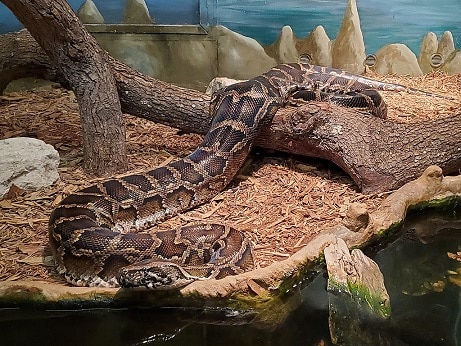
Maximum length: 579cm.
The Burmese python is a being of pure muscle, with every fibre geared towards constricting its prey. It’s one of the world’s longest snakes at over 5.5 metres, but compared to the absolute longest (the reticulated python), it’s far more aggressive.
The Burmese python is responsible for the highest number of attacks on reptile keepers, with up to 20 hospitalisations per year. It’s an invasive species in the Florida Everglades, and while it hasn’t killed anyone yet in the wild, a few fatalities have occurred in captive settings, with the python wrapping itself around the victim’s neck.
This aggression rears its ugly head whenever food is involved. Burmese pythons are aggressive towards their prey in the wild, and in captivity, they can develop a mental association between the human handing them meals and the meals themselves. Before you know it, they’re rearing back for an assault whenever you open their cage.
Just recently, a yellow Burmese python escaped from its enclosure in England and was seen on a bedroom windowsill, so motionless that it looked like an art installation. Everyone had a good laugh later, but a small child would have been a tempting meal. Burmese pythons are mainly popular in captivity because of their large size and unfussy diet, but should never be underestimated.