
| 1 | Sonoran whipsnake |
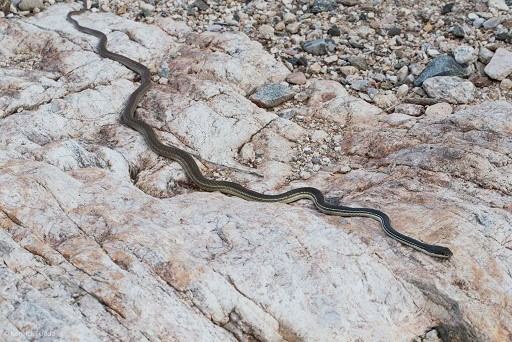
Maximum length: 186.3cm.
One of the fastest snakes in North America. The Sonoran whipsnake (Masticophis bilineatus) belongs to the same genus as the US coachwhip. While not as common on American soil, inhabiting only Arizona and extreme southwestern New Mexico, this species stretches deep into Mexico.
This species is thin for one main reason: its immense agility and speed. The Sonoran whipsnake is an active forager, which preys on species such as western Mexico whiptails and rufous hummingbirds. While some bulkier snakes can move quickly, the fastest are generally thinner, and the Sonoran whipsnake charges its prey down and grabs them using sheer agility.
This also gives the Sonoran whipsnake the ability to escape humans easily. Grabbing them is almost impossible, and in the unlikely event that you succeed, you can expect painful lacerating bites to your arms. Sonoran whipsnakes are non-venomous but have a vicious pair of front fangs.
Other ID signs include a greyish back, but a far paler, even white underside, which includes a white chin. This species is slightly shorter than the US coachwhip, but still exceeds 1.5 metres.
| 2 | Haas’s bronzeback |
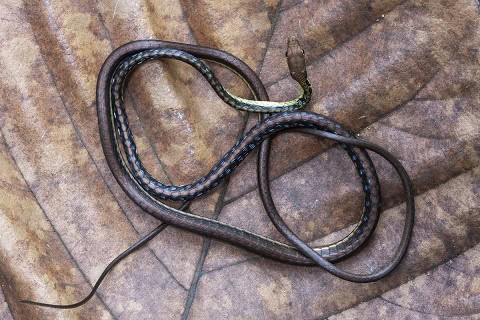
Maximum length: 94.5cm.
A tree branch species of southeast Asia. This species only inhabits the far south of Thailand, but is found in peninsular Malaysia, Singapore, Sumatra, Borneo and Java. Wherever this species exists, it is relatively rarely observed, particularly compared to its neighbour the painted bronzeback.
Haas’s bronzeback is mildly venomous and poses no threat to humans. It’s confirmed to prey on frogs such as the copper-cheeked frog, and is able to pluck frogs from the forest floor by dangling down from branches while fastened with a prehensile tail.
Physically, this species has a greyish body, contrasting sharply with a creamy underbelly. These are separated by a black line that runs through each eye and connects at the nose. Where Haas’s bronzeback is hard to beat is in its thin body width, and its unusually long tail, which comprises 34-38% of the total body length.
Haas’s bronzeback also has blue skin beneath its scales, which becomes visible when its body stretches while eating. Other ID signs include a relatively small eye compared to other bronzebacks, such as the elegant bronzeback (Dendrelaphis formosus), which has enormous eyes.
| 3 | Asian vine snake |
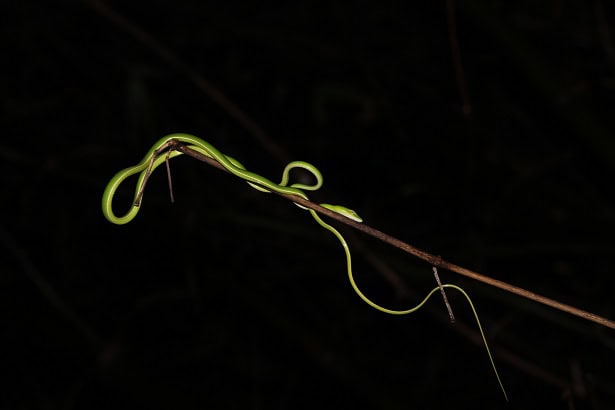
Maximum length: 197cm.
If it’s crushing bulk and brute constricting force you require, then the Burmese python is the Thai snake for you. If you require an immensely thin and agile body, which can travel between the most fragile tree branches with ease, then the Asian vine snake is the species for you.
This mildly venomous snake belongs to the Ahaetulla vine snake genus (21 members), and is easily the most common. In fact, this is one of the most common snakes of southeast Asia. Asian vine snakes are found mainly in forests, and are abundant all over Thailand, Vietnam and Cambodia. To the west, they just reach extreme northeast India and Bangladesh.
At the opposite end, to the southeast, they’re found on Java, Bali, Timor-Leste, and finally Sulawesi. They don’t appear in concrete urban areas, but may manifest in leafy villages, as long as there’s plenty of trees.
The Asian vine snake mainly preys on reptiles such as Indian garden lizards. Bites are believed to be extremely mild in humans, although there are no detailed case studies yet. The scariest thing about the Asian vine snake is its weird, keyhole-shaped pupils.
| 4 | Red whipsnake |
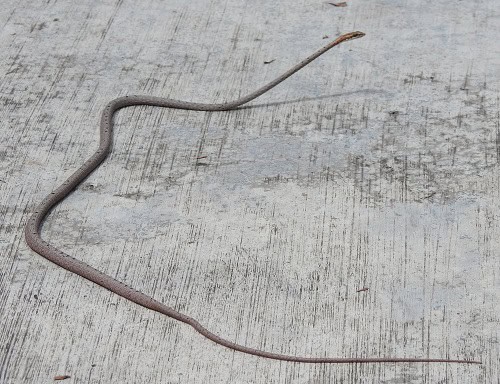
Maximum length: 100cm.
A widespread species in Thailand, Indonesia and Malaysia. This species is similar to the Sonoran coachwhip, in that its thinness is a hunting feature, designed to increase its speed and agility. Red whipsnakes move through the Thai wilderness at a lightning pace, speed they use to seize prey such as common flying dragons.
Red whipsnakes are found in forests, but not strictly, as they also stray to the sunny forested edges. They’re not as red as the name suggests, being more typically brown. The reddest part of their body is their bright red tongue, while their pupils are round rather than vertical.
Red whipsnakes split their time between the ground and branches, unlike Haas’ bronzeback which is mainly a branch snake. They appear in central and northern Thailand, but only in sparse numbers. It’s in southern Thailand where this species suddenly takes over, and they remain common through peninsular Malaysia and Singapore.
This thin snake is harmless to humans, with only a mild venom, but according to this Thai snake expert, their strikes are exceptionally accurate, so be warned.
| 5 | Cope’s vine snake |
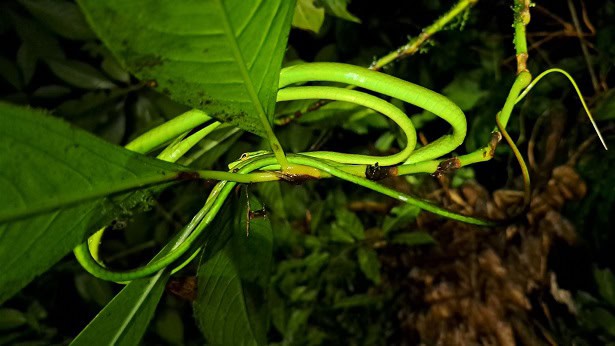
Maximum length: 107.3cm.
A tree-hopping snake, which not only lives on branches, but crosses between them with ease. Cope’s vine snake preys on frogs and lizards and begins its territory in Honduras, before spreading through Panama, western Colombia and Ecuador.
Cope’s vine snake is a lowland rainforest species, which has never been found above 800 metres in altitude. This species is relatively common, and poses no threat to villagers, scientists or anyone else. Rather than a lazy ambusher, Cope’s vine snake is an active forager.
As well as incredibly thin, this species is one of the greenest in all of Costa Rica and Panama. They overlap with the more widespread green vine snake (Oxybelis fulgidus), which reaches as far as Brazil. But this version has a pair of lighter stripes on its underside, while Cope’s vine snake is distinguished by lacking these completely.
Another difference is that the green vine snake has a pointier, projecting snout, while Cope’s vine snake has a blunter, more rounded snout. Other green snakes in Panama and Costa Rica include the Bothriechis palm pitvipers, but these are far thicker-bodied.
| 6 | Striped sharpnose snake |
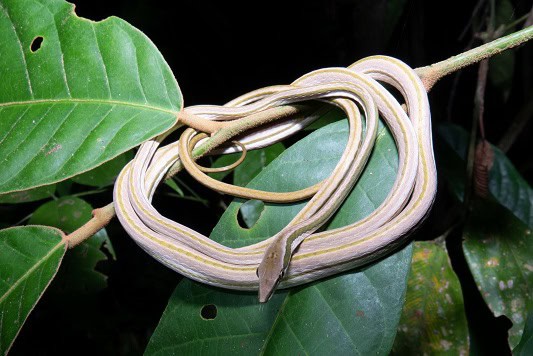
Maximum length: 133.5cm.
A widespread but rarely seen species, which ranges from Ecuador to Peru to central Brazil. This species is a forest snake through and through, which virtually never appears in open grassy areas.
Striped sharpnose snakes are venomous, but the exact potency is unknown. They have a positive correlation with canopy cover – the more trees, the more likely they are to appear. They hunt by dangling down from branches, and without their thin, rope-like body, this would be far harder.
One of their strangest characteristics is that when disturbed, they hold their tongue out in a straight line, keeping it still. This species is part of the two member Xenoxybelis genus, also including the southern sharpnose snake. These species originally belonged to the Philodryas group, until various odd physical attributes were noticed, as well as their love of branches. They’re thinner than any Philodryas member for one thing, and then there’s their namesake sharp snout.
Striped sharpnose snakes also have bulging eyes (see above), and their sharp snout is particularly noticeable from a bird’s eye view.
| 7 | Bernier’s striped snake |
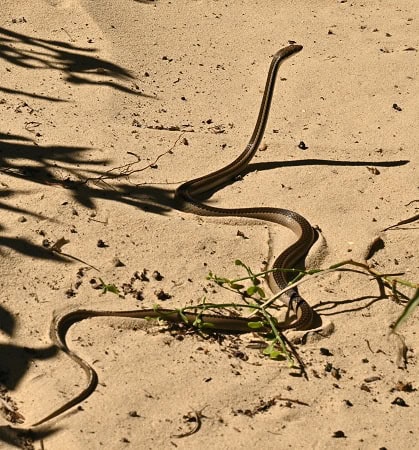
Maximum length: 1.1 metres.
Our tour of thin snakes now takes us to Madagascar, to the dry countryside of dusty roads, crunchy leaves and endless twigs in woodlands that make a crunching sound when you step on them. There’s one snake that doesn’t have to worry about this – Bernier’s striped snake (Dromicodryas bernieri). This species is found across most of Madagascar, and often appears in these dry areas, which they navigate with ease, thanks to an exceptionally thin and light body.
This species is similar to the Sonoran coachwhip in its habits, moving by day, and actively foraging for reptiles, including the Madagascar ground gecko (Paroedura bastardi). Compared to the bulky Madagascan ground boa, this species is like an Olympic athlete, constantly exploring and flecking its tongue. Bernier’s striped snakes pose no threat to humans, and are only missing from the far northwest of Madagascar.
Though regularly encountered by ordinary Madagascar citizens, this species is poorly researched. One interesting fact is that Bernier’s striped snake sometimes takes shelter in ant nests, as well as lay their eggs in them.
| 8 | White-spotted catsnake |
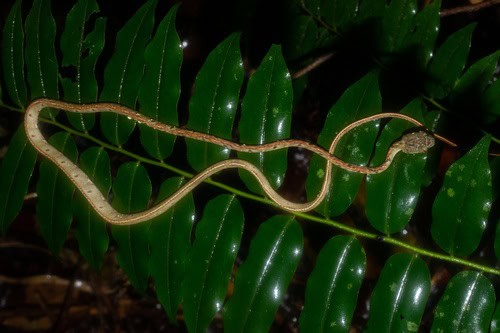
Maximum length: 2.1 metres.
The Boiga catsnake clan has over 40 members in southeast Asia and Australia. They’re already well suited to a branch-dwelling lifestyle, with thin bodies and an innate sense of balance, plus a prehensile tail. But the white-spotted catsnake (Boiga drapiezii) is one of the best-adapted of all, as their body is even thinner than usual.
This species ranges from southern Thailand all the way to eastern Java. They’re also common in Sumatra, peninsular Malaysia, Singapore and Borneo. This species has some of the most jungled patterns, with mossy green and a pair of fungal, bulging eyes.
The white-spotted catsnake’s head is incredibly wide compared to its body, but not because the head is huge, rather because their body is so slender. This is one of the few tree snakes worldwide that rivals the blunt-headed tree snake of South America for ludicrous thinness.
White-spotted catsnakes are only ever found in forests, usually below 900 metres in altitude, and they’re rarely found off branches. Other catsnake species stray to the ground for portions of time, but Boiga drapezeii seems to be strictly arboreal. Their diet includes reptiles and tree frogs, and they pose no threat to human beings.
| 9 | Blunt-headed tree snake |
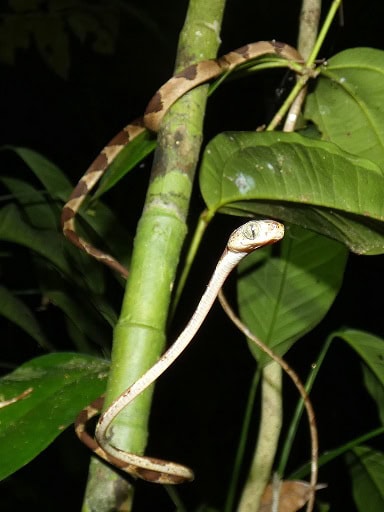
Maximum length: 155.4cm.
The blunt-headed tree snake (Imantodes cenchoa) is a mega-common species of the Americas, ranging from eastern Mexico through central America all the way to southeast Brazil. This species is one of the most successful tree snakes on Earth, weaving over thin branches and crossing precipitous gaps between them with ease.
When you look at their body, it isn’t hard to work out why. The blunt-headed tree snake might have the thinnest body relative to length of any snake. They have no weight at all, and the thinness peaks at a tiny neck, which suddenly becomes larger at the head.
Blunt-headed tree snakes are able to climb trees effortlessly, and cross between gaps a boa constrictor could never manage. Their thinness combines with a bulging pair of eyes to make them truly bizarre.
This mildly venomous species has a variety of confirmed prey, including pug-faced anoles, border anoles and bridle anoles. Mammals are almost unheard of in their diet. One of their skills is locating sleeping lizards, resting in hollows on tree branches. Their eyesight is strong enough that they don’t require a flicker of movement to take notice, but can identify, stationary sleeping future meals.
| 10 | Copper parrot snake |
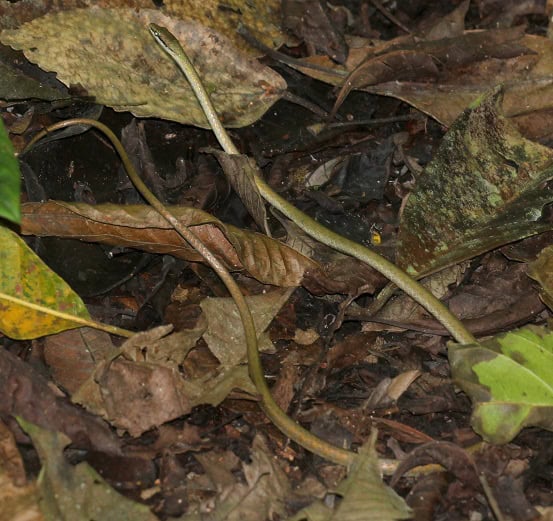
Maximum length: 132.6cm.
One of the more obscure members of the parrot snake clan. Unlike the all-conquering giant parrot snake, copper parrot snakes are found mainly in Ecuador and Colombia, and sightings are scarce. Somehow, they must lack one of the skills of the giant parrot snake, but one feature they don’t lack is a thin body.
Like all members, the copper parrot snake (Leptophis cupreus) is a semi-arboreal snake, which spends a great deal of its time on branches, but is comfortable on the ground. They’re green with a paler underside, and they have a mild venom which poses little threat to humans, and must be chewed in to absorb anyway. Though not quite as nimble as a blunt-headed tree snake (which they coexist with), they’re capable of crossing precipitous gaps between branches as well.
As well as rainforests, copper parrot snakes can be found in rural areas such as pastures with old clumps of trees left standing. Rainfrogs are their main prey, and while they sometimes gape their mouth wide to intimidate, they generally flee if pressured. A thin body adds to this nimbleness and speed, and therefore the species’ entire survival chances.