
| 1 | The USA’s largest burrower |
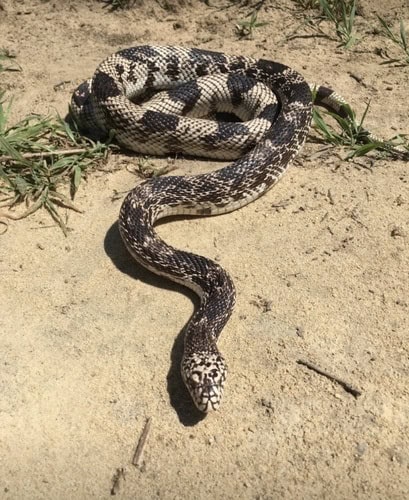
The pine snake (Pituophis melanoleucus) is a species of the eastern USA, which ranks as one of the largest snakes in the USA overall, with an all-time record length of 228.6cm. It’s a non-venomous species, which hunts its mostly mammal prey using constriction, and can turn aggressive when confronted by humans as well, ripping and tearing with a vicious pair of fangs.
Pine snakes inhabit 9 confirmed states, including Florida, Georgia, North Carolina and South Carolina. Wherever they live, they’re fairly uncommon, but this species does have one great claim to fame, one a copperhead can never compete with: being the USA’s ultimate burrowing snake, and one of the top burrowing snakes in the entire world.
Pine snakes are mainly found in forests and woodlands with dry soils. Within these forests, they spend over 50% of their time underground, not just for hibernating, but during the day. They don’t just take over existing burrows dug by mammals, but are able to forge their own burrows, using a special snout. This has an enlarged rostral scale, designed for shifting aside massive quantities of soil. Other snakes in the US have this specialised snout, like the scarlet snake (40-60cm), but none as large as the pine snake.
When a pine snake has finished digging its burrow, the pile of fresh earth outside can be 2-3 feet wide. This makes it one of the most extreme burrowers on the planet. Pine snakes can spend months at a time in their burrows, even remaining faithful to them for years.
| 2 | Digs tunnels 6 metres long |
Despite living in forests, pine snakes virtually never climb trees. Instead, their favourite direction to travel is downwards, into the safety of the underground. Pine snakes are strategic when it comes to digging, as they even follow the lines of old tree roots. They also lay eggs in their underground tunnels, and are able to find their way back to previous burrow entrances using scent alone.
The entrances to these tunnel lairs typically look like small dark holes, nothing exceptional whatsoever. But on the inside, a pine snake’s den can stretch to 6 metres long, and 1.2 metres high.
Pine snakes often gather communally in underground burrows, with up to 33 flocking to one chamber. Other snakes also get in on the action, like corn snakes, hognose snakes, and black racers, which have been observed coexisting with pine snakes in their burrows.
Various interesting quirks have been discovered about pine snake burrows. For example, compared to in Florida or Mississippi, those further north (e.g. New Jersey) tend to excavate longer, much deeper chambers. Additionally, those further south are more likely to reside singly (e.g. in Florida), due to the warmer temperatures.
| 3 | Non-venomous yet vicious |
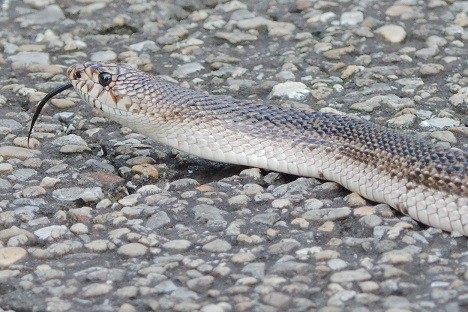
At an average of 120-200cm, and an all-time record of 228.6cm, the pine snake easily ranks among the top 10 longest snakes of the USA. It’s slightly shorter than the coachwhip (record: 259.1cm), but its body is significantly thicker, in order to fulfill its constriction hunting methods.
Pine snakes are diurnal in nature, moving mostly by day. If encountered by a human, their first reaction is to throw themselves into an S-shape coil, similarly to a rattlesnake. They often hiss as a warning, but they may also unleash one of the snake kingdom’s weirdest noises: a bellowing growl. This is partially created by a modified glottis in their throat, and has unique harmonic elements according to a 1995 study. Their gopher snake relative further west (Colorado, California) also produces this odd noise occasionally.
If the intruder refuses to leave, then the pine snake will launch a real, not feigned strike. Unlike the eastern hognose snake, this species won’t give up and start faking death. Pine snakes have every intention of biting human skin and drawing blood. They make wide, sweeping strikes in the direction of the intruder, only adding to the air of unhinged aggression.
| 4 | Nemesis: red fox |
Pine snakes have a highly flexible diet. Their focus is on mammals, but they also prey on birds and reptiles. Many dietary items are inhabitants of the burrows and tunnels they enter, including gopher tortoises and Mazama pocket gophers. Owls are surprisingly popular with pine snakes as well, including western screech owls and elf owls.
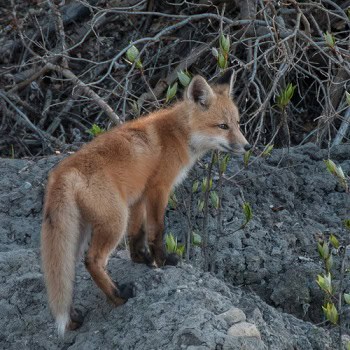
Despite exceeding 2 metres, and being a muscular constrictor which exerts brutal squeezing force, pine snakes have a long list of predators in their pine-oak habitats. Several of these are intelligent enough to locate their underground dens and assault the sleeping snakes within, including American red foxes, striped skunks, and northern short-tailed shrews.
A 5 year study from 1989-1994 examined pine snake nest dens in New Jersey’s pine barrens. Of 201 dens, 44 were dug up for eggs by red foxes, and 7 by skunks.
5 pine snakes were killed by short-tailed shrews over the study, one by a fox, and two by striped skunks. More disturbingly, 29% of nests followed from 1988-1990 were dug up by human poachers, searching for eggs to steal (and probably sell).
| 5 | Egg thief: scarlet snake |
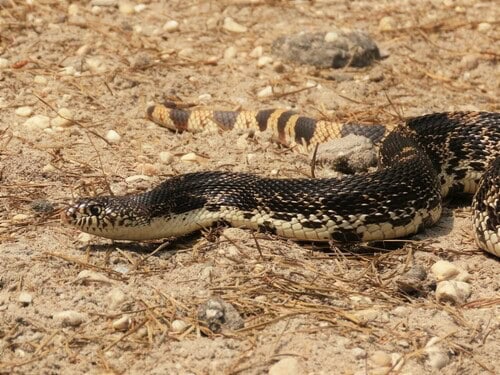
Pine snakes are also preyed on by the red-tailed hawk, America’s most infamous ophiophagous bird, which also preys on the nearby eastern ratsnake. As for fellow serpents, scarlet snakes have been observed puncturing pine snake eggs with their enlarged front teeth, before drinking the white and yolk inside.
The common kingsnake (Lampropeltis getula) is another confirmed predator. In fact, a 1989 study found that pine snakes deliberately avoided travelling over ground that had been smeared with kingsnake scents.
Likewise, hatchlings refused to enter a laboratory maze that had been smeared with red fox scents. The fact that hatchlings were sensitive shows that this is a genetic feature, that pine snakes have adapted to this predator potentially for millions of years, in the formerly untouched American wilderness.
Other confirmed predators include Swainson’s hawks and golden eagles. One reason why they’re vulnerable is their tendency to nest in open fields. While they stick to sandy forests and bushy margins normally, shielding them from vegetation, they move to relatively treeless areas to construct their nest burrows (or find and enlarge an existing burrow). It’s almost certain that red foxes too recognise pine snake scents, just as they recognise their’s.
| 6 | Can move 1000 metres in a day |
Pine snakes are known for their large home ranges, which cover several hundred acres. Males can migrate huge distances in pursuit of females, lured on by tantalising scents. Some radio-tracked pine snakes have travelled over 2 miles in an entire day. Despite this adventurousness, they’re still able to return to their home burrow on time in November or October (depending on climate).
According to a 2009 study, pine snakes become less active during the height of summer. Their activity had two peaks: spring and late summer to autumn. 9 pine snakes were implanted with radio-trackers, and it was discovered that they averaged at 273 metres per movement.
The single largest move in a day was 1221.4 metres, accomplished by a male on May 15th 2001. Another male managed to travel 557.2 metres in 4.5 hours, while the longest female distance travelled was 886.0 metres on August 1st 2001.
The study was conducted in Tennessee’s Arnold Air Force Base (AFB), an abandoned WW2 military installation which has now been reclaimed by nature. One characteristic was the remains of concrete building foundations scattered around the reserve, and the pine snakes eagerly took advantage of cracks in these structures for hibernation dens. All pine snakes tracked entered hibernation between October 14th and November 11th.
| 7 | Habitat: open forests with dry soil |
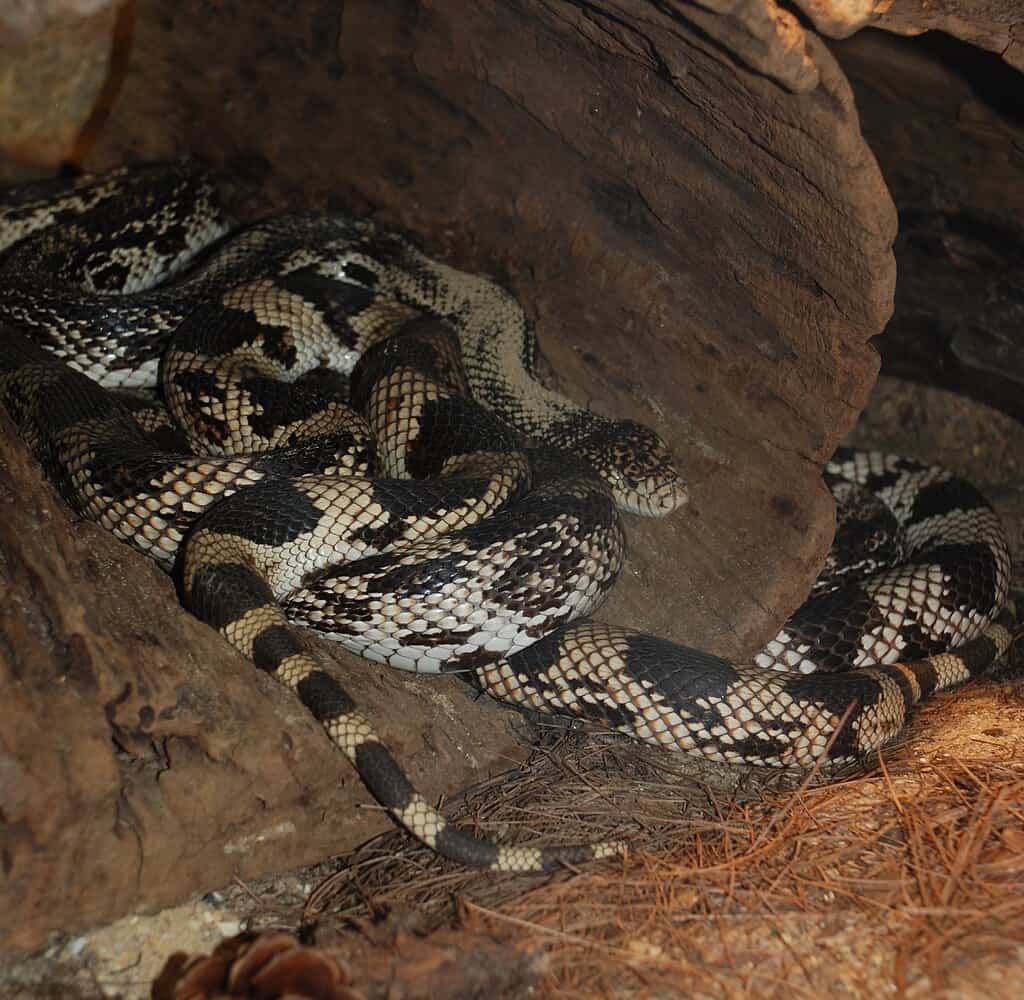
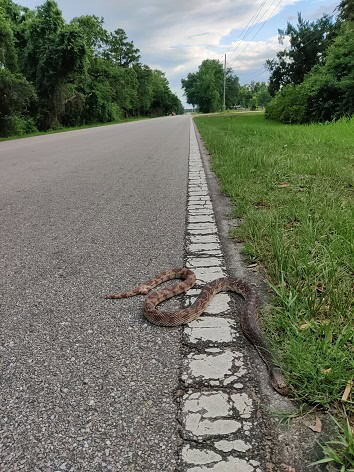
Pine snakes are relatively slow-moving snakes, yet are persistent and relentless, ultimately travelling large distances. Hence, roads between dry woodlands are the most likely place for a layman to find them, similarly to hognose snakes.
Pine snakes are rarely found near swamps or marshes. In fact, this is one of the least likely snakes in the USA to find swimming. As for forests, they tend to avoid dense, closed canopy forests, as the lack of sunlight keeps the soil too moist. They prefer spacious, open forests with dry soils.
Hence, you’re unlike to find pine snakes alongside a timber rattlesnake or copperhead, despite the three sharing a large range in the eastern USA. You’re more likely to find them rubbing shoulders with a southern hognose snake, another woodland burrower, which also enjoys dry soils for burrowing.
Pine snakes sometimes steal the hibernacula of fellow species members; for example, a female was found to occupy a male’s burrow after he left, and used the empty tunnels as an egg chamber. When excavating burrows, scientists have found egg shells clearly from different years, proving their faithfulness to one burrow. Their eggs have also been collected under shingle piles and even below an old mattress.
| 8 | Territory of the pine snake |
Pine snakes have been recorded from 13 states overall, with the most plentiful sightings being in Florida, Georgia and North Carolina. However, they’re ultra rare in West Virginia, with only a single confirmed sighting (Monroe County) in 1940 in the form of roadkill. Likewise, records are very scarce in Virginia and Kentucky.
Meanwhile, the New Jersey populations are a fully separated pocket to the north, as pine snakes have never been encountered in Maryland or Delaware to the south. Despite being isolated, sightings are plentiful here, as they’re confined to the New Jersey Pine Barrens, a vast area of rural, undisturbed land containing remnant Atlantic pine forests, with a thriving ecosystem. This lies southeast of Philadelphia, and contains the protected Pinelands National Reserve, a land of sandy soil which is poor for agriculture, but perfect for pine snakes.
Technically, eastern Texas and western Louisiana also contain pine snakes, but this is a fully independent species. The Louisiana pinesnake (Pituophis ruthveni) is severely endangered, as it occurs only in longleaf pine forests, and only in pocket gopher burrows, making it far less flexible even compared to normal pine snakes.
| 9 | 3 subspecies |
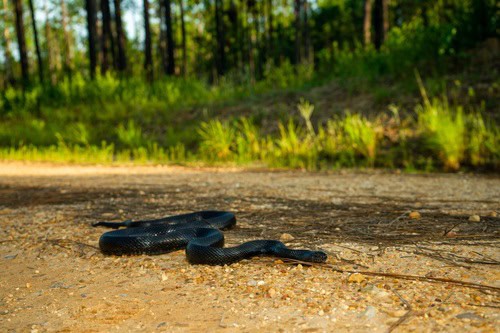
The Louisiana pinesnake is a separate species altogether, but the main pine snake has 3 official subspecies.
The first is the northern pine snake (Pituophis m. melanoleucus), which is the only subspecies found in New Jersey. This also inhabits the Carolinas, Georgia, Tennessee and Alabama. This is the most strongly black and white subspecies, with vividly contrasting blotches, except for newborns prior to shedding their skin. Some even have bright orange, red or purple spots on their lower body, making them highly prized with collectors.
The westernmost, and rarest subspecies is the black pine snake (Pituophis m. lodingi). This version is usually black from head to toe, with even its belly a uniform black. However, a few have occasional white bands, and its face has a smattering of red. This version inhabits the 4-way border zone between Mississippi, Alabama, Louisiana and far western Florida.
Finally, the Florida pine snake (Pituophis m. mugitus) is the dullest of three. This inhabits most of Florida, except the far south (such as the everglades). It also inhabits South Carolina, Alabama and Georgia.
This subspecies is often a murky beige-brown, with the blotches much less distinct and vivid. Around the neck, the blotches often blend together completely. However, a few individuals have vivid black-white colours closer to the northern subspecies. There’s also various areas where the subspecies blend together, such as Georgia.
| 10 | Capable of living 20 years |
The pine snake is a true constrictor, applying several coils to crush its prey to death. However, smaller prey like juvenile rodents are swallowed alive, without constriction.
One of the pine snake’s most brutal tendencies is to invade underground burrows, and swallow nestling mice while they sleep. Here, they’re too constrained to constrict properly, and default to pinning prey against underground walls instead.
Pine snakes reach decent ages, with the record being a female held at San Diego Zoo who reached 20 years, 9 months, and 2 days old. Their clutch size varies, with a range of 3-24, but an average of eight. Their eggs are unusually large, and so are the hatchlings, at an average of 30-45cm.
Despite the effort they take to construct underground dens, pine snakes aren’t known to guard their young. Incubation of the eggs lasts for 73 days on average, with eggs typically hatching in August or September. When a male pine snake catches up with a female, he sometimes bites her neck to prevent her escape.