
| 1 | The 2nd longest rattlesnake worldwide |
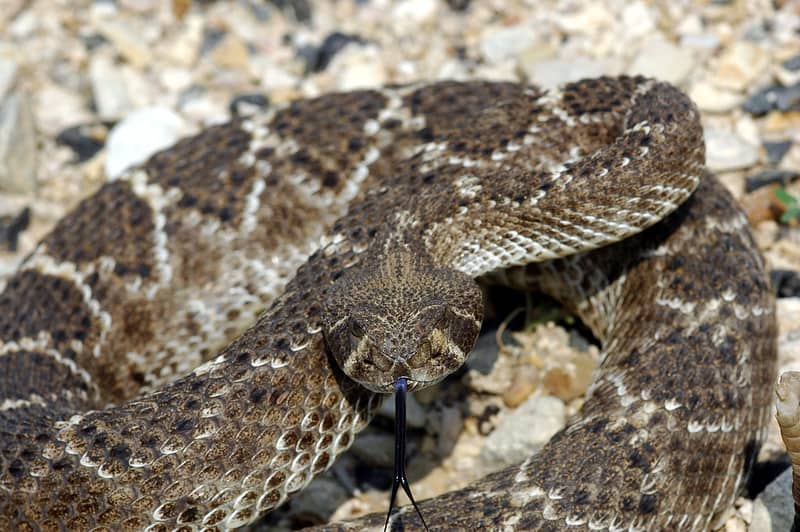
Among US snake enthusiasts, there’s a constant debate as to which species tops the tally for deaths inflicted per decade. The likes of copperheads and cottonmouths bite plenty of people, but there’s only two genuine contenders for actual deaths, and those are the eastern diamondback rattlesnake, and its close relative the western diamondback rattlesnake (Crotalus atrox).
The western diamondback is the second longest rattlesnake, and second heaviest venomous snake in America, easily outstripping the tiger rattlesnake or rock rattlesnake. It’s also the second longest and heaviest rattlesnake worldwide.
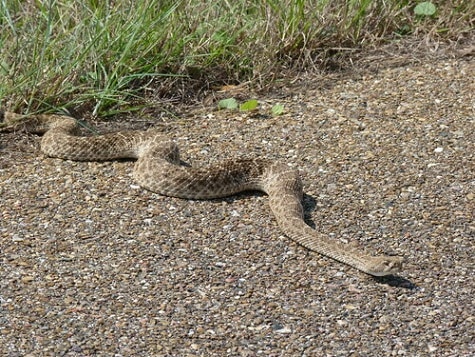
Western diamondbacks inhabit a huge, unbroken stretch of the southern US, beginning in southeastern California, and covering most of Arizona, New Mexico, Texas, Oklahoma and more. They also inhabit a large chunk of Mexico, reaching as far south as Mexico City. Their northerly limit lies in far southern Kansas.
Western diamondback rattlesnakes look extremely similar to their eastern cousin, but there’s no risk of confusion, as the two have no area of overlap. The western diamondback fizzles out in western Arkansas, while the eastern species only reaches far southeastern Arkansas. Western diamondbacks are slightly shorter than their cousin as well, with an all-time confirmed record of 233.7cm versus 251.5cm for the eastern.
| 2 | Texas’ most dangerous snake |
Western diamondbacks are shorter, but significantly more aggressive than their eastern cousin, which tends to be lazier and lurk for hours in vacant Floridian tortoise burrows. Western diamondback rattlesnakes are able to shake their rattle 40-60 times per second. The raw potency of their venom is 2.72mg, which is weaker than a cottonmouth’s at 2mg, and far weaker than an eastern coral snake’s at 0.2mg.
However, the western diamondback’s brute size allows for a much more generous splashing of venom. Each bite injects 250-350mg of toxin-filled nightmare juice, and potentially up to 800mg. This is only slightly less than the gaboon adder’s monster yield. Like the eastern diamondback, 10-20% of untreated bites are fatal, and its strikes rarely miss.
As for the annual death toll? We don’t know which diamondback wins, for one simple reason. Many victims who stagger into hospital and eventually succumb are able to identify a “rattlesnake”, but not the actual species.
Eastern diamondbacks overlap with timber rattlesnakes in their woodland habitats, while western diamondbacks have endless neighbours. Consequently, the data is incomplete. All we can say is that the two diamondbacks undoubtedly hold the 1 and 2 spot for annual deaths. The smart money is on the western diamondback, given that eastern diamondbacks are more likely to be shy and hide away in woodlands. Western diamondbacks also cover a larger area of land in the US overall.
| 3 | Common near towns and settlements |
Western diamondbacks are constantly sighted in the southern US, and one reason is their flexible habitats. They can pop up almost anywhere, from desert scrub, mesquite grassland and pine-oak woods to shrublands, grasslands and rocky limestone hills. They’re also comfortable about hanging around near buildings, resting against old stone walls and wooden fences.
This species is far more common in towns and settlements compared to rock rattlesnakes or ridge-nosed rattlesnakes, which are found in Arizona, but only in remote areas well away from humanity. People have even been awakened by western diamondbacks while sleeping in backgarden hammocks. One report found that western diamondbacks triggered 85.1% of callouts to professional reptile handlers in the city of Phoenix, Arizona.
Western diamondbacks do have a few habitat preferences, as they’ll congregate near rocks if possible. They also prefer flatter, more open ground.
For example, one study compared them to black-tailed rattlesnakes (Crotalus molossus) in the same desert location of Tucson, Arizona. Western diamondbacks were found on steep slopes only 20% of the time, versus 65% for the black-tailed rattlesnake. But the latter appeared on creosote bush flats just 10% of the time, versus 60% for western diamondbacks. The two species were clearly separating from each other, despite covering the same rough regions on a map.
Western diamondbacks also reach decently high altitudes, with records including 2134 metres in New Mexico, and 2440 metres in San Luis Potosi, Mexico.
| 4 | The first snake to walk? |
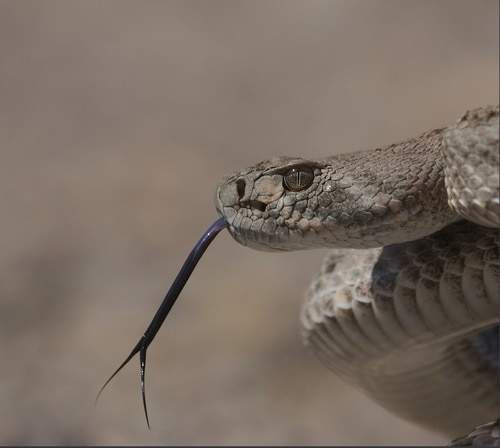
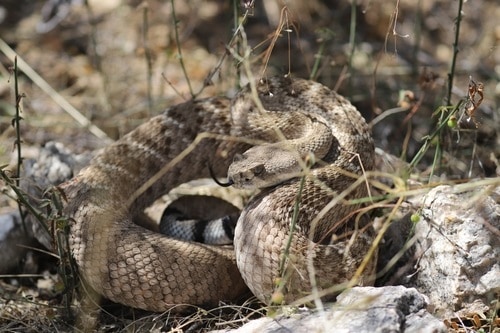
When cornered, the western diamondback uses the classic rattlesnake strike posture. It’s pretty much the opposite of a cobra, which rears up its chest very straight, and stares at the aggressor menacingly. The western diamondback coils up into a bizarre shape, not like a traditional S, but with its entire body contorted, and its neck actually held higher than its head, which then faces the aggressor on. See this bone-chilling video for a great example.
The sidewinder of the Mojave Desert is infamous for its sideways locomotion, designed to avoid burning desert sands, but the western diamondback has an even more bizarre movement style. It begins by forming a complete body coil, which faces forward, possibly towards a human aggressor. Then it shifts backwards using the left and right sides of this coil as a rudimentary pair of feet. It alternates with each point so that the centre never touches the floor, just these two small left-right areas.
This was first reported in 2003, and resembled a complete snake coil wobbling backwards. According to the media, it was the closest to a walking snake that had ever been discovered.
Why this happens (and how often) is a complete mystery. It might be a combination of two requirements: 1) minimising contact with the searing desert sands, and 2) facing forward to warn an aggressor, while slowly backing off. Unlike a coachwhip, the western diamondback isn’t fast enough to instantly blast off over the horizon, so it has to get inventive.
| 5 | No paralysis, plenty of haemorrhaging |
The classic symptoms of a western diamondback bite include swelling, myonecrosis, internal bleeding, organ damage, headaches, nausea, vomiting and abdominal pain. However, the species’ speciality is undoubtedly haemorrhaging. Around 53% of its toxic enzymes target the circulatory system, whether as anticoagulants that destroy clotting factors like fibrinogen, or toxins which physically degrade the linings of capillaries and venules, causing spontaneous bleeding. There’s also a mycardial depressant factor which weakens the beating of the heart.
Western diamondback venom usually doesn’t contain neurotoxins, unlike the notorious tiger and Mojave rattlesnakes. But a neurotoxin similar to mojavetoxin has been detected in a few populations.
Western diamondback venom varies by region, as the most lethal venoms are found in the southwest of its territory (California, western Arizona). These have the lowest protease activity, while the colonies further northeast (e.g. Arkansas) have the highest protease and lowest lethality.
Metalloproteinases are the main toxin class in the venom soup overall, followed by cytotoxins and myotoxins. Permanent skin or tissue loss is a real possibility. The venom is especially harsh on the kidneys, damaging their structure, whereas the black-banded sea krait it was compared to had no effect at all. A vial of western diamondback venom once lost little of its potency after 16-17 years of pitch black storage.
| 6 | Prefers mammals, but flexible |
With such a large territory in the Americas, the list of prey western diamondbacks have to choose from is dizzying. Here’s a small sample of the meals they’ve been confirmed to eat…
Mammals: Ord’s kangaroo rat, eastern cottontail, black-tailed jackrabbit, prairie vole, fox squirrel.
Reptiles: lesser earless lizard, regal horned lizard, desert iguana, greater earless lizard, Texas banded gecko.
Birds: northern mockingbird, American mourning dove, laughing gull, Caspian tern, northern bobwhite.
Mammals dominate, as a study involving 108 prey from 101 western diamondbacks found that 71.3% were mammals, followed by 9.3% reptiles, and the remainder being unidentified. A 1976 study was even more biased towards mammals, at 94.8% of prey by weight.
It’s extremely rare for western diamondbacks to eat fellow serpents. One exception was an adult western diamondback which scavenged a member of its own species in the form of roadkill, before regurgitating the rotting necro-meal. Snake-eating (ophiophagous) diets are rare in the rattlesnake family, and western diamondbacks follow this rule. A rare exception is the Querétaro dusky rattlesnake of southern Mexico.
The reverse happens regularly though. Western diamondbacks are confirmed prey of the California kingsnake, which has innate resistance to rattlesnake venom. Another confirmed predator is the Middle American indigo snake.
| 7 | Starvation cannot stop them |
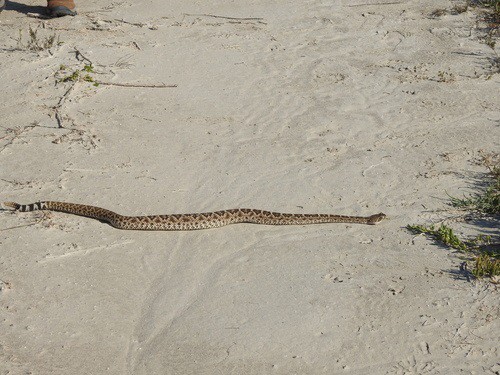
The likes of blood pythons can go over a year without eating, whereas corn snakes eat every 7 or 10 days. The western diamondback is a natural starvation machine, as it’s able to go over 2 years without swallowing a meal. In 2006, a study gathered 16 western diamondbacks, and starved them for 168 days (5.5 months), while mimicking their natural climate.
Not only did the rattlers survive and thrive, relying on their stored fat reserves, but they managed to grow longer during their starvation period. They successfully reduced their resting metabolic demands by 80%, and they were experts at preserving the energy they had, once they’d begun “digesting” themselves.
Their bloodstream glucose fell, while their circulating ketones increased, a similar response to starved humans (e.g. the keto diet). They had physiological advantages for starvation, such as protecting spare free fatty acids from oxidation in the bloodstream. Over the 5.5 months, they gradually decreased their speed of movement.
It’s one thing to crawl around a desert becoming meaner and leaner, but western diamondbacks can add centimetres, even after 4 months with no mice or gophers. Perhaps nature knows that they can’t afford to fall behind their fellow kind in length and mass, otherwise they’ll be at risk of being hunted.
| 8 | Subtly alters its rattle |
The western diamondback is one of the most fully evolved snakes on the planet, and yet another trick is altering its rattle’s frequency, to create an illusion of close proximity. Researcher Boris Chagnaud first noticed this higher frequency when he entered an animal-holding facility. As he approached the rattlesnakes’ enclosures, their rattles noticeably changed in pitch.
Chagnaud and his team then conducted an experiment in which western diamondbacks were faced with two objects: a black disk, and a human-shaped torso, which rapidly approached them. At longer distances, the rattle’s frequency averaged at 40 hertz. When the objects reached close distances, the frequency abruptly jumped to 60-100 hertz. The approach velocity of the object also affected the size of the jump.
Next, they tested people’s perceptions of the rattle. The study entered a futuristic phase, as they sent human volunteers into a virtual reality grassland populated with western diamondbacks. Whenever they encountered a piercing rattle, they were asked to estimate the distance.
When the lower frequency rattle sounded (40 hertz), the volunteers estimated the western diamondbacks’ distance away with decent accuracy. But when this was switched to higher frequencies of 70 hertz, at 4 metres away, the volunteers almost always underestimated the distance, believing the rattler to be 1 metre away, right on their toes, when it was actually much further.
Western diamondbacks are tricksy and deceptive – in a bushy desert flat, they could trick you into thinking they’re closer than they really are, sending you fleeing back to your car, and achieving their goal of avoiding a fight simply by shaking their tail. The rattle of this species isn’t a simple shaky sound like a kid’s toy, but much more complex.
| 9 | Strikes faster than other vipers |
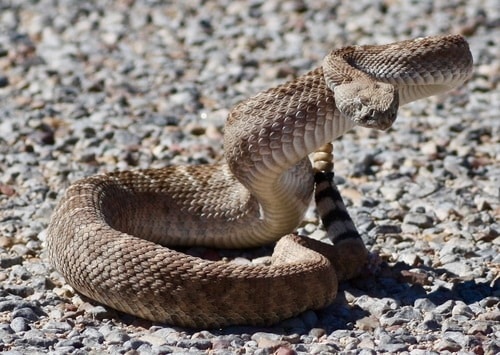
A 2002 study compared the western diamondback’s predatory and defensive strikes. The first was stimulated using live mice, and the second using a Pikachu toy. The results showed that defensive strikes were launched from twice the distance of predatory strikes on average. Predatory strikes kicked off at 0.75-15cm away, while defensive lunges began at 2-17cm away. The ranges were similar, but the average distances were 4.09cm versus 9.43cm.
Likewise, defensive strikes reached higher speeds, achieving a maximum velocity of 5.5 metres per second, versus 4.28 m/s for predatory strikes.
Meanwhile, the average maximum velocity of the 13 predatory strikes was 2.61 m/s. This was far higher than in two deadly Old World vipers, the nose-horned viper (1.47 m/s) and gaboon adder (1.55m/s).
The same was true for the maximum velocities, which were roughly twice as fast. Again, this was 4.28m/s for the western diamondback, while the nose-horned viper and gaboon adder achieved maximums of just 2.2 and 1.9 m/s respectively. The strikes for those species were also predatory strikes, meaning that this was a direct comparison.
| 10 | The annual rattlesnake festival |
The southern US is home to an annual tradition: the tradition of the “rattlesnake roundup”, where men, women, and children enter the countryside and kidnap as many rattlesnakes as they can, then gather in the town centre in joyous scenes of celebration and music. Beginning in the 1950s, the original goal was pest extermination, with some rattlesnakes being gruesomely beheaded. These days, most are paraded around for educational purposes, or simple spectacle.
Dozens of writhing serpents are poured into a colossal snake pit using a bucket, and children are allowed to stroke the snakes in awe while handlers grip their menacing heads. The events crown a “Miss Snake Charmer”, and awards for the heaviest rattlesnake collected are handed out. It’s a free-for-all of snake madness.
While timber and prairie rattlesnakes are captured and dunked in the pit, western diamondbacks are undoubtedly the most popular species, partially because of their conspicuous jumbo size. Whether the roundups are harming wild populations are unknown. Timber rattlesnakes have been hurt by these festivals in the northeastern US, but it’s assumed that western diamondbacks are so dominant that the roundups make a dent at best.
The largest roundup happens in Sweetwater, Texas, and supposedly, this results in the annual capture of 1% of the state’s total rattlesnake population (some believe this is nonsense). Texas is the main host to this madness overall.
| 11 | The personality debate |
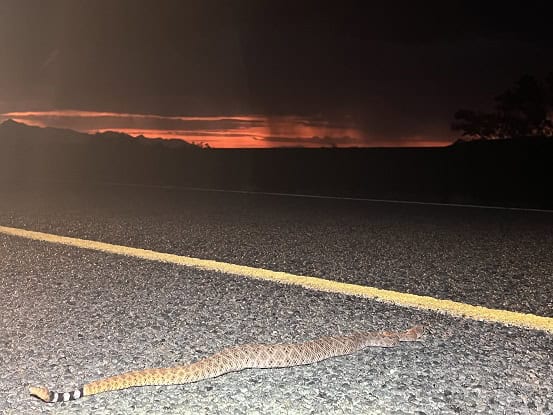
The western diamondback is generally regarded as one of the most vicious rattlesnakes, but like any creature on Earth, it has varying personalities depending on individuals and circumstances. Some have approached western diamondbacks to within a few feet and triggered no reaction at all, not even a gentle rattle. Others allow hikers or dog walkers to wander past without moving any body part other than their cunning eyes. But in several detailed reports, western diamondbacks do live up to the savage legends of old.
One horrifying tale took place in the Suizo Mountains of Arizona. A pair of scientists found a male western diamondback and attempted to capture it for processing. Unfortunately, this rattler was searching for a nearby female, making it unusually aggressive.
The glaring western diamondback lunged forward with its fangs bared, forcing the closest scientist to backpeddle, and use his rucksack as a makeshift shield. The scientist kept backpeddling, and the western diamondback kept advancing, never ceasing its demented attempt to land a venomous bite.
By the time the rattlesnake gave up the fight, the scientist had moved 20 metres back from his original position. This is the closest you’ll find to the classic folklore tales of western diamondbacks chasing humans down.
Western diamondbacks aren’t communal in the slightest, so if you spot two adults together, it’s likely to be a male and a female, and you should be extra cautious. Also stand back if you see an adult with several tiny rattlers. Mother western diamondbacks have maternal instincts, less so than the prairie rattlesnake or Arizona black rattlesnake, but more so than the majority of snakes. They abandon their young after 10-14 days, but until then, they will defend them viciously. The first skin shed marks the moment when young western diamondbacks become fully independent.
| 12 | Attacks from beyond the grave |
Killing a western diamondback is always sad, but if you’re cornered in a supermarket aisle, you might have no choice. But never let your guard down, as happened in May 2018, when a Texas man found a 1.25 metre western diamondback slithering around his backyard.
According to Jennifer Sutcliffe, her husband grabbed his trusty shovel and decapitated the rattlesnake. He bent over to pick up the severed head, thinking the threat was over, but felt two sharp fangs embed themselves in his hand.
Immediately, the man began to have seizures. He was airlifted to hospital, where he was given CroFab, the standard US rattlesnake antivenom. The man required 26 vials of antivenom, versus the usual 4. For 24 hours, the doctors warned that he might not make it. The man survived, though continued to suffer from weak kidney function.
The incident happened while the couple were weeding their flowerbed, in the town of Corpus Christi. Western diamondbacks join the illustrious snake club of biting people from beyond the grave, also occupied by the red-belled black snake of Australia, whose severed head once bit a graveyard worker just 45 minutes after he killed it in 2010, amidst rows of spooky graves and tombs (he survived).