
| 1 | A southern Brazilian menace |
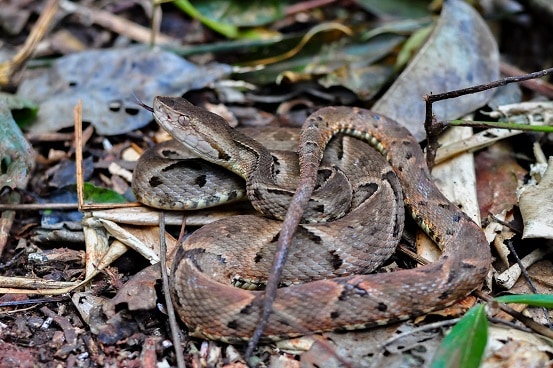
The Bothrops pitviper genus is a venomous group with over 30 confirmed species in Brazil alone. There isn’t a single corner of Brazil that doesn’t host at least one Bothrops species, and the main version in southern and central Brazil is Bothrops moojeni, sometimes called the Brazilian lancehead.
This species is also found in Paraguay, Uruguay and far northern Argentina, and averages at 160cm, with a record of 230cm. In certain regions of Brazil, Bothrops moojeni causes the highest number of snakebites per year. For example, one study covered a teaching hospital in the Brazilian municipality of Uberlândia, gathering all available snakebite records.
From 1984 to 1990, there were 322 recorded snakebites, and at 54% of cases, the Brazilian lancehead was easily the main culprit. In second place was Neuwied’s pitviper, at 33% of cases. Bothrops moojeni is a particular terror in Minas Gerais and São Paulo states, which are two of Brazil’s most populated.
Brazilian lanceheads mainly stick to the ground, rarely climbing trees. It’s also rare for them to hide in mammal burrows, and they swim in flooded riverside pools only occasionally. The Bothrops pitviper clan varies enormously, as their venomous cousin the green jararaca is pure green, and spends most of its life on tree branches. But the Brazilian lancehead is a committed ground-dwelling species, where it lurks ominously like a resting tank.
| 2 | Habitat: riverside forests |
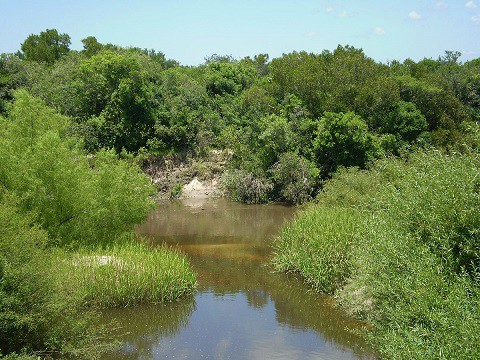
Brazilian lanceheads live in very select habitats. They stay far from rainforests, open savannah, parched arid landscapes, or dry rocky canyons. Instead, they strongly prefer riparian forests – woodlands on the borders of rivers, adjacent to open grassy fields. The technical term for these is gallery forests, tree clumps which are only supported by the river’s moisture and would fail to survive without it.
Brazilian lanceheads lurk in these narrow tree corridors all day, and pounce on any curious person that dares to explore them. For example, the main Bothrops pitviper they overlap with in southern Brazil is Neuwied’s pitviper, but this version is found exclusively in open savannah. The two snakes almost never coexist, as they have evolved to occupy different niches (remember this when your tourist bus breaks down).
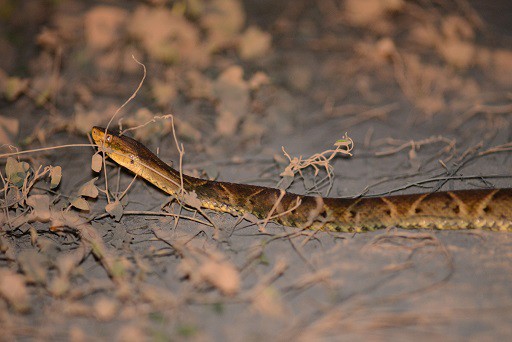
Part of this species’ danger is its strongly nocturnal lifestyle. Rather than the glaring light of the sun, Brazilian lanceheads are adapted to small, fleeting traces of light, which their night-adapted pupils can maximise and exploit. The riverside tree clusters they lurk in only add to the darkness.
| 3 | Skin-shredding venom |
The Brazilian lancehead has a fairly ordinary venom for its Bothrops group, but the difference is that the skin-shredding local symptoms are turned up to the maximum. The venom consists of 37-39% snake metalloproteinases, which cleave through amino acid structures in skin cells.
Your skin produces its own metalloproteinases, which break down old skin, readying it for reconstruction. This is perfectly healthy, but the Brazilian lancehead contains a devilish equivalent, repurposed for evil. The next chunk consists of serine proteases (15-19%), which target peptide bonds in skin cells and the bloodstream.
A study on 37 patients revealed the typical symptoms. Swelling occurred in 100% of victims, non-clotting blood in 72.7%, and spontaneous bleeding in 5.8%. 29.4% experienced “complications”, including 8% of victims who suffered necrosis, where skin or muscle tissue dies and begins to slough off. 6% experienced kidney failure.
On the positive side, Bothrops moojeni is well covered by the endless vials of antivenom rolling off of Brazilian production lines. The standard Bothrops antivenom for the country, soro antibotrópico, consists of 50% jararaca antibodies, followed by 12.5% Brazilian lancehead antibodies. The remaining three 12.5% chunks come from the jararacussu, crossed pitviper and Neuwied’s pitviper. Even the tiniest village medical hut with a thatched roof stocks this advanced antivenom.
| 4 | Rare danger: increases heat sensitivity |
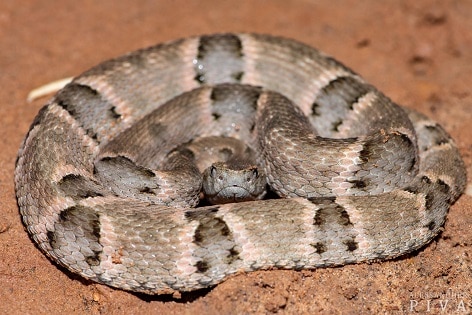
Brazilian lancehead venom is proven to increase your pain sensitivity, both to the hard pressure of touch and the flickering flames of heat. In 2017, scientists identified a new toxin in the venom called BomoTx, within a previously known class called Lys49 myotoxins.
They performed a simple test, first injecting mice paws with BomoTx. The dosage was insufficient to cause pain by itself, but when exposed to heat, those given the toxin withdrew their paw much faster than those without. The same was true for placing pressure on the mice’s paws – by adding BomoTx, less pressure was needed to cause the mice pain.
The scientists also identified the mechanism, a complex chain of cellular reactions that began with a release of ATP. This ultimately led to the overexcitement of two groups of neurons. The technical term for the heat sensitivity was “thermal hyperalgesia”, an altered perception of temperature.
Bothrops moojeni has also contributed to humanity, as one of its anticoagulant toxins called moojenin has been transformed into a pharmaceutical drug. It’s called batroxobin, and turns the anti-blood clotting dangers on their head to reduce the risk of stroke. This drug is already in use, having passed all phases of clinical trials.
| 5 | The place where 10,000 live |
Another study compared this snake to its cousin the crossed pitviper (Bothrops alternatus), also found in southern Brazil. The latter also increased pain sensitivity, to 25% above the norm within 1 hour. This lasted for 24 hours.
The increase caused by the Brazilian lancehead dissipated faster, within only 4 hours. However, the peak was sharper, with venom injections causing 40% increased pain sensitivity. The study found that antivenom swept away the sensitivity with ease, as with other symptoms. It also found that “The intensity of the local effects caused by B. moojeni venom is considerably more potent than B. alternatus venom“. That means more necrosis and swelling.
The world capital of the Brazilian lancehead is a snake farm called Pentapharm do Brasil, located in the Minas Gerais state of Brazil’s southeast. This facility can house 10,000 snakes at once, which are reared for antivenom production. The Brazilian lancehead is the sole species reared here, with its venom dried and sold off to hospitals dotted all over the Brazilian map.
Miraculously, injuries are few and far between. From 1981 to 1999, just 13 accidents happened at the facility, among 7 workers. Another 18 workers kept their guard up and were never bitten. 12 accidents were straight up bites caused by clumsy handling of the snakes, and the last was a splash of loose venom in a technician’s eye.
| 6 | Rarely misses when lunging |
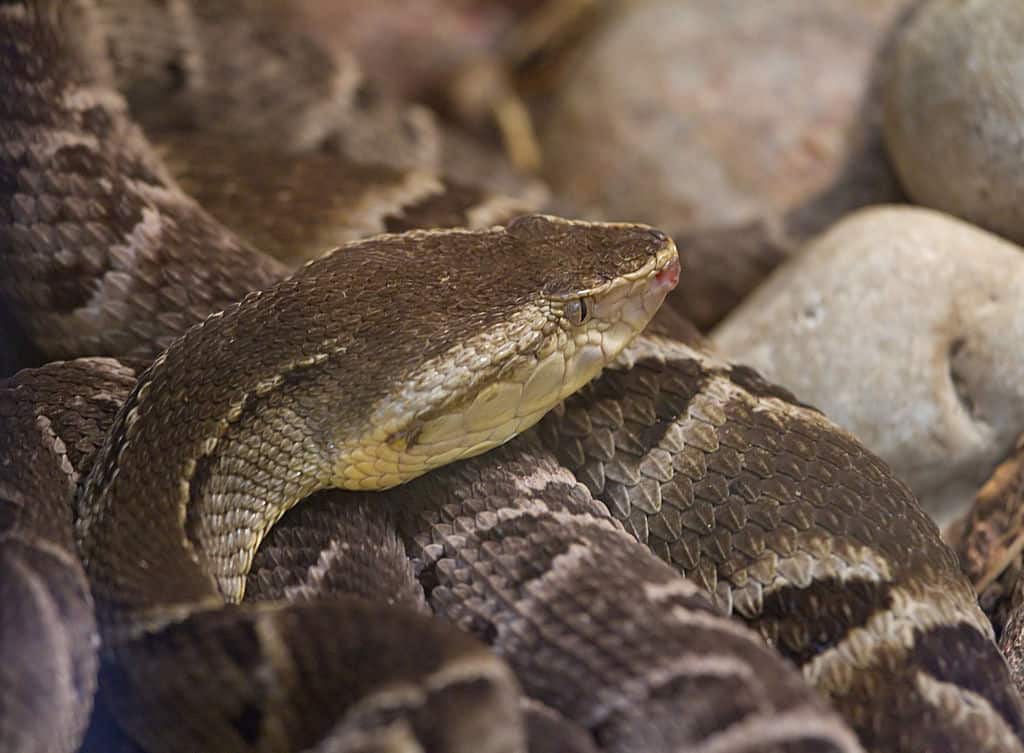
In 2007, a study tested the strike style of 5 Bothrops pitvipers. Some characteristics were consistent between them, such as strike distance. However, Bothrops pauloensis and the crossed pitviper tended to coil their bodies tightly before making a lunge. The Brazilian lancehead and jararaca held their bodies in a far looser position.
The Brazilian lancehead was unique in one respect: it raised its head the highest before lunging, while other members kept their heads closer to the ground. This also gave it the lowest angle when striking, i.e. more horizontal, as it needed to travel less vertical distance into the air.
Like the other four, the Brazilian lancehead was deadly accurate, with almost no failed strikes. This isn’t guaranteed in venomous snakes; the Shedao Island pitviper of China has a 46.7% failed strike rate. Bothrops moojeni and its cousins are a cut above in precision, and therefore extra risky to approach.
The style of the study was humane, as the scientists taunted the snakes with a plastic water bottle, but coated it with 0.5cm of rubber to protect their fangs. The scientists later inspected the rubber coatings to check whether the snakes’ strikes were true. Sure enough, they got their answer when a puddle of venom drained out of each.
| 7 | Turns itself into an umbrella |
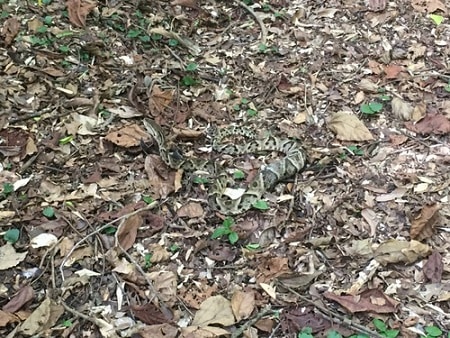
Collecting rainwater on scales isn’t unique in snakes, particularly among stationary branch-dwellers like the emerald tree boa. But Bothrops moojeni is rare in having a specific experiment conducted. The scientists used Brazilian lanceheads reared on mice, kept in temperatures of 30C, and sprayed water all over their backs.
The moment the first droplets struck their scales, the snakes began shifting into a tight arrangement of coils, always with their head at the centre. Each body loop was kept close together, allowing the water to collect between them.
The snakes began drinking the water immediately, and accumulated water in their storage pool for 15-30 minutes, continuing to drink for 3-5 minutes. This technique was particularly effective in juveniles, as their scales seemed to allow water droplets to form more readily.
Brazilian lanceheads have a strong preference for warm conditions, becoming active on the hottest, stickiest nights where insects are buzzing at your arms. A study compared them to crossed pitvipers, Neuwied’s pitvipers and more, and found that this species preferred the warmest conditions.
| 8 | Eats a non-fussy diet |
Whether it’s Scotland or Brazil, riverside forests are always some of the liveliest ecosystems around. There’s fish, toads and all the assorted tree creatures that prey on them, and this creates a buffet of opportunity for the Brazilian lancehead. This snake is a non-discriminate predator. As adults, 41% of its diet consists of mammals, followed by 31.9% frogs, 17.4% lizards and 6.2% snakes (study).
As younglings, Brazilian lanceheads favour frogs, which then shrink as a proportion each year. One amphibian they’re confirmed to eat is the white-spotted tree frog, which one individual swallowed headfirst, taking 7 minutes from start to end. They’re a snake-eating snake, with one prey being Brongersma’s blind snake. As for their own predators, a young Brazilian lancehead was once observed being eaten by a tarantula in a Brazilian forest. When disturbed, the tarantula fled, the snake still in its clutches.
Brazilian lanceheads also eat particularly large meals, as one study recorded a prey item 107.9% of their own body weight. This was a striped worm lizard, a long reptile which looks like a snake itself. The lizard weighed 41 grams, versus the snake’s 38 grams.
| 9 | No variation in appearance |
Bothrops moojeni is one of the larger Bothrops pitviper members, with an average length of 160cm, and a record of 230cm. Its patterns are non-flashy, with varying shades of beige and brown, contrasting against a white belly smattered with grey spots.
The Brazilian lancehead has few colour morphs, but younglings have a white tail tip, which darkens into adulthood. A survey from Brazil found that 70.9% of juveniles had pale tails, versus only 2.9% of adults. The tail is believed to be for luring in frog prey, before their venom becomes powerful enough and their lunge accuracy sharpens enough to take over.
The pupils of this species are vertical like most nocturnal snakes, and the scales are sharply keeled. Brazilian lanceheads give birth to live young, and the quantity varies wildly, from 3 to 30. The larger the female, the more neonates she produces.
Females are slightly larger than males with this species. Almost all Brazilian lanceheads are born in summer, and 60% in December.
| 10 | The toxic transformation |
One of the Brazilian lancehead’s claims to fame is that its venom transforms in adulthood. Juveniles begin life with vast amounts of coagulant toxins, impairing the blood’s ability to clot. These fall significantly within 2 years, while the amount of metalloproteinases rises, worsening the swelling, necrosis and other forms of devastating skin destruction.
The biggest change happened from year 1 to 2. This venom is the opposite of the prairie rattlesnake’s, which is rich in metalloproteinases when younger, but shifts to myotoxins (muscle-degrading) in adulthood.
Bothrops moojeni also varies by region of Brazil, with some causing less haemorrhaging but having a higher fatality rate. Normally, the Brazilian lancehead is immune to its own venom, but the normal snakes died when injected with the mutated venom of these supersnakes from unusual regions.
Despite the risk of amputations, Bothrops moojeni doesn’t have a monstrously high kill rate. However, there’s a risk of brain haemorrhage, due to the venom physically attacking small blood vessels. It can be a roll of the dice as to which organs are worst affected.