
| 1 | A thin, rapid-striking snake |
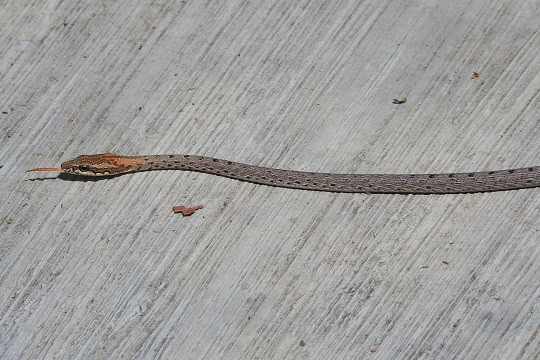
The red whipsnake (Dryophiops rubescens) is a species of southeast Asia, which is only mildly venomous, and has no ability to kill a human being that we know of. It’s a species of 8 confirmed countries, including Thailand, Vietnam, Cambodia, Malaysia, Brunei, Singapore, Indonesia, and the Philippines, where it’s mainly found on the island of Palawan.
Even though red whipsnakes are much less dangerous than the king cobra or monocled cobra, they’re still more than equipped to survive the dangerous wilds of southeast Asia. Red whipsnakes are mainly found in forests, but they also appear in villages nearby. They’re semi-arboreal in nature, spending much of their lives on tree branches, climbing thick trunks, and hiding in gnarly tree hollows. Yet they’re also comfortable on the ground, including in open grassy fields directly next to forests.
Red whipsnakes travel at a steady pace, but can be extremely fast when pushed. They sometimes use this speed to attack human beings, making non-lethal yet vicious and aggressive strikes.
According to this Thai snake expert, red whipsnakes can strike humans so rapidly that the victim barely has time to comprehend what’s happening. They flee from danger like a racetrack greyhound, and their strikes have a high accuracy rate. Red whipsnakes complement this with excellent climbing abilities, and a natural instinct for dark hideaways where they can escape from danger.
| 2 | Sometimes common, sometimes a ghost |
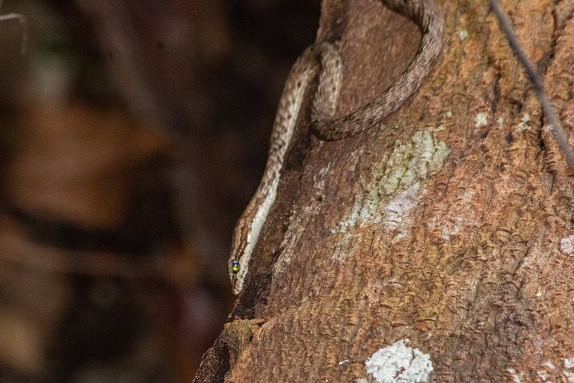
The main bulk of the red whipsnake’s range begins in the south of Thailand, where they’re fairly common, with regular observations. Further south, they’re particularly abundant in peninsular Malaysia, and are fairly abundant on Borneo, the island split between Indonesia, east Malaysia and Brunei. Encountering this species here is a story to tell your friends, but nothing a herpetologist would care about.
That all changes further north, as beyond southern Thailand, the red whipsnake suddenly becomes much more sparse. It becomes like a ghost, flitting in and out of random countryside spots, which are completely unpredictable. A sighting can end in seconds, as though the red whipsnake was never there at all.
In northern and central Thailand, red whipsnakes cover a huge amount of territory, yet on this iNaturalist map, the dots representing sightings are incredibly spread out. There’s sometimes hundreds of miles between each one, with the most distant sighting of all lying in Doi Kun Tan National Park, far to the north.
The same goes for Cambodia and Vietnam. In March 2021, a red whipsnake was found in Mondulkiri Province in Cambodia. This was the first ever record for the province, and only the second record for Cambodia as a whole. Yet this was well within Cambodia’s borders, showing that north of southern Thailand, this species is simply naturally scarce, and extremely difficult to find.
| 3 | Only just discovered in Vietnam |
An even more extreme example came from Vietnam, where this species has probably lived for millions of years. Yet it wasn’t until February 2021 that the red whipsnake was officially confirmed by scientists to exist in the country.
The location was Cat Tien National Park, in the central south of the country, not far from Ho Chi Mingh City (Saigon). This is a hub of snakes, including such lethal creatures as the ruby-eyed green pitviper. The red whipsnake was on a tree trunk 15 metres above the ground, in a thick area of forest with a closed canopy. When the scientists tried to disturb it with a stick, the red whipsnake moved even higher up the tree. High quality photos were taken which confirmed its identity.
Again, this wasn’t a random individual which had strayed over the border; it was from the heart of southern Vietnam. According to the scientists, Cat Tien National Park is one of the most heavily surveyed sites in the country for reptiles, which simply shows how secretive this snake can be.
The discovery of the red whipsnake brought the confirmed number of reptile species in Vietnam to 470. Since then, the first amateur observation on iNaturalist has been posted, also in Cat Tien National Park. But since then, no more sightings have been made.
| 4 | ID signs to remember |

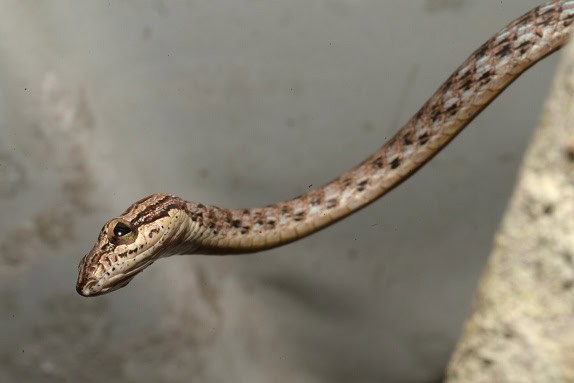
Red whipsnakes are fairly dull in colour, but have a few physical features which you can always distinguish them by. The first is an incredibly thin body, one of the thinnest in all of southeast Asia. It’s the exact opposite of a python: whip-like and nimble instead of slow yet crushing.
The red whipsnake also possesses a thick brown stripe running through each eye, which begins on the snout. A secret ID sign is that males have a darker head than the rest of the body, while in females, there’s no colour change.
The head is fairly narrow, widening slightly from the body, but falling well short of a pitviper’s bulky triangular head. There’s also an elongated snout, and a slightly horizontally shaped pupil, which is unusual in snakes. Red whipsnakes have a red tongue, with a black tip, and their underside is paler than their main body, almost snowy white.
This species reaches a maximum length of 100cm, but is usually less. Combined with their thin body, this makes the red whipsnake an incredibly light species, even weighing as little as 300 grams.
| 5 | Adapted for effortless climbing |
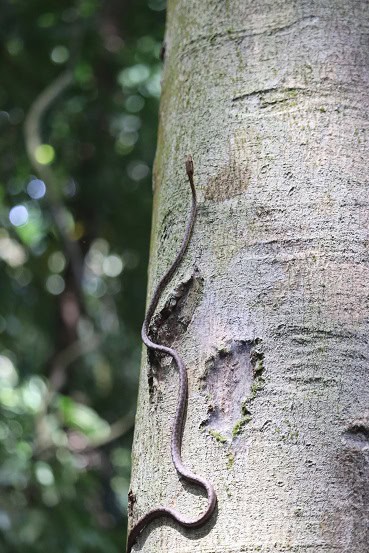
One alternative name for the red whipsnake is keel-bellied whipsnake. This is because of their underside, which features sharpened (keeled) scales, which have the purpose of digging into soft tee bark, thus enabling them to climb fully vertical tree trunks without worrying about plummeting to the hard ground. This adaption is very similar to the corn snake of the USA.
Red whipsnakes are well at home in forests, even sheltering beneath twisting, gnarly root beds. Yet compared to some green pitvipers, they have much more flexibility. They don’t require branches to survive, and they’re often found on the sunny borders of forests, rather than in the dense interior. This is a prime location for bumping into human villagers.
Red whipsnakes also avoid high altitude areas, mainly appearing below 500 metres. The sighting in Cambodia was recorded at 650 metres, which is one of the highest observations so far, while the sighting in Vietnam was made at 130 metres. One red whipsnake was actually found just next to a beach, on Palawan in the Philippines. It was resting on a tree, and consequently, its altitude was recorded at 1 metre.
| 6 | Singapore hotspots |
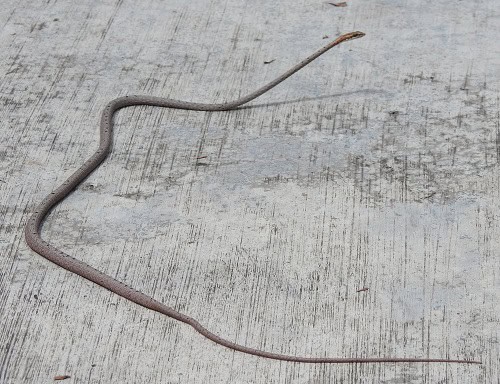
Despite being rare in certain areas, the red whipsnake is nowhere close to endangered, and has a rating of “least concern” from the IUCN. In Singapore, it’s much more rarely observed, and has a rating of “critically endangered” from the local government. Singapore is one of the more urbanised countries in the world, with concrete and towns replacing a former pristine wilderness. Nevertheless, this species is secretive, and it appears that D. rubescens is much healthier in Singapore than once believed.
The main Singapore populations lie in the Upper Peirce nature reserve and Central Catchment reserve, both of which lie in central Singapore, an oasis of nature surrounded by paved roads and streets. Another hotspot lies on Pulau Ubin, an island to the northeast, which is the most rural area remaining in Singapore. This island is home to the popular Chek Jawa Wetlands reserve.
Sightings from Pulau Ubin include a red whipsnake slithering up a tree trunk vertically, coiled around a metal fence, and coiling its neck and upper body in a possible strike pose. There’s no weird local morph, as the red whipsnakes here look identical to elsewhere.
| 7 | The secret urban base in Singapore |
The red whipsnake also has a secret urban population on Singapore which has only been discovered over the last 12 years. This lies in a university – the Nanyang Technological University, found in the west of the island.
Though just as built up and developed as any university, this area is surrounded to the west by thick forests. The first sighting came in November 2013, in a hall of residence. The occupant opened their shoe cupboard to find a 50cm red whipsnake curled up inside, which was later released into the nearby forest.
Red whipsnakes sometimes curl up in tree trunk hollows, and perhaps this shoe cupboard was a close enough match. According to the scientists: “This is apparently the first record of this species from the western part of Singapore Island”. But more sightings were made in the years ahead, as iNaturalist currently has 3 confirmed red dots in the vicinity of Nanyang Technological University, which were made in 2019, 2020, and 2025. In one, a red whipsnake is coiled around the metal bar of a barrier near a road, while another shows a sequence of events: a red whipsnake is slithering around inside a building, finds the glass-panelled exterior of the building, and manages to weave through a tiny gap to enter the green vegetation beyond.
| 8 | Favourite meal: flying dragons |
On paper, red whipsnakes are stated to prey on a mixture of reptiles and frogs. Yet most recent observations have been of reptiles, and one particular favourite seems to be flying dragons. These are reptiles with large, membranous wings, which allow them to glide 60 metres while only losing 10 metres in height.
Two observations of this meal have been made on Singapore’s Pulau Ubin island. In the first, the red whipsnake was found with the flying dragon already in its jaws. Being a gliding creature, they’re understandably difficult to catch, and the author theorised that the red whipsnake was waiting on the ground when the flying dragon landed next to it, oblivious to the danger.
The second observation took place in 2017, along the road to the Chek Jawa nature reserve. The characters were a 90cm red whipsnake and a 10cm Sumatran flying dragon (Draco sumatranus), although which was the antagonist and protagonist, we’re not entirely sure.
The story had a positive for outcome for one character: the reptile. The scene began with the flying dragon being gripped firmly in the red whipsnake’s jaws. However, the reptile’s legs were also gripping the red whipsnake’s neck tightly. It was attempting to resist, and visibly alive and struggling.
The red whipsnake dropped its meal, perhaps after being startled by the observers. The flying dragon then entered leaf litter by the side of the road, while the scientists moved the red whipsnake, which later climbed up a tree.
| 9 | Ignores constriction, hunts at any time |
The red whipsnake is still a mysterious species in many ways, including their precise hunting style, and exact dietary breakdown. Despite ranging from northern Thailand to Java, no full diet study has ever been conducted. We’re mainly reliant on anecdotal observations, and another took place in eastern Malaysia in 2019.
The prey this time was a flat-tailed house gecko, which dashed around the back of a tree. It was suddenly ambushed by a red whipsnake, lurking on the ground, which successfully swallowed it.
The observation gave us some new information, as the prey took 15 minutes in total to be swallowed, which is pretty similar to the Indo-Chinese ratsnake, a common Thai snake, which once took 14 minutes to swallow a meal in an observation. The scientists also noted that the red whipsnake barely used constriction. Instead, it relied on simple grabbing, and most likely a mild venom, which is took weak to affect humans, but affects small reptiles more strongly.
The time in this encounter was 00:20, but one of the flying dragon encounters took place at 10.00. Red whipsnakes seem to be both nocturnal and diurnal, hunting at any time of the day.
| 10 | Cousin: Philippine whipsnake |
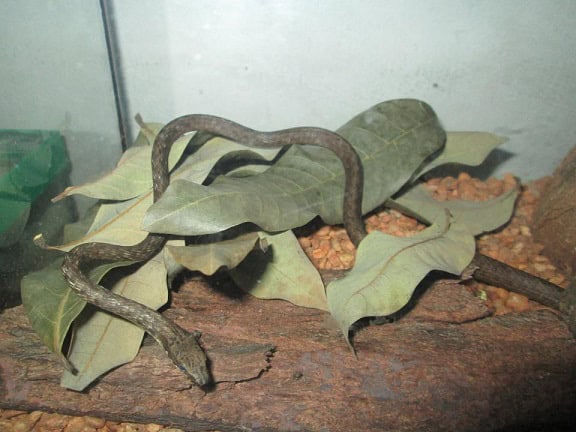
The red whipsnake belongs to the Dryophiops genus, which is far smaller than some. Unlike the Dendrelaphis bronzeback genus, which has 40 members across southeast Asia, Dryophiops only has two. The red whipsnake is the more common, but except for Palawan and a few small islands, the majority of the Philippines is controlled by the only other member: the Philippine whipsnake (Dryophiops philippina). This species is found on Luzon, including near the capital Manila, and has a fairly similar appearance. It’s dull brown in colour, often with a darkish head, and an extremely thin body.
Several strange observations have been made of this species, which could apply to its cousin as well, given the close relationship. Philippine whipsnakes are known to spread their chest scales to reveal bright colours underneath. They’ve been reported to sidewind, like the Saharan horned viper, and like the red whipsnake, they’re active both at day and night.
The two species have no area of overlap, occupying different islands. Worldwide, the Dryophiops genus is most closely related to the Ahaetulla vine snakes (20 members), which are either pure green or tree bark grey to blend with foliage. The red whipsnake looks dissimilar at first glance, and spends far more time on the ground than any Ahaetulla member.
Nevertheless, there’s a few secret similarities, such as the slightly horizontal pupil, elongated snout, and incredibly thin body width. The Asian vine snake is the most common Ahaetulla member in Thailand, and is also one of thinnest nationwide – both species made it onto our ultra-thin snakes list.