
| 1 | Jaeger’s ground snake |
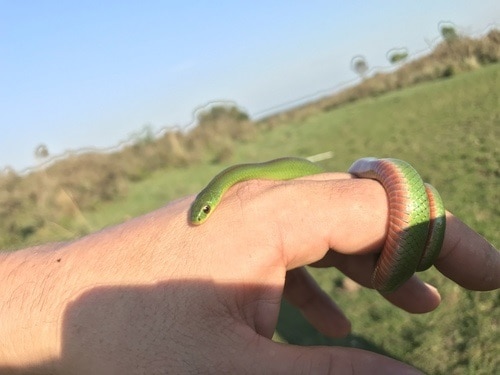
Maximum length: 55cm.
A small snake with vibrant colours, which is only slightly venomous. Jaeger’s ground snake belongs to the enormous Erythrolamprus genus (55 members), and inhabits the vast majority of Uruguay. It also inhabits northeast Argentina and far southern Brazil, and small portions of southern Paraguay.
Jaeger’s ground snakes are fast-moving and agile, but have no malice towards humans. They’re one of Uruguay’s harmless species, docile and inoffensive. This species is easy to recognise, with a clean, pastel green colour, contrasting against a juicy red vertebral stripe. There’s also a juicy red underside, which is separated from the green by a pale stripe. The only problem is spotting Jaeger’s ground snake in the first place, as its camouflage is excellent.
Jaeger’s ground snakes mainly inhabit grassland, usually sticking close to water sources, where they blend in perfectly. They can hunt underwater, and have aquatic adaptions such as a vestibule which prevents water from leaking into the nostrils. They also have nostrils angled higher on their head, to allow a submerged head just below the surface. Their diet consists of fish, frogs and arthropods, according to a 2016 study, with no mammals or reptiles detected.
Worldwide, this snake’s closest relative is the Almadan ground snake (Erythrolamprus almadensis), also found in Uruguay.
| 2 | Pampas lancehead |
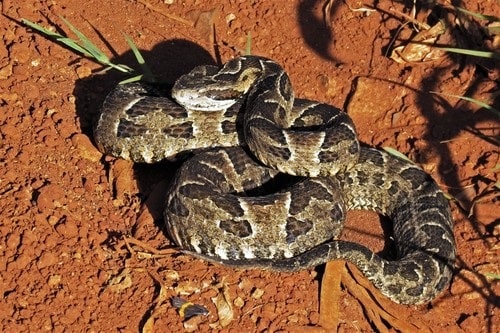
Maximum length: at least 120cm.
A common pitviper in Uruguay, which is as dangerously venomous as Jaeger’s ground snake is harmless. This cunning species is found across the entire eastern half of Uruguay, as well as far southern Brazil. Pampas lanceheads cope well with human modified areas, and regularly appear near country houses and in agricultural fields. Their venom is potentially lethal, but fairly normal for the Bothrops lancehead clan, causing haemorrhaging and necrosis rather than neurotoxicity.
Pampas lanceheads have a flexible diet, with a 2005 study finding a breakdown of 56.2% mammals, 21.2% frogs and toads, 7.5% lizards, and 7.5% fellow snakes. They not only launch savage attacks on humans, but can vibrate their tails against leaves to create a buzz like a rattlesnake, or even flatten their upper body to appear larger.
In certain regions, this species can be extremely common. In one survey, scientists studied 33 snake species just over the border in Brazil’s Serra do Sudeste region, and found that Pampas lanceheads were the most abundant by headcount, alongside the Patagonian racer.
Uruguay also plays host to the closely related crossed pitviper (Bothrops alternatus). The two have separated into different habitats: crossed pitvipers are more common in wide sweeping grassland, and shun forests. Pampas lanceheads, meanwhile, prefer forests or forests edges, particularly shaded areas with a covering of leaf litter.
Because of their patterns, Pampas lanceheads are attracted to areas with rapidly alternating shade and sunlight. Pampas lanceheads can eat large prey, as one was recorded eating a meal 62.7% of its own body weight.
| 3 | Patagonian racer |
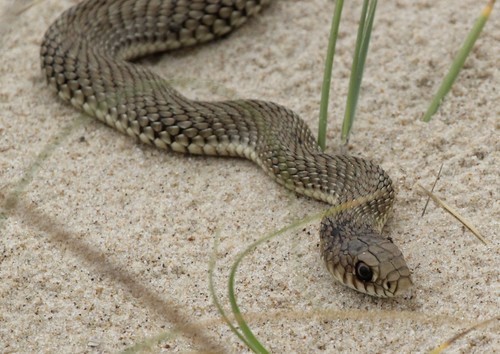
Maximum length: 150cm.
An extremely widespread species across southern South America. Patagonian racers also roam a huge chunk of Brazil, Paraguay, and Argentina. They’re one of the most southerly snakes in the world, and Uruguay lies right at the heart of their empire.
Rather than ambushers, Patagonian racers (Philodryas patagoniensis) are active explorers, with a permanent restless energy. They’re regularly spotted crossing dusty rural roads, and are decent tree climbers, although they mainly stick to the ground. Patagonian racers appear in forests and forest edges, but strongly prefer open habitats.
Their diet is varied as well. Patagonian racers are confirmed to eat fellow snakes such as burrowing night snakes, the yellow-bellied liophis and their cousin, Lichtenstein’s green racer. Amphibians and toads contributed 38.9% of their meals in a 2005 study, mammals 15.6%, and lizards 23.3%.
You’re very likely to spot this snake bounding up a dry hillside, searching eagerly for its next meal, and if so, there’s little to worry about. Patagonian racers have never caused a human fatality. They’re a minor danger in Uruguay, as bites can trigger swelling of the affected limb, painful redness, and occasionally dizziness. That said, they bite relatively commonly, as this study analysed 297 cases in Brazilian hospitals from 1959 to 2008. Watching the Patagonian racer is safe, but resist the urge to touch them.
| 4 | Amazon false coral snake |
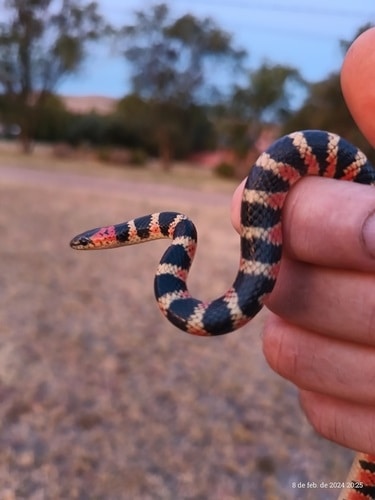
Maximum length: 120cm.
This harmless snake inhabits a large chunk of the local area, including northern Argentina and southern Brazil, but southern Uruguay has perhaps the highest density of sightings of anywhere. Amazon false coral snakes (Oxyrhopus rhombifer) have only a mild venom, and inhabit a mixture of forests and open savannah. They shun towns and urban areas, and consequently, there’s little chance of finding them in the capital Montevideo.
This snake occasionally has blood red eyes, and always has brightly colourful patterns, usually in alternating red-black bands. This is the most southerly member of the 15-strong Oxyrhopus genus, with the most northerly being the forest flame snake, found in southern Mexico.
Being a small species, Oxyrhopus rhombifer has a tough life. This snake is confirmed prey for the Pampas lancehead, as well as the burrowing owl, one of South America’s most snake-addicted birds. Its own diet consists of mammals and lizards, including Kemp’s grass mice and Paraguay mabuyas.
To compensate for their lack of venom, Amazon false coral snakes have endless defensive strategies. They can go immobile and fake death, raise a distracting tail, adopt a threatening S-shaped posture, and make sudden, erratic movements. They’re also the only Brazilian snake known to vibrate their entire body in self defence. Exactly what this achieves is unknown.
| 5 | Brazilian keelback |
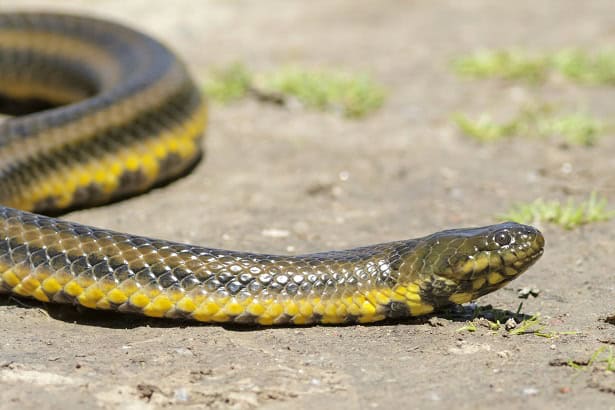
Maximum length: 100.5cm.
A common water-loving species of southeast Brazil, virtually all of Uruguay, and parts of northeast Argentina. Brazilian keelbacks (Helicops infrataeniatus) inhabit aquatic environments such as rivers and streams, co-existing with semi-aquatic creatures like herons, which view them as a tasty snack alongside fish.
Brazilian keelbacks lack a dangerous venom, and pose no threat to humans. In certain areas, this humble, non-lethal snake can be very common. The Brazilian keelback has the advantage of habitat flexibility, occupying a wide variety of water types. They can appear in flowing water bodies such as streams and rivers, and standing ones like lakes and ponds. While hunting, they can move along the water surface and depths alike.
This species isn’t massively researched, but we know plenty about its diet, thanks to a large study covering 278 individual Brazilian keelbacks. By stomach content, 60% of meals discovered inside their bodies were fish, and 40% amphibians. By individual meals, fish comprised 69.5% and amphibians 30.5%. Either way, there wasn’t a mammal in sight.
Many members of this species look almost like baby yellow anacondas, with their yellow-black tones, and it would be easy to mistake them in the wild. Brazilian keelbacks are mainly active by day, so keep an eye out for their yellow shades popping up from below the lake surface.
| 6 | Ocellated pampas snake |
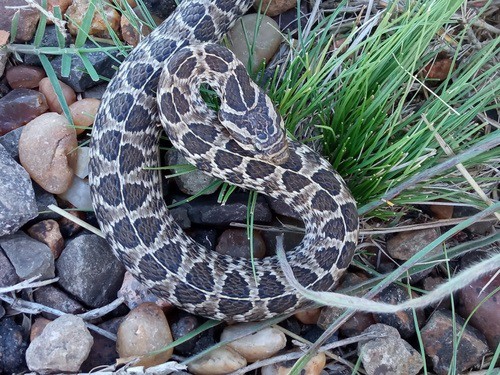
Maximum length: 52.1cm.
A species of the 3-member Tachymenis genus, also including the false tomodon snake of Argentina, which may be world’s 2nd most southerly snake. The ocellated pampas snake (Tachymenis ocellata) is instead centred around Uruguay, spilling into northeastern Argentina as well.
Very little is known about this species. It appears in more open areas, instead of claustrophobic Atlantic forests, and the only diet observations so far are of a meal of slugs dating back to 1972. Ocellated pampas snakes lay eggs as opposed to live young.
The ocellated pampas snake is mainly separated from its Tachymenis cousins by a thin bright stripe down its spine, which is always present (see above). Rather than bright red or green, they’re a consistent grey-brown, which may have evolved to mimic local pitvipers such as the Pampas lancehead.
Ocellated pampas snakes aren’t rare in the slightest, as sightings are plentiful across Uruguay. Despite this, few people have bothered to research them. The biggest question is their venom potency. This species could be a sleeping menace, as the third Tachymenis member, the Peruvian ground snake, has caused one recorded fatality.
| 7 | Dumeril’s diadem boa |
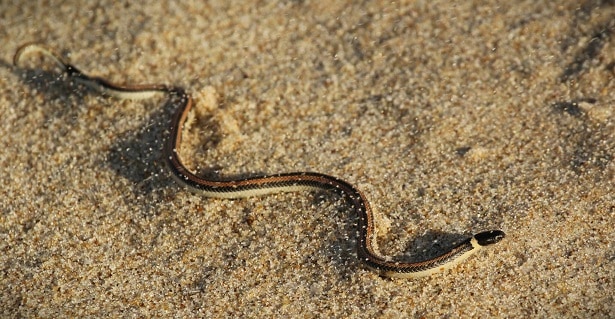
Maximum length: 68cm.
Uruguay and Argentina are a hotbed of obscure snakes which few in the West have heard of. Another is Dumeril’s diadem boa (Phalotris lemniscatus), part of the 15 member Phalotris genus, all of which are found in South America. This shy, burrowing species averages at 50cm, and isn’t actually a boa. A simple ID sign is a pale neck collar, followed by a very black head.
This species has flexible habitats, ranging from Araucaria forests to pampas grasslands. Dumeril’s diadem boa looks shy and harmless like many burrowing snakes, yet this snake holds a deadly secret. Bites are uncommon, yet several have produced surprisingly nasty effects.
In one case, a 13 year old boy experienced bleeding gums 12 hours after being bitten. A 61 year old woman experienced bloody urine, a headache and haemorrhaging. Finally, a 1978 report detailed a bite from a male juvenile Dumeril’s diadem boa. The patient experienced kidney failure, liver failure and worst of all, minor brain damage, almost dying.
Dumeril’s diadem boa might be one of the most underestimated venomous snakes of South America. Their diet, meanwhile, consists of elongated creatures, such as amphisbaenians, fellow snakes and earthworms. This species is yet another snake to be preyed upon by the South American serpent community’s worst nightmare: the burrowing owl.
| 8 | Keeled sepia snake |
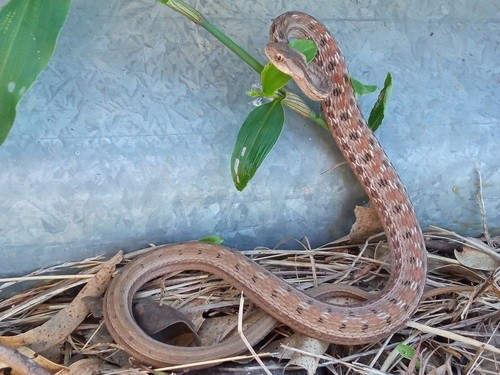
Maximum length: 69.7cm.
A nocturnal snake, which activates at around twilight to begin its search for amphibians. Keeled sepia snakes (Dryophylax hypoconia) are found throughout Uruguay, extreme northeast Argentina, and southeast Brazil.
This species is highly specialised in amphibians, with 97% of its prey consisting of frogs, and the remaining 3% lizards, according to a 2013 study. Consequently, this snake prefers damp and wet areas of Uruguay, rather than dusty plains.
Keeled sepia snakes aren’t fully aquatic, but are concentrated along the courses of large rivers and their tributaries, and in marshland. A rounded snout is a classic ID sign, but their pupils are trickier, appearing round in some photos and more vertical in others. This is a deceptive snake, as while they always appear brown from a distance, their patterns gain complexity up close.
Until 2022, keeled sepia snakes were placed in the Thamnodynastes genus, and many old studies are still listed under that name. This is a snake with no notoriety, and no fearful legends repeated in hushed tones, yet a 2021 report detailed a 27 year old female who was bitten on the left wrist. She experienced swelling of the hand and forearm, which began at 20 minutes post bite, and took 30 hours to begin to decrease.
| 9 | False mussurana |
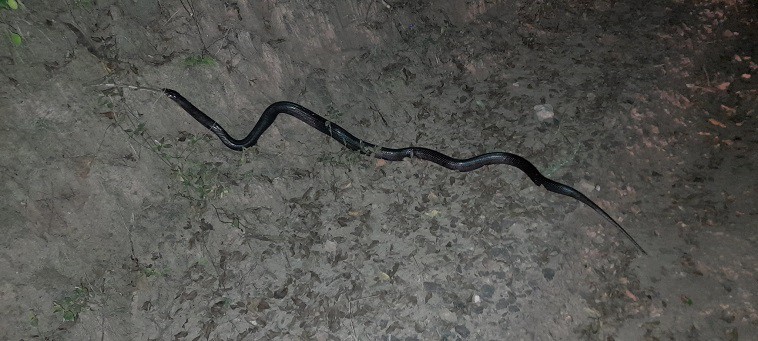
Maximum length: 180cm.
A heavily snake-eating snake, with flexible habitats and a potentially nasty venom. False mussuranas (Boiruna maculata) appear all over the place in Uruguay: moist forests, dry chaco and parched desert alike. They were originally discovered in 1896, and Uruguay was the original location. They also inhabit northern Argentina and a swathe of Paraguay.
False mussuranas have few discernible features from a distance, with a basic, patternless black back in adulthood. Their belly ranges from ivory to red, and they reach an adult length of up to 180cm, with an average hatchling size of 35cm.
The false mussurana is a multi-skilled hunter, combining powerful constriction with a nasty venom, which has yet to be fully researched. In 2021, a 50 year old man bitten on the first right finger experienced swelling from the fingers to upper arm. A small necrotic zone appeared around the bite. No antivenom was administered, because the scientists struggled to identify the species at first.
In a 2002 study, snakes comprised 33% of their diet, lizards 16.5% and mammals 12.5%. They have numerous confirmed snake prey, including forest flame snakes, Patagonian racers (also on this list), and the venomous crossed pitviper and South American rattlesnake.
One brown mussurana tried to hunt a Jaeger’s ground snake, but its prey was so thin that the mussurana couldn’t constrict it, forcing it to rely on its backup venom instead. Brown mussuranas are a moderately popular species in captivity overseas.
| 10 | Uruguayan coral snake |
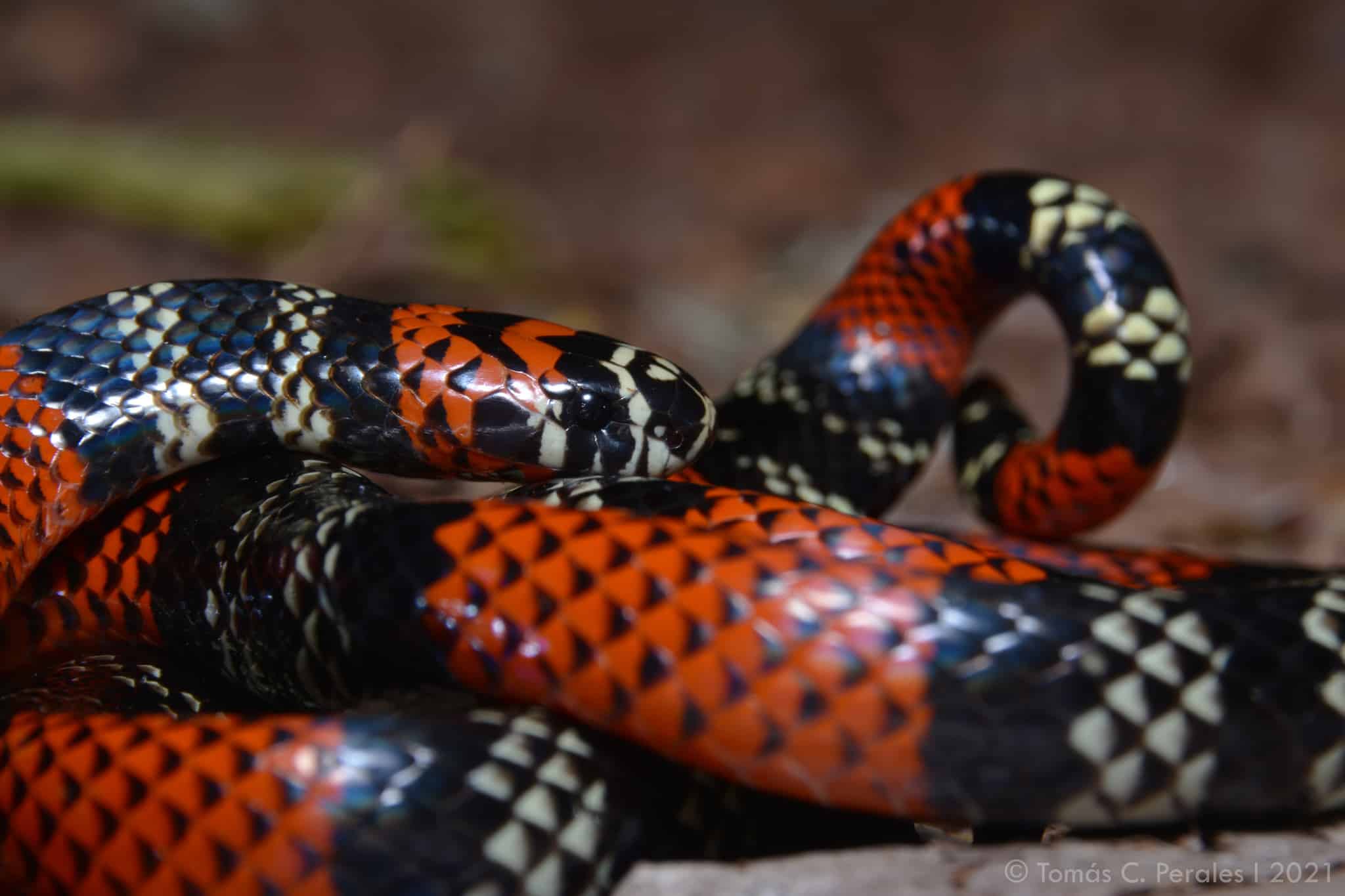
Maximum length: 120cm.
Perhaps the deadliest snake on Uruguayan soil. The Uruguayan coral snake (Micrurus altirostris) typically measures 80cm, and has a large territory in southern Brazil, Paraguay, and of course Uruguay itself. This species is most commonly found in Atlantic forests, plus roads and fields directly adjacent to forests.
This is Uruguay’s main coral snake, and while it causes far fewer bites than the Pampas lancehead or crossed pitviper, it contains far more neurotoxins, akin to a black mamba. It took until 2018 for a detailed bite report to finally be released, and the lethal power of Micrurus altirostris venom was plain for all to see.
The victim was a 25 year old man, bitten by a Uruguayan coral snake on the third finger of his left hand. First came abdominal pain and nausea, and after 5 hours, the man was hit with a wave of dizziness, blurred vision and double vision, which are all classic neurotoxic symptoms. Simultaneously, his finger only showed a slight swelling.
The man was moved to intensive care, where he rapidly progressed to full limb paralysis and respiratory failure. He was soon placed on mechanical ventilation with an intubator, so disabled was his breathing.
The man endured, and on day 4, he was released from artificial ventilation. He was discharged on day 7 with no lasting effects, except the memory of having gently brushed shoulders with death.
Remember the ID signs for this deadly species: larger red spaces, followed by 3 black bands and 2 white bands, before the red resumes. The red and white are often sprinkled with subtle black dots.
| 11 | Wide ground snake |
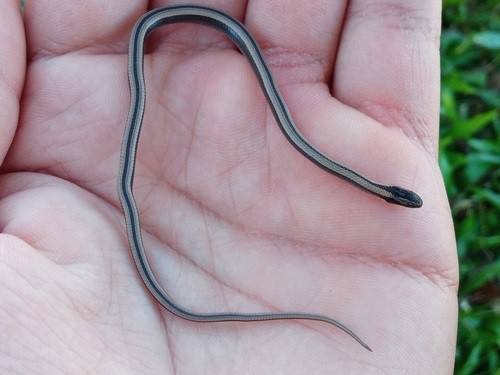
Maximum length: 50cm.
A member of the small Psomophis genus, which has 3 members worldwide. The wide ground snake is the most southerly, covering Uruguay and northeastern Argentina. The other members include…
Psomophis joberti – lives further northeast, in eastern Brazil.
Spirit diminutive snake (Psomophis genimaculatus) – found primarily in Bolivia, also Paraguay.
Barely anything is known about these 3 snakes. Wide ground snakes (Psomophis obtusus) appear mainly in wetter areas of Uruguay, and are not just short, but have a thin body too. They’re sometimes found in sand dunes within coastal restinga forests, and they’re one of the few South American snakes known to practise communal nesting, a rare social activity for snakes (which are mainly solitary). Their main prey is believed to be amphibians.
Physically, wide ground snakes have round pupils rather than vertical, and a bright pink belly, contrasting against a duller grey back. This is strangely similar to the slender smooth snake of Madagascar, and it’s possible that wide ground snakes startle predators by flipping over and revealing these bright colours.
Overall, research is almost non-existent for this Uruguayan snake, despite being them relatively common.