
| 1 | Constantly scaring scuba divers |
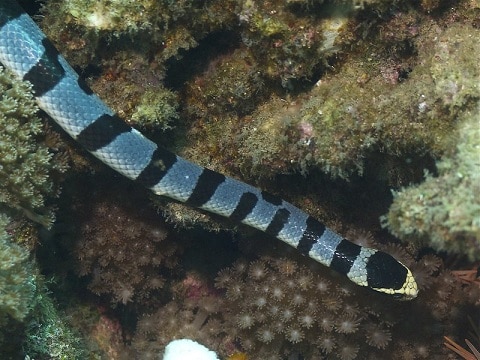
There are some sea snakes which only appear on remote coral reefs way offshore, like the rare leaf-scaled sea snake. Then there’s sea snakes which appear in glitzy coastal resorts in Thailand, rubbing shoulders with scuba divers every day, yet somehow never bite anybody. The species we’re talking about here is the banded sea krait (Laticauda semifasciata), a mostly black and white species which reaches a maximum length of 152.5cm.
Banded sea kraits are found along the coastlines of Thailand, Malaysia, Fiji and Australia, where they can be very common in certain areas. They’re mostly aquatic in nature, but less so than members of the Hydrophis (true sea snake) genus. They split their time between land and water, coming ashore to breed and digest food, where they gather in huge numbers on coastal rocks. Consequently, this species tends to hug coastlines rather than swim around the open ocean.
Banded sea kraits are deadly venomous, loaded with powerful neurotoxins, yet many of the busiest, most picturesque Thai resorts are full of them (e.g. Phuket). Tour guides are often forced to explain that this species rarely bites humans, even when a few metres away.
Many a Thai tourist has been swimming peacefully underwater, exploring rock formations, then almost had a heart attack after spotting a black and white sea krait staring at them inquisitively. There’s no reason why this couldn’t happen to you.
| 2 | Deadly, but mostly peaceful |
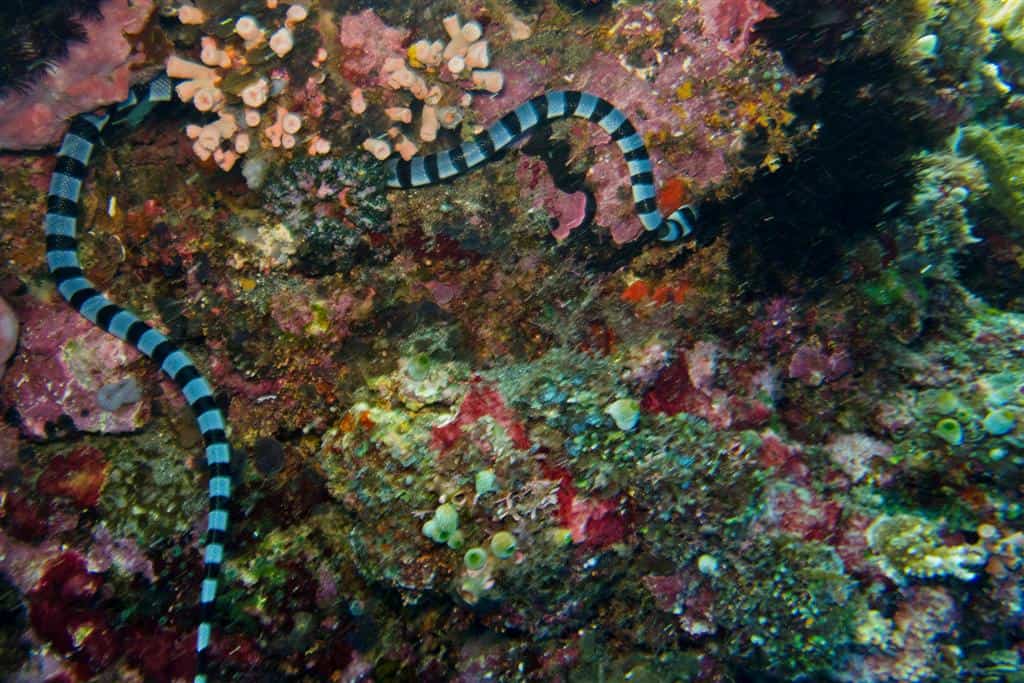
Worldwide, there’s around 70 sea snakes, and the banded sea krait is one of the most commonly observed in human areas. Fishermen meet the banded sea krait particularly regularly, as they often get scooped up in their fishing nets. They’re even notorious for appearing in the exhaust pipes of boats. Some believe that banded sea kraits are lured into glitzy coastal resorts at night by the shining bright lights of hotels.
None of this is dangerous in any way, assuming that you don’t touch them. There are many reports of banded sea kraits slithering onto moving boats, and sitting next to the occupants peacefully while they continue to fish. Nevertheless, physical contact is the stimulus which causes their personality to flip, so always be careful.
Like other sea snakes, banded sea kraits are optimised for ocean activities, particularly their tail. This is unusually wide, and designed to function as a paddle, which they move from side to side to aid swimming. Their head is the opposite of a pitviper’s bulky skull: narrow and barely larger than the neck. The goal here is to help them probe into shadowy eel lairs, but also to reduce drag while swimming underwater.
| 3 | Venom breakdown |
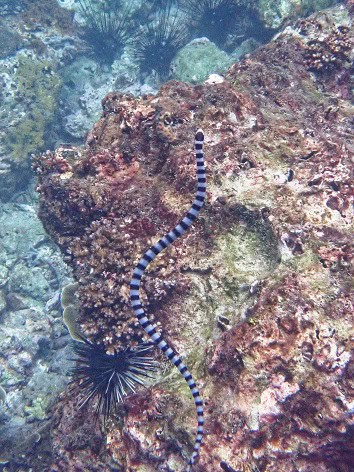
The LD50 rating of banded sea krait venom is 0.4mg, significantly deadlier than the king cobra at 0.9mg. Deaths do happen occasionally, such as a 23 year old man in October 2018. This man was sailing a fish trawling boat about 5 hours off the north coast of Australia, when he was bitten by a banded sea krait that had become tangled in his fishing net. The man ultimately died before the emergency services could arrive.
Mostly though, this snake coexists peacefully with humans, in the sunny coastal paradises it calls home. One old myth among divers is that banded sea kraits have such tiny mouths that they can only successfully bite the earlobes or between your fingers.
This is untrue, but they do have tiny fangs, which are incapable of biting through scuba diving wetsuits. They rarely show aggression towards humans anyway, as they have no predators which look like us (except for any undiscovered underwater sea apes).
| 4 | Occasionally found in New Zealand |
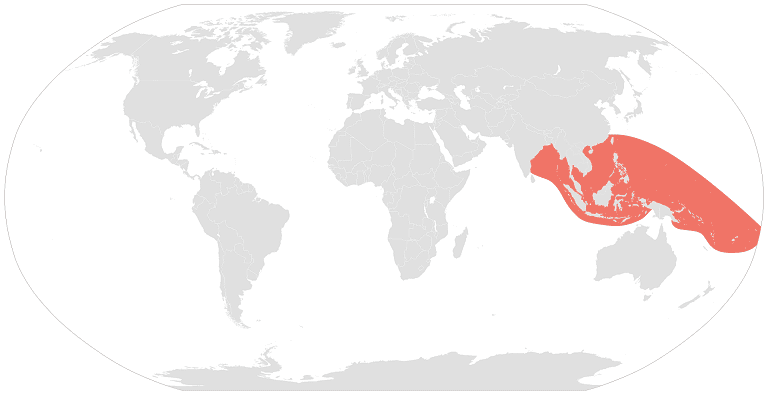
New Zealand is a rare country not to have any native snake species, neither on the North or South Island. But every so often, a banded sea krait will go haywire and travel south on a rogue mission, ending up well inside New Zealand territorial waters. 6 of these lone snakes were found near the North Island from 1880 to 2005, suspected to have strayed from Fiji or Tonga. That’s only the ones scientists noticed, and with thousands of miles of ocean, there’s bound to have been thousands more.
The majority were found off the northeast coast, between the Bay of Islands and East Cape, but one strayed as far south as Castlepoint near Wairapa, a scenic spot with limestone cliffs and a smooth white lighthouse. Another appeared at Whangaruru Harbour in the far northeast in January 1990.
The snakes hadn’t suffered from their journey, as all washed up alive. Being hard to spot, it’s possible that Laticauda colubrina has a secret colony in New Zealand that few know about. At the very least, it could have a secret colony on the southeast coast of Australia. It’s officially the most commonly spotted snake in New Zealand, beating the yellow-bellied sea snake.
| 5 | Preys heavily on eels |
Banded sea kraits eat fish occasionally, but over many millions of years, they’ve backed themselves into the niche of eating almost entirely eels. For example, a study on Makaluva Island, Fiji gathered 50 banded sea kraits and found that 16 contained eel remains while the other 34 contained no recognisable remains. Specific species they’re known to hunt include Conger cinereus, Gymnothorax bayeri, and Gymnothorax buroensis.
Because females are so much bigger than males, the two hunt differently. Females prowl deeper, shadowy waters and eat large conga eels, normally just one at a time. Males will eat many small eels at once, normally in the Moray eel family, and prowl shallower waters.
Their hunting strategy doesn’t rely much on relentless pursuit. Instead, they poke their heads into narrow crevices in rocks, the classic underwater canyons where bright eel eyes lurk. The problem is that this leaves their tails vulnerable to hungry sea eagles or tiger sharks. So the species has evolved a solution: a tail that mimics the head. The colour scheme is identical, and instead of thinning to a point, the tail suddenly widens again. The predators are well aware of the snake’s venomous fangs and this deception encourages them to stay away.
| 6 | But the eels are fighting back |
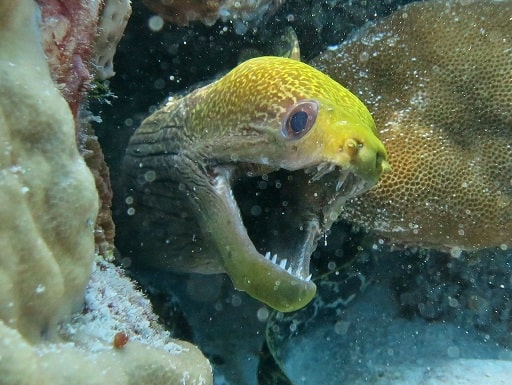
In America, the garter snake has gained a resistance to tetrodotoxins found in newts, its main food source, and certain newt populations have increased their toxins further in response. Something similar is happening with banded sea kraits, but with their prey.
In a study from 1995, scientists injected 75 mg/kg of the species’ venom into two eels from the same southwest Pacific region: the liver-coloured moray eel (Gymnothorax hepaticus) and the undulated moray eel (Gymnothorax undulatus). The only symptom they showed was increased ventilation rate, higher intake of water through their gills, the equivalent of someone gasping for air. Tellingly, the eels had no resistance to venom from the olive sea snake, which lives nearby but doesn’t eat eels.
2 years later, the reverse happened when venom from banded sea kraits was injected into an eel they never naturally encounter, the spotted moray eel of the Caribbean. At doses of 0.01mg, the ventilation rate increased. At doses of 0.1mg, the ventilation rate increased, they flopped over, they began convulsing and they automatically died. They had no resistance to the venom whatsoever. The studies proved that the banded sea krait is forcing the nearby eels to adapt, in an evolutionary arms race. That the banded sea krait still succeeds is down to its nimbleness in thrusting its head into rock crevices.
| 7 | Taller than they are wide |
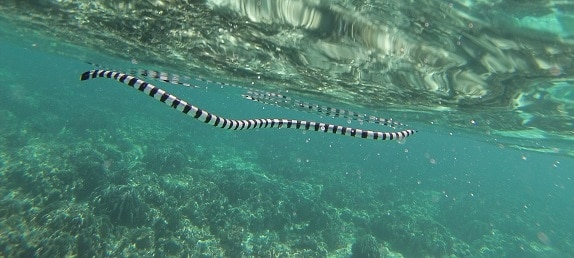
Banded sea kraits hold the honour of being taller than they are wide. They’re an average length snake, but females are massively larger than males, at an average of 142cm compared to 85cm.
Banded sea kraits have fairly smooth scales, which overlap very slightly. Each snake has 22-64 stripes on its body, which are evenly spaced. The black stripes are consistently dark, but the inbetween sections can vary from white, to yellow, to white with a slight bluish hue. Each stripe curves interrupted around the body except for the belly, which is a consistent white/pale yellow colour.
The main lookalike of this species is the similarly black and white Chinese sea krait, which is eaten in soup by the Japanese. However, our snake today has a large creamy yellow patch above its mouth, which is why another common name is the yellow-lipped sea snake. Chinese sea kraits also tend to have larger black stripes and smaller pale areas.
| 8 | Tanah Lot temple, Bali |
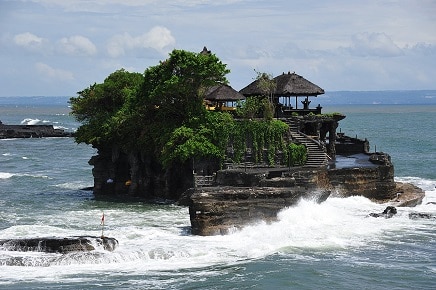
Yet another spot where humans live peacefully alongside this deadly snake is Tanah Lot temple in Indonesia. This is one of 7 sea temples (pura segara) off the coast of Bali, believed to form a chain of spiritual protection around the island, and dates back to the 16th century.
From a distance the small island resembles a stone ship, and at low tide it’s possible to talk across by foot. Each year the temple attracts masses of Hindu pilgrims, but most importantly, the rock is surrounded by caves, carved out by the relentless forces of coastal erosion. Inside these caves you can find masses of banded sea kraits, which are considered to be spiritual guardians of the temple above. The monks will handle these “holy snakes” with no qualms, to the shock of tourists.
Only Balinese Hindus are permitted to enter the temple’s most inner sanctum, but any tourist can travel to these sandy caves and be blessed by one of the resident snakes. The monks would argue that their spiritual connections prevent them from being bitten, but it’s really down to their vast amount of snake handling knowledge, which equals any herpetologist for this species.
| 9 | The legendary giant version |
The true origin of Tanah Lot has long since passed into legend. The protagonist was said to have been an all powerful priest called Dang Hyang Nirartha, who spotted the rock and recognised in it such immense beauty that it was surely a holy spot. He decided then and there to found a temple, but here’s where variations appear. Version 1 states that Niratha threw his sash into the water and transformed it into a colossal serpent using his magic. This snake was tasked with keeping a watchful eye on the new Tanah Lot temple.
The second version, meanwhile, states that the giant, this time evil serpent already lived there. As Nirartha vowed to build his temple and began walking forward, the colossal snake ambushed him in a rage. A battle for the ages ensued. Nirartha emerged as the victor, but rather than killing the serpent, he allowed it to continue living at Tanah Lot, with one condition: that the serpent would guard the new temple for eternity.
This serpent is believed to lie dormant deep within Tanah Lot today, in a slumber. One thing for certain is that endless banded sea kraits in the caves below are said to be its servants.
| 10 | Digests its meals on land |
Banded sea kraits are much more land-dwelling than the average sea snake, with estimates ranging from 25% to 50% of total hours. As well as breeding, banded sea kraits always return to dry land in order to digest meals, and lay eggs. They can sometimes climb to altitudes of 40 metres on the rocky outcrops they inhabit, and they’re even able to climb trees.
Not everything is perfect however. The paddle-like tail gets in the way, and on land they’re normally 20% slower than when swimming in the sea.
The banded sea krait’s main habitat in the sea is shallow reefs including coral reefs. However, they also like coastal mangrove zones. They sometimes plunge to depths of 60 metres, and have an amazing sense of direction. In one study, a bunch of banded sea kraits were transported to islands 5.3km miles away. All eventually migrated back to the rocky islet where they started, taking an average of 30.7 days, seeking out their cosy, familiar homes like a homing beacon.
| 11 | Seduction techniques |
A male banded sea krait starts its seduction schemes when it swims around the coastline, trying to identify the precise point where a female exited. When its seduction senses start tingling, the snake will find the female and lie on top of its body, doing nothing except giving off a sharp twitch every so often. This is designed to spark the female into life, making her receptive to mating attempts. Stage 3 involves the mating itself, but sometimes, male snakes will wait nearby while other males do the “activation” work, before leaping in opportunistically and taking the spoils.
Banded sea kraits are a species to create a breeding ball for real, unlike the cottonmouth where they’re constantly rumoured to in old Louisiana folk stories. 2-9 males can attempt to breed with a banded sea krait female at once. For some reason, their eggs are incredibly hard to find. They’re laid in crevices on land, but only 2 batches have ever been discovered in the entire history of observing the species.
It’s said that a banded sea krait breeding ball can be motionless for days, just lying on the exposed rocky outcrops. 3-10 eggs is the norm for this species, and hatchlings are near identical in colour to adults, sticking to black and white stripes. Males have a particular taste in females: the larger the better. This is because larger ones almost always produce more babies.