
| 1 | A Chinese village snake |
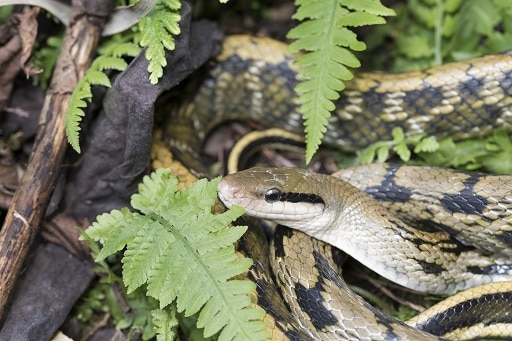
The beauty ratsnake (Elaphe taeniura) is a non-venomous constrictor which ranks as one of the most common snakes in southern China. It’s a species not of dark jungles, but idyllic rural spots, including peaceful villages, farmland, and spacious woodlands. Rather than rare, this is a species which ordinary Chinese people encounter constantly on a day to day basis, and are so familiar with that they don’t even think about it anymore.
Beauty ratsnakes are super widespread in southeast Asia, yet few Westerners have even heard of them, except a few thousand Belgian people near a railway track where they’ve become an invasive species. To the north, beauty ratsnakes reach as far as chilly Beijing. Outside of China, they’re common in Thailand, Vietnam and Malaysia, and just spread to northeastern India. They also have strong colonies on Hong Kong and Taiwan.
Beauty ratsnakes are incapable of killing, but have an aggressive personality, snapping and biting if cornered in any way. Many Chinese people fear this species, but others love them, as a ratsnake crossing the threshold of the home is widely believed to be the spirit of an ancestor visiting, and therefore a great gift.
Beauty ratsnakes are agile, and have immense climbing abilities, which they use to ascend trees and also cave walls. In fact, this species is somewhat notorious in China for getting stuck on roofs, perhaps even landing on peoples’ heads when they attempt to descend.
| 2 | Named for its elegant patterns |
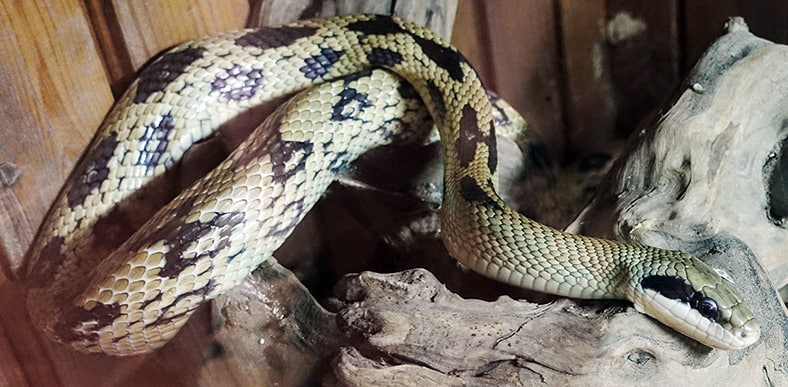
Beauty ratsnakes are very distinctive – hence their “beautiful” name. Their scales are a mixture of yellow, olive-green and black, all of which contrast sharply, but always in an elegant manner like a sculpture or an ornament.
One of the more consistent ID signs is a black facial marking, which starts behind each eye, and carries on backwards. This contrasts sharply against the beige or even yellow colours underneath.
Except for this black marking, beauty ratsnakes have a uniform-coloured neck area. The distinctive alternating patterns only kick in once the torso arrives (as you can see above). Rather than the standard zigzags or stripes, these take the form of a complex mosaic pattern, like a painting.
Beauty ratsnakes regularly reach 2.5 metres. One of the longest was supposedly a 2.8 metre pet owned by two Netherlands girls, from Den Haag. This author also claimed to have seen a 3 metre female owned by a German breeder, who he bought hatchlings from. As for things you can’t deduce from a photo, beauty ratsnakes have very smooth scales to touch.
| 3 | A home invader |
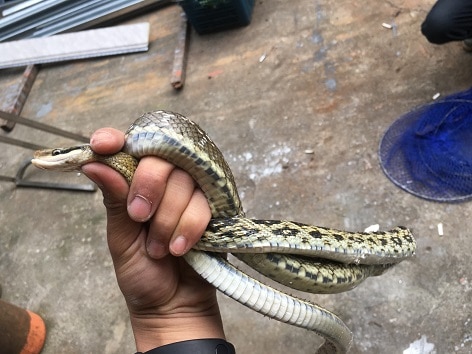
Beauty ratsnakes are not just common in villages, but are notorious for taking up residence in people’s houses. In 2017, for example, a Chinese man persuaded his neighbours to remove a ratsnake that had been living in his house for 5 years, to the man’s evergrowing despair. They dropped it in the countryside, but 1 month later, the beauty ratsnake had slithered all the way back to the man’s house, using its innate serpent homing instincts. The man finally summoned a group of expert reptile handlers, who dropped it far away.
Because of this close contact, beauty ratsnakes are hunted en masse by Chinese people, for medicine and food alike. They’re used in snake soups regularly, and their skins are particularly coveted for making handbags. Their other colloquial names in China include the cauliflower snake and black-browed brocade snake.
Beauty ratsnakes are not only vibrant, but their colours don’t fade at all as they age. In fact, the existing patterns “blow up” and become more detailed, like zooming in on an HD image.
| 4 | Eats 200 rats per year? |
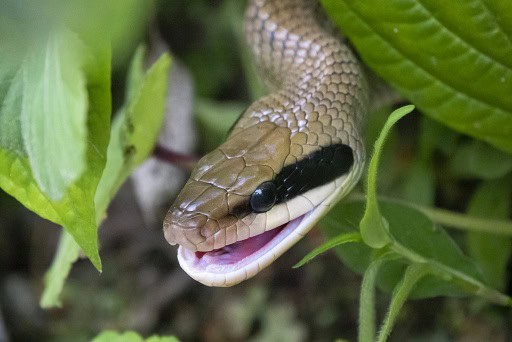
One reason why beauty ratsnakes invade barns and farmhouses so much is the rodents living inside them. As their name suggests, this species loves to eat rats, and mice are also on the menu.
According to the wildest reports, this species eats 260 mice per year, and 150-200 rats. A single meal for a beauty ratsnake can include 3-5 mice. Their climbing skills come in use with hunting, as beauty ratsnakes don’t require fissured tree bark in order to climb. They can easily travel up a vertical brick wall, and one of their motivations is grabbing the mice lurking in roofs.
In captivity as well, beauty ratsnakes can wolf down mice with aplomb; there’s no trickiness about selecting their diet. Hatchlings happily dine on hairless frozen pinkie mice. In captivity, beauty ratsnakes eat every 5-6 days, and it’s probably identical in the wild.
Smarter Chinese farmers are well aware of their powers against crop-nibbling pests, and keep them around. With no venom and no danger, farmer and snake can share a comfortable, idyllic life together. Rumour states that the local mice will be too frightened to appear at all if a beauty ratsnake is in the area (which might be false, seeing as they manage to eat hundreds).
| 5 | Infamous for climbing roofs |
Beauty ratsnakes are active hunters, seeking out their meals purposefully rather than lazing around in a bush and hoping for the best. In areas where mice are abundant, they can be on the prowl constantly, moving from place to place, like an all you can eat buffet dazzling them from all sides.
The beauty ratsnake’s hunting process always starts the same way – with a rapid lunge and bite. Their speed when striking is supposedly like an arrow from the string. They then wrap their entire body around the prey, without releasing the initial bite grip.
Rather than injecting venom, the beauty ratsnake is a constrictor, and a good one as well. As it squeezes a mouse to cut off the oxygen supply to its brain, the force can be so hard that the mouse’s eyes and nose start bleeding. If a mouse manages to escape, then the beauty ratsnake will never frantically try to recoil its body around it. They’ll always start the process again with a fresh bite.
From start to finish, a beauty ratsnake can swallow an average 50 gram mouse in 3-5 minutes. But bulkier rats can take up to 40 minutes to get down their gullet.
| 6 | 9 confirmed subspecies |
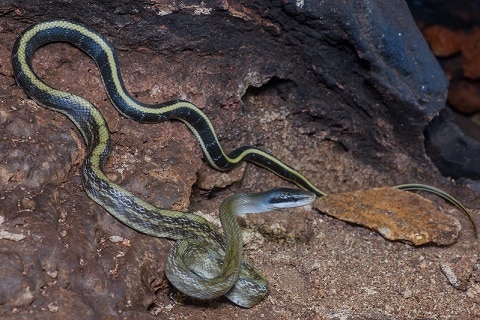
One interesting fact about the beauty ratsnake is the large amount of subspecies they have. All have the signature black line behind the eye, but different patterns otherwise. So far we’ve discussed the main Chinese subspecies (elpahe taeniura taeniura). The others include…
Elaphe t. mocquardi
Location: south-east China forests and Vietnam. Characteristics: far thicker and more connected black markings. Slightly shorter at 150-170cm.
Elaphe t. friesi
Location: Taiwan. Characteristics: the longest subspecies at 200-270cm. Has neat, circular black spots on back of head.
Elaphe t. yunnanensis
Location: India, Laos, Myanmar, eastern Thailand and Vietnam. Characteristics: a red tongue versus blue-black for most subspecies. More x-shaped patterns. 140-160cm.
Elaphe t. grabowski
Location: Malaysia. Characteristics: very obvious, this version is rich blue. 180cm in length with a red wine tongue.
Elaphe t. callicyanous
Location: Guangzi (southern China), Cambodia, Thailand, Vietnam. Characteristics: paler blue, with detailed patterns, and long at 250cm.
Elaphe t. helfenbergeri
Location: Thailand, Myanmar. Characteristics: yellow stripes that alternative sharply with black, but upper body blends together more. 200cm. Blue-black tongue. See image above.
Elaphe t. schmackeri
Location: the Japanese version. Characteristics: probably the dullest colours, with orange-brown and black alternating. 200cm.
See this article for images of the subspecies.
| 7 | Ridley’s cave racer |
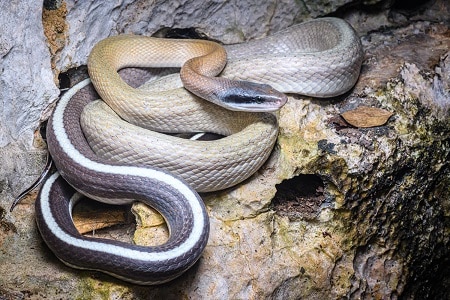
The 9th, and weirdest subspecies has a totally different name, despite belonging to the beauty ratsnake collective. It’s known as Ridley’s cave racer (Elaphe taeniura ridleyi), because that’s where it lives for most of its life.
All beauty ratsnakes have the power to live in caves, but Ridley’s cave racer has sequestered itself ever further into its cold damp caverns. It uses the species’ immense climbing skills to slither up the cold rocky walls, and can be active at any time of the day, with the darkness of the deep passages muffling the day-night cycle.
Ridley’s cave racer has an unusually high amount of bats in its diet. It waits on walls, or by cave entrances, hoping for a flock of bats to fly out like a horror film. It will wait with its lower body on the wall and its stiff upper body hovering in thin air, still as a statue, with its mouth wide open. At the opportune moment, it will pounce on the bats flying past in their dozens. Once it catches the bat, it uses the same constriction method as normal.
| 8 | Stronghold: Gua Wang Burma |
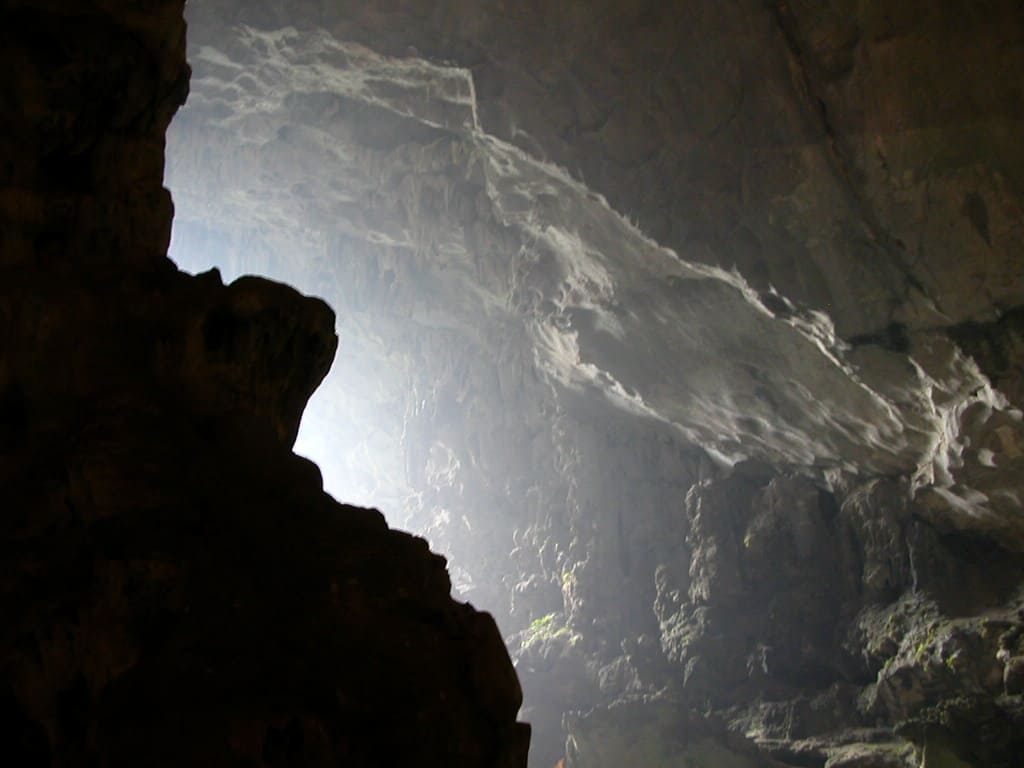
Ridley’s cave racer also has most unusual appearance, lacking any patterns except even black stripes on its lower body (and the eye line), and having pale, clammy looking scales. It’s another rare one to have a red tongue. It’s native to Thailand and Malaysia, and can spend all its life in caves. They can lurk deep in the caverns; this study found one 150 metres in, wrapped snugly around a stalactite three meters above ground, while another was 7 meters deep (the point was that both were found in entirely new caves).
One of its strongholds is Gua Wang Burma cave. This cave is notoriously ecologically rich and lies below a mountain on the Thai/Malaysian border, in the forested Perlis State Park. It’s actually possible for tourists to enter one cave entrance in Malaysia and exit another in Thailand. Some tourists are lucky enough to see Ridley’s cave racer on the walls, looking as pale as moonlight, or simply the shed skins lying around.
There are two sections: Gua Wang Number 1, a mostly open cave passage, and Gua Wang number 2, filled with tight crawl spaces and treacherous walkways. The cave racer isn’t alone, as in 2014, an entirely new snake species was discovered, a tiny shy cave snake dubbed the Gua Wang Burma wolf snake (or Lycodon cavernicolus).
| 9 | Non-venomous yet vicious |
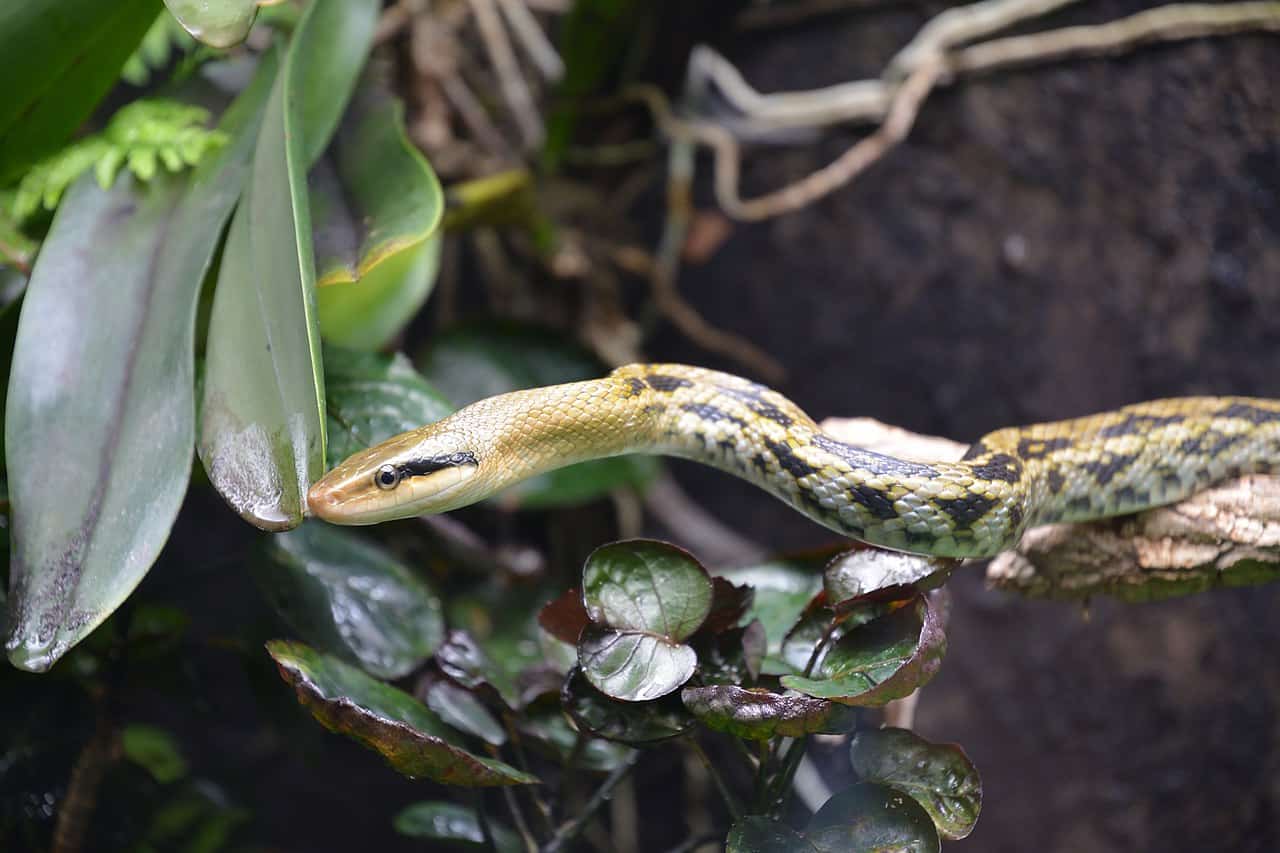
Back to China now, and beauty ratsnakes mostly hunt during the day. They have a favourite temperature range to hunt in: 24-31 degrees C. Of course, these are conditions which most humans like, and it means that encounters are common. They have populations in cities as well, where they’re commonly seen on roads.
Beauty ratsnakes are far from shy. They won’t instantly flee at the sight of a 5ft 10 potential predator overhead. In fact, they can produce an aggressive display, with an s-shaped coil from which they straighten out their chest and raise their bodies 20-30cm into the air, while opening their mouths wide. Beauty ratsnakes lack any venom, but they have a bite which they don’t hesitate to use.
Their speed when striking people matches their speed when grabbing mice. The bite is reportedly no more painful than a needle, but it’s better to be safe than sorry. Beauty rat snakes are maniacs – they have no venom, but either don’t realise that they have no chance of defeating a 160 pound great ape or just don’t care. Maybe the aggression is an evolutionary leftover which forget to die off alongside the venom.
| 10 | Tricky as a pet |
Newborn beauty ratsnakes are also aggressive in their first days, before slowly calming down, particularly when handled regularly to reassure them. But beauty ratsnakes captured from the wild may never calm down. They might keep a twitchy, aggressive demeanour for years. It doesn’t help that beauty ratsnakes are a strong snake as well.
You can deduce a beauty ratsnake’s mood by its tongue movements. When flustered, it will arch its tongue upwards and downwards, from the top of its head to below its chin, moving between the two slowly and deliberately.
Their egg total is medium, at 5-20. Mother beauty ratsnakes defend their eggs, sticking by them for the full 70 days pre hatching and only venturing away to hunt. Unusually, the shells are so thick and leathery that some beauty ratsnake babies have trouble escaping. Breeders have reported finding dead yet fully formed babies inside the shells. The eggs are a white colour, and measure 3 by 5cm on average.
| 11 | Invasive in Belgium |
Officially, Belgium only has three native snakes, and they’re identical to Britain: the grass snake, adder and smooth snake. But the beauty ratsnake has changed all that, as they’re now listed as an invasive species, thanks to imported pets escaping. There’s a stretch of railway in Flanders which is overrun with this species, with 21 being caught in the first 8 months of 2021, and the first reports dating back to 2006. The train operator Infrabel was forced to reassure people that they weren’t a threat to personnel.
The beauty ratsnakes are lurking in cable trenches or in the bed of the railway itself. They love the railways in particular because they retain heat so well, and ecologists are taking advantage of this to remove them, by placing black rubber mats in sunny spots to lure them in. Their next fate was to be transported to a snake centre in West Flanders and sterilised.
As of 2022 this invasion is still going on. It’s hard to tell what’s happening. The core of the snake sightings are happening in a 2km zone (the railway), but the total sightings in Belgium are distributed over 200km.