
| 1 | Location: southwest Africa |
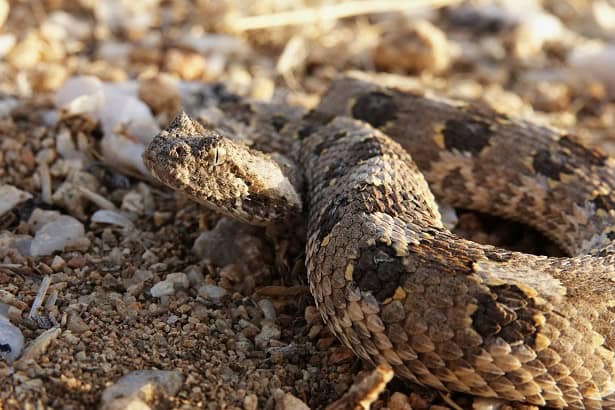
The horned adder (Bitis caudalis) is a venomous viper species found only in southern Africa, which belongs to the 18-member Bitis genus, all of which are native to Africa. While not as common as the all-powerful puff adder (Bitis arietans), this is a fairly widespread species, appearing in Namibia, Botswana, southern Zimbabwe, southwest Angola, and over 50% of South Africa, particularly the western half.
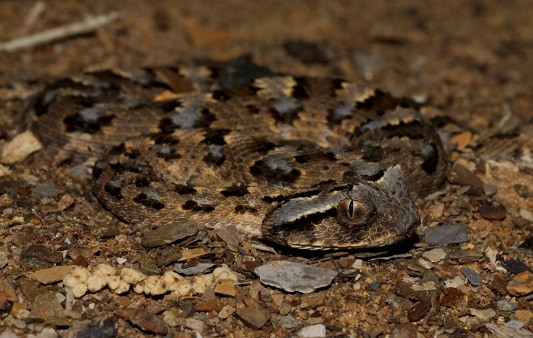
Should you be wandering around the deserts of Namibia and come across a random snake, there’s no way you could fail to identify this species. This is a snake which delivers on all of its promises, as the horned adder features a single sharp, vertically-oriented horn above each eye. These horns are found in virtually all species members, rather than just 50% or 60%. Each horn consists of a single enlarged scale, and is clearly visible from a distance.
The exact purpose of these horns is unknown, although it may relate to hunting. Horned adders often bury themselves in soft sand, by wriggling or thrashing their bodies around. Eventually, just their upper head, eyes and horns are left poking out. It’s possible that their horns function as lures for prey, tricking them into thinking a tasty meal is nearby, before a hungry viper springs out and devours them.
Another possibility is that the horns shade their eyes against the sun, similarly to the sidewinder rattlesnake of the USA. Either way, the horned adder is a difficult species to misidentify in its southern African heartlands.
| 2 | A snake of parched, dry lands |
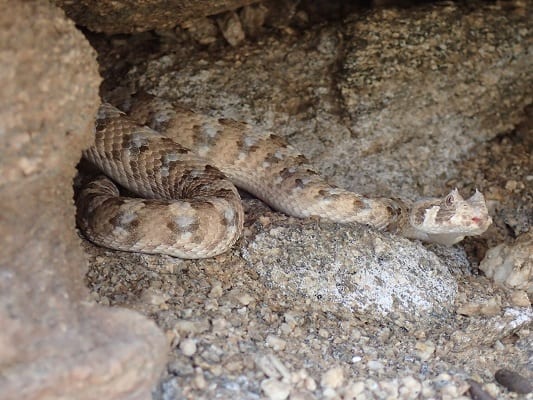
Horned adders are found only in dry areas, including arid savannah, sandy scrubland, and the edges of semi-deserts. They never appear in urban areas, forests and woodlands, and even grassland is an extreme rarity. They love bone dry spots, such as desolate, dusty canyons, with a only a few strands of vegetation trying desperately to survive.
Horned adders can even be found on the sand dunes of Namibia, sharing space with Peringuey’s adder, their close relative. While less adapted to deserts than Peringuey’s adder, they have the same ability to sidewind, minimising contact with the burning desert floor.
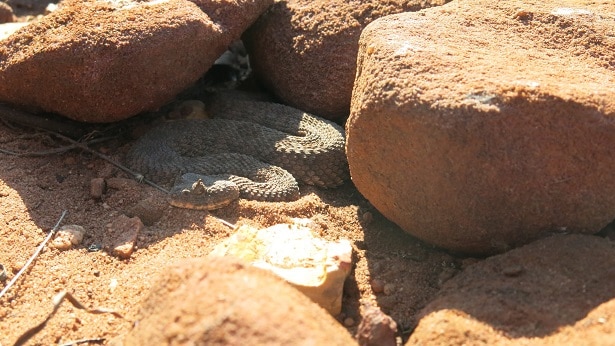
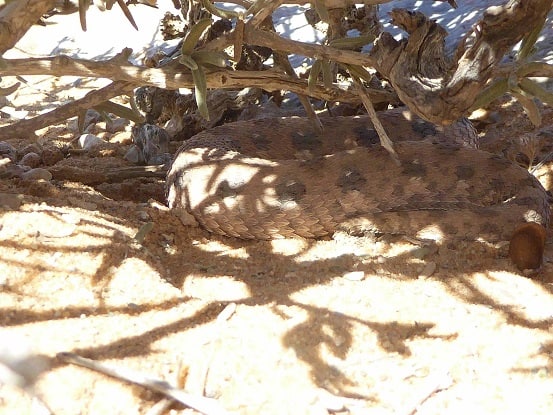
Horned adders are found in dry shrubby areas occasionally, but never in regions of high rainfall. Like all Bitis members, this is a heavily nocturnal species. By day, horned adders disguise themselves amidst dry rocks, or wait patiently in dark mammal burrows.
| 3 | Horned adder highways |
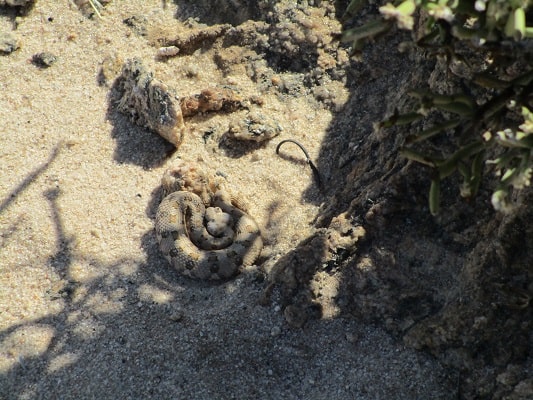
Rather than rare, the horned adder can be a common species in the areas where it lives. One study covered a highway in the Kalahari desert of southwest Botswana, gathering 189 snakes. Of those, an overwhelming 134 were horned adders. This snake can be an abundant local creature like a squirrel or rabbit, except a lot less cuddly. In other areas, the opposite can be true, as the horned adder mysterious disappears.
This species coexists with a close relative in western South Africa – the many-horned adder (Bitis cornuta). The two species are easy to tell apart, as the latter has jagged, multipronged horns, spiraling in multiple directions. The horned adder’s horns are much simpler, with a single, straighter horn sprouting from just above each eye.
Other members in South Africa include the puff adder, which is much larger (up to 191cm) and has no horns at all. The red adder (Bitis rubida) is a similarly small size, but also has no horns, and tends to appear in moister high altitude areas, making it very unlikely to appear in the same locations.
| 4 | Changes colour based on soil type |
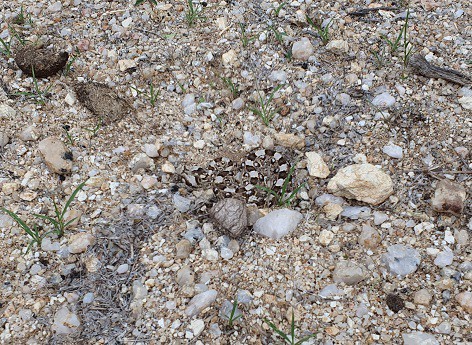
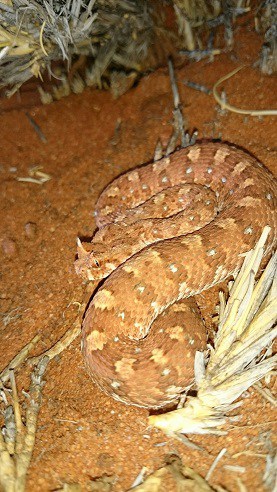
One secret of the horned adder which may lead to great confusion is its massively variable colour scheme, which correlates with certain soil types. Its patterns are mostly consistent, with sloppy squares arranged like a ladder, with dark contrasting sharply against light. But the precise colours vary wildly. The stone grey pictured above is typical, but in the reddish canyons of western South Africa, the local horned adders are brick red as well.
Then there’s everything imaginable inbetween. Some horned adders have bright gold markings. A royal sect is blessed with a fully gold body, to blend with the sands of southern Namibia. Beige or grey are the most common colours overall.
Regardless of colour, horned adders are always adorned with complex blotches – you won’t find a clean yellow one, for example. The thick blotches often have glowing edges in the greyer snakes.
Amid this variability, one feature stays consistent: a pearly white belly. Bitis caudalis has a red tongue with a black tip, and like all vipers, its pupils are savage vertical slits. This species has a bulky triangular head when viewed from above, and its scales are keeled (rough) to touch.
| 5 | A pocket-sized viper |
Apart from its horns, Bitis caudalis is also pocket sized. This is a tiny viper which you could easily walk past on an open dusty plain without noticing anything. Females are longer, and the largest ever recorded measured 60.0cm. This was a Namibian female which had spent 6 years in captivity, and the largest purely wild female reached just 52.3cm. In all records of this species, only one male has ever exceeded 40cm, a 40.8cm individual found in Luderitz, coastal Namibia. Females also have a bulkier head, while males have a proportionately longer tail (which is normal for snakes).
This makes them one of the smaller vipers worldwide, although their relative the Namaqua dwarf adder (Bitis schneideri) is the smallest overall, at just 15-25cm. Their personality is another question. A cornered Bitis caudalis may dig itself down into sand and watch you closely. They’ve been reported to play dead occasionally, and they’ll take a sharp intake of breath and hiss loudly, and make repeatedly jabbing lunges, to terrify enemies into fleeing. Horned adders aren’t especially fast, but this changes rapidly when in a determined mood to vanquish their enemies.
| 6 | Expect swelling and blisters |
Horned adders are less common than puff adders, but still deal out multiple bites to local Africans per year. One case happened in 1977, to a 20 year old man in Zimbabwe. He fell victim to a 28.0cm horned adder, receiving a full bite on the left index finger, and the first swelling arrived within 7 minutes. The finger became numb, and the man reached hospital after 22 minutes.
By 52 minutes post bite, the back of his left hand was swollen. The index finger grew to twice its normal size, and the swelling peaked at 2 hours 2 minutes, covering his whole hand. The man survived without lasting injuries.
The venom yield of Bitis caudalis is a respectable, but hardly earth-shattering 85mg. However, the LD50 toxicity rating ranges from 0.15-1.2mg, which is far stronger than a cottonmouth (2mg). The local symptoms in humans include swelling, necrotic lesions and painful blisters. Systemic symptoms include shock, vomiting and nausea. This is pretty normal for Bitis family adders, but horned adders may secretly be the most neurotoxic of the Bitis family.
| 7 | Rare neurotoxin identified |
The likes of puff adders and gaboon adders (Bitis gabonica) have a smattering of neurotoxins, but aren’t famous for them. It’s the catastrophic tissue damage which makes them so intensely feared, often causing life-changing amputations. A 1982 study extracted a new toxin from horned adder venom: caudoxin. In chick muscles, this caused a complete neuromuscular blockade, which translates to paralysis or respiratory failure in a living, breathing animal.
Tests revealed that acetylcholine receptors in muscle cells weren’t blocked by caudoxin. This is the mechanism of post-synaptic neurotoxins, the class which disrupt brain signals after they’ve been issued. Instead, caudoxin was a pre-synaptic neurotoxin, cutting them off at the source. The study discovered that caudoxin acted on different sites to beta-bungarotoxin, one of the most notorious presynaptic neurotoxins, found in the many-banded krait of Hong Kong.
Decades later, a 2021 study decided to test 14 of 18 members of the Bitis snake genus. This study confirmed that Bitis caudalis has an abundance of presynaptic neurotoxins, of the PLA2 class, but also discovered post-synaptic neurotoxins. This experiment tested the complete venom rather than one isolated toxin.
| 8 | Targets fellow snakes and birds |
Bitis caudalis venom turned out to be especially neurotoxic. Red adders and many-horned adders (both found in South Africa) were the only other two to possess both pre and post synaptic neurotoxins. Meanwhile, the four member “giant” Bitis subgroup lacked any post-synaptic neurotoxins. These were the gaboon adder, rhinocerous adder, butterfly adder, and Ethiopian adder. The smaller species were more neurotoxic overall.
Horned adders were highly variable. Members were gathered from four locations, and in three, they had the strongest post-synaptic neurotoxins of any Bitis adder species. They had the strongest blocking effect on acetylcholine binding sites in muscles. But in the 4th location, there was virtually no blocking effect. These adders were taken from Messina, northern South Africa, near the Zimbabwean border.
Theoretically, this means that as you stagger off after a horned adder bite, your muscles should slowly weaken, and your breathing should become laboured, and you may start drooling or get blurred vision. But the study also tested different prey types. It found that for all 3 horned adder localities with strong neurotoxic powers, mammals and humans were the least affected. The neurotoxins were targeted preferentially towards two groups: fellow snakes and birds. They were also effective against fellow amphibians and reptiles. Humans may be partially immune to this feared African serpent.
| 9 | Slows your blood clotting |
Two year earlier (2019), another big study had tested the coagulant dangers of African adders, the ability to destroy blood clotting. It tested the same 14 Bitis members, and found that horned adder venom had strong procoagulant activity. It acted on fibrinogen to accelerate its conversion into fibrin, forming loose, weak fibrin strands that served no purpose.
This is called venom-induced consumption coagulopathy (VICC): when venoms deplete clotting agents like fibrinogen, thus depleting the stocks so far that none are available for genuine wounds. The victim experiences free bleeding. When combined with PLA2s that target blood vessel structures, they can cause spontaneous bleeding all over the body, particularly from the gums and nose.
3 separate locales of horned adders contained these procoagulants. There was variation once again. Venom samples from Namqualand and Messina had far stronger procoagulant activity, while those from Mariental were weaker. Bitis caudalis also had a smattering of anticoagulants, the opposite of procoagulants. These are far simpler, cleaving through fibrinogen and fibrin directly, with the same ultimate result.
This time, there’s no escape. A later study found that Bitis caudalis coagulants were equally powerful in mammals, birds, amphibians and reptiles. These are the toxins you can expect to wreak havoc if you tumble into a horned adder den by accident.
| 10 | Diet: gravitates towards lizards |
In 1998, a study mapped out the precise diet of this species. Rather than a handful of snakes, it covered 580 horned adders gathered from museum collections in South Africa, Namibia, and Zimbabwe, including Port Elizabeth Museum and Transvaal Museum.
There was no doubt that one food group ruled: lizards. Common species included the bushveld lizard (Heliobolus lugubris), occelated sand lizard (Pedioplanis lineoocellata), and Wahlberg’s Kalahari gecko (Pachydactylus wahlbergii). There was one snake recorded: a fellow horned adder. Mammals also made up a small portion. Most were unidentified mush, but the bushveld gerbil and African pygmy mouse were successfully identified. A few birds and amphibians were found apiece.
Horned adders are clearly a highly flexible snake, but with a strong attraction towards lizards, which makes sense given their parched habitats. An older study from the deserts of southwest Botswana found similar prey. It discovered 54 prey from 49 individual horned adders. 50 were reptiles, 3 were mammals and 1 an amphibian. The single most common species was Wahlberg’s Kalahari gecko, so it seems that horned adders have favourite meals which they return to again and again. The first study found that only larger horned adders ate endothermic prey (mammals, birds).
| 11 | Grinds to a halt at 10C |
Horned adders have a decent presence in the global reptile trade. They don’t match the corn snake for popularity, but more determined keepers can acquire them, to mixed results. Some have tried to breed them, only to have a litter consisting of lifeless slugs, and a couple of living neonates. This species gives birth to live young, in litters of 4 to 19.
In the wild, they love to wriggle their way down into soft sands and wait patiently, until just their horns and eyes are exposed. You can even see this in captivity. As they catch the scent of a lizard coming, they might wriggle their way down the terrarium’s substrate, even when there’s no need. One keeper advised caution when placing large rocks in the cage. Why? Because when they dig down, these might be dislodged, and roll onto the snake’s head.
Horned adders are mainly nocturnal, and a 2009 study tested their response to air temperatures. It found a small drop in movement from 20C to 15C. From 15C to 10C, there was a dramatic drop, and at 5C, the horned adders didn’t move at all. However, when the scientists introduced geckos to the cage, they still seized them at 10C, before halting completely at 5C. It’s seems that as temperatures fall, horned adders switch primarily to ambush tactics, lurking in the disguise of a rock. At 5C, their digestion is probably too compromised to attempt any hunting. This isn’t just theoretical, as temperatures in the Namib desert regularly drop below freezing at night. Horned adders must store themselves in deep rock cracks or burrows in order to survive.