
| 1 | Easy to be bitten by |
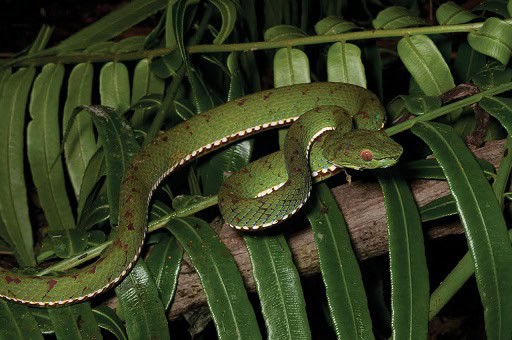
The Philippine pitviper (Trimeresurus flavomaculatus) is the resident venomous terror of the Philippines, or at least one of the resident venomous terrors. It’s a widespread species throughout the country, appearing on most of the major islands except Palawan. That includes Mindanao to the south, Samar to the east, and the large island of Luzon to the north, home of the capital Manila.
Philippine pitvipers are most commonly found in forests, where they spend large proportions of their time on tree branches, but also venture to the ground regularly. They belong to the vast Trimeresurus pitviper genus, which has 44 members in southeast Asia, and is still adding more members, with 4 additions being made in 2022 alone (mainly in Indonesia). The Philippine pitviper is easily the most common member nationwide, with another member being McGregor’s pitviper, found on the northerly island of Batan.
This is a branch-dwelling species, which is likely to strike at your face, chest and arms. Nevertheless, Philippine pitvipers have a significantly less deadly venom than the average cobra, and far less than the black mamba. This species has caused no confirmed deaths, although it’s possible that fatalities have happened off the record.
| 2 | Longer than most Thai pitvipers |
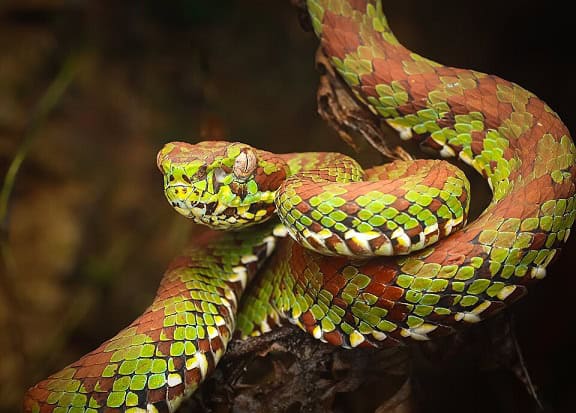
The Philippine pitviper has a claim to fame among its kind. Of the 44 Trimeresurus green pitvipers in southeast Asia, it’s officially the second longest when judged by maximum record.
The official longest member is the Sumatran pitviper, a common species not just on Sumatra, but Borneo and peninsular Malaysia. This reached a record of 160cm, but the Philippine pitviper isn’t far behind. The bulkiest brute of all was encountered on Calayan Island, off the north coast of Luzon, almost at the northern extent of the species’ range. The location was a secondary growth forest, and the snake was an adult female.
The scientists euthanised the huge snake, and found a body length of 130.8cm, plus a tail length of 22.0cm, making for an overall length of 152.8cm. This demolished the previous record for the species, which stood at 109.2cm, over 40cm shorter.
This record also demolished many of Thailand’s infamous green pitvipers. The white-lipped pitviper is the most common nationwide, and peaked at 104cm. The large-eyed pitviper is particularly common in Bangkok, and reached a record of just 74.1cm. As of 2026, the Philippine pitviper officially holds the number 2 spot for length.
| 3 | Variable in colours |
The Philippines might be remote, but their humid forests hold one of the most brutish pitvipers in southeast Asia. You might assume that terrifying snakes await you, but you might not be prepared for the sheer length of the monsters you encounter.
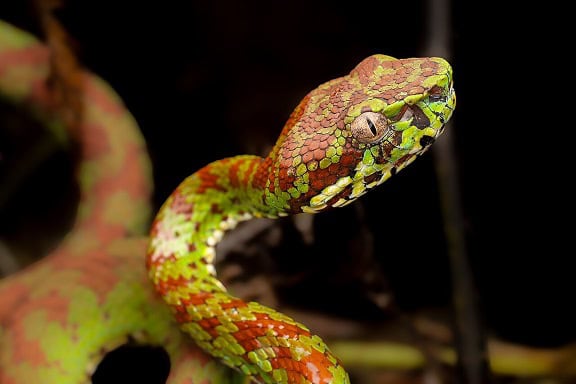
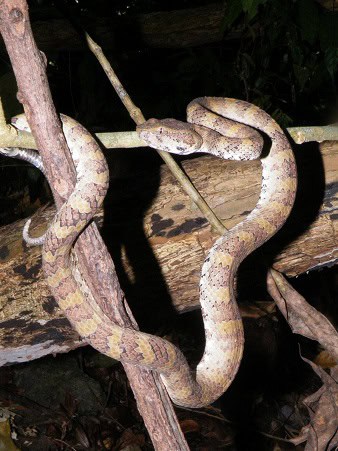
Another dangerous fact is that the Philippine pitviper is highly variable in appearance. This is generally a green species with small red blotches, adorning its body at intervals. But the exact proportions between the two vary significantly. In a couple of individuals, the red takes over completely, making this one of the few red pitvipers on Earth. There’s also a widespread morph with brick red contrasting against parched brown.
Even this species’ eyes vary in colour. They’re typically bronze or brown, but a few have green eyes similar to their body. They also have the usual vertical pupils of a viper, and a fairly bulky and triangular head.
| 4 | A bleeding specialist |
Generally, Trimeresurus pitvipers have a milder venom than their cobra neighbours, and the Philippine pitviper is no exception. Rather than neurotoxic, its venom is usually described as haemotoxic – disruptive to blood clotting elements like fibrinogen and thrombin. The real world result is that old cuts burst open again, spewing blood, potentially bloody gums and urine, or new cuts which seem tiny but never seem to stop bleeding, due to the complete inability of wounds to seal themselves.
Beginning in 2023, the Philippine pitviper’s venom has been analysed in great detail. Firstly, the study contained an in vitro portion – testing the venom on human blood samples, which were donated by 6 volunteers. The venom completely disrupted the clotting of blood samples, with a high thrombolytic activity, the ability to cleave through existing blood clots.
Meanwhile, the second portion of the study was conducted on live mice, which is useful, as this species preys mainly on amphibians. Some snakes have active venoms against their chosen prey, like the eastern hognose snake of the US, whose venom only strongly affects amphibians. This study tested a mammal, and would reveal therefore whether the venom had powers against a group which they barely feed on (such as us)…
| 5 | Hijacks blood clotting |
The results of the in vivo study were very similar to the first portion, as the Philippine pitviper had a strong thrombolytic activity. In the mice treated with venom, there was significant lysis or destruction of the clots, compared to a control, which had no effect.
In a medical situation, this can actually be beneficial, cleaving through bloodstream blockages, but for snakebite victims, this study backed up the old reports of the bite being mainly haemotoxic. The next experiment was conducted in 2025, and tested two closely related species: the Philippine pitviper and McGregor’s pitviper, found on the Batanes Islands in the extreme northern reaches of the Philippines.
Both venoms were strongly procoagulant, triggering the formation of numerous small, weak clots throughout the bloodstream. Fibrinogen supplies were being rapidly depleted, to no benefit, caused by the snake venom’s activation of thrombin, the natural enzyme which converts raw fibrinogen to fibrin, the final building blocks of blood clots. Of the two, McGregor’s pitviper was slightly stronger, but the Philippine pitviper still had a high potency.
Procoagulant venoms essentially act by increasing clot formation unnecessarily, so that no clotting materials such as fibrinogen remain for genuine clots. This can trigger haemorrhaging just as powerfully as anticoagulant venoms, which are more basic, simply dissolving raw clotting elements. Other procoagulant species worldwide include the rainforest hognose pitviper of Costa Rica, and the tiger snake of Australia.
| 6 | Curable with antivenom |
The study also revealed lethal sub-pathways of the venom, including increasing the activity of Factor IXa and factor Xa. This is another classic pathway of a procoagulant venom, as both enzymes increase the activity of thrombin. Factor Xa converts prothrombin to the thrombin enzyme, while factor IXa helps to activate factor Xa, forming yet another step of the blood clotting chain.
The last phase of the study was testing antivenoms. The Philippine pitviper lacks its own antivenom. In fact, only a single Philippine snake has its own antivenom manufactured by the country – the Philippine cobra (Naja philippinensis). Doctors can use antivenoms from overseas, but the Philippines is vast, scattered and heavily rural, and to this day, many victims often rely on local healers and traditional medicinal plants from the forest instead.
The study tested two antivenoms. The first was an antivenom manufactured solely against the white-lipped pitviper, Bangkok’s main venomous species, which doesn’t come close to inhabiting the Philippines. The second was Hemato Polyvalent Antivenom, which contains antibodies raised against the white-lipped pitviper, Malayan pitviper and eastern Russell’s viper.
The study had a positive outcome, as both pitvipers neutralised a swathe of the Philippine pitviper’s effects, despite the complete lack of geographic overlap. The Philippine pitviper clearly had a large toxin overlap with its relatives, and hadn’t managed to evolve many unique toxins, despite living far away.
| 7 | Diet of the Philippine pitviper |
Within forests, Philippine pitvipers are often found near streams, pools or swamps. They’re often found along the well-vegetated edges, scouting the vicinity for food, and this is because their diet almost entirely consists of amphibians. Species they’re confirmed to hunt include common puddle frogs, Luzon narrow-mouthed frogs, and common southeast Asian treefrogs.
Like all Trimeresurus pitvipers, this species is an ambush predator. It waits patiently in a coiled position, sometimes with a prehensile tail coiled firmly around a branch. It lunges at frogs whenever they walk past, usually with a high accuracy, occasionally missing if the frog executes a particularly fast hop.
Sometimes, their love of amphibians proves fatal. The cane toad is the most notorious invasive amphibian in the world; it was released into Australia in the 1930s to control sugar cane beetles, but instead decimated the native snakes, due to a frothy white bufotoxin released from its back. It was also released into the Philippines for pest control, and in 2020, scientists found a Philippine pitviper with a cane toad in its mouth. Both were dead – the toad from venom and the snake from poison. Fortunately, the Philippine pitviper is still listed as “least concern” by the IUCN, and the invasion hasn’t had much effect yet.
| 8 | Secrets of the Philippine pitviper |
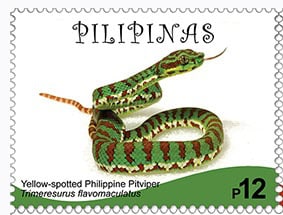
While they favour forests, Philippine pitvipers are flexible in their habitats, appearing in a variety of areas disturbed by mankind as well. This has enabled them to spread far and wide over Luzon, Samar, etc, rather than becoming stranded in ever-shrinking patches of pristine forests. Rather than high altitudes, they inhabit lowland areas, generally sticking to altitudes of 0-300 metres.
Philippine pitvipers look like a rainforest species through and through, with patches of fungi red sprouting on top of moist leafy green. However, they actually prefer slightly drier forests than some of their relatives nearby. The Philippine pitviper tends to appear in areas receiving 2000-3000mm of rainfall annually, as does its relative Schultz’s pitviper. Meanwhile, their cousin the Sumatran pitviper appears in areas of equatorial Indonesia receiving up to 4000mm each year.
Their diet also differs to their relatives. Schultz’s pitviper (Palawan’s main species) preys on a mixture of lizards and frogs, while McGregor’s pitviper and the Sumatran pitviper prey heavily on mammals. The Philippine pitviper is the most exclusively amphibian-eating of the local pitviper crew.
| 9 | Many morphs in one area |
Trimeresurus flavomaculatus is one of the more variable pitvipers in colour. The Philippines are vast, split between many islands, and therefore, there’s always a chance that one of these morphs represents a hidden, undiscovered species. Of all snake groups on Earth, the Trimeresurus pitviper clan has one of the highest rates of new species being churned out…
That said, the evidence shows that this species is simply highly variable. Rather than colours correlating to certain spots, multiple colours can appear in one area, with no apparent connection to anything.
For example, this 2017 survey ventured to the Abasig Matogdon Mananap Natural Biotic Area, found on Luzon. Multiple Philippine pitvipers were observed within this area, and they ranged from green-white to green-black to brown-red. The colours weren’t bred out of existence, they continued to appear at random, like the eyelash viper of Central America.
Another example happened on the Philippine island of Polillo, to the east of Luzon. Originally, this was believed to be home to a subspecies called Trimeresurus flavomaculatus halieus, partly because of its variable colours. But in the 2000s, the subspecies was abolished, as scientists found that it was simply a superficial colour morph after all, with insufficient genetic variation.
| 10 | The secret independent species |
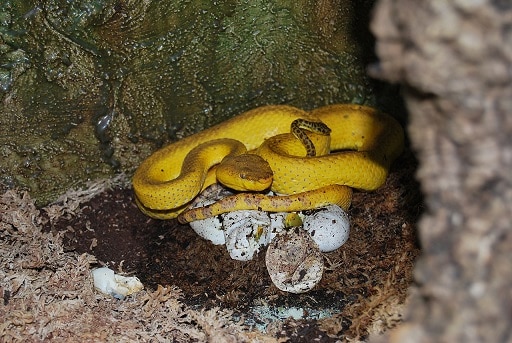
That said, there’s one great exception to this rule, where a local population of the Philippine pitviper turned out to be not just a subspecies, but a completely different species altogether. That snake was McGregor’s pitviper (Trimeresurus mcgregori), located on the Batanes Islands, which are the northernmost extent of the Philippines.
Originally, this species was a subspecies under the title T. flavomaculatus mcgregori. But this time, the colour difference was so extreme that it piqued scientists’ curiosity. For one thing, McGregor’s pitviper never had a single scale of green on its body. There’s brown like the main Philippines version, but not a hint of leafiness. Secondly, a high number of individuals were banana yellow, a colour which has never been observed on the mainland version.
There was also the fact that the Batanes Islands are separated from the rest of Indonesia by 130 miles, and have never been connected to the mainland Philippines, even during ice ages. It became official: McGregor’s pitviper was independent. These days, it’s one of the most endangered pitvipers on Earth, with a rating of “endangered” from the IUCN.
| 11 | Species they live alongside |
The Philippines pitviper lives in a paradise of snakes, or perhaps a hellscape, if snakes are the one thing you fear above all else. The survey which ventured to Abasig Matogdon Mananap Natural Biotic Area wasn’t focused on the Philippine pitviper; it simply noted all snakes it encountered. Therefore, we know that in its scenic local forests, the Philippine pitviper lives in a serpent wonderland alongside the following neighbours:
Reticulated python – Earth’s longest snake, a crushing constrictor which reaches 6.95 metres and can swallow entire sunbears.
Asian vine snake – an extremely thin, incredibly widespread tree snake, which ranges from the Philippines to Thailand. Mildly venomous.
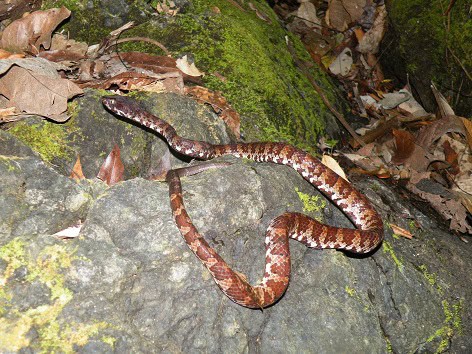
Müller’s wolf snake – a harmless, completely non-venomous snake, which is endemic to the Philippines. The scientists found it resting on a mossy rock.
Philippine cobra – this infamous cobra covers most of the Philippines, and can spray venom as well as inject it. Highly neurotoxic. Scientists found an individual waiting on the forest floor, whereas Philippine pitvipers are more common on branches.
Banded Philippine burrowing snake – a highly mysterious species, which tends to be jet black overlaid with occasional snowy white. Endemic to the Philippines.
Common mock viper – a widespread species from the Philippines to Hong Kong, which mimics vipers to survive, but has a moderately intense venom of its own.
Reinhardt’s lined snake (Cyclocorus lineatus) – a dull-looking species, which lives exclusively on the Philippines. Feeds on fellow snakes, skinks, and skink eggs.
One species wasn’t mentioned in this report, but almost certainly encounters the Philippine pitviper. It’s the Luzon king cobra (Ophiophagus salvatana), which derives the vast majority of its meals from fellow snakes, and may be this pitviper’s nemesis, although no encounters have been observed yet.