
| 1 | Mega-widespread in Africa |
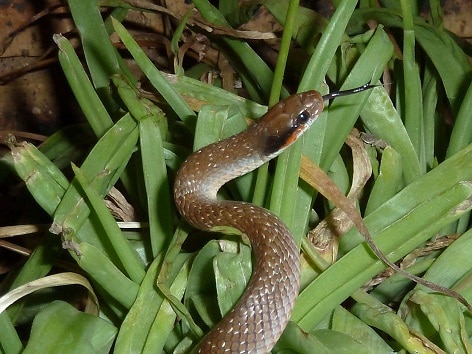
The red-lipped snake (Crotaphopeltis hotamboeia) is a species of sub-Saharan Africa, which inhabits at least 40 countries, possibly more. It’s a completely harmless species, which only has a mild venom, and is perfectly safe to pick up in the palm of your hand. Few people worldwide have heard of this species, yet within Africa, the red-lipped snake has several interesting claims to fame.
Alongside the venomous puff adder, this species is one of the most widespread snakes in the whole of sub-Saharan Africa. It’s particularly abundant in eastern South Africa, but is also common in Tanzania, Mozambique, Zimbabwe and Kenya.
Red-lipped snakes occupy most of western Africa, including Nigeria, Ghana and Togo and reach as far north as Ethiopia. They aren’t found on Madagascar, and fail to cross the Sahara desert, but are regularly encountered by humans everywhere else, as this is a common backgarden snake.
Rather than arid areas, this is generally a species of more moist areas. You can find red-lipped snakes in grasslands, wet savannahs, lake edges, and overgrown grass tussocks near ponds. While Africa is full of small, blackish snakes, this one is particularly easy to recognise, due to its namesake lip. This can be either bright red or snowy white, contrasting sharply against the dark grey body.
| 2 | Common, but low on the food chain |
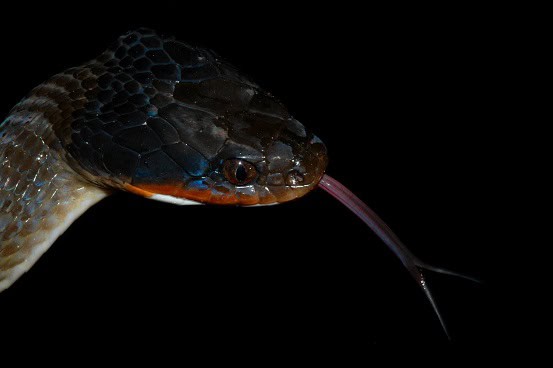
Red-lipped snakes belong to the Crotaphopeltis genus, which has 6 members, all found in sub-Saharan Africa. Of this group, they’re easily the most common, with by far the greatest habitat flexibility. Another member is the rare Barotse water snake (Crotaphopeltis barotseensis), which only appears in the swamps of southern Angola and northern Botswana.
Red-lipped snakes are not only widespread, but are active foragers, making them easy to spot as they patrol the countryside for frogs and toads. You can even find them in cities occasionally, though not too commonly. Cape Town is one example, with one location lying just to the west of Cape Town International Airport. In Nairobi far to the north, they can show up anywhere where remnant clumps of trees or patches of grass still exist.
Though common, this species doesn’t have an easy ride in the wild, with many cunning predators. Red-lipped snakes fall victim to several fellow snakes in their natural habitats, including the cape file snake, Bibron’s stiletto snake, purple glossed snakes and shield-nose snakes. They’re also confirmed prey for spiders of the Latrodectus genus, AKA the button spiders and widow spiders. They’re easy pickings for the deadly creatures of southern Africa, yet this species does have one memorable survival trick…
| 3 | A head-triangulating snake |
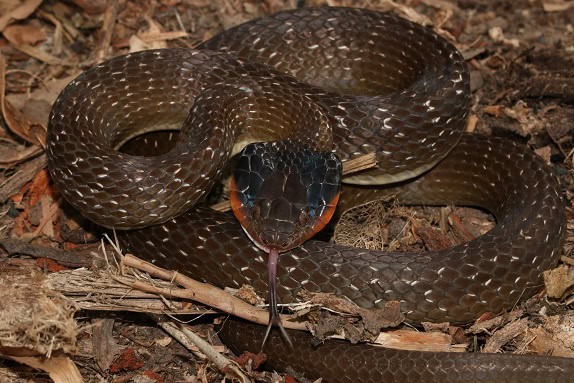
Out of all harmless African snakes, none can triangulate their head quite like the red-lipped snake. Africa’s various vipers have naturally triangular skulls, including the common puff adder and gaboon adder.
Ordinarily, the red-lipped snake has a moderately wide skull, not quite a tube with no neck like some coral snakes, but relatively slender. In times of stress, however, this snake can shift bones in its own skull, dramatically altering its head shape to create a vividly triangular viper mimic. The goal is to intimidate predators, and they reinforce this deception by performing mock lunges in mid-air and coiling their lower bodies.
Fortunately, all this is a bluff, as the reality is that red-lipped snakes are completely safe. Their toxin profile hasn’t been studied in any detail, but the potency is very mild. The worst a red-lipped snake can inflict is a mild swelling and throbbing pain around the bite site, and possibly higher than usual bleeding, which hints at haemotoxic properties.
This is also a rear-fanged snake, which must repeatedly chew its victims to inject any significant quantity of venom. Before this, you actually have to pick them up, as this species never launches a mid-air strike like a cobra.
| 4 | Diet: loves frogs and toads |
Most vipers in Africa prey heavily on mammals, but the red-lipped snake has chosen a different path, as this is one of the continent’s top amphibian-eaters.
In a 2000 study, scientists examined preserved specimens of the red-lipped snake from museums in South Africa. They discovered 73 prey items, and of these, an overwhelming 97% were amphibians. The remaining 2 were both reptiles: a thick-toed gecko and a skink.
The leading category of amphibians was “unidentified”, numbering 20, but the top confirmed prey was the Raucous toad, AKA Bufo rangeri, which is poisonous to most animals, releasing a deadly white liquid from its back. In second was Boettger’s dainty frog, which lacks poison, but two other poisonous toads were discovered: the Fenoulhet’s toad and Karoo toad (Bufo gariepensis).
Also recorded in their diet was the unbelievably chunky-looking shovel-nosed frog (Hemisus marmoratus). Across other studies, the red-lipped snake has only been recorded to eat one mammal, a mouse. One chameleon has been recorded in their diet, a southern dwarf chameleon, but not a single fellow snake.
| 5 | The longest of all time |
Red-lipped snakes aren’t tiny, but have never been recorded to reach 1 metre. The official record was set in March 2003, when wildlife officials confiscated 3 red-lipped snakes from a woman in Port Elizabeth, South Africa.
The woman lacked the permits to keep the snakes, and was believed to have imported them illegally from Zimbabwe. Most importantly, the largest of the 3 snakes was a male measuring 89.1cm. This easily broke the previous record of the species, a male measuring 81.0cm.
The same article also revealed some geographic variation. The snakes were identified as from Zimbabwe because of their lips, which vary in colour according to the authors. In the eastern cape of South Africa, Crotaphopeltis hotamboeia has a bright red lip, typical of the species, but in Zimbabwe, they’re usually a paler red.
Further north in east Africa, the redness completely disappears, and turns to a ghostly white lip. In some parts of eastern Africa, this species is even known as the white-lipped catsnake.
| 6 | Significant geographic variation |
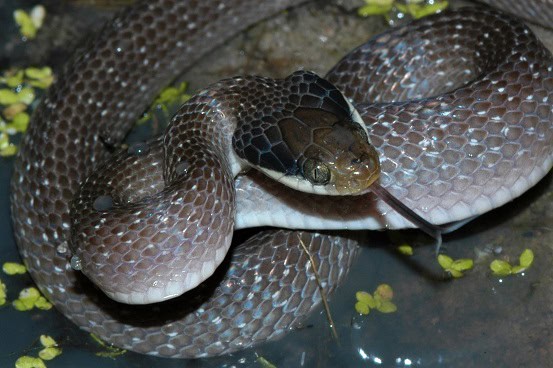
This massive colour variation is also noticeable on amateur images on iNaturalist. Sightings include…
One – a red-lipped snake from near Durban, eastern South Africa (image). This individual has the usual bright red lip, grey body, and pale underside.
Two – a calm-looking red-lipped snake from southern Malawi (image). This individual is nearly completely black, without a single hint of red near its lip.
Three – a snake from Guinea, far western Africa (image). This red-lipped snake has a white lip instead, and is triangulating its head.
Four – this Chad individual looks so different that it’s like a separate species (image). The snake is pale yellow, with a white lip, contrasting against black sides of the head. Chad lies at the extreme north of the red-lipped snake’s range.
Generally, those in western Africa completely lack red on their face. The further north you travel within Africa, the less likely the namesake redness is to appear. Despite the massive variation, all red-lipped snakes in sub-Saharan Africa are classified as the same species, just with superficial morphs.
| 7 | Changes colour at will |
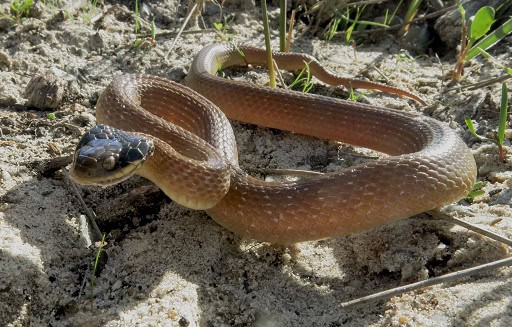
Adding even more confusion, red-lipped snakes are capable of changing their own colour at will. This has only been recorded for a few snakes worldwide, such as the Arizona black rattlesnake, which changes from black to brown depending on sunlight intensity.
The sighting took place in Kasese municipality, Uganda in July 2022. Scientists came across a red-lipped snake at a Kahendero road junction, keeping the snake in storage until the evening, when it was found to be light brown with a faint white speckling over its entire body. This was fairly standard for a Ugandan red-lipped snake, but over the next 40 days, something strange happened. The red-lipped snake repeatedly cycled back and forth in colour, swapping between 4 unique colour phases.
The 2nd phase was entirely black except a paler underside. The 3rd phase was a greenish brown with a white lip, and the 4th was a dark brown colour without any pale lip whatsoever.
It seemed that Crotaphopeltis hotamboeia is able to control not just its entire body colour, but its lip colour specifically. In this Ugandan snake, the colour changes weren’t explained by the time of day, or skin shedding. Temperature was the biggest factor, regardless of the time of day, as warmer conditions consistently led to a darker colour.
| 8 | Only missing from a few locations |
There’s only a few spots in sub-Saharan Africa where red-lipped snakes can’t be found. They’re missing from the vast majority of parched Namibia, particularly the parched Namib desert of the southern half. They’re not found in the deepest Congo rainforests, nor the heavily jungled Equatorial Guinea. They skip offshore islands such as Madagascar, which has almost no snakes in common with the African mainland.
Nevertheless, the red-lipped snake is still one of Africa’s most widespread snakes, appearing in every sub-Saharan African country, except dry areas immediately south of the Sahara desert, such as the upper halves of Niger, Mali and Chad. The westernmost extent of this species is Senegal, bordering the Atlantic Ocean. On the Pacific coast thousands of miles to the east, they’re abundant in Mozambique, and are particularly common in Tanzania.
Some African species thrive in parched deserts, but the red-lipped snake is fundamentally a species of moisture, as this is where their amphibian prey congregate. You can find a red-lipped snake in grassland, moist savannahs, and even back gardens in some areas. They can also cope with moderately dense forests, particularly in marshy areas within forests.
| 9 | Genetic testing and discoveries |

In 2020, a study finally analysed whether the massively variable red-lipped snake is really one species, taking samples from all over Africa. The scientists discovered 6 genetic clades in the species, which were found in 1) south-eastern Kenya, 2) the Republic of Congo to Angola, 3) central and eastern Africa, 4) the southern reaches of Africa, 5) northeastern South Africa, and 6) southeastern Africa.
These were separated by DNA chasms, yet the difference was much larger than between separate members of the Crotaphopeltis genus. For example, another member is Tornier’s catsnake (Crotaphopeltis tornieri), which inhabits the mountain forests of Tanzania and northern Malawi, and is much rarer. The genetic distance between this and the red-lipped snake was over 12.8%.
Meanwhile, the clades within the red-lipped snake were separate, but by far less. The scientists estimated that the requirement for full species separation was a 12.8% genetic distance, but no clade within the species came close to this. The genetic clades that did exist didn’t even correlate to lip colour.
The conclusion was that the red-lipped snake is simply a highly variable species in appearance, without containing any secret new species.
| 10 | New discoveries in Namibia |
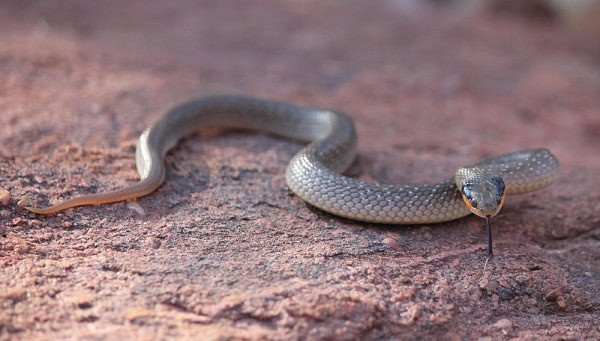
One of the few habitat types that red-lipped snakes avoid are harsh, arid environments. They skip most of Namibia (a dry country), plus the drier west of South Africa, but this is still an extremely hardy and tough snake, and in March 2021, their range in Namibia was extended by almost 160km.
Red-lipped snakes had previously been known in the moister Otjozondjupa Region, in Namibia’s northeast. The new discovery was made outside the house of a farmer, who also ran a safari tour. The farmer sent an image of the snake to Francois Theart, the study’s author, who identified it easily, based on a pale lip, dark body, and pale underside. If the snake was pale beige, it would have been more confusing, but Namibia has no snakes which closely resemble the red-lipped snake.
With this observation, the red-lipped snake had officially penetrated deeper into arid Namibia then ever before, deepening their claim as one of Africa’s most common snakes. The closest previous record in Namibia lay 158km to the northwest. The drier areas of Namibia are home to several frogs, such as desert rain frogs and bushveld rain frog, possibly allowing the species to cling to survival.
Meanwhile, this iNaturalist map doesn’t have any dots in Namibia, so the red-lipped snake is actually even more widespread than the map suggests.
| 11 | Nigerian discoveries |
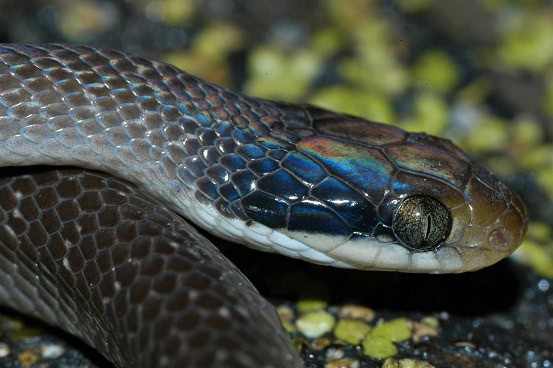
In one cool study from 2013, scientists stomped around various parts of Nigeria, picking up as many red-lipped snakes as they could. The species appeared in most habitats, yet there were still clear trends.
The species’ least favourite habitats were mature forest and mangroves, with just a handful of sightings. They were overwhelmingly most common in plantations, followed by farmland and farm-bush. Meanwhile, savannah, urban areas and secondary forests had a respectable amount of sightings.
Despite disliking thick forests, red-lipped snakes can still move through them, showing what a flexible species they are, and hence explaining why they’ve come to completely dominate sub-Saharan Arica, easily outstripping the cape cobra or black mamba for total territory covered.
The study also covered diet, discovering 154 prey items, and found high amounts of frogs and toads again, comprising 72.5% of total prey. However, reptiles made up a larger share compared to in the South African study, comprising 21.5% of prey. Three arthropods were also discovered. No mammals were recorded whatsoever, nor fellow snakes, agreeing with the other study. The single top prey species was Hallowell’s toad (Sclerophrys maculata), and the diet composition was similar between the sexes.