
| 1 | Australia’s fastest snake |
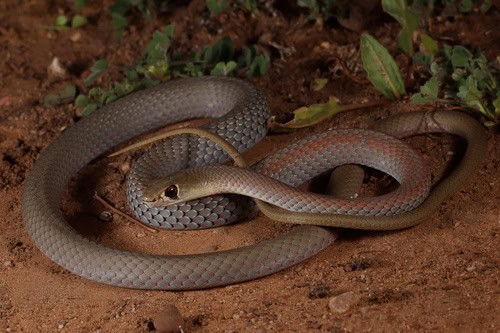
Some snake records in Australia are undeniably held by one species. The scrub python is the longest, with an all-time record of 5.65 metres. The eastern brown snake causes the greatest number of fatalities, while the inland taipan has the most toxic venom drop for drop (but is fairly shy). That still leaves one record vacant – the fastest snake in Australia – and that position is taken by the yellow-faced whipsnake (Demansia psammophis).
The yellow-faced whipsnake belongs to the 15-member Demansia genus, of which it is easily the most common. This species is abundant all over the east coast of Australia, ranging from roasting Cairns in the far north to slightly cooler Newcastle in the south. This is a regularly sighted snake in Sydney suburbs and Brisbane alike.
Yellow-faced whipsnakes are mainly found in New South Wales and Queensland, but also cross into northern Victoria and eastern South Australia. They move exclusively by day, and have unusually large eyes.
The other noticeable thing about this species is its unusually thin body, and this is connected to its speed. The yellow-faced whipsnake is accurately named, as it can escape from a predatory bird or grasping pair of human hands in a flash.
| 2 | Common in Sydney suburbs |
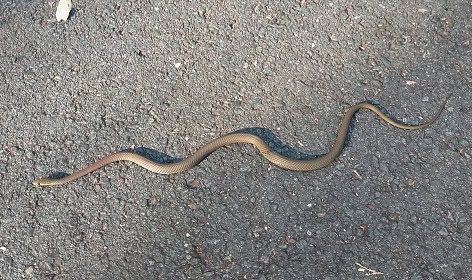
The yellow-faced whipsnake averages at 50-80cm, with a maximum length of around 100cm. Not only is this species fast, but it’s highly flexible, appearing in a wide variety of habitats, both manmade and natural. Yellow-faced whipsnakes can appear in arid scrubland, spacious woodland, open plains, agricultural fields, back gardens and dirty alleyways alike. They only avoid the absolute wettest spots, such as rainforests and swamps.
Yellow-faced whipsnakes mainly stick to the ground, yet are excellent climbers. They’re capable of zipping up tree branches to escape pet cats, and are commonly found staring at pedestrians from brick walls. Their speed is designed not just for chasing lizards (their main prey), but escaping human clutches. This is a pointless snake to try and grab for a photo, as at the last second, they’ll inevitably slip right through your fingers and vanish into the undergrowth.
The yellow-faced whipsnake is an elapid, the deadly and infamously neurotoxic group which contains many lethal Australian snakes: brown snakes, tiger snakes death adders, etc. Yet compared to these cousins, its venom is relatively mild, and deaths are extremely rare.
| 3 | Charges after its lizard prey |
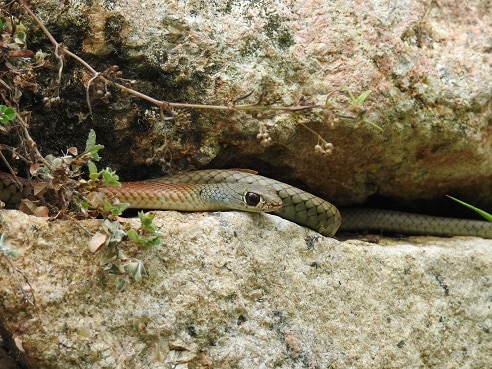
The yellow-faced whipsnake is nervous and twitchy, and would be terrible at ambush strategies, losing patience within 5 minutes of settling down behind a bush. Instead, this species is an active forager, deploying all its speed to charge down fast-moving lizards.
Yellow-faced whipsnakes begin the chase by scanning their surroundings with their unusually large eyes. While they often fleck their tongues and detect scent trails like any other snake, they’re highly alert to moving prey, like a lion spotting a gazelle whipping past.
The next step is rapid pursuit, as the yellow-faced whipsnake simply sprints after its lizard prey in a manic dash. When it arrives, things don’t get any subtler, as the whipsnake simply grapples with its prey and force them down. Yellow-faced whipsnakes sometimes apply a single coil to restrain their struggling prey, but they rarely apply actual constricting force.
Yellow-faced whipsnakes are highly alert, with the ability to accurately anticipate a lizard’s line of movement. They don’t always succeed, with some lizards’ feet escaping their jaws by mere millimeters. But if a carpet python tried to implement the yellow-faced whipsnake’s hunting style, it would fail miserably, dragged down by its immense bulk.
| 4 | Piles of 600 eggs |
Yellow-faced whipsnakes don’t spend their entire lives moving, and prefer to rest in rock crevices or within hollow logs. Here, they’re notorious for appearing in communal formation. It’s common to find 5, 9, or even 16 yellow-faced whipsnakes resting calmly together inside the same serpent sanctuary.
The same applies to their eggs. Yellow-faced whipsnakes produce batches of 5-20 on average, and have a natural instinct to lay them near fellow eggs of their species.
One example happened in Morton National Park in New South Wales, in September 1979. 217 eggs of the yellow-faced whipsnake were found below a single rock measuring 1.5-0.8 metres, positioned on a south-facing sandstone hillside. Of these, 179 eggs had hatched, though probably not all at once (imagine the wave of baby serpents). The eggs had visible slits originating from the newborn snakes’ egg tooths, which they use to hack themselves free.
Meanwhile, two eggs were dried out, and were probably unfertilised. 36 eggs been assaulted by insects, which had devoured the embryos inside. In the most extreme case, 500-600 yellow-faced whipsnake eggs were found together in a network of ground crevices (reported in 1972).
A similar Australian snake is the common keelback, which has been found to preferentially lay its eggs near old discarded shells, as proven in a study where scientists provided one shelter with shells and one without shells.
| 5 | Moves exclusively by day |
Yellow-faced whipsnakes have another ability in addition to speed: extreme heat resistance. A 2003 study from Sydney compared them to 3 common neighbouring snakes:
- The golden crowned snake, a common snake in suburban Sydney, which often falls into swimming pools.
- The marsh snake, an east coast species which inhabits creek edges and marshes.
- The small-eyed snake, a slow-moving venomous species which searches under rocks for sleeping skinks.
The yellow-faced whipsnake was the only species of the 3 to move during the hottest hours of the day. The majority of their activity occurred from 10:00-15:00, with the earliest activity at 7am and the latest activity at 18:00. Demansia psammophis was completely diurnal, with no nighttime activity.
Meanwhile, the small-eyed and golden crowned snakes were both fully nocturnal, never moving during daylight. The former was only ever active after 20:00, while the latter occasionally revved up at 18:00. The marsh snake was flexible, being most active at 21:00-23:00, but capable of moving sometimes during the day.
Yellow-faced whipsnakes can prowl Australia’s arid countryside, while other snakes are forced to shelter in cool burrows. The body temperatures of the 4 species were also tested. Yellow-faced whipsnakes were active at by far the highest body temperatures, specifically 31.3-33.2C. The other 3 were active at body temperatures ranging from 18.1-23.4C.
| 6 | Underestimated venom |
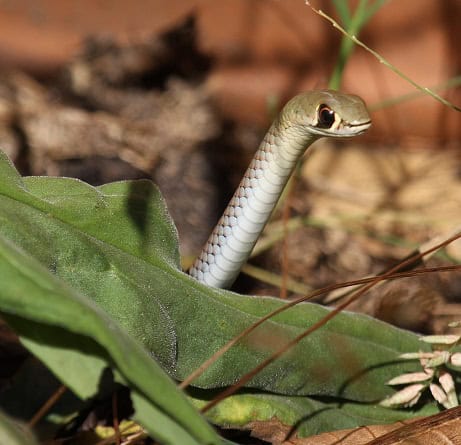
Demansia psammophis is an Elapid, the deadly and infamously neurotoxic family which contains cobras, coral snakes, sea snakes and brown snakes. However, their venom is relatively mild, and deaths are extremely rare. Yellow-faced whipsnakes are shy creatures which default to flight, and will only bite if cornered.
A 2011 study was the first to analyse the venom’s chemical makeup. The species was compared to its northern cousin, the lesser black whipsnake (Demansia vestigiata). The former had weak, easily reversible neurotoxic activity, whereas yellow-faced whipsnakes were slightly stronger, inhibiting 90% of twitches in a chick nerve preparation within 52.7 minutes.
Both had moderate procoagulant effects, when clot formation is accelerated throughout the bloodstream, depleting necessary fibrinogen and thrombin. Both venoms were moderately cytotoxic. Despite not using yellow-faced whipsnake venom, an antivenom reversed both the cytotoxic and coagulopathic effects. According to the study, the whipsnakes’ venom “exhibited weak to moderate pharmacological activity compared to common Australian elapid venoms“, such as tiger snakes. Similarly, yellow-faced whipsnakes had only a “weak postsynaptic neurotoxin“.
Don’t get overconfident though. A rare death occurred in 2007, when 37 year old Ron Siggins was bitten by a yellow-faced whipsnake in Harcourt North, and collapsed while his friend was calling an ambulance. He died shortly afterwards. It was speculated that a bad reaction with medication was to blame. Always seek medical assistance if bitten.
| 7 | A male wrestling enthusiast |
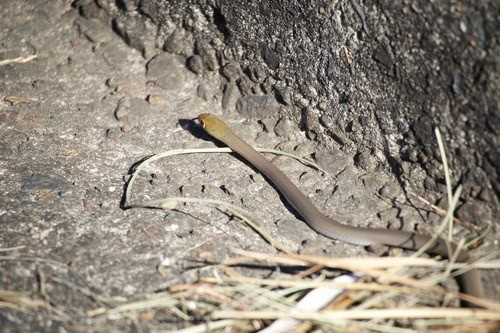
Australia is not only the land of the venomous snakes, but land of the wrestling snakes. Males in the eastern brown and small-eyed snake species are confirmed to wrestle, mainly to secure female affections. Wrestling is most common in snakes where males exceed females, and this is true for yellow-faced whipsnakes, with a species maximum of 110cm.
Therefore, they too were long suspected of being wannabe WWE superstars, but this was only confirmed for the first time in October 2020. A small Demansia psammophis was spotted near a drainage culvert in Oxley Creek Common in Brisbane. It slithered innocently into a creek known locally known as Snake Gulley, but when scientists returned, it was intertwined with a fellow male. Both were relatively small at under 50cm, and for at least 7 minutes, the snakes attempted to force one another downwards to secure domination.
The snakes rolled while intertwined, and even wrestled while slithering backwards. Their brawl took place in an area of 6 metres. The snakes wrestled in a low, horizontal posture rather than spiraling upwards (see this nightmarish picture of two oriental ratsnakes wrestling). Eventually, the smaller male lost and fled the scene, but the larger whipsnake pursued it in a hot rage.
| 8 | Diet: 90% reptiles |
The diet of the yellow-faced whipsnake consists overwhelmingly of lizards. You only have to watch one charge after a light-footed skink on a hot terrace in your garden to know this, but recently, science has confirmed it too. A 2006 study compared 4 whipsnake (Demansia) species: the yellow-faced whipsnake, olive whipsnake, lesser black whipsnake and collared whipsnake.
The latter ate reptiles exclusively, and while yellow-faced whipsnakes were slightly more flexible, they still obtained 90% of meals from reptiles, with skinks dominating. The remainder included 7% frogs and 3% reptile eggs. Not one mammal was recorded. Specific prey included common garden skinks, delicate skinks, and Verreaux’s tree frogs.
Australia has many other snakes which overwhelmingly eat reptiles, including small-eyed snakes and white-lipped snakes. Theoretically, this should create huge competition for yellow-faced whipsnakes. But there’s a big seperating factor: the former two are nocturnal hunters, which primarily ambush sleeping reptiles below rocks and in crevices at night, invading their lairs. Demansia psammophis is diurnal, and prefers to charge after moving lizards. Therefore, they still have their own niche which means that they won’t plummet into extinction.
| 9 | ID signs to remember |
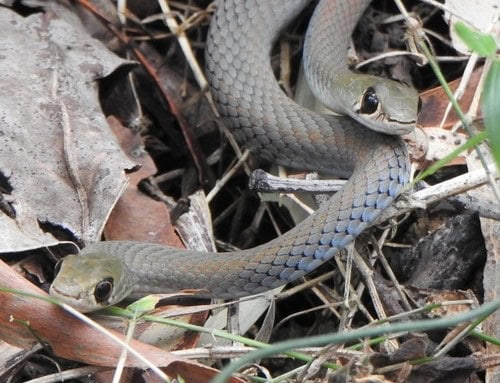
Yellow-faced whipsnakes are sometimes confused with deadly eastern brown snakes, but are easily distinguished by their facial markings. The most memorable include a dark patch directly below the eye, white patches to the sides of the eye, and a black horizontal line on their snout.
Eastern brown snakes, meanwhile, have a completely plain face. Yellow-faced whipsnakes also have significantly larger eyes. Both have no noticeable patterns on their bodies, but instead of plain brown, yellow-faced whipsnakes have shimmering colours ranging from bluish to reddish to hints of green, with a large variety.
Yellow-faced whipsnakes have never been recorded to eat a fellow snake. But they do become prey themselves, specifically for the king brown snake (mulga). Other confirmed predators include whistling kites, Burton’s legless lizards, domestic cats, and wedge-tailed eagles.
According to a 2006 study, yellow-faced whipsnakes tend to grow faster than other Australian Elapids. This is likely because of their thinner body, meaning that less calories, less cells and less square inches of new body are required to begin adding length.
| 10 | Feared by lizards |
Because of their diet, Australia’s lizards have an innate aversion to yellow-faced whipsnakes. This isn’t learned over time, but built into their genetic code. Yellow-faced whipsnakes can impact a lizard’s entire life, even if they survive. An imaginative 2000 study created two large enclosures that mimicked a skink’s natural habitat. Plenty of food was available in these enclosures, but both also had a retreat site, where there was shelter, but little food.
The experiment was that enclosure A would be covered in yellow-faced whipsnake scents, and enclosure B an inactive control scent. The verdict was clear: over the first 6 months of the experiment, the skinks in enclosure A were less mobile, began hunting later in the day, and spent more time in the safe zone. The fear was evidently playing on their minds, even forcing them to skip meals. In the control enclosure, meanwhile, they ate to their heart’s content.
After 1 year, the skinks learned not to fear the snake scents, due to lack of consequences. But the initial lack of food meant that they lagged behind the control lizards in growth, and never caught up. This might happen in the wild too – yellow-faced whipsnakes reducing lizards’ sizes simply by existing.
One year later, a 2001 study found that lizards with broken tails were much more vulnerable to yellow-faced whipsnakes than those with intact tails. The lizards were no easier to spot, nor were their scents easier to detect. It was simply that their locomotor abilities were reduced, their abilities to escape.
| 11 | The Demansia whipsnake clan |
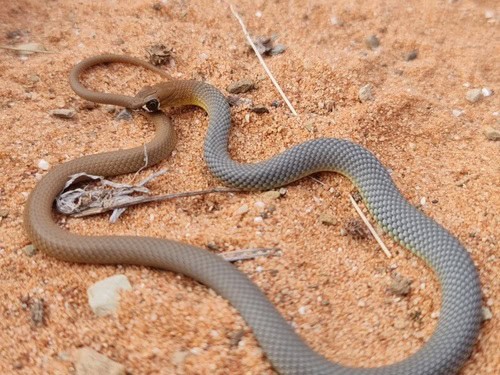
The Demansia genus has 15 members and yellow-faced whipsnakes (D. psammophis) are undoubtedly the most common, covering most of the east coast. In second place is the reticulated whipsnake of Australia’s west coast (D. reticulata). This is abundant near Perth, and has no overlap with its eastern cousin. Reticulated whipsnakes are distinct due to their bi-coloured bodies, with a bluish upper half and a brick-red lower half.
Meanwhile, the largest species of the 15 is the greater black whipsnake (Demansia papuensis), at a maximum of 165cm. The smallest is the grey whipsnake (Demansia simplex) at a maximum of just 56cm.
The most recent discovery is the central whipsnake (Demansia cyanochasma), which was only made official in 2023. This inhabits arid areas of the central outback, in remote locations, explaining why it took so long to research. Old specimens were confused with the reticulated whipsnake to the west, as the two share the blue-reddish body split. But the central whipsnake has far less black on its body, giving them a cleaner appearance, while reticulated whipsnakes have a clear black edge to each scale that creates a net-like appearance (reticulated means netted).