| 1 | Golden-crowned snake |
Maximum length: 98cm.
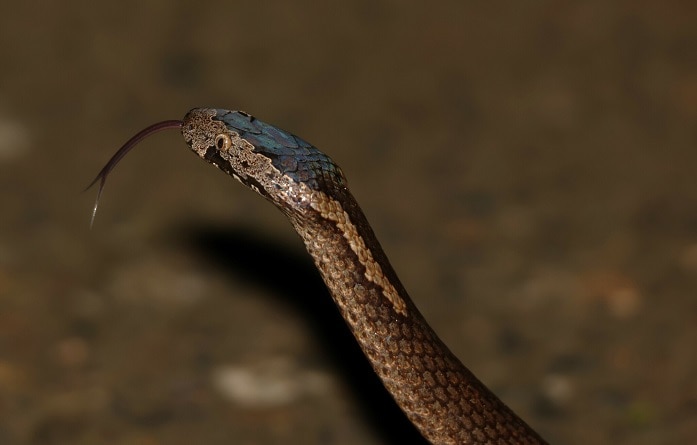
Everyone knows about the eastern brown snake or tiger snake, but Australia contains dozens of lesser known snake species, many of which are common, yet have successfully avoided the public limelight. One is the 50cm golden-crowned snake (Cacophis squamulosus), which is abundant along the east coast, including near Brisbane and Sydney.
This shy species is fully nocturnal, moving in the dead of night. In the wild, golden crowned snakes inhabit rainforests and wet sclerophyll forests. However, they can thrive in suburban Sydney as long as a water source is nearby, and are sometimes spotted crossing roads at midnight, or even on kitchen tiles after dragged in by hungry cats.
This snake has an odd defensive display, as when cornered, it thrashes its body around wildly, while pointing its head sharply downwards. It’s theorised that this is to display the namesake light crown on the head. Another tendency is to rear up the upper third of its body like a cobra, while kinking its neck into an S-shape. If agitated, then golden crowned snakes will make sharp strikes repeatedly, but usually with their mouths closed.
Golden crowned snakes are mildly venomous, but have never killed a human. The vast majority of their diet consists of skinks such as sunskinks (Lampropholis genus), and occasionally frogs, toads and blind snakes. They completely ignore geckos, according to a 1980 study which dissected preserved museum specimens.
This is an egg-laying species, producing an average of 6 per clutch. Hatchlings measure 16cm on average.
| 2 | Marsh snake |
Maximum length: 100cm.
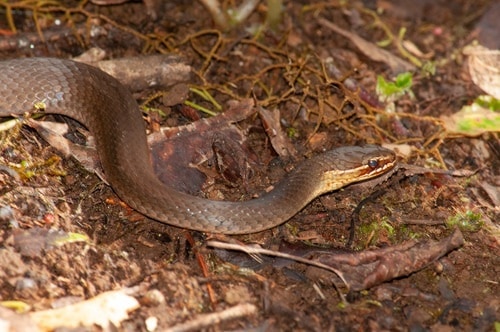
Another east coast snake, but this time diurnal rather than nocturnal. The marsh snake (Hemiaspis signata) is a peaceful species which often gathers with its fellow kind in small groups, for reasons not currently understood.
Marsh snakes average at 50cm, but the largest can reach 1 metre. They inhabit marshland and wet forests, and occupy many locations in suburban Sydney, including Northbridge Golf Club, Cooper’s Park at Belleview Hill, and the Artarmon railway line. A pale white line spreading from the mouth, and another from the eye, is a signature ID sign of this snake.
Hemiaspis signata is mildly venomous, but incapable of killing humans, as most bite reports merely describe local swelling. One boy developed moderately reduced fibrinogen levels and increased fibrinogen degradation products, hinting at coagulopathy (blood clotting disruption).
Marsh snakes mainly prey on skinks such as the three-toed skink (Saiphos equalis), which they immobilise with their venom, then drag to a safe location (like long grasses) to swallow in peace. Again, this species shuns geckos, eating them only rarely, as they comprise less than 1% of their overall diet.
| 3 | Slatey grey snake |
Maximum length: 180cm.
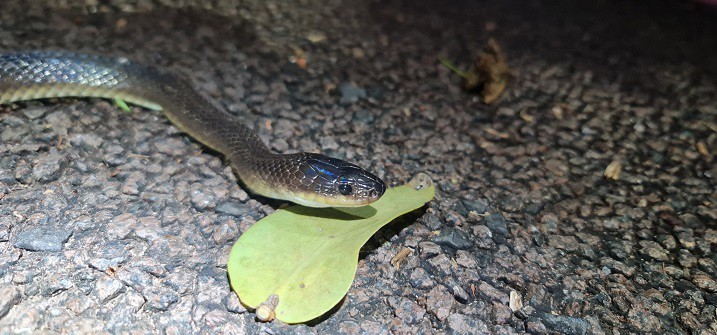
A species with a specialised diet: reptile eggs, including those of fellow snakes. The slatey grey snake (Stegonotus australis) inhabits moist forests in the far north of Australia, specifically two regions: Northern Territory and Queensland, where they’re relatively common. While their venom is only mild, they can bite humans hard if manhandled, or purposefully release an intolerable snake stench.
According to a 2009 study from Queensland, which found slatey grey snakes by repeatedly driving along rainforest roads, their favourite eggs were those of the eastern water dragon and Boyd’s forest dragon. Among snakes, they’re particularly addicted to eggs of the common keelback and Lesser Sunda blind snake.
This species isn’t limited to eggs either, as other confirmed prey include swampland lashtail dragons, banded tree monitors, and prickly forest skinks. They occasionally prey on rats and amphibians, but the reptile world is clearly their area of expertise.
Male slatey grey snakes are significantly longer than females. Originally, this species was dubbed Stegnotus cucullatus, but that name now only applies to those in Indonesian West Papua. Many old Australian studies are still listed under the S. cucullatus name.
| 4 | White-lipped snake |
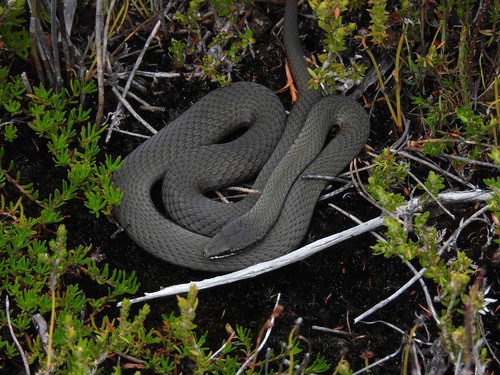
Maximum length: 50cm.
A common species of mild Victoria in Australia’s far south. The white-lipped snake (Drysdalia coronoides) is a short species which has the boast of being one of Australia’s most cold-adapted snakes. This species is particularly common around Melbourne, and is one of just three snake species native to Tasmania, alongside the tiger snake and lowland copperhead. Another claim to fame is being found near the summit of Mount Kosciuszko, Australia’s highest mainland mountain at 2,228 metres.
This species’ colours consist of a car tyre black contrasting vividly against a snowy white lip line. Its venom is confirmed to contain neurotoxins, specifically a unique post-synaptic neurotoxin named drysdalin. However, the venom yield is just 2-3mg, and its fangs are especially small. No human deaths are confirmed.
A 1981 study analysed the white-lipped snake’s diet. Of 61 prey discovered, there was just 1 mammal and 3 frogs. The overwhelming majority consisted of lizards, mainly skinks, including rainbow skinks, southern grass skinks, and Spencer’s widow-eyed skinks. 6 reptile eggs were also discovered.
While white-lipped snakes just about reach Sydney, this lies at the extreme northeastern extent of their territory. Uncommonly for an Australian snake, this species produces live young (usually 3-5), although it’s been found that in chillier Tasmania, females only reproduce once every 2-3 years.
| 5 | Black-naped snake |
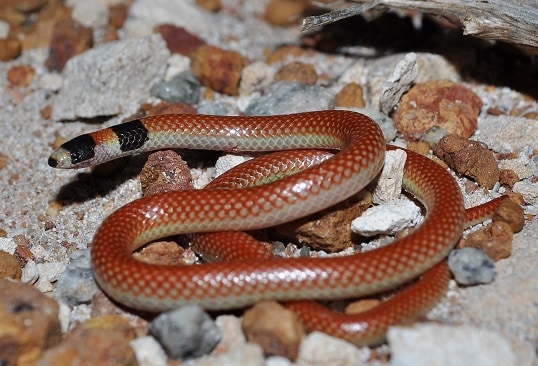
Maximum length: 46.8cm.
A small snake of southwestern Australia, including the large city of Perth. This species is totally harmless to humans, and reaches a maximum length of 46.8cm. The black naped-snake (Narophis bimaculatus) requires soft soil to survive, as it’s rare to find them on hard ground like clay or granite. Hence, they’re typically found in intermediate semi-arid areas, such as dry shrubland, coastal heaths, coastal sand dunes and mallee woodlands.
Black-naped snakes love to take shelter under cover objects, burying themselves in soil or dried leaves. One of their special features is taking shelter in the abandoned nests of stick ants. Their diet includes reptiles almost exclusively, particularly skinks such as broad-banded sand-swimmers and common dwarf skinks. They also feed on legless reptiles such as sedgelands worm-lizards, which are easier to suck down than skinks (no legs is always a bonus).
Narophis bimaculatus is fairly easy to recognise, with a signature ID sign of a small black patch atop the head. This is followed by a larger black patch atop the lower neck. The tip of their snout is also black, as though dipped in paint.
This taxonomy of this species is constantly shifting. For decades, it was assigned to the Simoselaps genus, then Neelaps. As of 2023, it’s the sole member of the Narophis genus. Black-naped snakes overlap with the similar desert banded snake (Simoselaps bertholdi), but that species has alternating orange and black bands covering its whole body, not just the neck.
| 6 | Blackish blind snake |
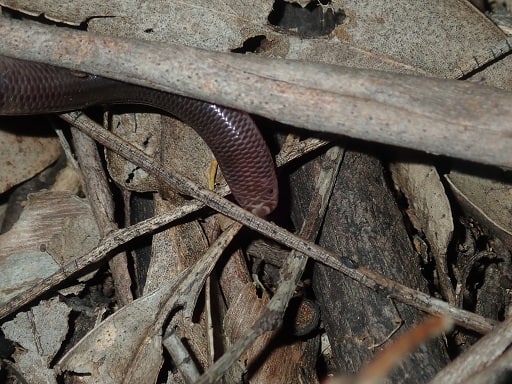
Maximum length: 75cm.
A common blind snake of eastern Australia, and a familiar species to local residents of Sydney and Brisbane. The blackish blind snake (Anilios nigrescens) spends the majority of its time underground, and its eyes have gradually shrunk in response to the diminished light. This species is a diehard ant-eater, which forces the swarming colonies into its mouth using a raking manouvre.
The blackish blind snake is completely harmless to humans. Its most “dangerous” weapon is a spiky tail which it pokes people with. Anilios nigrescens is one of the longer blind snakes worldwide, reaching a maximum of 75cm. However, this snake still falls victim to fellow Australian species, such as the small-eyed snake.
Blackish blind snakes are very discerning when it comes to their meals. They completely ignore the trails of earthworms and even termites, whereas trails of worker ants readily catch their attention. Popular prey include southern meat ants and banded sugar ants. Blackish blind snakes follow these trails back to the central ant colony, where they hit the motherload of mealtimes.
In a 1992 study, blackish blind snakes were able to follow scent trails that were weeks old as well as days old. However, they have some limitations, as they were poor at following the trails of individual ants, rather than commonly used pathways.
| 7 | Australian coral snake |
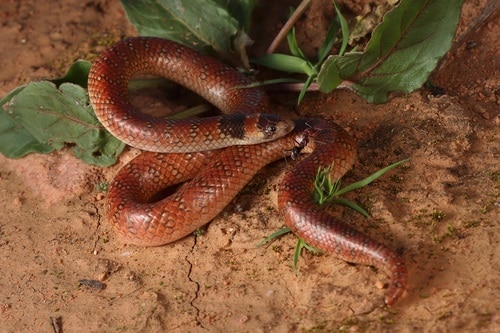
Maximum length: 50cm.
A 30-40cm snake which avoids dense forests, and prefers open woodland, dry grassland and arid scrubland. The Australian coral snake inhabits eastern Australia, but doesn’t hug the coastline like other species. It inhabits drier inland areas as well, such as gorges and dry creek beds.
Australian coral snakes (Brachyurophis australis) are identifiable by a jet black patch on the head, and then a second on the lower neck, combined with subtle white markings overlaying an orange body. Despite being an elapid like the tiger snake or eastern brown snake, this species’ venom has been reduced down to nothing. The Australian coral snake is no threat to humanity as a whole, or individual explorers lost in a dry canyon. They rarely bite even if picked up and manhandled (though we don’t recommend this).
Australian coral snakes have specialised teeth, with a serrated edge. The purpose of this is slicing into their main prey, namely reptile eggs, and accessing the nutritious white and yolk within. These comprise the majority of their diet. They also have an adapted snout with an upturned edge, designed for digging up those leathery reptile eggs, by sifting through soil to find the hidden stashes.
The Brachyurophis genus is most closely related to the Australian Simoselaps genus, also mildly venomous. However, the two are believed to have diverged 18 million years ago. Brachyurophis likely split from the more dangerous brown snakes and death adders 23 million years ago.
| 8 | Black-striped snake |
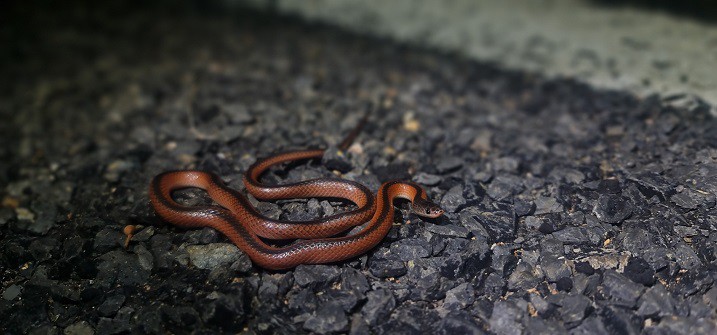
Maximum length: 61.5cm.
The black-striped snake (Cryptophis nigrostriatus) belongs to the same genus as the better known small-eyed snake (Cryptophis nigrescens), which lurks under rocks and eats a diet of 95% skinks. The black-striped snake lives further north, inhabiting Queensland exclusively, rather than east coast areas such as Sydney. It’s easily distinguishable from its cousin, due to its orange body overlaid with a thick black vertebral stripe.
Black-banded snakes average at 50cm long. Their habitats include woodlands and tropical sclerophyll forests, where they spend much of their lives burrowing, often lurking in the upper 10cm of soil. Like their cousin, most of their prey consists of skinks.
Few case studies exist on their venom, but one victim was struck 3 times in quick succession by a black-striped snake. The effects were reported as “mild”, with the victim experiencing painful stomach cramps and stiffness similar to arthritis near the bite site. The small-eyed snake has killed one person on record (in 1965), so it’s conceivable that this snake holds secret dangers.
Black-banded snakes lay live young, typically in batches of six. The stripe varies with this species. In some, it’s clearly demarcated against the orange, while in other individuals it fades in more gradually.
| 9 | Lake Cronin snake |
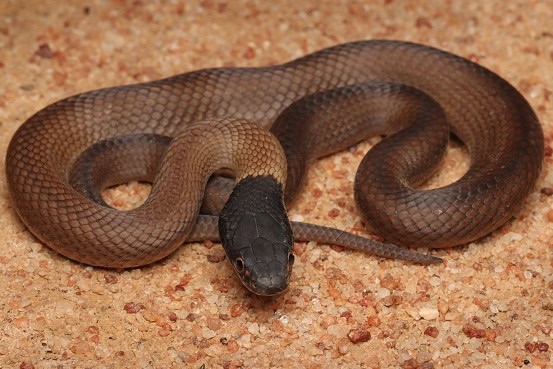
Maximum length: 82cm.
One of the rarest snakes in Australia. The Lake Cronin snake was discovered in 1979 in its namesake lake in southwest Australia, and only a few individuals have been discovered since. It’s a brown snake with a black head, which belongs to its own unique genus of Paroplocephalus. This is most closely related to the Hoplocephalus genus containing the rare broad-headed snake.
Nothing is know about the diet or predators of the Lake Cronin snake. Its wider habitat is the Great Western Woodlands region, and it may be a partial tree climber, judging by a shed skin found 1.5 metres high in a gum tree.
This snake might be rare, but that doesn’t make it cute or harmless. In fact, the Lake Cronin snake bit someone on the very day it was discovered.
In October 1979, a 24 year old scientist was bitten on his fingers by a strange brown snake, and initially brushed it off. 15-30 minutes later, he experienced a headache, vomiting and sweating all over his body. He arrived at the hospital, where tests revealed low levels of the blood clotting agent fibrinogen and high levels of fibrinogen degradation products. There was little myotoxicity (muscle tissue toxicity) or neurotoxicity. The man was released within 24 hours, and made a full recovery.
| 10 | Variable black-naped snake |
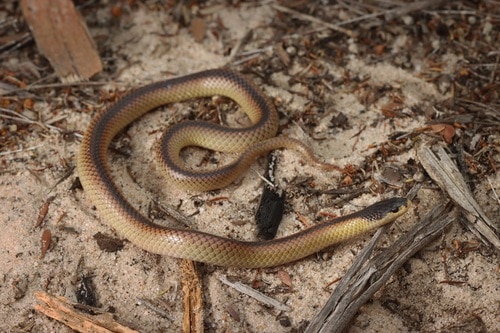
Maximum length: 55.8cm.
A small snake which ordinary Australians can easily walk past on a weekend trip through the woods. Variable black-naped snakes (Suta dwyeri) average at just 25-35cm, and inhabit eastern Australia, with a recognisable black head against an earthy-beige body. Their habitats include woodlands and dry sclerophyll forests, especially those with plenty of loose rocks and rocky outcrops.
This species is a big fan of shelter and cover objects. In the wild, they hide under rocks and fallen woodland debris, as well as abandoned mammal burrows. They’ve also been found on the outskirts of towns like Conargo, lurking under sheets of corrugated iron.
Variable black-naped snakes aren’t aggressive in nature, as when cornered, they prefer to coil up into a tight ball, protecting their most important body part: their brain. Their venom is mild and non-lethal, but be warned: they’re capable of leaving a deposited fang embedded in your finger.
One man was bitten on his right thumb just below the knuckle. The black-naped snake hung on for 3-4 seconds, and 6 hours later, the man’s thumb stiffened, and the surrounding skin became sensitive to touch. The symptoms didn’t spread beyond the thumb, and they abated within days.
Variable black-naped snakes virtually never strike at people from a distance, but rapidly enter bite mode if picked up and manhandled. This is another reptile-eating snake, with prey including geckos and skinks.
| 11 | Red-naped snake |
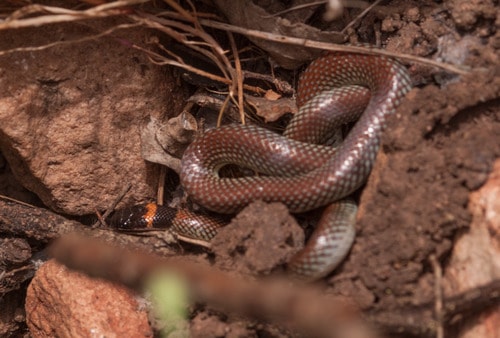
Maximum length: around 45cm.
Australia has a disproportionate amount of snakes with orange-brown bodies, followed by a black head or neck. This list alone has several, but the red-naped snake (Furina diadema) has one clear ID sign: the namesake red patch between the two black patches higher up.
Red-naped snakes are especially common in suburban Brisbane, where they mingle with surprised citizens. They sometimes fall into backgarden swimming pools, or are dragged through the cat-flap by feline pets.
In urban areas, red-naped snakes can be found by ripping up sheet metal, assorted backyard rubbish and timber piles. In the wild, they can be found by rummaging through thick beds of leaf litter, which they love to lurk in, in order to pounce on unsuspecting skinks walking past.
This snake sometimes appears in communal formation, with several gathering in the same spot. Scientists visited a sheet of corrugated iron in Menangle, New South Wales 14 times over 32 months, and each time they found 6-8 red-naped snakes lurking comfortably below. They’ve also been found sharing hibernation sites with the yellow-faced whipsnake.
Staying out of sight is the red-naped snake’s top survival priority. This is a nocturnal species which will never be found striding through a sunny street during broad daylight, like an eastern brown snake. If frightened, they have two choices: 1) make repeated bluff strikes with their mouths closed, or 2) vanish into soil cracks. Bites are rare, though not unheard of, and their venom is mild.