| 1 | Persian horned viper |
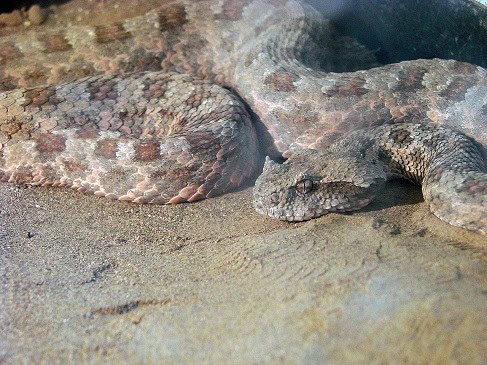
Maximum length: 129cm.
Perhaps the most common viper in southern Iran, this species is recognisable by its beige desert shades and namesake horns. Persian horned vipers (Pseudocerastes persicus) often exceed 100cm, and inhabit the vast majority of Iran except the cooler northern areas near Tehran.
This is a species of dry-semi deserts, with an abundance of rocks and mammal burrows to hide in. The Persian horned viper is an aggressive species, immediately shifting into a coiled position and hissing loudly when discovered. Its venom is typical for a viper, with an abundance of anticoagulants which disrupt blood clotting. Unlike Field’s horned viper in Israel, this snake possesses virtually no neurotoxins. A 2023 report revealed extensive swelling in a human victim, but no systemic symptoms.
Persian horned vipers are smarter than average, as they take special care to avoid the highest temperatures, in order to avoid death by desiccation and crispiness. When hunting, they often hide in dark crevices within jumbled limestone rock formations, waiting for their lizard and rodent prey to scamper past. When tired, they retreat to a cool mammal burrow. It’s believed that Persian horned vipers use one burrow as an established den over a period of time.
This species is part of the small Pseudocerastes genus, and of the 3 members, it easily has the largest territory, spreading from Oman to Iran to Pakistan. The other two Pseudocaerastes members are the spider-tailed viper, found exclusively in Iran (scroll down), and Field’s horned viper, found in southern Israel and eastern Egypt.
| 2 | Dark-headed dwarf racer |
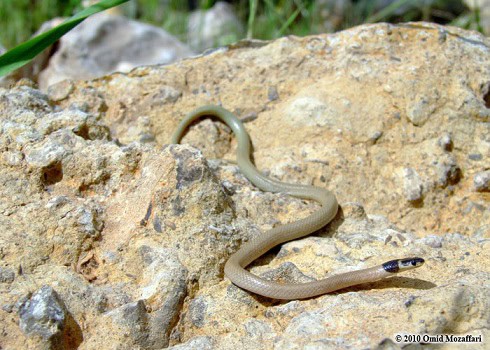
Maximum length: 37.1cm.
This harmless, non-venomous snake inhabits most of western and southern Iran. Dark-headed dwarf racers (Eirenis persicus) measure 27-35cm, with a maximum of 37.1cm, and are instantly recognisable by their namesake black head. This snake appears at altitudes ranging from 500-2500 metres, primarily in grassy, hilly country, and sometimes lightly wooded mountain areas.
Dark-headed dwarf snakes are harmless, but extremely difficult to get close to, as they instantly flee when approached. Compared to other Iranian snakes, they’re almost unbeatable for identifying and instantly vanishing into dark holes. To accomplish this disappearing act, Eirenis persicus is a particularly fast-moving species for its size.
This is a species which finds you, not vice versa. If you deliberately tried to find the dark-headed dwarf snake, you’d probably die of thirst, as its hilly, dry terrain is so enormous. Each sweeping vista or village hillside in southern Iran could hold dozens of this species, completely unseen. Its diet includes large insects such as crickets and grasshoppers, similarly to the Eirenis members in Turkey.
Originally, the black-headed dwarf snake was thought to be extremely widespread, ranging all the way to northeast India, but in 2015, it was broken down into 6 species. New members included Eirenis occidentalis of southeast Turkey, and Eirenis angusticeps of northeast Pakistan and parts of the Himalaya. However, Eirenis persicus remained the main species in southern and western Iran.
| 3 | Spotted desert racer |
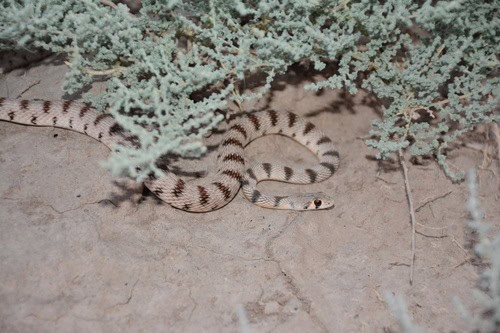
Maximum length: 94cm.
This species is found in most of Iran, as well as northwest Pakistan, Turkmenistan and Uzbekistan. The spotted desert racer (Platyceps karelini) poses no threat to humans, and mainly inhabits dry open territory. This includes semi-deserts, gravel slopes, dry foothills, grassland and sometimes agricultural land.
Spotted desert racers lack the power to kill, but they do have one special feature: they’re the most likely Iranian snake to release a vile snake musk that forces everyone to leave the vicinity. They also have a mildly toxic saliva, which they use to subdue their mainly lizard prey, but this is too weak to cause serious damage in humans. Bites are said to itch for a few hours and little more.
Spotted desert racers typically measure 65-75cm. This species has large round eyes, and a jet black patch below each eye. which then blend together to make their eyes look even larger from a distance. This is a fast-moving snake which is quick to escape if cornered.
Spotted desert racers appear at a variety of altitudes, from sea level up to 2500 metres. With their dense black blotches contrasting sharply against a sandy base, this is one of the easier Iranian snakes to recognize.
| 4 | Spider-tailed viper |
Maximum length: 86cm.
One of the most nightmarish snakes, as it combines two primitive human superstitions: the fear of snakes (ophiophobia) and the fear of spiders (arachnophobia). Spider-tailed horned vipers exceed 80cm in the largest individuals, and are the rarest of the 3-member Pseudocerastes genus, as they inhabit only a tiny portion of southwest Iran, and possibly Iraq just over the border.
Spider-tailed horned vipers (Pseudocerastes urarachnoides) occur in rocky semi-deserts, and on the sheer faces of rocky hills, with minimal vegetation except for the occasional dry shrub. Their diet seems to contain birds exclusively, and they use a unique strategy to obtain them: a tail with modified scales designed to resemble a spider.
With 8 enlarged spines, mimicking 8 dancing legs, this is the most bizarre tail in the snake kingdom, or even entire reptile kingdom. They carefully position this tail on a rock slab, making sure to keep their body hidden. When interested birds swoop in for a meal, fooled by the deception, the spider-tailed horned viper pounces.
Unlike the Persian horned viper, this species holds on tightly to its prey after envenomation, rather than using a strike-and-release strategy. This spider-tail only develops with age, as juveniles lack it completely.
Pseudocerastes urarachnoides is believed to have diverged from the Persian horned viper 8 million years ago, after the pair diverged from Field’s horned viper (Israel, Egypt) approximately 12 MYA. The three members have unusually dissimilar venom for such closely related snakes.
Persian horned viper venom is heavily anticoagulant, while the Field’s version specialises in neurotoxins. Meanwhile, the spider-tailed horned viper lacks neurotoxins, and has a mainly procoagulant venom, stimulating factor X and prothrombin. This depletes important clotting factors and forms weak clots throughout the body, leaving no supplies left to clot actual wounds. The savage result is uncontrollable bleeding.
| 5 | Eastern black desert snake |
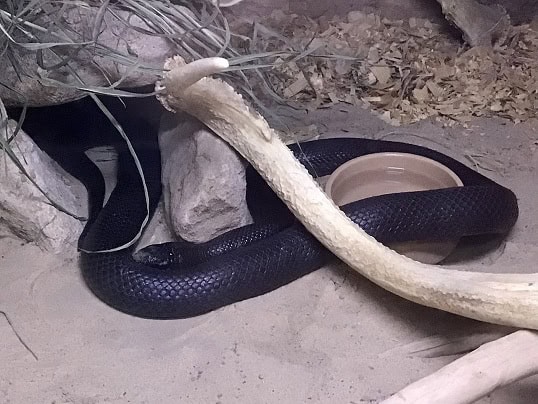
Maximum length: 130cm.
A close relative of the true cobras (Naja genus), but actually part of the 2-member Walterinnesia genus. This species is incapable of spreading a classic cobra neck flare. Originally, Walterinnesia contained one species, the black desert cobra (Walterinnesia aegyptia) which inhabited Egypt and a huge swathe of the Middle East. In 2007, however, this was separated into a western and eastern species, and the latter is what inhabits Iran, specifically western and southern Iran.
Eastern black desert cobras (Walterinnesia morgani) average at 50cm, yet can reach much larger maximum sizes of 130cm. While their venom glands are overflowing with neurotoxins, they cause relatively few bites due to their elusive nocturnal lifestyle.
Some nocturnal snakes such as the jararaca in Brazil are most active around dusk, but black desert cobras are most active at midnight, preferring the absolute dead of night. As darkness falls, they emerge from their desert hideyholes and pursue their skink and gecko prey, unseen by humans. Their favourite habitats are rocky, gravelly deserts, and they can reach altitudes of 2000 metres.
While rare, bites are typically lethal, as an Israeli girl died after accidentally sitting on the western version, succumbing at 20 hours post bite. This species is purely black, and moves quickly through the desert, though fortunately, this speed is usually directed away from you, typically into the safety of a dark burrow rather than hurtling towards your face.
This species has another claim to fame. Of all Elapid snakes (cobras, sea snakes, coral snakes, mambas), Walterinnesia morgani reaches the closest to continental Europe, just entering southeast Turkey. Millions of years ago, fossils from France reveal that Europe had its own native cobra: Naja romani.
| 6 | Levantine viper |
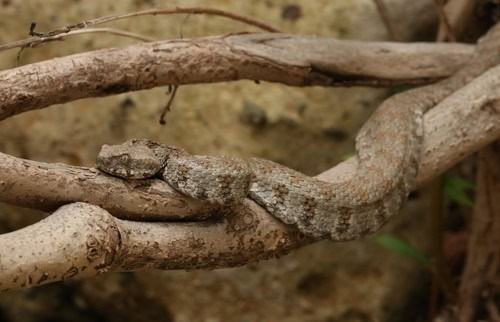
Maximum length: 230cm.
One of Iran’s most widespread vipers, and the one responsible for the most bites. The Levantine viper (Macrovipera lebetinus) is abundant in northern Iran, including near the capital Tehran. This is a large viper which can reach 230cm, and studies suggest a far deadlier venom than the desert-dwelling Persian horned viper further south. Its venom reduces kidney functionality, leads to hemostatic disturbances, and can cause extensive tissue necrosis and swelling.
A 2021 review analysed 5 bite cases from Iran, including a 15 year old boy who was bitten by an 80cm Levantine viper on the palm of his hand. Within 12 hours, swelling had spread to cover his entire arm, reaching his shoulder. The boy was hospitalized for 13 days.
Other symptoms include nausea, vomiting, fever and trembling. Levantine vipers can appear in grassland, gorges, river valleys, hillsides with scattered trees. They’re often found in areas with shallow rocky streams, which they bathe in on hot, sunny days to cool their bodies. Likewise, on the hottest days, they’re often found in the cool shade below trees (watch out). Levantine vipers commonly appear in agricultural areas, where they feed on brown rats darting between the rows of crops.
This species isn’t even close to endangered. As a widespread snake, ranging from Cyprus to Pakistan, Levantine vipers are divided into 6 subspecies. Iran hosts two: Macrovipera lebetina obtusa in most of the north, which has relatively dark colours, and M. lebetina cernovi in northeastern Iran.
| 7 | Glossy-bellied racer |
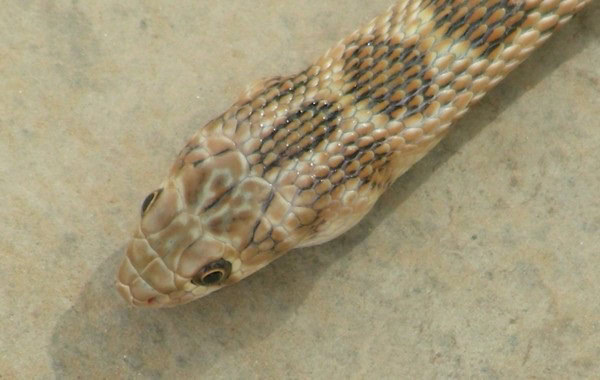
Maximum length: 109cm.
A fast-moving snake which is extremely tricky to catch, slipping through your fingers at the last second. Glossy-bellied racers (Platyceps ventromaculatus) are most common in southern Iran, as well Iraq to the west.
This species inhabits a variety of habitats, including agricultural land, bushy territories and even urban zones. They’ve been found on islands like Sir Bani Yas in Abu Dhabi, and apparently birds are terrified of them. When a glossy-bellied racer was spotted nestled in a Sidr tree, several white-cheeked bulbuls let out loud alarm calls. Birds are an occasional part of their diet, with geckos and lizards dominating.
Glossy-bellied racers are strong climbers, as they also slither up the sides of buildings, even being discovered on third floors. They’ve been found in the marshlands of southern Iraq too, which also cover extreme southwestern Iran. Male are slightly longer, at a maximum of 109cm, versus 100cm for females.
The glossy-bellied racer is one of Iran’s most flexible snakes, although they tend to appear at altitudes of below 500 metres. To the east, they also inhabit Afghanistan and northeast India, though it’s possible that this is secretly a closely related separate species. The glossy-bellied racer has never killed a human being in recorded history.
| 8 | Latifi’s viper |
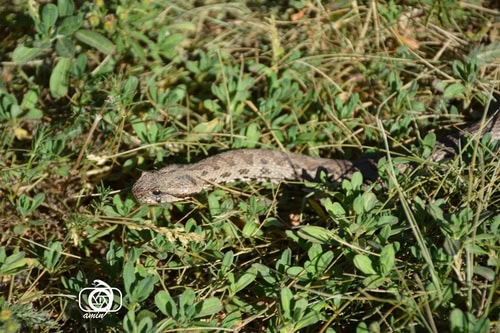
Maximum length: 78cm.
An endangered snake, which is endemic not to just Iran, but northern Iran, in temperate areas east of the capital Tehran. This dangerous species belongs to the same Macrovipera genus as the Levantine viper, but is far rarer.
Latifi’s vipers live only at altitudes of 1800-2900 metres, and exist in 10 fragmented pockets in the Alborz Mountains. They’re adapted to high altitude, relatively cold habitats, including alpine meadows and rocky scree slopes with occasional vegetation poking through. Overgrazing by cattle is one of their main threats, as well as illegal hunting.
Male Latifi’s vipers are slightly longer, at a maximum of 78cm versus 70cm in females. Their diet seems to consist of mammals. When offered reptiles in captivity, including native Persian long-tailed desert lizards, they refused to accept them, but they happily swallowed standard house mice and Norwegian rats.
This is a very dangerous snake. If you find a Latifi’s viper after a long, grueling search, you should always celebrate while standing well back. A brutal 2022 case resulted in death, as a 15 year old girl was bitten on the chin, only for her parents to misreport it as a wasp sting. Her face swelled up, followed by her airways, resulting in hypoxic brain damage. Only when an expert spotted two fangs marks on her chin was antivenom administered, but it was too late, and the girl died 3 weeks later. Being endangered hasn’t removed any of their dark powers.
| 9 | Derafshi snake |
Maximum length: 45cm.
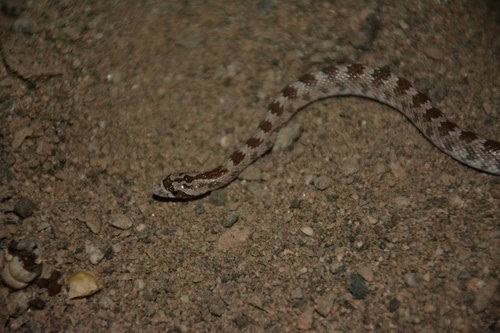
A timid snake which poses no threat to human beings. Derafshi snakes (Lytorhynchus ridgewayi) measure 30-35cm on average. They’re nocturnal in nature, and appear in a large swathe of southern and eastern Iran, though they’re absent from northern areas such as near the capital Tehran.
This is a snake which shuns civilised forests and grasslands. Their territories include dry, rocky slopes, arid semi-deserts and gravelly plains. They’re also found on semi-vegetated sand dunes. Their prey must be able to cope with these arid landscapes, and therefore mainly consists of lizards and geckos.
The Derafshi snake seems to be copying vipers, to protect itself using fear and illusions. It has similar beige-brown shades to many vipers, and a somewhat triangular head. Though difficult to see, the Lytorhynchus genus is also known as the leaf-nosed snakes due to a strange appendage on members’ faces.
This photo shows another classic ID sign: a brown, anchor-shaped marking atop their head. Derafshi snakes lack any real skills, with the exception of flattening their rounded body to appear larger. They have smooth glossy scales, and a blue iridescence when exposed to light.
| 10 | Collared dwarf snake |

Maximum length: 40.3cm.
Another member of the 23-strong Eirenis clan. The collared dwarf snake (Eirenis collaris) is found in northern Iran, including near Tehran, where it often coexists with the European worm snake (a harmless blind species).
Collared dwarf snakes are also found in Azerbaijan, Armenia and Georgia. Like other Eirenis species, this snake is typically found resting under loose rocks and dry bushes, always gravitating towards shelter, rarely straying across open ground where a bird could spot its black neck, and rapidly swoop in for a tasty meal.
Collared reed snakes appear in dry areas such as parched plains and dry semi-deserts. But they’re also sometimes found on grassy slopes in oak woods, fields and manmade plantations. This is a confirmed communal snake, as several individuals can sometimes be found resting together in underground hibernacula 50cm below the surface. This species poses no threat to humans, though it does pose a threat to scorpions, centipedes and worms, its main prey.
At first glance, this species is very similar to the dark-headed dwarf snake. Firstly, the collared dwarf snake lives further north overall, spilling well beyond Iran’s northern borders. Secondly, this species has significantly less black on its head. There’s mainly a jet black neck band, with a few more markings on the head, whereas in Eirenis persicus, the blackness covers a greater area, sometimes even covering the entire top of the head.
| 11 | Long-nosed worm snake |
Maximum length: 31cm.
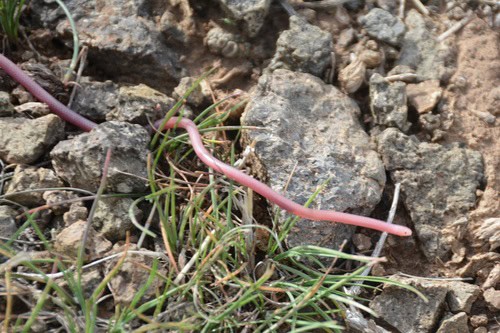
A tiny blind snake, which averages at 20-25cm, and preys on a mixture of ants, termites and soft-bodied insect larvae. This species is also known as the hook-nosed blind snake due to its downwardly pointed snout, which is easy to see in the palm of your hand.
Long-nosed blind snakes (Myriopholis macrorhyncha) are found in a variety of habitats, including dry woodlands and soft-soiled agricultural fields, particularly along field edges. They have a vast empire worldwide, ranging from Kenya in the far south to southern Turkey in the north. In Iran, they’re found in most of the country except the northeast.
Hook-snouted blind snakes have no teeth on their lower jaw, and a spine-like appendage on their tail. Their eyes are shrunken due to their underground lifestyle, and they have smooth and slippery skin to touch. This species only emerges from its underground hideyholes at night, and you’ll never find them gliding confidently down a Tehran street. This species has a huge territory, but Iran itself was host to two of the longest hook-snouted worm snakes to date, which measured 28cm and 31cm, caught in 2020.
This is a hotly debated species, as Myriopholis macrorhyncha is so widespread that scientists believe that it probably contains several related species. There’s a clear physical difference, as those in Africa are brown, while the Eurasian versions (including Iranian) are translucent pink, with even their internal organs visible.
Preliminary investigations suggest that the true hook-nosed blind snake is found in Africa, meaning that the Iranian populations may be granted a name change in the next few years. Either way, this is a likely snake for an Iranian farmer to accidentally plough up in his field.