| 1 | Ashe’s spitting cobra |
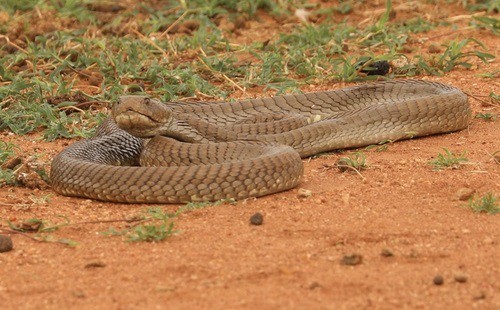
Maximum length: 274.3cm.
One of the most dangerous snakes in Kenya, alongside its red spitting cobra relative. Ashe’s spitting cobra has two lethal powers: 1) the ability to spit venom globules at people’s eyes, and 2) a lighting fast strike which injects their usual cobra venom.
Ashe’s spitting cobras (Naja ashei) are found in drier areas of eastern and northern Kenya, favouring semi-deserts, coastal thickets, and dry savannah. They were only made an official species in 2007, when they were split from the black-necked spitting cobra due to their blatant colour difference. With a record of over 2.7 metres, this is the largest spitting cobra worldwide.
Ashe’s spitting cobras are able to eat other venomous snakes, including the puff adder (Bitis arietans) and even their red spitting cobra cousin. White-throated savannah monitors are also confirmed prey. Ashe’s spitting cobras like to dash around the Kenyan countryside in a manic state, but they also take shelter in vacant underground burrows and termite mounds.
Mount Kasigau, Kenya, is a confirmed hotspot for this species. Bite symptoms include blistering, swelling, necrosis, and other local tissue damage. Their venom contains an ingredient not found in other spitting cobras: cobra venom factor, comprising 0.12% of total toxins. This inhibits complement C3 protein, thus weakening the body’s healthy inflammatory and immune responses.
Otherwise, Ashe’s spitting cobra is similar to its cousins, containing 69% three finger toxins, and 27% PLA2s. Generally, spitting cobras are significantly less neurotoxic than other cobras, specialising in local tissue destruction.
| 2 | Montane egg eater |
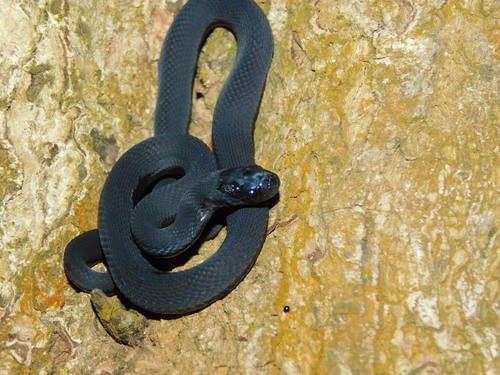
Maximum length: 110cm.
There are many Dasypeltis egg-eaters in Africa, but the montane egg eater (Dasypeltis atra) controls northern Tanzania, a chunk of Kenya, and Uganda. Montane egg-eaters are found above 1500 metres, in high altitude forests or savannah, up to altitudes of 2800 metres. This includes the hills near the capital Nairobi, located at 1795 metres above sea level.
This species is a master egg-eater, swallowing both freshly laid eggs and those containing half-matured embryos. Montane egg eaters initially swallow their eggs whole, with a huge bulge like a bowling ball moving down their throat. They then writhe and flail around, cracking the shell with their sharpened vertebrae. The nutritious liquid spills into their belly, while the flattened and crushed shell is regurgitated.
This is a nocturnal species, which retreats to tree hollows and abandoned birds’ nests by day. Montane egg eaters are completely harmless to humans, as their teeth are way too tiny to inflict serious damage. Instead of attacking, they try to intimidate their enemies by gaping their mouths wide, showing off a rich, velvety black inside. They do this while performing repeated mock strikes, praying that the predator doesn’t call their bluff.
While they’re most concentrated in the high plateau of southwest Kenya, montane egg eaters are also found in the Taita Hills of southeast Kenya, as discovered in 2015. Another of their hotspots is the forested slopes of Mount Kenya. This snake has many colour morphs, as a large chunk are car tyre black like above, while others are sandy beige to blend with bare soils, or brown overlaid with fine white markings.
| 3 | Mount Kenya bush viper |
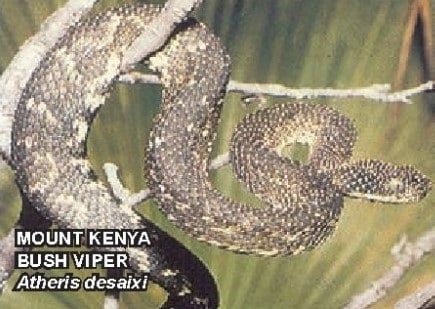
Maximum length: 70cm.
Mount Kenya is the nation’s highest peak, reaching a summit of 5199 metres, just below Mt Kilimanjaro, Africa’s highest mountain at 5895 meteres. It’s a popular tourist destination, but if you wish to climb this towering peak, you must first tiptoe past a deadly guardian: the Mount Kenya bush viper, AKA Atheris desaixi.
This species is extremely rare, and clings to low tree branches for most of the day, in patient ambush posture. Mount Kenya bush vipers are confirmed in just two locations: the southeast flanks of Mount Kenya itself, and the Nyambeni mountain range just to the northeast.
Mount Kenya bush vipers begin life as a plain yellow colour, with a white tail tip. In adulthood, they develop grey-green scales, each with a pale edge, which combine to create a spotted appearance.
Though armed with a destructive anticoagulant venom, which likely triggers haemorrhaging in victims (though no detailed reports exist), Atheris desaixi has other defensive tricks to deploy. They often rub their keeled scales together to produce a loud sawing noise, like the saw-scaled viper of India. This species is generous, as they at least try to give encroachers on their secluded forest slopes a warning.
Captive keepers have noticed how Mount Kenya bush vipers cease this nervous sawing as they gradually grow comfortable in their terrarium. This branch-dwelling viper is one of Africa’s rarest venomous snakes. As far as we know, they’re found exclusively in southwest Kenya.
| 4 | Rukwa sand racer |
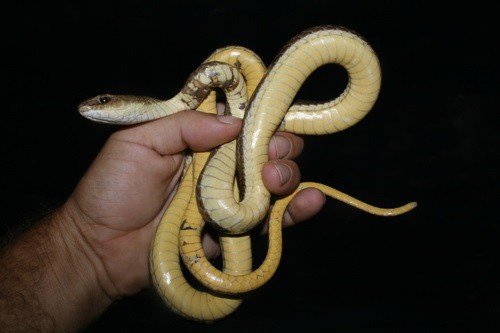
Maximum length: 147.8cm.
One of the Kenya’s rarest snakes, with only scattered records across eastern Africa. The Rukwa sand racer (Psammophis rukwae) has a large empire, stretching from southern Chad to Tanzania, with Kenya lying squarely in the middle, yet its confirmed locations often have hundreds of miles between them. This species is thin-bodied, and reaches a confirmed maximum so far of 147.8cm, discovered in Kafukola, Tanzania.
This is a fast and twitchy snake, which is believed to use its agility to chase down lizards across the majestic African flats, before wrestling them down its throat. Despite their name, Rukwa’s sand racers prefer habitats with some moisture rather than bone dry deserts. They’re most likely to be found in flood plains, grasslands and savannahs, avoiding forests.
This species is nearly always brown and beige, with a couple of distinct morphs. One is plainer, while the other has darker, parallel stripes stretching down its body. Another strong ID sign is a plain yellow belly, like in the image above.
Rukwa’s sand snakes have smooth scales to touch, although with their rapid speed, touching them is very difficult. Their pupils are round, and they move by day, hunting lizards using their advanced eyesight. Of the 33 Psammophis members, this is easily one of the most poorly researched.
| 5 | Olive marsh snake |
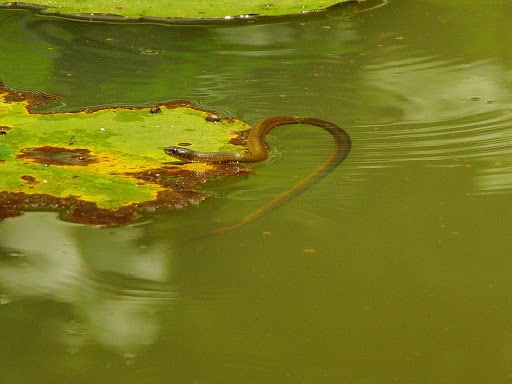
Maximum length: 60cm.
A harmless water-loving snake with round pupils, which is particularly common in southwest Kenya, but appears all over the south as well. The olive marsh snake (Natriciteres olivacea) is a species of rivers, lakes, swamps, and of course marshlands, usually within moist savannahs.
Olive marsh snakes have a large territory, stretching from Ethiopia to Mozambique. They’re reasonably flexible in their habitats, but won’t appear without sufficient water to duck, dive and swim around in. The exception is rainy season, when the increased water sloshing around the Kenyan countryside allows this species to travel far and wide.
Olive marsh snakes are placid, and rarely attempt to bite. Their diet consists of frogs, tadpoles, small fish and frogs’ eggs, and they appear from sea level to a maximum altitude of 2200 metres. In northern Mozambique, the local people refer to them as Kaputi.
This species varies significantly in colour, as those near Mount Meru in Tanzania are bright green overlaid with maroon stripes, while a handful from the Congo have been pure black. Olive marsh snakes have an average adult length of 35cm, and lay an average of 3-11 eggs per clutch. If grabbed by the tail, they suddenly rotate their body, in order to detach their own tail and escape by the skin of their teeth. A 1987 survey found that 43.6% of olive marsh snakes examined had missing tails.
| 6 | Sudanese sand snake |
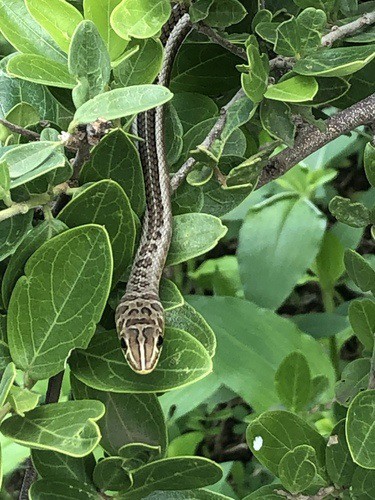
Maximum length: 132.5cm.
Another fast, whippy snake, which charges down its prey and forces them down manually. Sudanese sand racers (Psammophis sudanensis) inhabit both moist and dry savannah, coastal thickets and high altitude grassland. They range from 0 to 2700 metres above sea level, and pose little threat to human beings. They mainly inhabit western Kenya, as well as northern Tanzania, where they zip past lazy puff adders and weave skillfully through the legs of zebras (possibly).
This species closely resembles the Rukwa sand racer, and belongs to the same Psammophis genus (which has 33 members), but is a fully distinct species. This time, nearly all individuals are adorned with parallel stripes running lengthways down their body, with stony grey contrasting against a lighter grey and beige. The longest male Sudanese sand racer measured 121.0cm, while females are slightly longer, at an all-time species record of 132.5cm. Both were recorded in Torit, South Sudan.
The Sudanese sand snake is one of a handful of species worldwide known to rub a strange secretion over its scales. They rub in this strange substance using their nose, as though waxing themselves. This is one of the serpent kingdom’s great mysteries, although one theory is that this substance prevents moisture loss, in scorching arid environments.
Sudanese sand snakes can be very abundant in certain locations. In one herpetological survey of the savannahs of Chad, they were the single most common colubrid snake, making up 17% of 1010 colubrids collected. There’s also a distant outpost in western Africa, over a thousand miles away, where the species is far scarcer.
| 7 | Israeli catsnake |
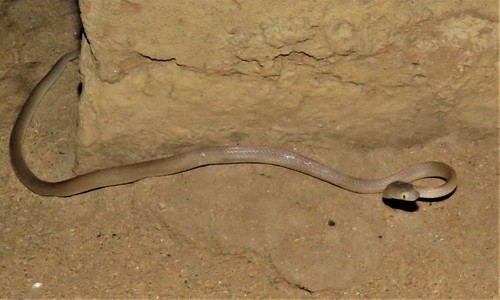
Maximum length: 100cm in east Africa, 110.5cm in Egypt.
A species of parched and dry areas, rather than lush forests. This is a mildly venomous snake with a very thin body, but a large round head, resembling the handle of a whip.
The Israeli catsnake (Telescopus dhara) is a species with a large, sprawling territory. Despite the name, they stretch from Oman and the UAE, through Egypt and Somalia, all the way to Kenya and northern Tanzania, which lie at the southernmost extent of their territory. Unlike many of this list, this species avoids southwestern Kenya, instead appearing in the dry semi-deserts and savannah further north and east.
Telescopus dhara is a thoughtful and deliberate snake, which never dashes around in a rush like Ashe’s spitting cobra. Nevertheless, they’re not cowards either, and will rear up, hiss and strike at opponents if their comfortable danger threshold is exceeded. No human deaths are known, but few bite reports exist at all. This is a nocturnal species, which retreats to the safety of dry rock cracks by day.
In East Africa, the record length of Telescopus dhara is 100cm, and the average 50-80cm. One of their confirmed prey is the Kenyan rock agama (Agama lionotus).
| 8 | Red-spotted beaked snake |
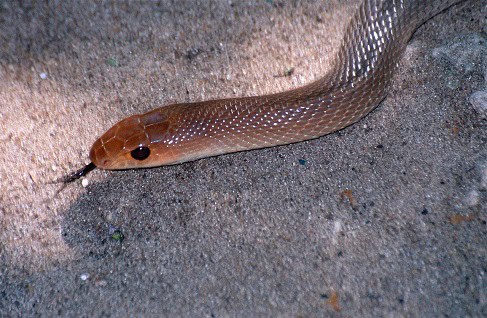
Maximum length: 240cm.
A snake of drier areas rather than forests, including semi-deserts and dry savannahs. This species occupies northern Tanzania, much of Kenya, and a swathe of Somalia. Red-spotted beaked snakes (Rhamphiophis rubropunctatus) are especially common along the eastern Kenyan-Tanzanian border, lurking in coastal thickets and scrubland.
This species is quietly one of east Africa’s larger snakes, reaching up to 240cm. The namesake red spots are found mainly in youths, or sometimes on their flanks, on the border between their pale ivory belly and redder body.
This species should really be called the red-headed beaked snake, as the redness suddenly gains intensity at the head, and this may be their most obvious ID sign. They also have especially round and black eyes, which contrast sharply against their red head, as well as a black tongue.
This is a venomous snake, secreting its toxin mixture via rear fangs. The exact chemical profile and lethality of this venom remains a mystery. Red-spotted beaked snakes are also capable of spreading a small hood, mimicking a cobra.
This is another species to rub its body with a strange waxy substance. Scientists even timed this rubbing behaviour in one study, and found it to last 154 seconds per average session.
| 9 | Tana Delta smooth snake |
Maximum length: 50cm (so far).
A snake which has not been seen for 90 years. The Tana Delta smooth snake (Meizodon krameri) is known from just 2 specimens, discovered in 1934 near the Kenyan villages of Kau and Golbanti, in the Tana River Delta region.
In 1985, these stored individuals were reanalysed and declared to be not Meizodon regularis, as originally thought, but an all new species. They differed by having fewer ventral (belly) scales, and 26 maxillary teeth versus 23. The two 1934 snakes measured 32cm and 50cm.
It was official – Kenya had a new snake species. Yet since 1985, this species has seen no update. No new individuals have been discovered, whether by accident or a dedicated survey.
The Tana Delta smooth snake may be extinct, but it’s more likely a master at flying under the radar. The Meizodon snake genus is especially secretive. The most widespread member is the semiornate snake (Meizodon semiornatus) of Mozambique and South Africa, yet even this is rarely encountered by villagers, such is their liking for cover objects like logs and rotting leaves.
Meizodon members are uncomfortable when exposed, and this is why the Tana Delta smooth snake remains hidden till this day. Bookmark this snake in your mind for a future “lost snake rediscovered” media frenzy, so that you can smugly inform your friends that you’ve already heard of it.
| 10 | Battersby’s green snake |
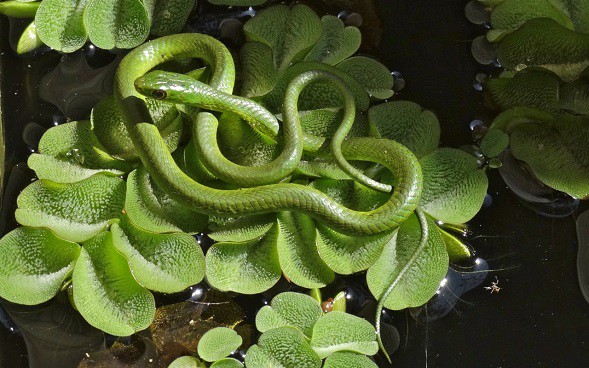
Maximum length: 90cm.
A water-loving species, which is abundant around the capital of Nairobi. Battersby’s green snake (Philothamnus battersbyi) is a pure green with no patterns, varying from duller light green to a full grassy green like above. Spotting one is a hopeless task when in the middle of juicy reeds, water-lillies and thick riverside vegetation. There’s a small white base to each scale, but this is only visible when they inflate their body as a defensive warning.
Battersby’s green snake is a climbing species, but is almost always found in bushes or trees close to a water body. They also have the power to hunt underwater. This species has no dangerous venom, but Battersby’s green snake has sharp teeth, and knows how to use them. When biting, they wrestle their head from side to side, creating deeper and more extensive lacerations.
This species reaches a maximum of 90cm, and their large bulbous eyes are one memorable feature. They’re also common in Rubondo Island National Park, in Lake Victoria in far northern Tanzania.
This is a close relative of South Africa’s green watersnake (Philothamnus hoplogaster), but while equally green, that species has a higher number of ventral (belly) scales than P. battersbyi.
| 11 | Peter’s burrowing asp |

Maximum length: 1.1 metres, possibly 1.3m.
A deadly venomous snake which thankfully lives well away from towns and cities. Peter’s burrowing asp (Atractaspis fallax) is a heavily fossorial species, with strong burrowing capabilities.
This species shuns forests, preferring more open areas with moderate vegetation cover. Peter’s burrowing asps are found in grassland, both wet and dry savannah, coastal thickets and semi-deserts. Savannahs below 1000 metres are their most common location.
This species isn’t rare, and can reach high numbers in southern Kenya. Like other Atractaspis members, they’re strictly nocturnal, and hide in underground tunnels during the day. If heavy rains batter the Kenyan countryside, then Peter’s burrowing asp will wait patiently until sunset, and venture to the surface to hunt for snakes and lizards.
This snake has some particularly cool nicknames. In Somalia, it’s known as Jilbris, or the 7-step snake, referring to how long you can stagger away before dying. An even better nickname is the “father of ten minutes”. Peter’s burrowing asps prey on fellow snakes, as this image shows one assaulting a Kenyan sand boa.