
| 1 | Black-necked spitting cobra |
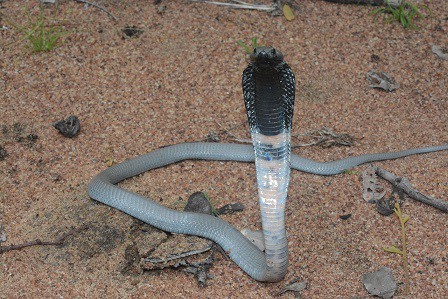
Maximum length: 240cm.
The most common spitting cobra in Africa, inhabiting a massive chunk of the continent’s centre. The black-necked spitting cobra (Naja nigricollis) is nocturnal, and likes to hang out in hollow tree trunks and old termite mounds. They also like to spit venom in people’s eyes, and each globule contains 9.75mg, easily beating the red spitting cobra of Ethiopia, which averages at just 2.64mg. The black-necked spitting cobra can spit 57 times in 20 minutes without tiring.
This species ranges from the Atlantic coast in Gambia, all the way to the Pacific ocean in Tanzania. Inbetween, they inhabit countries such as Nigeria, Angola, DRC and Ghana, and are feared in all of them. Locals have many folk remedies which they rub into their eyeballs, from human breast milk to a shrub called Indigofera pulchera.
As well as temporary blindness, the venom has weirder effects, as one man suffered from an eyeball so numb that doctors could poke it painlessly. The bite is equally nasty, killing 5-10% of untreated victims. Nigerians often mistake this cobra for a black mamba, which they’re wrong about, but they’re still correct when they rush inside and lock their doors in a panic.
The black-necked spitting cobra is as dark as you’d expect, except the belly, which is a brain pink. This species regularly uses the signature neck flare of all cobra species.
| 2 | Philippine spitting cobra |

Maximum length: at least 160cm, possibly 200cm on certain islands.
This potentially lethal snake occupies the northern areas of the Philippines, including the large island of Luzon. Its colour varies significantly, from a baked brown to almost black mixed with banana yellow. The Philippine spitting cobra (Naja philippinensis) requires water to survive, but can appear in most water body types, including ponds, rivers or large puddles in agricultural fields.
The Philippine cobra is regarded as one of the world’s most dangerous snakes. Instead of the cloudy mist of a black-necked spitting cobra, this species sprays its venom in dual thin jets. A Philippine cobra can accurately spray a pair of eyes from 3 metres away, so if you open you bathroom door to find one staring at you, the situation is truly dire.
Their main venom, meanwhile, has a unique toxin profile. Modern spitting cobras originated from a common ancestor 6.7-10.7 million years ago, but Naja philippinensis has separated from the pack to have a particularly neurotoxic venom, which rarely causes necrosis of the surrounding flesh. The toxins are clearly injected, and then the main cause of death kicks in – respiratory paralysis.
Filipino rice farmers are the main victim of this spitting cobra. In one area, the Naja philippinensis bite rate was 107.2 per 100,000 people, many of whom will have been sprayed and clutching their eyes in agony first.
| 3 | Indochinese spitting cobra |
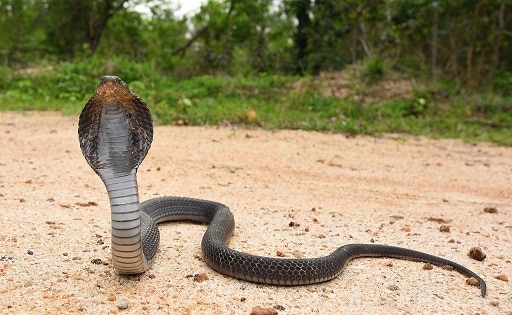
Maximum length: 160cm.
The signature spitting cobra of Thailand, as well as Cambodia, southern Vietnam and parts of Myanmar. The Indochinese spitting cobra (Naja siamensis) has the shortest spitting distance of any, reaching just 1 metre. However, they make up for this with a high accuracy rate, and nimble, energetic movements. Thai snake experts warn never to underestimate this common spitting cobra.
A 2021 study found that this species was a mist-er, releasing a venom cloud towards peoples’ eyes rather than thin jets. The result of a spray to the eyes, like usual, is instant, incapacitating pain. Be warned – this spitting cobra doesn’t have to have its neck flared to spit. A toxic venom mist can be unleashed with no warning.
The Indochinese spitting cobra inhabits the entire Thai mainland, skipping the southern peninsular regions bordering Malaysia. This is a paler spitting cobra, but the underlying scales are actually grey; the white patches are simply extremely large.
Occasionally, you can find Thai restaurants serving up the meat of Indochinese spitting cobras. Thankfully, these slabs of flesh no longer have the ability to spit. Despite their short range, Indochinese spitting cobras are able to spit repeatedly without tiring.
| 4 | Red spitting cobra |
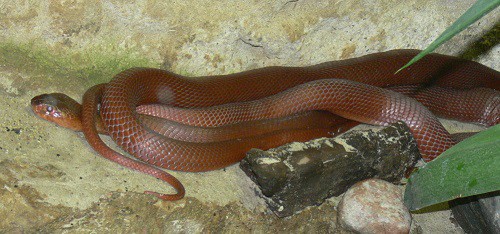
Maximum length: 150cm.
The red spitting cobra (Naja pallida) is the main spitting cobra of east Africa, mainly inhabiting Ethiopia, Somalia and Kenya, with smaller pockets in Tanzania and Uganda. As the name foretold, this is the reddest spitting cobra worldwide, making them easy to separate from the nearby black-necked spitting cobra. Another two ID signs are a black patch on the neck, and black mark below each eye, although these are occasionally missing, leaving an unending sea of red scales.
The red spitting cobra delivers relatively little venom per spit, at an average of just 2.64mg, but in all respects, it’s a horror. This Ethiopian species can spit 40 times in one encounter. It takes until the 20th spit for the venom to become diluted, and this cobra can spit accurately from 2.5 metres away.
Red spitting cobras are most common in savannahs in Kenya and Ethiopia. After heavy rains which fill up pools and renew seasonal streams, their frog and toad prey come out in abundance, meaning that red spitting cobras are also most common after heavy rains. As they spray, red spitting cobras twist their heads sideways slightly, so that the venom covers a larger area in mid-air.
| 5 | Javan spitting cobra |
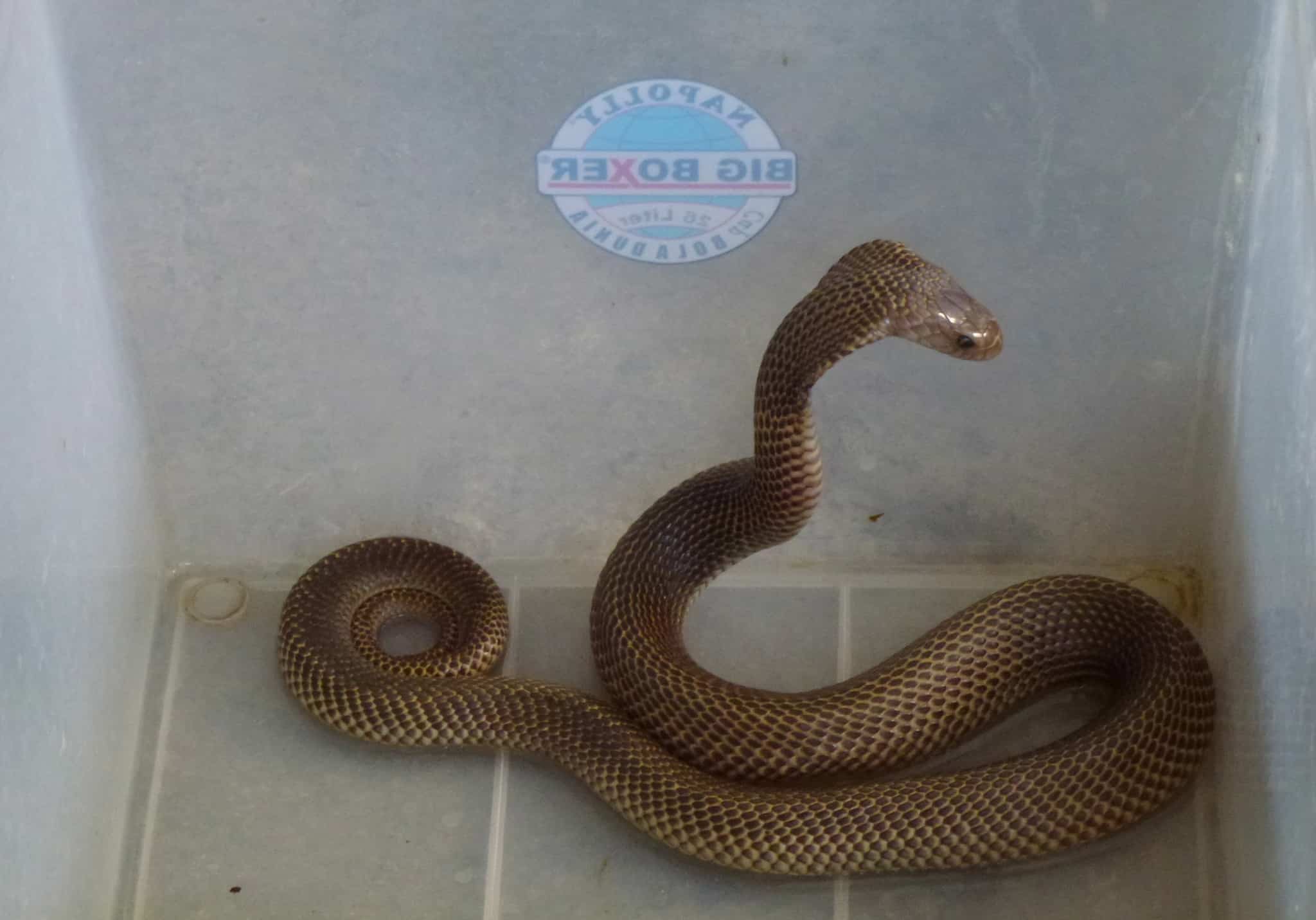
Maximum length: 185cm.
A common Indonesian species, which commonly causes mayhem for the local inhabitants. The Javan spitting cobra (Naja sputatrix) is found mainly on the large island of Java, but also the Lesser Sunda islands to the east, including the bustling tourist island of Bali. It’s one of the least flashy species, varying from grey to nearly black, although there’s a cool sub-enclave with a white background and speckled spots. Its belly is a simple white rather than the black-necked spitting cobra’s fleshy pink.
This species doesn’t hesitate to spit in random people’s eyes. People have attempted to keep this cobra in captivity, but as this guy found out, they can take 2 years before they stop spitting wildly at their owners.
This vicious cobra is a common species on Java, and copes well with deforestation. One of their hotspots is the Indonesian University (Universitas Indonesia) in west Java, one of the country’s most ancient educational institutes. According to a 2021 survey, the Javan spitting cobra was the most commonly sighted snake on campus, and in 2016, a student was bitten by one in the Department of Psychology, requiring serious medical attention. This spitting cobra commonly shows up in the slaughterhouses of central Java, captured for its skin and flesh.
| 6 | Ashe’s spitting cobra |
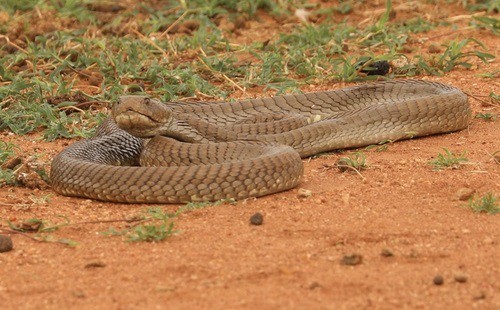
Maximum length: 274.3cm.
The largest spitting cobra species worldwide. This brute lives in east Africa, and co-exists with the red and black-necked spitting cobras. Originally, it was was considered to be a black-necked subspecies, but its browner colour was noticed in the 1960s, and in 2000, genetic analysis finally proved it to be an independent species.
Ashe’s spitting cobra (Naja ashei) averages at 1.4-2 metres, whereas red spitting cobras only reach 2 metres in extreme outliers. The official record was just over 2.7 metres, from the Baringo region of Kenya, which is officially the largest spitting cobra ever documented. Their heads are equally large and bulky.
Ashe’s spitting cobra has a brutal temperament, never hesitating to spit at innocent people that accidentally set off its threat sensors. Supposedly, they can spit venom for hours without running out of supplies. The composition of their venom is similar to the black-necked spitting cobra, with cytotoxins and neurotoxins aplenty. However, they inject a much higher quantity, in line with their larger size.
Ashe’s spitting cobras reside in savannahs, both dry and wet, and occasionally semi-deserts. Their heartlands lie in Kenya, but they’re also found in extreme northern Tanzania and extreme southern Ethiopia.
| 7 | Equatorial spitting cobra |
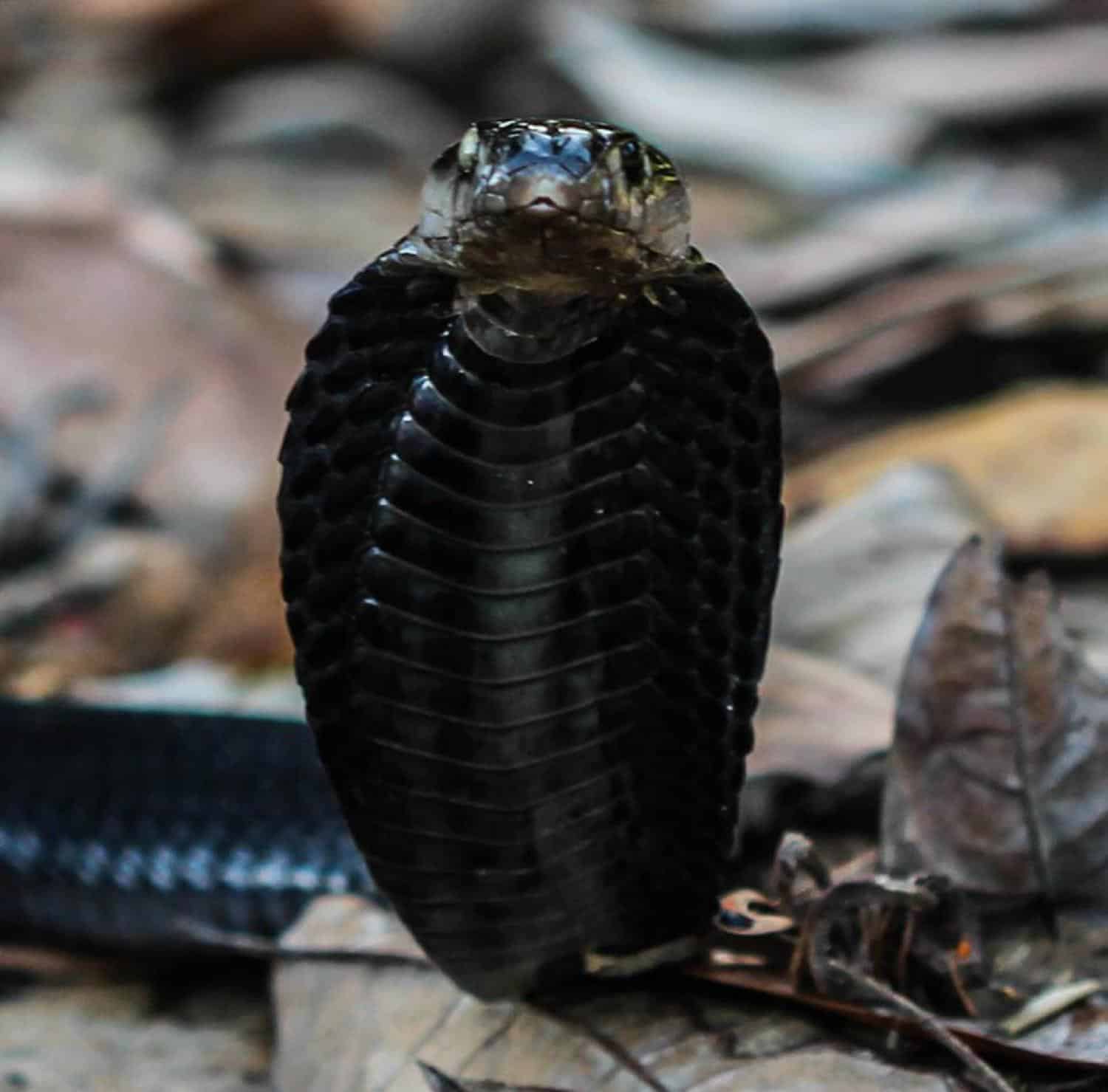
Maximum size: 150cm.
A common southeast Asian spitter, ranging from far southern Thailand to Malaysia and Indonesia. Equatorial spitting cobras (Naja sumatrana) are widespread, inhabiting Singapore, Borneo and Sumatra alike. However, they have no area of overlap with the Javan spitting cobra or Philippines cobra. Within Indonesia, they skip Java, while in the Philippines, they stick to the westerly Palawan islands.
Like the Indochinese spitting cobra, this species fires its venom in thin jets rather than a fine mist. Their instinct is to aim for the eyes, causing red, painful wateriness, which can progress to temporary blindness and scarring if the victim is unlucky. However, they’re one of the less aggressive spitting cobras, taking a lot of abuse and bother before finally snapping and spitting. Their venom is particularly rich in hyaluronidase, which burns through hyaluronic acid in skin tissue.
The equatorial spitting cobra has two colour morphs. In far southern Thailand and northern peninsular Malaysia, they’re a golden yellow. But in the rest of their range, they’re a deep black, one of the blackest spitting cobras of all.
| 8 | Mozambique spitting cobra |
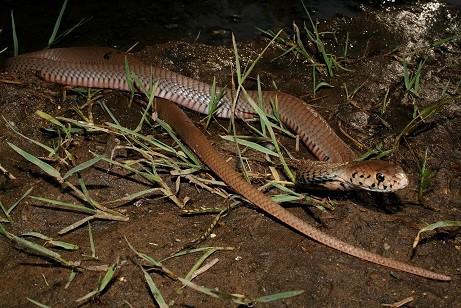
Maximum length: 181cm.
The main spitting cobra of southern Africa, including Zimbabwe, Mozambique, Botswana, Malawi and more. This spitting cobra is named M’fezi by the Zulu people of South Africa, and can occupy savannah, farmland, villages and forests alike.
The Mozambique spitting cobra (Naja mossambica) isn’t a calm snake. They’re twitchy and excitable, and won’t hesitate to spit if they feel slightly bothered. Venom globules from this species travel through the air at 10mph, and remain accurate for 3 metres. A direct hit will result in 3 days of blindness, but permanent blindness is also possible.
Like its African cousins, the Mozambique spitting cobra is a toad lover, particularly enjoying the clay-coloured African red toad. Its bite packs a nasty punch, causing skin and tendons to disintegrate.
Mozambique spitting cobras have another terrifying quality: they’re notorious for slithering into people’s bedrooms at night. A study found that 81% of bites happened while victims were sleeping, and 94% while indoors, usually on the toes or ankles. People often roll over onto them unconsciously, not realising they have a spitting cobra bedfellow.
Another brutal feature of this species is eating other snakes, including black mambas and puff adders. Rotting carcasses are another of their mouthwatering staples. Last but not least, this spitting cobra has the ability crawl up toilet pipes.
| 9 | Mandalay spitting cobra |
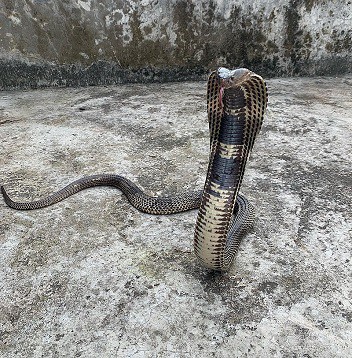
Maximum length: 140cm.
One of the rarest spitting cobras worldwide, restricted solely to the dry regions of inner Myanmar (AKA Burma). These areas are former savannahs which are now agricultural land, and the resident spitting cobra was only identified as a species in 2000. The Mandalay spitting cobra (Naja mandalayensis) is a black snake, intermingled with beige. Rather than arranged in huge stripes, this beige is more intermingled with the black, as though this cobra has had sand thrown over it.
Despite being poorly researched, the Mandalay spitting cobra causes havoc in inner Myanmar. A study examined 8 locals sprayed in the eyes, and found that all experienced conjunctivitis, swelling, sharp pain, and temporary loss of vision.
This is one of the angrier spitting cobras as well, requiring little provocation to start spitting repeatedly. They can also hiss while slithering forward when bothered, and have a spitting range of at least 2 metres. A bite, meanwhile, results in necrosis and life-threatening neurotoxicity.
Mandalay spitting cobras are heavily nocturnal, basking on the dry earth during the day. The downside to being recently discovered is that no specific antivenom exists. Myanmar is also home to the monocled cobra, which the general cobra antivenom works excellently against, but in Naja mandalayensis, it’s significantly less effective.
| 10 | Zebra spitting cobra |
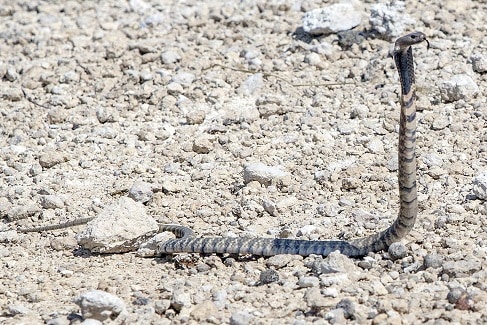
Maximum length: 193cm.
Another new spitting cobra species, a resident of southwest Africa, specifically Namibia and Angola. The zebra spitting cobra (Naja nigricincta) was separated out of the black-necked spitting cobra species in 2007. All along, it turned out that Namibian villagers had been battling their very own spitting cobra, as this version had unique black and white stripes, and a particular fondness for dry areas.
The zebra spitting cobra is often encountered by villagers on tarmac roads, particularly after rains. This species lacks any fear of human beings, and will spit instantly, without even thinking, defaulting to aggression automatically.
This is another spitting cobra which invades bedrooms – one unfortunate 7 year old boy was bitten on the face while he slept, and received a venom globule in his right eye for good measure. Miraculously, he survived. He received skin grafts, and was discharged from hospital after 3 weeks, while his agonised right eye developed a corneal lesion which healed naturally.
Naja nigricincta is something of a terror in rural Namibia, and is mostly nocturnal (hence the tendency for bedroom invasion). It suffers from the same antivenom problems – most have been designed for the Mozambique spitting cobra, and don’t work as well. This newly discovered spitting cobra can spit at least 9 feet (2.7 metres) while remaining accurate.
| 11 | Mali spitting cobra |

Maximum length: 106.8cm.
The Mali spitting cobra (Naja katiensis) is a poorly researched species of west Africa, which is also relatively short. This species ranges from Gambia in the west, to northern Cameroon in the extreme east, covering a large swathe of Nigeria, Burkina Faso, and southern Mali inbetween. It mainly inhabits savannahs, and is a mainly golden brown species of cobra, along with darker patches which tend to fade in slowly and lack a sharp contrast.
Mali spitting cobras are able to move by day or night, but are mainly diurnal rather than nocturnal. Their venom is poorly researched, but one victim experienced swelling that subsided within 4 hours. This was replaced with a large area of skin tissue necrosis, with few neurological symptoms.
On paper, the venom contains almost every toxin type: neurotoxins, cytotoxins, and metalloproteinases, which typically cause haemotoxic effects like spontaneous bleeding. Like other spitting cobras, Naja katiensis aims for the eyes by default when spitting. Overall, its bite seems similar to its neighbours like the black-necked spitting cobra, which are generally less neurotoxic than non-spitting cobras.
This species has no overlap with the Mozambique or red spitting cobra, but does overlap with black-necked spitting cobras in places like Nigeria and Togo. The two are easy to distinguish, as the latter is far darker in appearance overall.