
| 1 | Gold-ringed catsnake |
Maximum length: 2.5 metres.
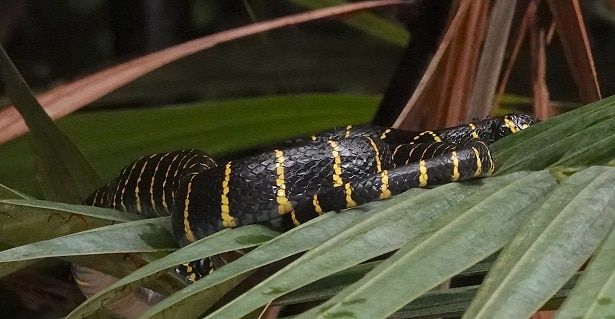
The gold-ringed catsnake (Boiga dendrophilia) is a species of southeast Asia, which clings to branches for most of the day, and is almost impossible to miss. This species is not only completely different to most of its Boiga catsnake relatives, but looks like no other snake nearby.
Gold-ringed catsnakes are found in eastern Malaysia, Indonesian Borneo, Brunei, Java and Sulawesi. They inhabit mangrove forests, but also lowland rainforests just as commonly. Gold-ringed catsnakes have a jet black body overlaid with thin yellow bands, with no colours other than these. There isn’t a hint of green, red or brown on this moderately venomous snake. They also have a yellow chin below the mouth, itself streaked with black markings.
This species has an unpredictable temperament, so if you recognise one sitting on its tree branch (which isn’t hard), stay well back. Their venom potency in humans is still up for debate, as according to a 2006 study, Boiga dendrophilia produces a rare toxin called denmotoxin. There’s also a powerful neurotoxin called boigatoxin-A, discovered only in 2005.
When injected into mice, this toxin prevented electric-induced twitches of muscle cells, with the real world result being paralysis. More reassuringly, mangrove catsnakes are rear-fanged, and most orient their mouths awkwardly in order to bite.
This species is nocturnal, barely moving during the day and activating the moment the sun sets. Give them space on their branches, and you will survive a gold-ringed catsnake encounter with only a cool story to tell.
| 2 | Tiger ratsnake |
Maximum length: 2.7 metres.
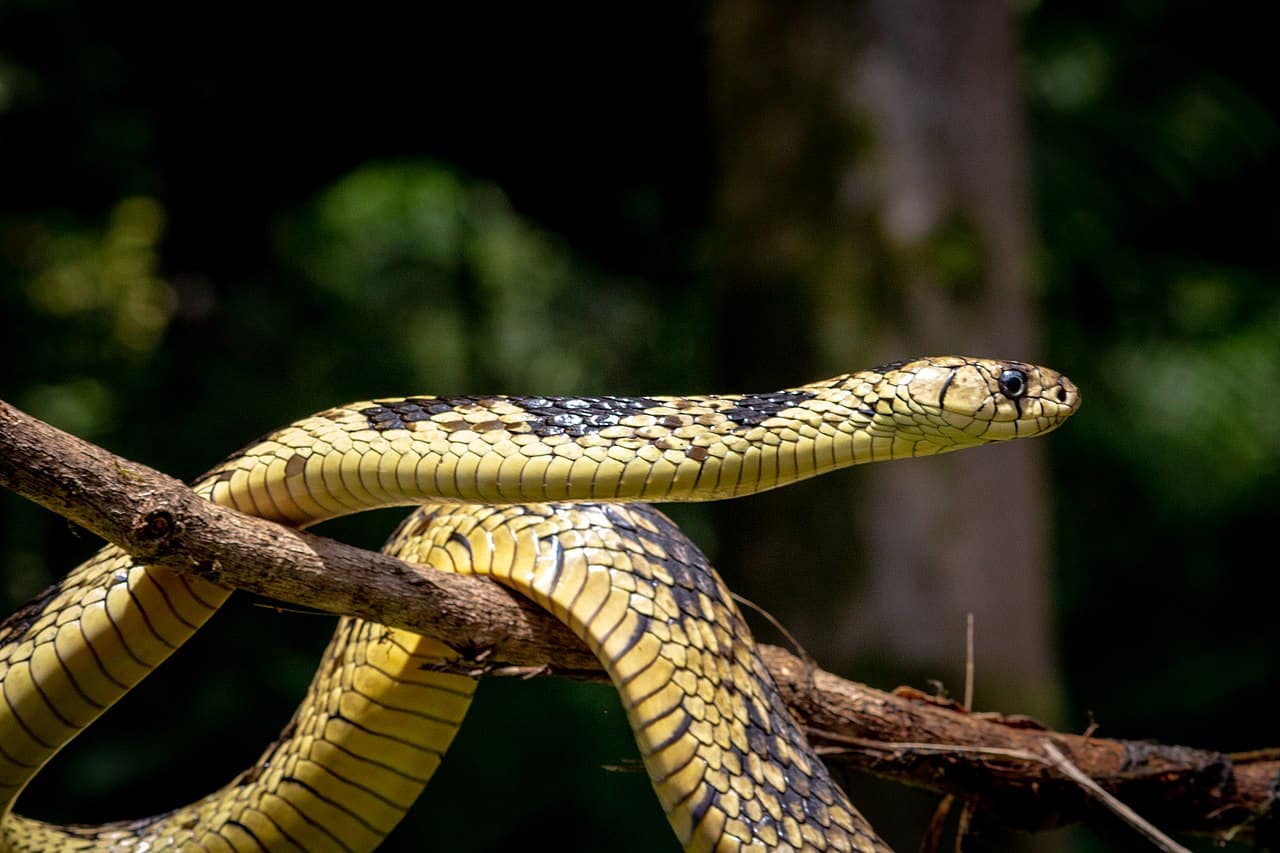
One of South America’s most common snakes. The tiger ratsnake exceeds 2.5 metres and is strongly yellow-black, though nobody is sure why. Camouflage isn’t the reason, as this is an adventurous snake which strides confidently through open territory.
Tiger ratsnakes aren’t afraid of humanity, and can move through farmlands and villages with ease. This is a strongly diurnal snake, moving from 7:00-17:00, and almost never at night. Black and yellow are virtually the only colours they possess, as their tongue and eyes are also black. That said, the exact patterns vary – in some individuals, the yellow covers more area, while in others the black spreads its tentacles.
Tiger ratsnakes swallow smaller prey alive, whereas their larger prey are constricted, or pressed against the floor until they weaken (or escape). Tiger ratsnakes can reach branches 10 metres high in their quest for birds, although 90% of their prey consists of mammals.
This is also a bat-eating snake, which will investigate a cobweb-filled rooftop just to locate them. Tiger ratsnakes have one of the largest territories of any snake, ranging from eastern Mexico to northeast Argentina.
| 3 | Yellow-bellied sea snake |
Maximum length: 113cm.
A snake of the open seas, and one of the easiest to recognise as it floats past your lost fishing boat. This species averages at 70-100cm, and ranges from eastern Africa, through Australia, to the Pacific coast of central America, with occasional sightings in southern California.
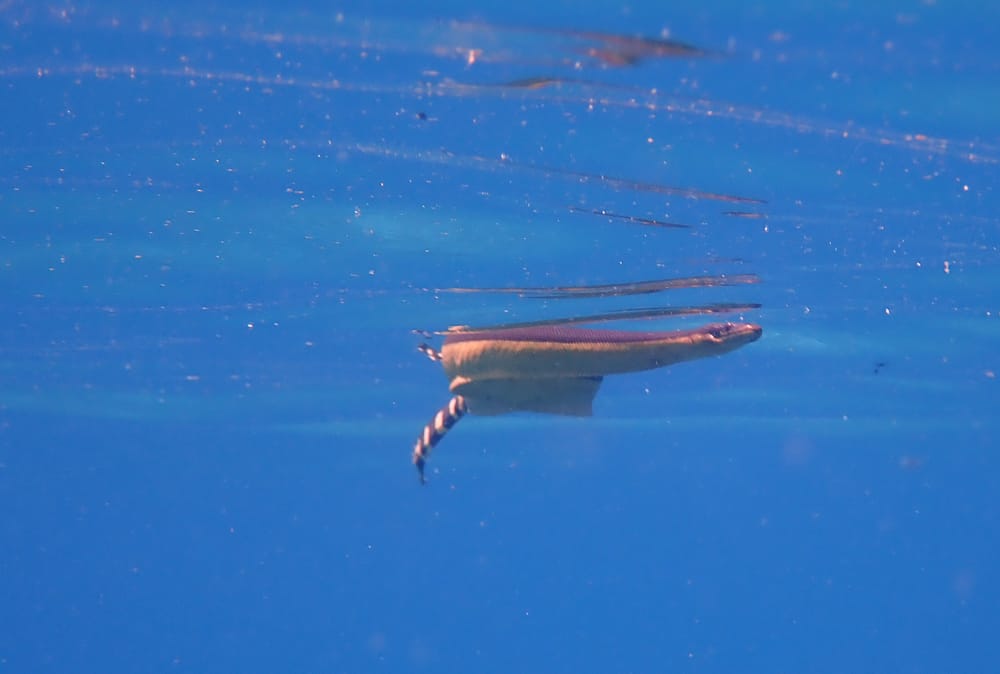
The yellow-bellied sea snake is purely black and yellow, with no room for subtleties in between. For most of their body, they possess a clear separated pattern, with black above and yellow below. This only changes when their paddle-shaped tail arrives, and the dividing line becomes a distorted series of wavy loops. Their face is also cleanly divided, with the border of the yellow lying just below the eye (which is also black).
Unlike with tiger ratsnakes, the yellow-bellied sea snake’s colour has a clear explanation. Their hunting strategy is to float on the water surface, sometimes amidst huge sea slicks of white foam and rotting vegetation. By wiggling their tail, they lure curious fish in, which they devour with a sudden lunge.
The problem is that this strategy leaves them exposed to hungry sea birds. With black visible from above and yellow visible from below, this snake can simultaneously blend into murky ocean depths and the sun-reflecting water surface.
| 4 | Usambara eyelash viper |
Maximum length: 54cm.
The hairy bush viper of Uganda is one of the internet’s favourite bizarre snakes, as it looks like a pineapple come to life, with razor sharp scales. The Usambara eyelash viper (Atheris ceratophora) belongs to the same group, yet lives solely in Tanzania, at elevations of 700-2000 metres.
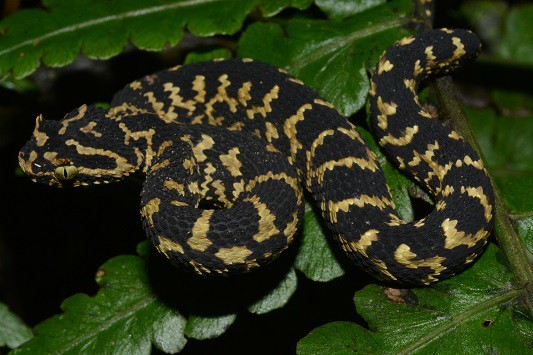
This species has several differences to its cousin, the first being elongated “eyelash” scales directly above each eye, giving it a flirty (yet evil) look. The second is a tendency to be purely black-yellow with no colours in between.
This snake has a thin neck, and is a tree climber, but tends to stay 1 metre above the ground. Usambara eyelash vipers prey on frogs, and reach a maximum of just 54cm, with females being longer. This snake has several morphs – some have more intermingling black-yellow scales, while others have vividly contrasting stripes. In this snake, the black is reduced to a faint sprinkling on the yellow like charcoal.
Usambara eyelash vipers live in their namesake Usambara mountains, which formed in Tanzania an estimated two million years ago. These mountains are free from glaciers, and are instead covered in a vast sea of tropical forests. The Usambara mountains have an unusually high amount of rare species – we’ve just discussed one, and others include the Usambara eagle-owl and Usambara forest toad.
| 5 | Samar cobra |
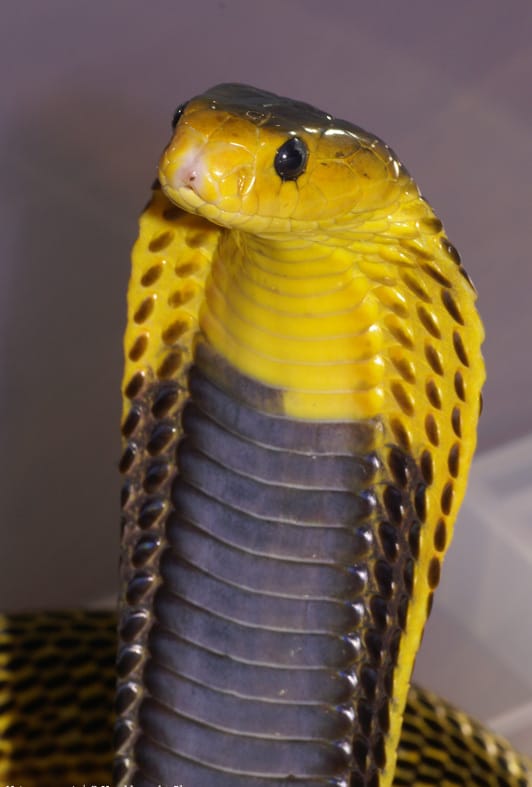
Maximum length: 140cm.
The Samar cobra looks like a curious and inquisitive snake, and they likely are, but this doesn’t mean that they wish you well. Samar cobras (Naja samarensis) reside in the Visayas and Mindanao islands of the southern Philippines, and are the most consistently black-yellow of the Naja cobra genus. Their chest and head are a bright lemon, while their black body has intermittent yellow speckles, all contrasting extremely vividly, like a treasure chest glowing in darkness.
Samar cobras reach 1.4 metres, and are as flexible as most cobras. They can inhabit forests and marshes, or lurk on village outskirts, blocking every road from north to south. Rice paddies are a particular hotspot, bringing them into constant conflict with farmers.
Unlike an Egyptian cobra, the Samar cobra has the ability to spit, using specialised front-facing hollows in the tips of their fangs, which force venom through in pressurised jets. A globule in the eye can cause permanent blindness if the victim doesn’t reach a doctor quickly enough. They also have a normal bite, which is primarily neurotoxic in nature.
Opinions differ on the personality of the Samar cobra. Some believe that they’re timider than the Philippines cobra on the northern islands, while others deem to them to be nervous and agitatable.
| 6 | Shropshire’s puffing snake |
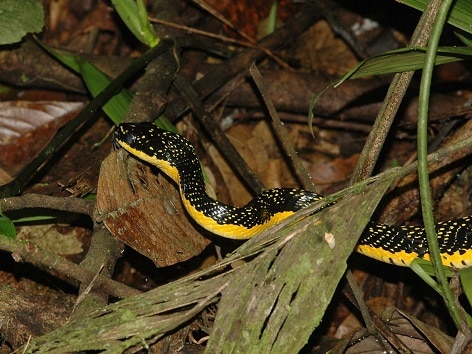
Maximum length: 163cm.
The puffing snake is a widespread species in South America, but this yellow-black snake is their less common cousin. Shropshire’s puffing snake (Phrynonax shropshirei) is a strong climber, which raids birds’ nests for hatchlings and possibly the eggs.
This snake mainly dwells in Ecuador and Columbia, west of the Andes. Shropshire’s puffing snake has cleanly divided patterns, with black on their back and yellow on their belly. But scales of each colour will sometimes spill into the other’s territory, with yellow speckles here and there.
This species is often spotted on roofs, hunting birds which roost there such as social flycatchers. Shropshire’s puffing snakes are non-venomous, but have a complicated intimidation display. They can throw the upper 1/3 of the body into a taut S-shaped coil, with the tail gripped firmly around a branch. This coil hovers in mid-air rather than touching any part of the ground.
Shropshire’s puffing snakes also hang their mouths wide open, to increase the intimidation factor further. They can even compress their sides to make their body deeper, and spread their lower jaws to alter their head shape.
| 7 | Yellow anaconda |
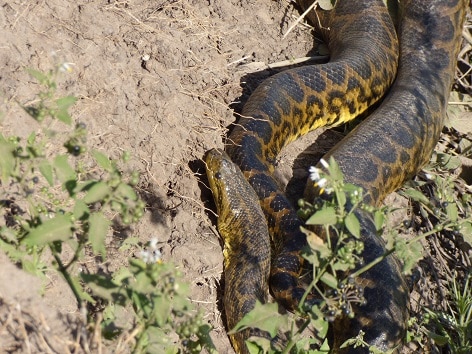
Maximum length: 4.6 metres.
A separate species to the notorious green anaconda (Eunectes murinus) of the Amazon rainforest. Yellow anacondas live much further to the south, inhabiting forested wetlands surrounding the vast Paraguay River and its many tributaries. Yellow anacondas are the shorter of the two species, but still reach 4 metres, with a maximum record of 4.6 metres in females.
Yellow anacondas (Eunectes notaeus) love shallow water most of all, weaving through thick jungle strands with only the tops of their heads poking up like a submarine. This species is great at disguise, but their yellow colours make them slightly easier to spot than green anacondas. They vary from a sharply contrasting black/yellow, to a shimmering golden sheen, like a member of the anaconda royal family.
Yellow anacondas have a wide diet, but prey most heavily on birds. Their favourites include streaked herons, cattle egrets and guira cuckoos.
Their mammal prey include large vesper mice and Chacoan marsh rats, while their serpent prey include the Brazilian smooth snake. Despite their brute size, yellow anacondas are relatively inactive, moving just 188 metres per month according to a 2020 study. You can find this species in northern Argentina, Paraguay, and far southern Brazil.
| 8 | Western mangrove catsnake |
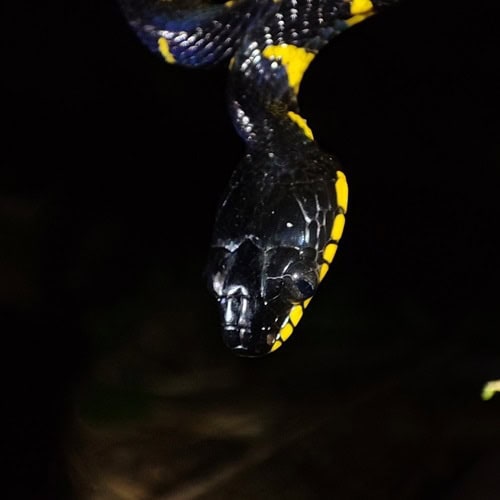
Maximum length: 2.5 metres.
An extremely close relative of the gold-ringed catsnake. The mangrove catsnake (Boiga melanota) was originally a subspecies, but elevated to a fully independent species in 2020.
Boiga melanota lives further west than its cousin, taking over the empire in peninsular Malaysia, Singapore, southern Thailand and Sumatra. Their habitats are similar, including mangrove swamps and moist rainforests, as are their branch-dwelling ways.
At first glance, the two catsnakes are nearly indistinguishable, as both are purely black and yellow. Yet the difference is actually extremely simple – with Boiga melanota, the thin yellow stripes never meet in the centre of the snake’s back. There’s always a gap along the mangrove catsnake’s spine, whereas with Boiga dendrophila to the east, the yellow stripes fuse. Many people with captive black-yellow catsnakes may not know the exact species – check the spine and you’ll know.
Another sign with Boiga melanota is the lack of yellow spots on its dark belly scales. Does any part of their body have a different colour? Yes – their tongue is a dull fleshy pink, far less vivid than the rest. The same applies to the inside of their mouth.
| 9 | Jungle carpet python |
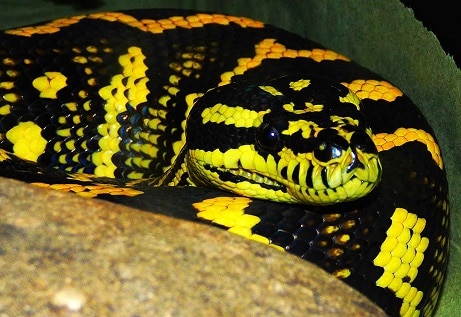
Maximum length: 4.2 metres (for the carpet python species).
This snake’s colour scheme is yellow on top of black on top of another helping of yellow. The jungle carpet python (Morelia spilota cheyni) is a northeastern Australian species, which lives in jungles and has an aggressive reputation.
This striking snake is a subspecies of the more widespread carpet python, which is common further south near Sydney. It shares biological attributes like being a thick-bodied constrictor, and primarily eating mammals. The main physical difference is its beautiful colour scheme, which has led to a particular popularity as a pet. In 2011, a New Zealand man was sentenced to 4 months in jail for illegally importing one (as all snakes are banned in New Zealand).
Jungle carpet pythons are found in Queensland rainforests, particularly in the Atherton mountains, at the northeast tip of Australia. Their patterns are yellow overlaid with wonky black blotches, which themselves have yellow speckles in the middle. Their eyes are also black, with a blue-grey tongue being the sole outlier.
Adult jungle carpet pythons generally reach 1.5-2.1 metres, but occasionally, a giga-python will be dragged out of the jungle measuring 2.6m. This species can easily reach 20 years old, and the flipside to their beauty is their temperament, as this is the bitiest of the carpet python subspecies.
Jungle carpet pythons actually grow more colourful with age. Initially, they’re grey and white, and after a few weeks, the first yellow stripe appears. With each skin shed, there’s a gradual intensifying, until they finally burst into the yellow-black superstardom of adulthood.
| 10 | Manchurian black ratsnake |
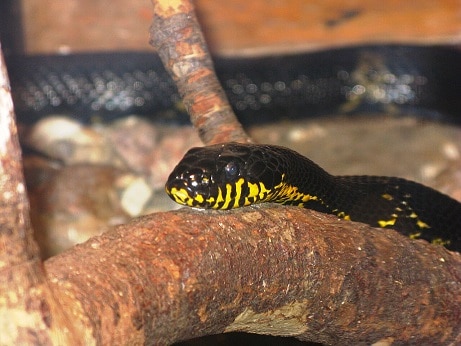
Maximum length: 250cm.
The most strongly black-yellow ratsnake of Eurasia, particularly around the face. Manchurian black ratsnakes (Elaphe schrenkii) are common in far eastern Russia, as well as South Korea, Mongolia and northern China. They naturally inhabit forests, forest edges, and mixed bushy and thorny plains. Anywhere with vegetation is a comfortable home for this snake.
This species reaches 1.4-1.8 metres, and is non-venomous, constricting its prey. They feed on mammals, but also birds and their eggs – in captivity, they happily swallow up quail eggs.
As for their patterns, the black is constant with this ratsnake, but as the head approaches, the creamy patches between darken to a vivid yellow. This also depends on the morph, as Manchurian black ratsnakes vary significantly in the wild. The black-yellow colours continue to their belly, but switch to a rapidly alternating checkerboard pattern, instead of occasional stripes.
This is one of the calmer ratsnake species. In captivity, Elaphe schrenkii will sit at the edge of a terrarium and watch their keeper inquisitively, flecking their tongues at any object that interests them. As juveniles, they’re more flighty and nervous, but by adulthood, they become perfectly peaceful. Elaphe schrenkii tolerates colder temperatures much better than some – keepers recommend 21-28C.
| 11 | Terrestrial snail sucker |

Maximum length: 80cm.
A totally harmless species, whose snail slurping abilities are very strong, but biting abilities are not. The terrestrial snail sucker (Geohpis sartorii) lacks any venom, and even its teeth are reduced in size.
The terrestrial snail sucker is a common species, appearing in Belize, Guatemala, southern Mexico, Honduras and Nicaragua. Compared to other snail suckers, they’re more common on the ground, climbing branches and resting on leaves, but not dwelling on them exclusively. They also poke their heads out of dark rock cracks occasionally.
Like other snail suckers, this species also derives a large portion of its calories from slugs. Terrestrial snail suckers aren’t always pure black yellow, but the patterns are always the same. They always have a jet black underlying colour, with occasional encircling bands. In around 50%, these bands are pure yellow like above, while in another percentage, they’re orange instead.
The black and lighter bands always contrast sharply, with no gradual fading in. Terrestrial snail suckers look like no other snake in Guatemala and Belize, as tiger ratsnakes are black-yellow, but larger and far messier in appearance.