
| 1 | Beni anaconda |

Maximum length: 4.4 metres.
One of 4 anaconda species currently recognized, the Beni anaconda (Eunectes beniensis) is found exclusively in northern Bolivia. This species was originally believed to be a hybrid of the green anaconda and yellow anaconda, but was declared to be independent in 2002.
Like its cousins, the Beni anaconda is a massively powerful constrictor with semi-aquatic habits. You can find this species in swamps, shallow creeks and seasonally flooded grassland, but only rarely in dense upland forest habitats. Beni anacondas are known by locals as sicurí, and are far more active during rainy season, grinding almost to a complete halt during dry season.
Beni anacondas are large, yet their murky green camouflage makes them difficult to find. The best method is wading through waist deep water, crouching down to shuffle through overhanging vegetation, and poking thick shoreline vegetation with a stick, until finally flushing one out.
In January 2010, scientists captured a female Beni anaconda measuring 220cm in a rice field, in its namesake Beni Department, Bolivia. This snake immediately regurgitated a 192cm male Beni anaconda, only slightly shorter than its own body. Cannibalism isn’t extremely rare in the snake kingdom, but Beni anacondas take it to giant new proportions.
The Beni anaconda is still a controversial species, as a 2024 paper argued that it likely belongs to the yellow anaconda (Euneces noteus), which mainly inhabits Paraguay. A point in favour of independence was that the two are divided by several hundred miles, with no point of contact, but the two only had shallow genetic divergence in preliminary tests. In either case, Bolivia is still one of the best countries to meet an anaconda (though this may be the last creature you ever meet).
| 2 | Erythrolamprus dorsocorallinus |

Maximum length: around 75cm.
This mostly harmless species lives in Peru, extreme western Brazil, and a huge swathe of Bolivia. Erythrolamprus dorsocorallinus averages at 50-60cm, and possesses only a mild venom.
This semi-aquatic snake is often caught near marshes within primary rainforests, and crossing foot trails within rainforests. It’s a common species on well-vegetated lake shores, and areas of moist grassland not far from water bodies. Moisture is a must for this species, as you’ll never find them in parched arid lands. This snake also likes to climb stems and rest on massive rainforest leaves.
This species preys heavily on amphibians, with two confirmed species being the brown egg frog and Chaco granulated toad. The latter is normally lethal, riddled with poisonous bufotoxins, proving that this snake has inbuilt resistance.
Erythrolamprus dorsocorallinus is one of the easier snakes in Bolivia to recognise. Its scales are mainly bright yellow, but each one has a slight black tip at the edge. The resulting effect is like a thin black net has been cast over its body. However, some individuals from Bolivia have blue shades as well, intermingling with the yellow. Scientists have noticed how all this fades to grey rapidly post death and preservation.
| 3 | Southern sharpnose snake |
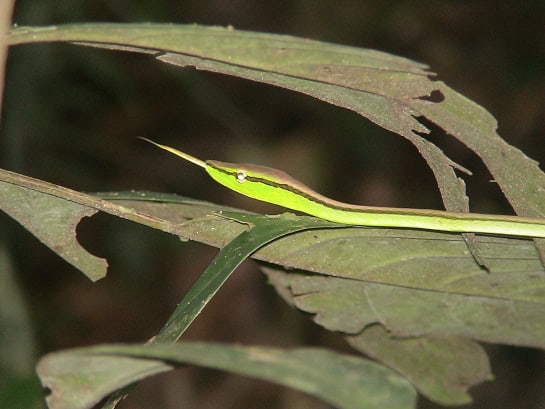
Maximum length: 125-130cm.
A very difficult species to track down, mainly due to its love of dense lowland rainforests. The southern sharpnose snake is pure rainforest spawn, with a jungle green appearance which blends with trees perfectly. This species is nearly always found resting on low jungle foliage, such as broad leaves or stems.
Southern sharpnose snakes are found only in Peru and Bolivia, and only in low densities. They prey primarily on lizards, with some frogs. Until 2020, this species was assigned to the large Philodryas snake genus, and known as Philodryas georgeboulengeri. However, its elongated snout and sharpened face were so blatantly different to other members that it was separated into the new Xenoxybelis genus. This group has one other member, which is much more common than its cousin: the striped sharpnose snake (Xenoxybelis argenteus).
Southern sharpnose snakes appear only in rainforests, usually at low elevations. A 2019 study found that the percentage of tree canopy cover had a close positive correlation with their abundance. They were especially sensitive to elevation, and disappeared completely from more mountainous forests.
Of the two Xenoxybelis members, southern sharpnose snakes were found to be significantly less flexible in their habitats. Finding this snake is always an achievement, whether in Bolivia or Peru.
| 4 | Linnaeus’ sipo |

Maximum length: 154.5cm.
An extremely widespread species in South America, including Bolivia, where they inhabit virtually the entire country. Linnaeus’ sipos (Chironius exoletus) are completely non-venomous, though will gape their mouths wide and make sudden jabbing strikes if cornered. At a maximum of 154.5cm, this is one of Bolivia’s longer snakes.
Linnaeus’ sipos correlate closely with forests, but are flexible about the exact type. They’re been found in rainforests, cloud forests, riverside gallery forests, and forest edges alike. Their diet consists mainly of frogs, especially treefrogs, with endless species being confirmed, including red snouted treefrogs, Canelos tree frogs, and upper Amazon tree frogs. They can also eat lizards, birds, and Nauta salamanders as potential backups.
The only prey this species never eats is mammals, possibly because the local anacondas and pitvipers have muscled in on this niche first. In 2008, Linnaeus’ sipos were discovered to eat the poisonous Porto Alegre golden-eyed tree frog (which is a long name), showing that they have innate toxin resistance.
Linnaeus’ sipos have large eyes with round pupils, and move mainly by day. At night, they sleep on precarious branch perches, at up to 8 metres above ground.
| 5 | Amazon coastal house snake |

Maximum length: 58cm.
An orange to pale grey species, which is widespread across South America. Amazon coastal house snakes (Thamnodynates pallidus) typically measure 50cm and are nearly always found near water. They associate with small pools within rainforests, where they lurk on tree branches 1 metre high, perhaps to use as a vantage point to scan for frogs below.
Amazon coastal house snakes range from sea level to 2000 metres. They’re regarded as extremely aggressive, biting and snapping at people the moment they’re gripped (which we can’t blame them for).
Once their fangs sink in, they can be very difficult to detach. In 2003, a man required 40 seconds and outside assistance to remove an Amazon coastal house snake from his finger. The bite began to swell slightly, which spread and achieved its peak within 35 minutes. The man also experienced excessive saliva production with a metallic taste, and a strong headache. The swelling took 36 hours to fully disappear.
This was the first ever detailed bite report for Thamnodynastes pallidus. Another comment was that pain and heat radiated from the bite site. Amazon coastal house snakes aren’t capable of ruining your life, but they could scupper your day or week.
| 6 | Mountain sipo |
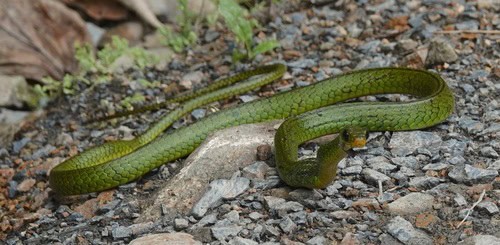
Maximum length: 156.9cm.
A moderately sized, non-venomous snake with a fast speed. Mountain sipos (Chironius monticola) closely follow the Andes mountain range in their territory, curving in a long line from northern Paraguay through Bolivia to Peru and Colombia. In Bolivia, they live on the forested eastern slopes of the Andes, generally ranging from 200-3000 metres above sea level. Another of their names is the Andean whipsnake.
Energy is the reason this snake has survived the humid rainforests of Bolivia. Mountain sipos are fast-moving, curious, inquisitive, and will make stabbing lunges at anyone who crosses their path.
Compared to their sipo cousins, they’re only semi-arboreal (tree-dwelling). However, they’re experts at weaving through small tangled bushes, and emerging from the opposite side holding an unexplained frog in their mouth. Mountain sipos are even capable of underwater foraging, searching amid jumbled rocks in forest streams. One of their strangest tricks is body-bending, crinkling into strange shapes to resemble a fallen branch.
Large eyes, a green body and moving mainly along the ground are hallmarks for this species. Their diet is varied, including lizards and frogs such as Zurucuchu robber frogs. Mountain sipos sometimes appear in cloud forests and drier forests, but tend to prefer forest margins and clearings adjacent to forests.
| 7 | Cutlass |

Maximum length: 180.6cm.
A non-venomous, yet potentially aggressive Bolivian snake. The cutlass (Phrynonax sexcarinatus) is a flexible snake, appearing both on branches and the thickly vegetated rainforest floor. Likewise, this species is found in forests, but also relatively open areas with plenty of sun exposure.
Cutlasses explore and forage by day, while at night, they sleep on branch perches up to 3.5 metres above ground. While incapable of dealing out death, they have an aggressive defensive display. A cornered cutlass (even if accidentally cornered) will throw its upper half into a sudden S-shape, before inflating its neck grotesquely. This is followed by a sharp, piercing hiss, before a sudden, savage assault on the interloper using a sharp pair of fangs.
Cutlasses are variable in appearance, as some individuals are tree bark grey overlaid with occasional brown bands, while others are slimy green (like above). Rather than frogs or lizards, the cutlass preys mainly on birds, similarly to its puffing snake relatives in central America. Juveniles feast on grasshoppers, moths and beetles, and other small rainforest insects.
The cutlass is widespread in South America, ranging from Bolivia at the southern end, to Colombia in the north. This species isn’t blind; if you walk past them on a branch, they’ll know that you’re there, and it would be wisest to keep on walking.
| 8 | Catesby’s snail-eater |

Maximum length: 72.6cm.
A harmless, but memorably patterned snake. For reasons unknown, Catesby’s snail eater (Dipsas catesbyi) has evolved a grey-red base overlaid with black circles like lumps of coal, each surrounded by a messy, snowy white border.
This non-venomous species inhabits a huge swathe of South America, including Bolivia, Peru, Ecuador and Brazil. Catesby’s snail eaters are very low on the food chain, with virtually no offensive weapons whatsoever. As well as snails, they prey on slugs and soft-bodied insects.
This species is so light and thin that it can rest on even the flimsiest rainforest leaf, while soaked to the bone in rainwater. In an untouched world, Catesby’s snail eaters would dwell mostly in rainforests, but they’re flexible enough to inhabit disturbed forests, banana plantations, and even rural gardens, where they’re occasionally killed by household cats.
A flustered Catesby’s snail eater will coil into a tight ball. Bites from this species are not just rare, but virtually unheard of. This species varies slightly in patterns, as the black blotches are occasionally larger, pushing the red and white back, and creating a blacker appearance overall. Catesby’s snail eaters overlap in Bolivia with the Bolivian snail eater (Dipsas turgida), but the latter has a more black and white appearance, and with messier dark blotches rather than circular.
| 9 | Boa constrictor |

Maximum length: just over 4 metres.
The boa constrictor is one of Earth’s most successful snakes, covering virtually all of South America (excluding Chile). As ever, they’re one of the most regularly sighted snakes in Bolivia. However, southeastern Bolivia hosts a specific form called Boa constrictor amarali, sometimes called the Bolivian short-tailed boa. This version has unusual silver tones and a shorter tail, and is relatively small at 1.2-1.8 metres.
This silver form is much sought after in captivity, though relatively rare due to Bolivia fully banning the export of native snakes. Several unique observations have been made of this possible subspecies, including a boa that died after swallowing a tree porcupine and being punctured by its spines.
Whether Boa constrictor amarali is actually a subspecies has been doubted lately. A 2024 study found only minor genetic separation between it and Boa constrictor constrictor, by far the most common subspecies (the classic beige-black one).
What’s certain is that Bolivia hosts an unusual amount of silver individuals. The 2024 study also discovered that boa constrictors along Brazil’s Atlantic coast near Rio de Janeiro were actually an independent species, which they named Boa atlantica, adding yet another new species to the 3900 snakes worldwide.
| 10 | Chlorosoma laticeps |

Maximum length: 148.9cm.
A heavily arboreal snake, which is nearly always spotted on low branches, whether on the thick arms of trees or thin and spindly fingers. Chlorosoma laticeps knows exactly how to manage its weight distribution to prevent itself from falling to the forest floor.
Despite regularly exceeding 1 metre, this is one of South America’s more mysterious snakes. Chlorosoma laticeps seems to have a large range, as it has sightings in Bolivia and southwest Brazil, but also a handful of sightings along Brazil’s Atlantic coast thousands of miles away. Either their territory has two massively separated pockets, or its numbers are so sparse that even scientists rarely encounter them.
This species belongs to the 3-member Chlorosoma genus, but is unique due to its oily black inner mouth. Elsewhere, the greenness spreads to its eyes, which have round pupils. Occasionally, Chlorosoma laticeps is one of the few blue snakes on earth, with a rare morph combining aqua blue with the usual green flanks.
Chlorosoma laticeps is a venomous species, with an abundance of metalloproteinases. There’s also a smattering of neurotoxic three finger toxins (less than 2% of total toxins), similarly to coral snakes. However, the exact potency in humans is unknown.
| 11 | Amazon tree boa |
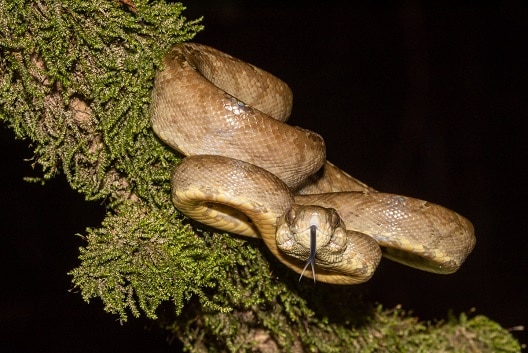
Maximum length: 188cm.
The second most widespread boa in South America after the boa constrictor, and the most widespread member of the Corallus tree boa genus (which has 9 members). Compared to other boas, Amazon tree boas are relatively thin-bodied, which enables their branch-dwelling lifestyle. They prey heavily on bats, even lurking next to bright, colourful flowers which bats feed on in order to snatch them.
Amazon tree boas (Corallus hortulanus) cover the vast majority of Brazil, as far northwards as Panama. To the south, they reach Bolivia, covering the entire upper half of the country. This is a tree snake, but without being exclusively restricted to rainforests. Amazon tree boas can even appear in villages and backgardens as long as trees are standing.
Opinions differ on this snake’s temperament. According to some, they’re docile and will stare at you calmly from a branch, while others report a vicious defensiveness. Amazon tree boas should be examined from a distance, and never touched. This snake has a dislike of moonlight, as studies show that at night, they move most during overcast weather, possibly to reduce their visibility even further.
| 12 | Boettger’s sipo |
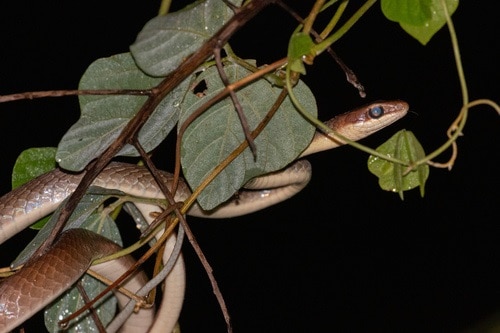
Maximum length: at least 140cm.
A fast-moving snake which moves exclusively by day, never during night. This is a mildly venomous species which poses little threat to a human being on foot, in a car, or sleeping in bed. Boettger’s sipo (Chironius flavolineatus) is found away from the Amazon rainforest, appearing in eastern Brazil, Paraguay and Bolivia.
This is a common species in Bolivia, which isn’t difficult to encounter. In terms of habitat, Boettger’s sipos are incredibly flexible. They can appear in urban areas, hillsides, riverside gallery forests and grassland alike.
Their diet, meanwhile, is the exact opposite, as Boettger’s sipos prey exclusively on amphibians. A 2008 study examined 167 Boettger’s sipos, and found that every meal inside their stomachs was a frog or toad. It’s believed that this species raids the dens of amphibians while they sleep.
Another quirk of this species is that they avoid large meals, unlike an anaconda. Their meals average at just 5% of their own body weight, probably because this is a relatively thin-bodied species. Boettger’s sipos always have a paler underside, contrasting against a brown or occasionally green-ish brown body.