
| 1 | Hemprich’s coral snake |
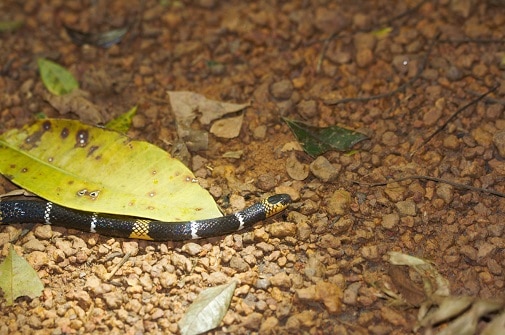
Maximum length: 91.7cm.
A little known, yet common species of coral snake. Hemprich’s coral snakes (Micrurus hemprichii) are found all over the Amazon rainforest, in central and northwestern Brazil. They also inhabit Colombia, Ecuador, and are particularly concentrated in French Guiana. This is purely a species of lowland and tropical rainforest, rarely straying to open fields, and definitely not towns and cities.
Hemprich’s coral snake is memorable for one simple reason: it’s one of the few coral snakes not to possess any red on its body. Instead, the colourful bands are bright orange or brownish. This species always has a black face, while the neck is surrounded by a thick orange collar, like a winter scarf.
This coral snake is as dangerously venomous as ever, but may be slightly milder than some species. A 2023 study painted a mixed picture, as two cases involved only local symptoms, with neither victim having a prolonged hospital stay. However, one woman suffered from shortness of breath, a classic neurological symptom.
Hemprich’s coral snake has one of the more unusual tendencies for the coral snake clan: male wrestling. In certain circumstances, two males will coil around each other like a pair of tangled wires, and attempt to raise their heads above each other. They even use a head punch manoeuvre, where they coil their necks up tautly, before releasing the head like a spring, slamming the rival snake to the ground.
| 2 | Aquatic coral snake |
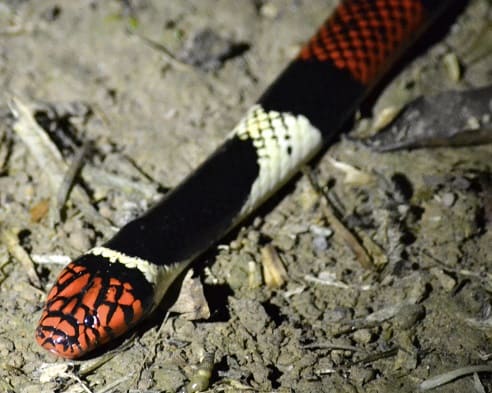
Maximum length: 139cm.
The aquatic coral snake inhabits a giant swathe of central and northwestern Brazil, sticking to the Amazon region. As the name suggests, this is the most water-loving coral snake of the 82 species worldwide. While they sometimes venture to forest floors during the dry season, aquatic coral snakes (Micrurus surinamensis) are more commonly found in swamps and slow-moving rivers, surrounded by humid rainforests which most sane people stay well away from.
Aquatic coral snakes appear not just in Brazil, but eastern Ecuador, Colombia and French Guiana. They’re far more fish-eating than most members, and one of their confirmed prey is the longtail knifefish (Sternopygus macrurus), which looks like a sharp rock wielded by a caveman. They also eat armoured catfish and marbled swamp eels, with the latter also being eaten by the Brazilian smooth snake, which is therefore their competitor.
This species has one of the highest venom yields of any coral snake, injecting 160mg per bite. The eastern coral snake of Florida manages just 3-5mg. Aquatic coral snakes aren’t that eager to bite, as they normally hide their heads in their coils first, flatten their bodies, and wiggle their bright tails as a decoy. However, they’ll bite if they feel all other options are exhausted.
Aquatic coral snakes are strongly nocturnal, and one decent ID sign is their face. The aquatic coral snake has a red face adorned with black markings, unlike Hemprich’s coral snake (black) or the Brazilian short-tailed coral snake (white with black).
Aquatic coral snakes hardly ever climb trees, but juveniles have been spotted on vines 1.35 metres above ground. Within the coral snake genus, their closest relative is the ribbon coral snake (Micrurus lemniscatus), followed by Hemprich’s coral snake.
| 3 | Painted coral snake |
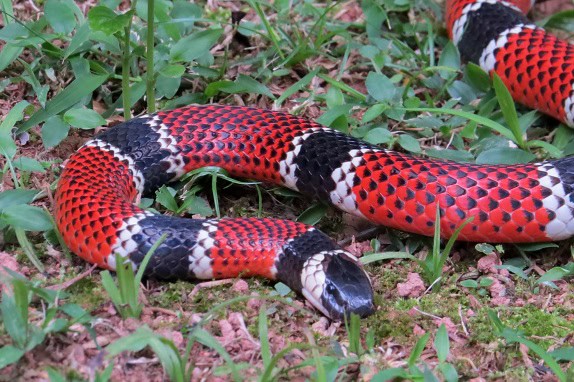
Maximum length: 98cm.
The Brazilian coral snake most often encountered by ordinary people. This species inhabits the populous southeast of Brazil, sticking to forests and forest edges, and is regularly walked past by countryside explorers near the large cities of Rio de Janeiro and São Paulo.
The painted coral snake (Micrurus corallinus) isn’t the most widespread in Brazil, but its range overlaps with the country’s most populated areas. Consequently, it tops the tables for coral snake bites nationwide, accounting for 36 out of 194 according to one study.
As a neurotoxic snake, this species can cause paralysis and respiratory failure, and also visual disturbances, difficulty swallowing, double vision, and a numb tongue. The mortality rate is high, as the painted coral snake contains both post and pre-synaptic neurotoxins.
On the positive side, this species causes almost no swelling or necrosis. Though deadly, coral snakes still comprise just 1% of Brazil’s national snakebite statistics. Being the top ranked snake among a 1% share still makes you far safer than the common lancehead or South American rattlesnake.
In terms of patterns, this species always has long red spaces touching white, not touching black. The black bars are surrounded on each side by a thin white bar. The long red spaces are usually adorned with subtle black spots. The pattern spacing is as follows: long red space, white, black, white, long red space, repeat forever. The species’ face, meanwhile, is pure black, obscuring its eyes.
| 4 | Caatinga coral snake |
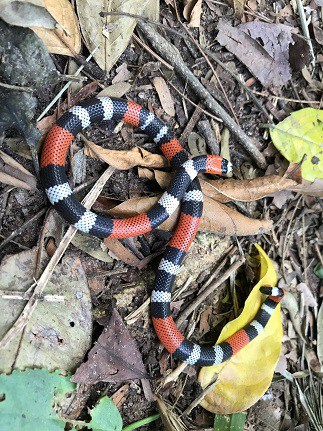
Maximum length: 147cm.
This coral snake holds the honour of being the easternmost in the world, at least within the 82 member Micrurus genus. Caatinga coral snakes (Micrurus ibiboboca) are abundant in eastern Brazil, including near Recife and Salvador. Brazil is the only country they inhabit, but they inhabit a large area of the Atlantic coast. There, they largely stick to forests, including deciduous and Araucaria moist forests, and occasionally agricultural fields.
The Caatinga coral snake appears to have a powerful venom, as shown by a case from northeast Brazil in 2017. A 60 year old man was bitten while tying up his cattle, after reaching into a thick clump of grass. The symptoms began with muscle paralysis and sweating, after which he was admitted to intensive care and given 10 vials of antivenom.
The next wave of symptoms included headache, chest pain, and a severely painful arm. Other neurological symptoms like visual disturbances and respiratory distress were lacking. The man ultimately survived with no lasting effects, probably because he received antivenom 75 minutes after being bitten.
Caatinga coral snakes largely prey on fellow snakes, a diet which sometimes goes wrong, as in 2010, one was observed to have died after attempting to swallow a large annulated cat-eyed snake. Other meals include amphisbaenians, lizards with elongated and legless bodies.
| 5 | Amazon coral snake |
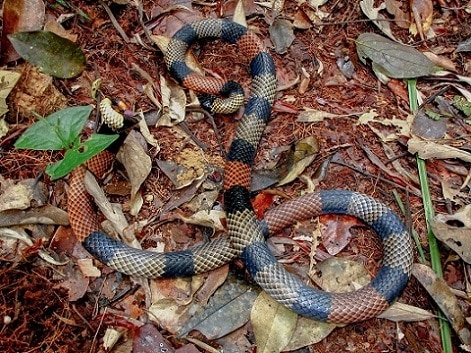
Maximum length: 160.2cm.
A larger than average coral snake, which mainly inhabits central and northwestern Brazil. This species holds a weird record, as it probably has the fewest sightings of any coral snake in proportion to its vast territory. As this iNaturalist map shows, this species covers the entire Amazon region from west to east, yet there’s no more than a handful of dots for sightings.
The Amazon coral snake (Micrurus spixii) is also known as the Peruvian coral snake, and many natives consider it to be the most dangerous snake nearby. This version has a subtly different venom to most coral snakes. While still possessing the usual neurotoxins which shut down all brain transmissions to muscles and lungs, its venom also has powerful haemorrhagic and procoagulant properties.
In a 2015 study, the venom caused severe swelling of mice legs, and a rise in creatine kinase, which is a widely used indicator of muscle tissue destruction, meaning that this venom is myotoxic (muscle-targeting).
Amazon coral snakes mainly stick to lowland rainforests. They have the following patterns: wider red bands, followed by black-white-black-white-black bands. Most of their face is black and white, but the corners of their mouth have a subtle red patch. Amazon coral snakes are closely related to the Brazilian short-tailed coral snake (Micrurus brasiliensis).
| 6 | Uruguayan coral snake |
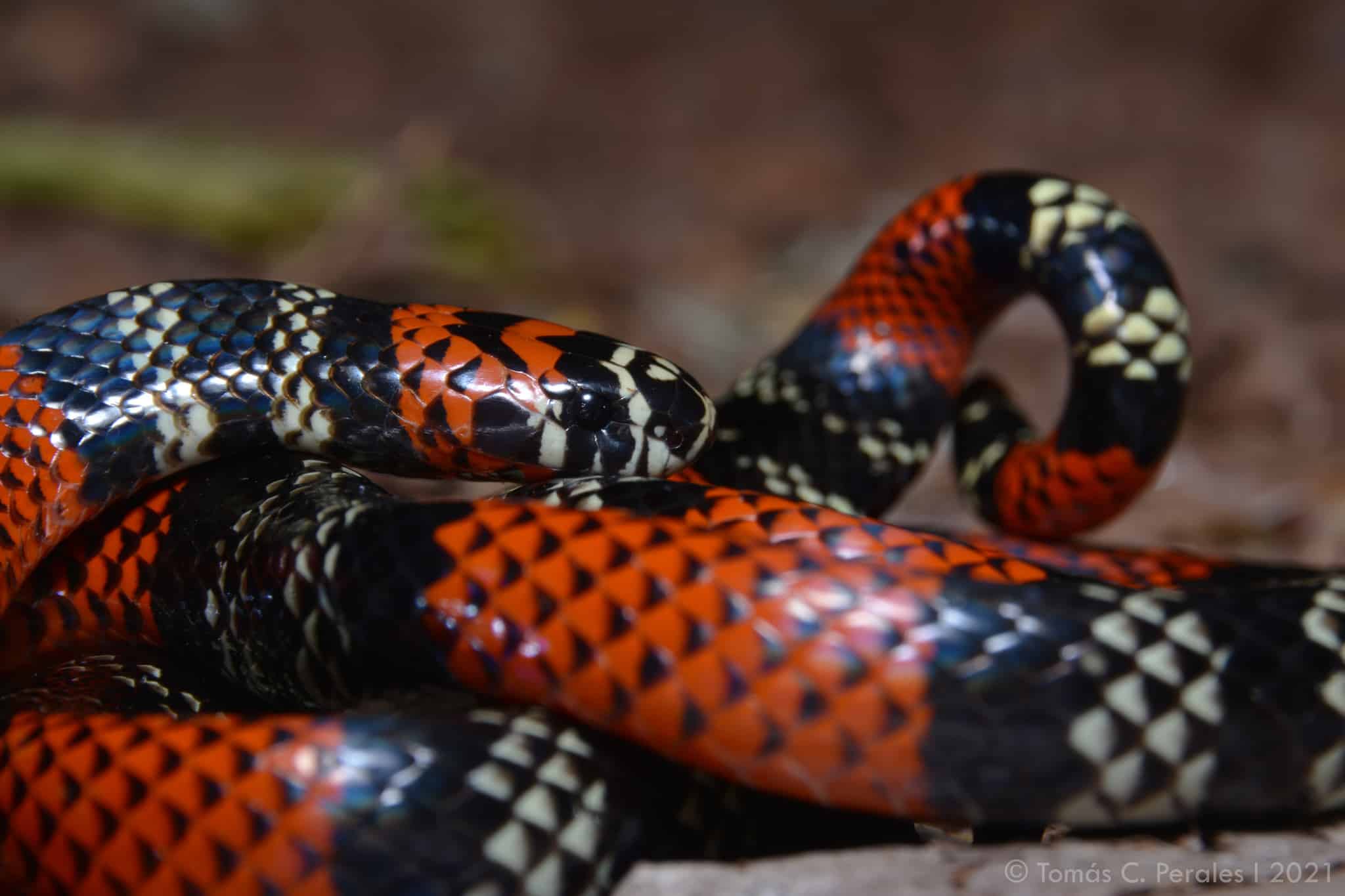
Maximum length: 120cm.
A coral snake found not only in Uruguay, but far southern Brazil, eastern Paraguay, and northeastern Argentina. The Uruguayan coral snake (Micrurus altirostris) is a species of humid forests, including the Atlantic forests of Brazil, and humid riparian forests following the course of the Uruguay river. This version mainly feeds on fellow reptiles, including snakes such as Brongersma’s worm snakes and pale-headed blind snakes.
This is a dangerous coral snake, which is to be underestimated at your peril. Studies reveal a host of powerful post-synaptic neurotoxins, which bind to and block acetylcholine receptors in muscle cells, preventing brain signals from being transmitted. This is a similar mechanism to the black mamba thousands of miles away. Most worryingly, the standard coral snake antivenom has only a limited effect on Micrurus altirostris.
This species typically measures 80cm. Uruguayan coral snakes have striking patterns, with traditional black, red and white bands, and a constant static of black patterns overlaying the red. Rather than clean black (like Hemprich‘s coral snake), this species has a messy black and white face, making it hard to spot their eyes amidst the chaos.
| 7 | Brazilian short-tail coral snake |
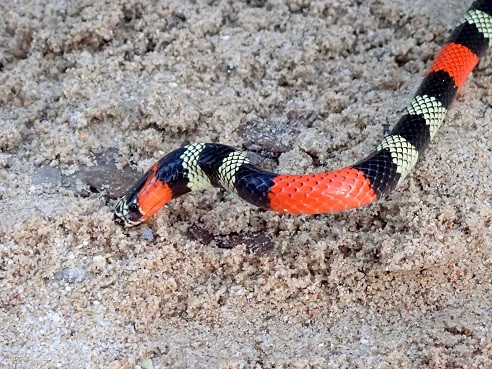
Maximum length: around 150cm.
This species was originally assigned as a southern coral snake (Micrurus frontalis) subspecies, until being granted full species rights in 1999. Brazilian short-tail coral snakes (Micrurus brasiliensis) are larger than average, and are a triad species with typical coral snake colours, in the following pattern: red, black, white, black, white, black, red.
This species lives solely in eastern Brazil, including Bahia and Minas Gerais states. It’s far less common than Hemprich’s coral snake, and is considered to be endangered.
Rather than rainforests, Brazilian short-tail coral snakes are mainly found in rocky grassland and dry, sandy forests, habitats which are slowly being destroyed to make way for profitable soybean and sugar plantations. They’re also threatened by the construction of hydroelectric plants. This species is contained solely within Brazil, with no spillage into Paraguay or Uruguay.
Being a new species, Micrurus brasiliensis is poorly researched compared to other Brazilian coral snakes. However, it’s confirmed to feed on fellow snakes, including Reinhardt’s burrowing snake (Apostolepis assimilis). This coral snake has a pale face with black markings, and the pale bands vary from white to yellow.
| 8 | Black-necked Amazonian coralsnake |
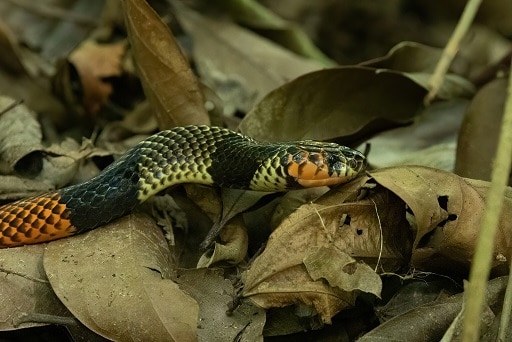
Maximum length: 155.5cm.
A species of extreme western Brazil, mainly in Acre state. Black-necked Amazonian coral snakes (Micrurus obscurus) also inhabit Peru, eastern Ecuador and southern Colombia, following a line of jungle east of the Andes. They’re mainly found in rainforests, including pristine and heavily disturbed rainforests. However, they also stray to adjacent agricultural land, forest clearings, and villages near forests. This species has been observed to takes shelter in hollow logs, and even under leafcutter ant nests.
Micrurus obscurus is one of the more striking coral snakes. While this member possesses the usual red, yellow and black colours, everything is constantly intermingling, particularly on the face, which is creamy with smudges of red, and a bright red jaw. Additionally, the yellow sections are much creamier-looking compared to other coral snakes.
This is a relatively long coral snake. In January 2012, a new record was set when a dead Amazonian black-necked coral snake was found on a forest road near some agricultural fields. It measured 155.5cm, which well exceeded a previous record of 134.5cm. This was also one of the longest Micrurus coral snakes found to date, across the 82 species.
This coral snake has a neurotoxic, myotoxic and haemorrhagic venom, covering many toxic bases. However, the yield is only 10-35mg per bite, and the venom is less lethal compared to other Amazonian coral snakes. Its venom also varies between individuals, possibly growing simpler with age. As well as biting, a disturbed Micrurus obscurus will thrash its body for up to 3 seconds.
This species is somewhat controversial. Its closest relative is the Amazon coral snake, Micrurus spixii, and some consider M. obscurus to be a mere subspecies. However, this 2019 study found that Micrurus obscurus has significantly shorter venom-inoculating fangs than its cousin.
| 9 | Southern coral snake |
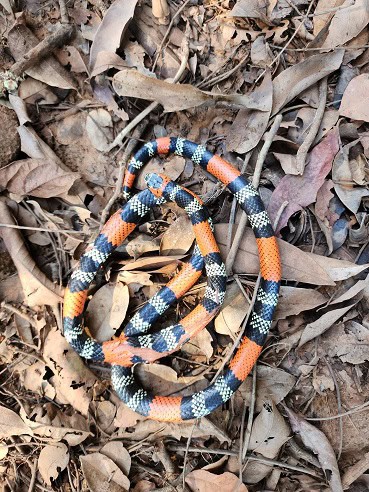
Maximum length: 164cm.
The second main coral snake of southeastern Brazil. This species also inhabits Paraguay, and is just as neurotoxic as its painted coral snake neighbour. In the same survey where painted coral snakes caused 36/194 coral snake bites in Brazilian hospitals, this species contributed 12, ranking 2nd nationwide.
The southern coral snake (Micrurus frontalis) is recognisable by its much whiter face, and wide red bands which touch black (versus white for the painted coral snake). Southern coral snakes can not only trigger paralysis, but target the heart, impeding cardiovascular function. Their favourite place to lurk is a thick leaf litter bed within a forest, but they also appear in agricultural and pasture land, often close to streams.
Their diet, meanwhile, includes mostly legless prey, including fellow snakes. This snake is known to bite off more than it can chew, as in a 2014 report from São Paulo state, a southern coral snake regurgitated a legless worm lizard. This lizard weighed 14.2 grams, versus the snake’s 16 grams, equating to 89% of its own body weight.
An anaconda can swallow giant meals, but coral snakes tend to eat smaller and medium-sized meals. Another southern coral snake swallowed a dead jararaca, São Paulo’s most dangerous pitviper. The problem was that this jararaca also contained a dead rodent, and so the southern coral snake was forced to abort again.
| 10 | Decorated coral snake |
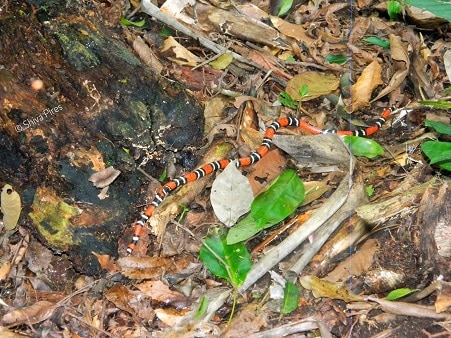
Maximum length: 64.5cm.
A relatively mysterious coral snake. The decorated coral snake (Micrurus decoratus) inhabits a small section of southeastern Brazil along the Atlantic coast, including near Rio de Janeiro. It appears in dark Atlantic forests, but only at altitudes of above 700 metres, and up to at least 1500 metres.
This is one of the smaller coral snake species. In a 2002 study covering 55 decorated coral snakes, the longest male measured 64.5cm, while the longest female reached 57.0cm. The study also identified 5 prey in their stomachs. Three were caecilians (elongated, legless amphibians), while two were amphisbaenians (elongated, legless reptiles). One prey was confirmed down to the species level: Hardy’s caecilian. Decorated coral snakes seem to prey on fellow snakes less commonly, perhaps because of their shorter length.
Decorated coral snakes have a strong tendency to raise their tails into the air when threatened, drawing attention to the bright colours. The study above found that they raised their tails without fail when frightened, even when touched gently. They also flatten their bodies to create a deceptive impression of size.
This species overlaps with the painted coral snake (Micrurus corallinus) in its entire territory in southeastern Brazil. The latter is far more common, and is easy to separate, as the painted coral snake has only one black band sandwiched between two thin white ones (pic), followed by a large red spacing. Meanwhile, the decorated coral snake has 3 black bands, with a white inbetween each (again followed by a swathe of red).
| 11 | Paraíba coral snake |
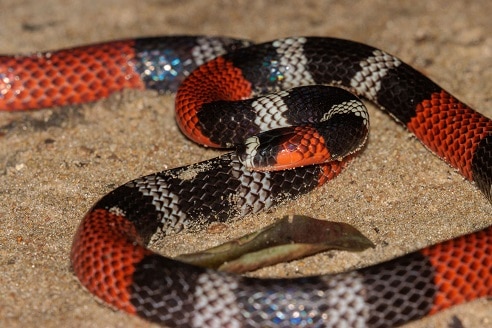
Maximum length: 93cm (so far).
A new coral snake species, identified only in 2014. The Paraíba coral snake (Micrurus potyguara) is found solely in lowland coastal forests, and lives exclusively in northeast Brazil. This species may be endangered, surviving in pockets of trees amid agricultural fields and grassland.
The new species was easily confusable for a layman, but possessed a series of characteristics not combined in any other coral snake. These included a head slightly broader than the neck, an entirely black snout tip, with a white ring around the snout before the eyes, and then the rest of the head being black.
The first black band after the neck was far longer than its neighbours, like the Caatinga coral snake (which it overlaps with). The Caatinga coral snake also had thicker white bands on its body, and a smaller number of ventral (belly) scales.
The Paraíba coral snake has a standard triad pattern: wide red bands, followed by black-white-black-white-black. As of 2023, its venom and diet are still unresearched. Meanwhile, the Latin name of Micrurus potyguara references the native Tupi people who once lived in northeast Brazil, who fished for shrimp for their economic survival.
| 12 | Annellated coral snake |
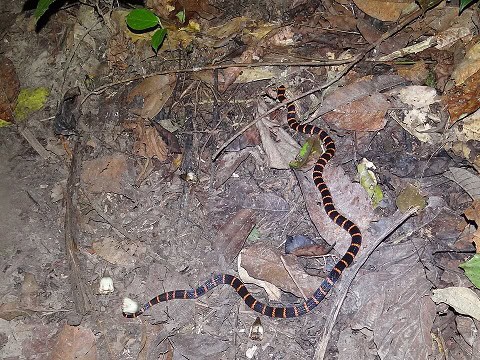
Maximum length: 72.8cm.
This coral snake mainly inhabits Peru, but also far western Brazil, as well as eastern Ecuador (east of the Andes). Annellated coral snakes (Micrurus annellatus) are relatively short in length (30-73cm), and are commonly found resting on leaf litter beds in rainforests, plotting their next move. They can also be found in cloud forests at up to 2000 metres in altitude.
Venom research is very scarce, but a few reports have trickled in. A 47 year old man was bitten in western Brazil, and experienced uncoagulable blood for 3 days, with clotting factors completely deactivating. Luckily, he didn’t experience any medically significantly bleeding, and was discharged from hospital in fine health.
Annellated coral snakes have 3 subspecies, with two inhabiting Brazil. Micrurus annellatus annellatus has just two colours on its body, with rapidly alternating black and white, and occasionally black and red.
M. annellatus bolivanus is more common in Brazil, and features the usual 3 colours, in the order of red, white, black, white, red. However, the red bands are by far the widest, and the white bands are severely thin (see this image). The annellated coral snake is one of the more poorly researched members overall.