| 1 | Inland taipan |
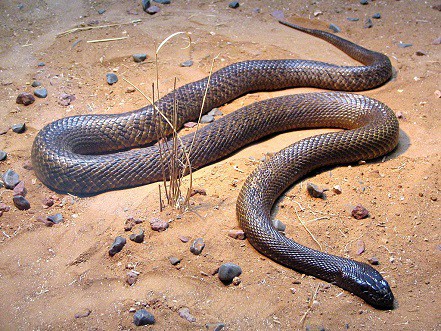
Maximum length: at least 250cm.
Out of nearly 4000 snake species worldwide, the inland taipan (Oxyuranus microlepidotus) is officially the one with the most toxic snake venom, at least towards mammals. This species has an LD50 score of 0.025mg, beating the king cobra at 0.9mg, and even the black mamba at 0.05mg.
Inland taipans avoids coastal Australia, and instead appear in the central outback, in desolate areas far from any towns and cities. This species might be lethal, yet it causes almost no human deaths, due to living far from civilisation.
Inland taipans are typically found in dark clay cracks, which they rarely emerge from. They eat and sleep in these cracks, cornering their rodent prey in dark passages. They occasionally slither out and visit shallow rivers bordered by eucalyptus trees, but even outback dwellers rarely encounter this snake.
Inland taipans are so deadly because their venom mainly consists of neurotoxins, which lead to respiratory failure and ultimately death. Approximately 90% of inland taipan bites result in envenomation, and the first symptoms appear within 15 minutes. Specific toxins in the mixture include oxylepitoxin-1, alpha-oxytoxin 1, and alpha-scutoxin 1.
| 2 | Stephen’s banded snake |
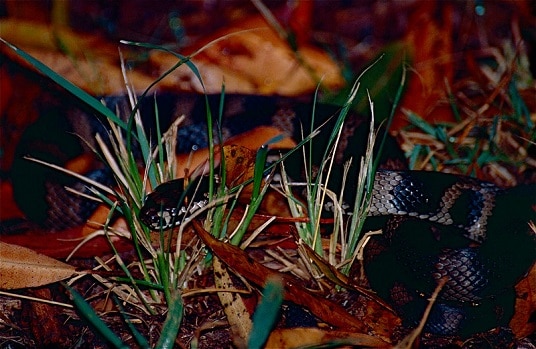
Maximum length: 120cm.
A tree-loving snake found in Queensland and New South Wales, including near Sydney and Brisbane. Stephen’s banded snakes (Hoplocephalus stephensii) can be found anywhere where trees grow, taking shelter in their dark hollows. This species is not only a tree snake, but can rest extremely high in trees, sometimes up to 20 metres above ground.
Despite resting for much of the day, Stephen’s banded snake has a nervous personality, and rapidly turns vicious when people enter its domain. Its venom matches its temperament, as Stephen’s banded snake produces a haemotoxic elixir which increases blood clotting via altering prothrombin. Paradoxically, this increases bleeding, as the blocked blood vessels burst, causing blood to pour from the victim’s eyes and open wounds.
One death has been recorded from this snake, a 60 year old man from Kalang. This coincided with the 2013 New South Wales floods, and the man didn’t receive antivenom for 7 hours, as the emergency services were unable to reach him. An additional danger factor is that Stephen’s banded snakes have supreme camouflage; you might not notice the horror disguised against a tree trunk.
No antivenom is available for Stephen’s banded snake yet. However, 4 vials of tiger snake antivenom has been found to work decently.
| 3 | Red-bellied black snake |
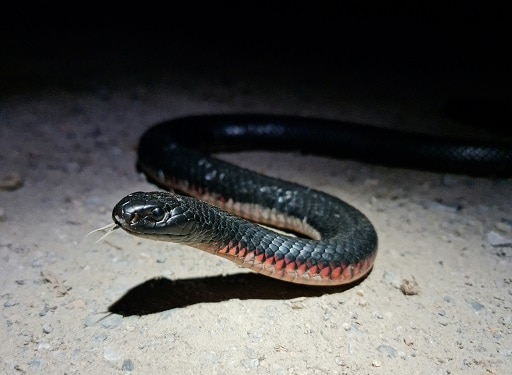
Maximum length: 254cm.
A semi-aquatic snake found in ponds, marshes, swamps and even manmade swimming pools. The red-bellied black snake (Pseudechis porphyriacus) is found all over the east coast, appearing in New South Wales, Queensland, Victoria, and a small portion of South Australia. This might be the single most commonly encountered snake by ordinary Australian people.
This species also has a less welcome record, as according to a survey from 2005 to 2015, the red-bellied black snake was responsible for 16% of Australian snakebites. Red-bellied black snake venom has strong anticoagulant properties, causing spontaneous bleeding. It contains the unique pseudexin, comprising 25% of the venom mixture, and a neurotoxin called a-elapitoxin Ppr1.
Bites from this species are also agonisingly painful, causing swelling, rotting flesh and redness. One of the freakiest symptoms is red-brown urine, due to myoglobin being released from assaulted muscle tissue.
Red-bellied black snakes are highly adventurous in nature, as females can travel over 1km in 24 hours. They’re always investigating burrows for prey, or going on adventures into people’s ponds to search for fish. Consequently, this snake is often encountered by ordinary east coast Australians, and that’s why it bites so many people.
Thankfully, this species rarely kills anyone, as the venom’s LD50 score is a comparatively weak 2.45mg. You also have a good chance of winning the snake roulette with this species, as only 70% of bites resulted in systemic envenomation in one study.
| 4 | Mulga |
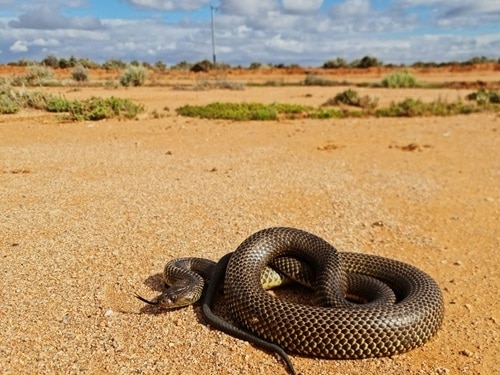
Maximum length: 330cm (Australia’s longest venomous snake).
The most thuglike of Australia’s venomous snakes. While their venom isn’t the strongest, mulgas are violent in personality, and will hiss loudly at anyone nearby. They’ll never back down and flee, and if the encroacher doesn’t get the message and turn around, they won’t hesitate to bite repeatedly, sometimes gripping the victim’s arm and chewing.
Mulgas are also known as king brown snakes, and occupy around 90% of Australia, only really skipping the east coast. With an average of 2 metres, they’re officially the country’s longest venomous snake. They often sneak into people’s bedrooms at night and bite them, and their dietary preferences don’t exist, as mulgas will eat almost anything, including other snakes.
The mulga (Pseudechis australis) has a mid-ranking LD50 rating of 1.91mg, and the last officially recorded death was in 1969, when a man reached under a wooden verandah in the wheat town of Three Springs. Instead, this species stands out with its colossal venom yield. The norm is 150mg, but over 1000mg isn’t exceptional.
Bites from a mulga can cause nausea, vomiting, abdominal pain, headaches, diarrhoea, and also visual changes. Don’t mess with this snake, because you won’t win. Mulgas are also known for brutal wrestling bouts with rival males of their species.
| 5 | Lowland copperhead |
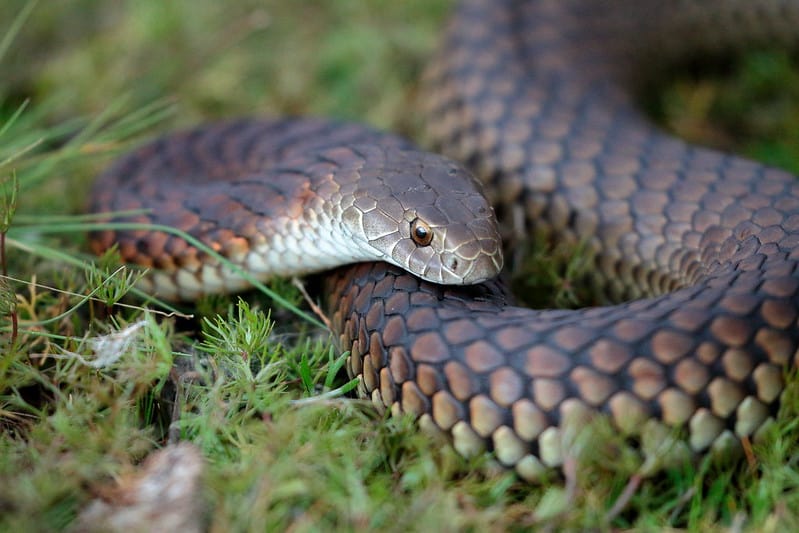
Maximum length: around 150cm.
The Australian copperhead, not to be confused with the US terror of Louisiana. Lowland copperheads (Austrelaps superbus) are most common in Victoria, and are one of just three snakes to inhabit Tasmania, alongside the tiger snake and white-lipped snake.
Lowland copperheads are venomous, but bite relatively rarely. They’re notable for coping extremely well with human habitats, as when agriculture arrives and decimates the natural landscape, this species simply stays put. They can inhabit areas dominated by intensive agriculture for 100 years, and during winter, they can hibernate beneath roofing iron, tractor tires and haybales.
Consequently, ordinary Australians encounter this species regularly, particularly along the southern Australian coast. Lowland copperheads have an LD50 rating of 2mg, which is relatively weak, but the venom yield can be high. Their venom is loaded with neurotoxins, cytotoxins and haemotoxins, the full arsenal.
Generally, lowland copperheads try to escape when cornered, and aren’t particularly aggressive, but they’ll still sink their fangs in if you force their hand. A 2017 study discussed a bite in a dog; it suffered almost complete paralysis, including respiratory paralysis, but was miraculously saved with antivenom.
| 6 | Common death adder |
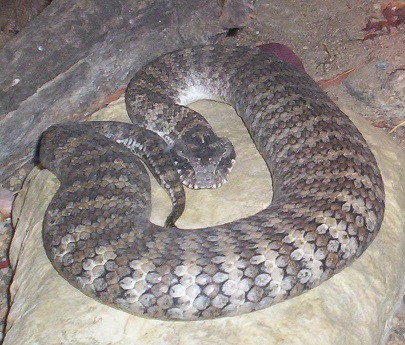
Maximum length: 100cm.
This venomous snake is deadly, but so relaxed that you’ll probably walk past and get away with it (don’t let your guard down though). Common death adders are 40-80cm long, but with an extremely thick body. They’re most common in eastern Australia, but also appear along the southern coast.
At 0.6mg, death adders have a stronger LD50 rating than the red-bellied black snake, and their venom yield is also high at 70-236mg. This is a highly neurotoxic snake, with a lethal ability to disconnect normal brain signals. If injected via their needle-like fangs, the venom causes speech, breathing and blinking problems, followed by the final symptom: lung failure. Before antivenom arrived in the 1950s, 50-60% of death adder bites were fatal.
If this was a hyperactive snake, it could be Australia’s deadliest. But the death adder is an ambush snake, and the most common place to spot them is resting motionless by forest trails, sometimes near popular dog-walking paths.
Common death adders can lie motionless for weeks, and go without food for longer. Consequently, the main worry for a local Australian is stepping on them. No deaths have happened this century, although the northern and desert death adders dealt out one death each in the 1990s.
| 7 | Rough-scaled snake |
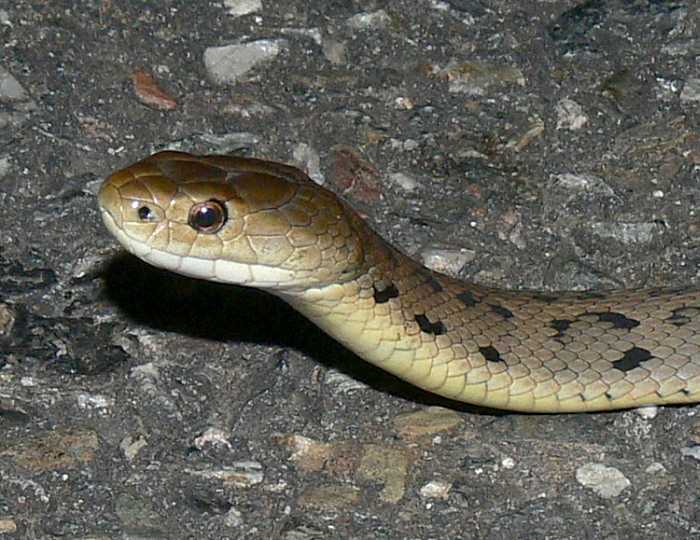
Maximum length: 100cm.
This venomous snake is the only member of the Tropidechis genus worldwide. Rough-scaled snakes are found in eastern Australia, including the outskirts of Brisbane. They has a particularly loud and explosive hiss, and though relatively shy, they often pounce on and bite victims before making a rapid escape.
Rough-scaled snakes have some neurotoxic qualities, but mainly specialise in bleeding. In a study on 24 bite victims, only 2 experienced neurotoxic symptoms. However, 10 had traces of blood in their urine, and one suffered a major intra-abdominal haemorrhage.
Mild symptoms like nausea and headaches were experienced by 17 people. Some victims survive easily with antivenom, but one death is confirmed, and this victim died within 5 minutes.
This snake is often confused with the common keelback, a harmless water dweller with a similar colouring. Rough scaled snakes aren’t strict tree dwellers, but will sometimes ascend 5 metres up branches during the course of hunting. They’re most often sighted while crossing roads, particularly during rainy summer nights.
| 8 | Eastern brown snake |
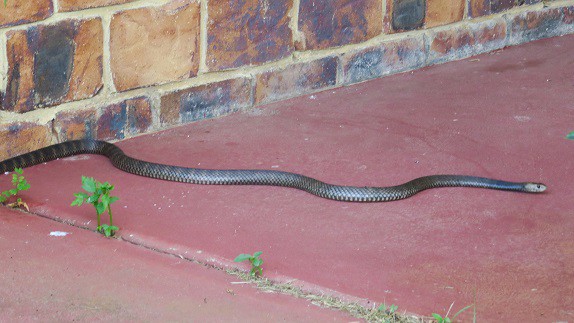
Maximum length: 240cm.
The eastern brown snake has the 2nd most toxic venom of any land snake, right behind the inland taipan (although several sea snakes are worse). From 2005 to 2015, the Pseudonaja brown snake genus caused 15 of 19 snakebite deaths in Australia, and 2011 saw 3 deaths from the eastern brown snake itself.
This snake causes very few local symptoms, such as necrosis, swelling, and blistering. Instead, the venom saves its powers for the inside, triggering nausea, followed by severe haemorrhaging. The cause of death is usually kidney failure.
Eastern brown snakes are common, and are often encountered by front doors, on pavements, or on bush trails by explorers wearing backpacks. They’re not especially aggressive, but nor are they cowardly. If this video is to be believed, they’re activated mainly by movement. Stay still, and they’ll calm down and start leaving, but move a muscle, and a piercing hiss will sound, and the eastern brown snake will spin right back into its aggressive posture.
Eastern brown snakes are only redeemed by their tiny venom yield, at just 4-10mg, although that’s more than enough to wipe people out. Additionally, the antivenom is stocked in almost all Australian hospitals.
| 9 | Small eyed snake |
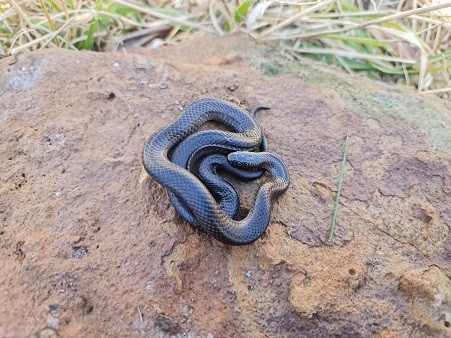
Maximum length: 120cm.
A venomous snake of eastern Australia, which doesn’t just have small eyes, but a jet black body, contrasting sharply against a creamy or pink belly. Small-eyed snakes are found anywhere with high moisture levels, including rainforests, woodlands, heaths and wet sclerophyll forests. Rocky outcrops are another of their hotspots.
Compared to other entrants on this list, small-eyed snakes have a particularly myotoxic venom, meaning that they attack muscle tissue. One of these myotoxins is particularly long-lasting, attacking muscle tissue for days after injection, including heart tissue. As you’d expect, muscle weakness is the main symptom, which separates this species from other venomous Australian snakes.
The small-eyed snake has one official death on the records. They tend to thrash around when disturbed, only biting if seriously pushed. One horrifying fact is small-eyed snakes live communally; you can sometimes lift up a rock to find several staring at you at once. This is a nocturnal snake, which prowls around at night and retreats to comfortable shelter during the day.
This species is often confused with the red-bellied black snake. However, there’s no change in strategy; you should run from both!
| 10 | Rough-scaled death adder |
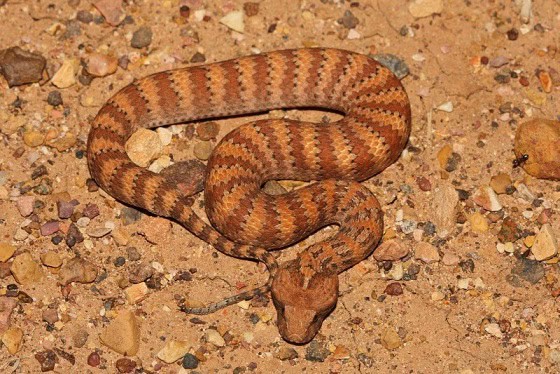
Maximum length: 80cm.
Another member of the Acanthopis death adder clan, which has 8 members. The rough-scaled death adder (Acanthopis rugosus) inhabits Papua New Guinea, but also a swathe of Australia’s far north, namely Northern Territory and western Queensland.
As it lives so far away from most civilisation, this species is far more poorly researched than its common cousin, but we still have some morsels of information. Research at Fogg Damm Conservation Reserve shows that juveniles primarily feed on reptiles, while adults gradually add more mammals as they grow older and larger.
Compared to other death adders, its venom is especially toxic to muscle tissue (myotoxic). In 2005, scientists extracted a unique toxin called acanmyotoxin-1 from this species, which was the first myotoxin ever discovered in a death adder.
Their name references their rough scales, although we never recommend getting close enough to run your hand gently along their back. Finding this species is extremely difficult. Rather than comfortable dog walking trails, this species inhabits stony hills, wide floodplains, and more remote woodlands of the far north. Consequently, they contribute virtually nothing to Australia’s national snakebite statistics, but rough-scaled death adders are still another reason to be wary of Australia’s infamously dangerous north.
| 11 | Tiger snake |
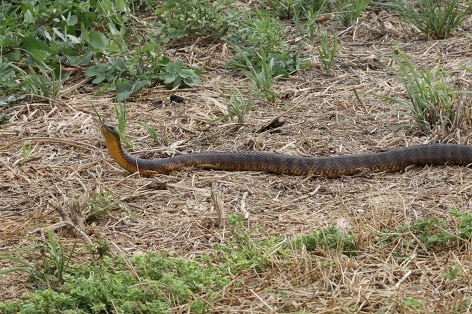
Maximum length: 180cm on the mainland, 240cm on certain islands (Chappell Island).
The 2nd most prevalent cause of Australian snakebites, accounting for 17% of envenomations between 2005 and 2015. Tiger snakes are easily identifiable by their banded patterns, and live in southern Australia, both west and east – you won’t find any in the parched northern territories.
This venomous snake prefers wet habitats, such as creeks, lagoons, wetlands, swamps and dams. They like to hide under deep, matted vegetation and fallen timber, but will sometimes climb trees. Tiger snakes are also found in Tasmania, off the south coast of Australia, as well as offshore islands like Chappell Island.
Tiger snakes (Notechis scutatus) don’t hate humans, but they certainly don’t care about them. This species produces at least 6 different neurotoxins, plus haemorrhagins, myotoxins, and coagulants. A bite begins with tingling, numbness and sweating, and up to 50% of untreated bites are fatal.
Tiger snakes are unpredictable, as they’ll sometimes flee, but in other cases, they’ll stand their ground. A cornered tiger snake will hiss loudly while inflating and deflating its body. This is not a bluff – tiger snakes mean what they say. At 0.12mg, the tiger snake has the third most potent venom of our list, and the venom yield can reach great heights, ranging from 35 to 189mg.
The worst news? Killing one incurs a fine of AU$7500, and a jail sentence of 18 months.
| 12 | Gwardar |

Maximum length: 1.5 metres.
The western brown snake, popularly known as the gwardar, is a widespread species in Australia which is particularly common on the west coast, skipping the populous east coast. This is one of Australia’s most dangerous snakes, combining lethal neurotoxins with a rapid speed.
Gwardars are most common in open woodlands, including sandhill woodlands, mallee woodlands and boree woodlands. They’re also found in parched open areas, including spinifex deserts and stony plains, where they survive by taking shelter in dark burrows or large cracks in the parched earth. They’ve also been found in crop fields occasionally.
In appearance, this is easily the most variable member of the brown snake (Pseudonaja) clan. The eastern brown snake of Sydney is nearly always a plain olive-beige, but the gwardar can be dense orange with a black head, like above. They can be pale grey with thick black bands, a plain olive colour, dark brown, or some combination of the above.
This species isn’t immune to the dangers of Australia, as they’re confirmed prey for monitors. Many events in the vast Australian wild go unrecorded, but gwardars are neurotoxic enough that they’re believed to be responsible for many deaths.