
| 1 | One of 3 Tasmanian snakes |
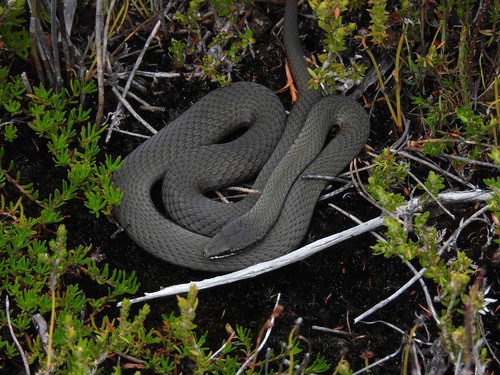
Even though Australia is a complete snake pit, the large island of Tasmania off the south coast only has 3 native species. The first is the dangerously venomous tiger snake, which reaches up to 2.4 metres. The second is the venomous, but relatively shy lowland copperhead. The final snake on Tasmania is the white-lipped snake (Drysdalia coronoides), which is the shortest of the three, at a maximum of just 50cm.
White-lipped snakes are venomous, but no deaths are confirmed. Their fangs are relatively small, and they usually default to hiding away shyly rather than mindlessly charging. This species tends to appear in more open areas such as grassland, marshes, lake shores and open woodlands, though they can appear in forests occasionally.
White-lipped snakes are also found on the Australian mainland, particularly in Victoria, but also parts of New South Wales and the extreme southeast corner of South Australia. They’re very easy to recognise, even on the mainland where they coexist with more species.
You only have to search for one ID sign with this snake: the namesake white lip. This is present on virtually all members of this species, and contrasts sharply against the scales below.
| 2 | Australia’s most cold-adapted snake |
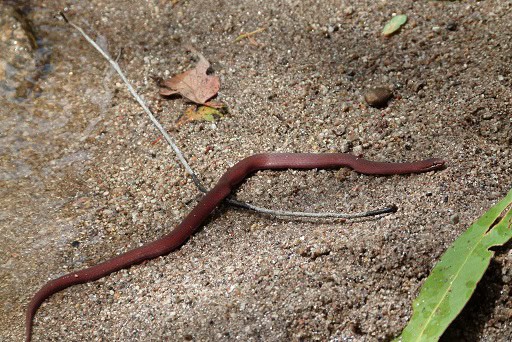
White-lipped snakes lack a powerful venom, and are relatively small in size. Nor can they zip up trees in mere milliseconds like the green tree snake. However, this species does possess the record of being Australia’s most cold-adapted snake.
The white-lipped snake is abundant in the Snowy Mountains of southern New South Wales, and has even been found close to the summit of Mount Kosciuszko, Australia’s highest mountain. This peak reaches 2228 metres above sea level, and the white-lipped snake has been discovered well above the snow line. They also appear in mountainous areas within Tasmania, such as Cradle Mountain national park.
The white-lipped snake can slither up cool, mountainous slopes where the eastern brown snake or mulga would rapidly start shivering and die. Wherever this species lives, it tends to be fairly common, but there’s an asterix – this species likes to hide beneath shelter. White-lipped snakes often take shelter below grass tussocks, rocks, or manmade objects like sheets of tin. They’re not semi-aquatic, unlike the red-bellied black snake, but they’re comfortable in marsh and lakes, and are skillful swimmers.
| 3 | Few bite reports |
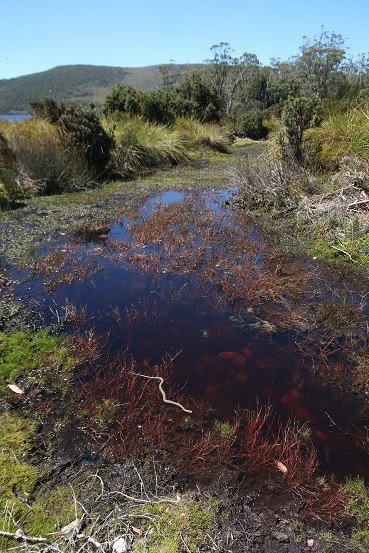
The exact venom potency of this snake in human beings is mysterious, although it definitely falls far short of the eastern brown snake. Bites in humans are virtually non-existent, and no detailed case studies exist in scientific journals.
We do have a chemical analysis of the venom, which revealed a composition of 86.4% three finger-toxins. 3TXs generally tend to be neurotoxins, hinting that this species holds a lethal secret. However, some species like the red-bellied black snake possess neurotoxins which barely seem to affect humans, with specialised effects on their frog prey instead.
Likewise, white-lipped snakes mainly hunt reptiles, not mammals, so humans might be exempt. But it’s equally possible that in a few years, the first detailed case study in humans will be released, and reveal more dangerous symptoms than once thought.
This species has an unpredictable personality, often delivering unexpected bites, compared to a usual timid demeanor. White-lipped snakes are active foragers, rather than patient ambushers. They tend to stalk their prey through the countryside, gradually closing in, before making a final fatal leap, which usually succeeds, but occasionally misses due to the lizard’s unexpectedly fast reactions.
| 4 | Diet: almost fully reptiles |
The white-lipped snake’s diet has been well-researched for 40 years, thanks to a study from 1981, which analysed all 3 members of the Drysdalia genus. At that point, the genus had 4 members, but since then, the crowned snake has been split into its own Cacophis genus.
The other two members of the Drysdalia genus are found on the Australian mainland, and are decently widespread, but much less common. The Masters’ snake (Drysdalia mastersii) is found mainly in South Australia, while the mustard-bellied snake (Drysdalia rhodogaster) is found only in New South Wales, and overlaps with the white-lipped snake.
The study examined dozens of members of each species. Among 382 white-lipped snakes examined, 62 identifiable prey were discovered. There was little ambiguity, as 52/62 prey consisted of reptiles, virtually all of which were skinks, with no fellow snakes. A further 6 were skink eggs.
The other 4 prey included 2 frogs from Tasmania, another frog from NSW, and a small mammal from Victoria. There were no insects, which contradicted earlier reports, which stated that Drysdalia members preyed heavily on insects.
| 5 | Hunts pregnant, slower reptiles |
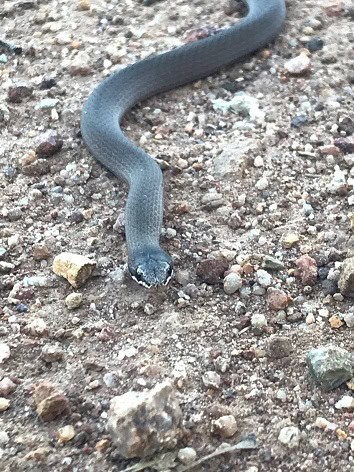
The other two Drysdalia members were similar in their love of skinks, although with a smaller sample size. Meanwhile, the crowned snake had a very different diet, consisting of over 50% frogs, with the remainder consisting of reptiles. This isn’t surprising given that the species was later switched to an entirely different snake group.
The study sampled the white-lipped snake from both mainland Australia and Tasmania. In Victoria, two popular meals were Spencer’s widow-eyed skink and the delicate skink, which were recorded twice each. In New South Wales, the eastern three-lined skink ranked first, followed by the common garden skink and southern water skink. Users on iNaturalist have also made observations, such as a white-lipped snake clutching a dark-flecked garden sunskink in its jaws.
White-lipped snakes also have an intelligent tendency to hunt gravid (pregnant) skinks. This was shown in a 1980 study by the same author, and the theory was simply that pregnant skinks are slower, and easier to catch. The white-lipped snake is a species which doesn’t like to overcomplicate things.
| 6 | Lizards know they’re coming |
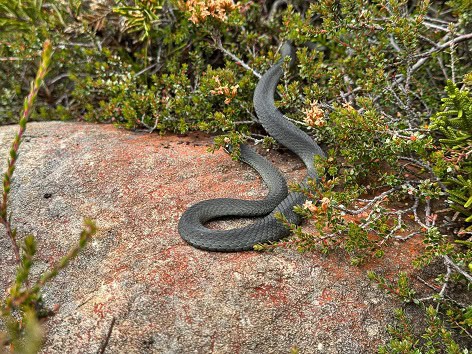
There are many prey species worldwide which have evolved to become hyper-sensitive to their predators. Terrestrial garter snakes react with great fear when they detect the California kingsnake, and the Texas banded gecko is particularly attuned to scent particles of the night snake. The white-lipped snake is another species whose prey are well aware that they’re patrolling the local neighbourhood.
A 2003 study examined the response of mountain log skinks to several scents, rubbed into a patch of mulchy substrate in large plastic tubs. The first was a simple control scent. The next two were scents of the red-bellied black snake, a dangerously venomous frog predator, and small-eyed snake, another skink predator. Finally, white-lipped snake scents were also used.
The scientists measured the overall time spent in areas of the enclosure with certain scents rubbed in. The control area won easily, showing that the skinks had some fear of all snakes. The small-eyed snake was a hair ahead of the red-bellied black snake for time spent.
Meanwhile, the skinks spent by far the least amount of time in the areas rubbed with white-lipped snake scents. Adults were even more avoidant than juveniles, hinting that they’d become even wiser with age, building on an instinctive dislike of the scent, encoded into their genes over many generations.
The skinks of Victoria and New South Wales instinctively fear this species. Small-eyed snakes also hunt skinks heavily, but are purely nocturnal hunters. Meanwhile, the white-lipped snake is mainly diurnal, with some hunting in the evening. The mountain log skink is also a diurnal species, which finds a shelter in the afternoon and retreats to safety before nightfall.
| 7 | Preyed on by two birds (at least) |
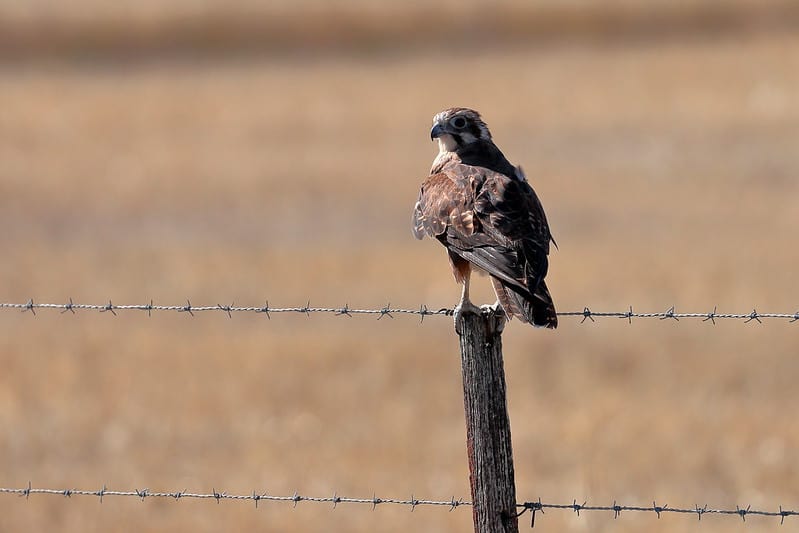
The white-lipped snake once made a cameo in a study on one of Australia’s common snake-eaters, the eastern bandy-bandy (Vermicella annulata). The twist with this species is that it’s extremely specific in its diet, feeding almost exclusively on blind snakes. Scientists discovered this in a 1980 study, where the bandy-bandy not only refused burrowing skinks and heliothermic skinks, but live white-lipped snakes. They only succumbed to the urge to eat Australian blind snakes.
This connection is another example of Australia’s endlessly complex ecosystem; blind snakes control ant populations, but without the bandy-bandy, the populations would plummet too far. Meanwhile, one of the white-lipped snake’s confirmed predators is the laughing kookaburra. This bird is invasive on Tasmania, and tends to reduce white-lipped snake populations wherever it appears. Fortunately, the decline hasn’t been too severe yet.
Cats are confirmed to kill white-lipped snakes well, although whether they actually eat their meat is unknown. A native bird predator is the brown falcon, which is confirmed to prey on white-lipped snakes, as a 1984 study from Tasmania found several in their nests. Brown falcons have also been observed repeatedly to prey on fully grown tiger snakes.
| 8 | Variable in colour (except the lip) |
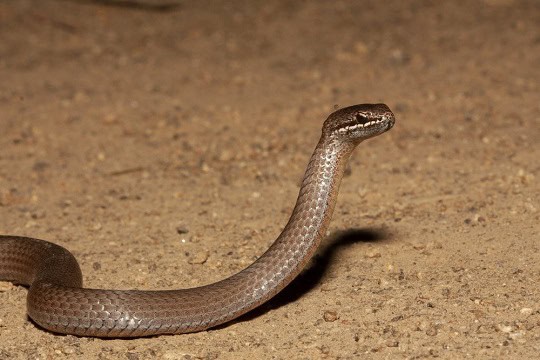
White-lipped snakes have almost no patterns on their bodies. They’re polymorphic in colour, as bluish-black is common, but so is varying shades of brown. A few can be a sandy beige, such as this individual from Wilsons Promontory Marine Park (Victoria).
This is a variable species, yet no matter the colour, Drysdalia coronoides always possesses the namesake white lip. Neither neighbouring snake on Tasmania possesses this. Tiger snakes have bodies consisting of dark, near black mixed with yellow or white, and this spreads to the head, but not in the same pattern directly below each lip. Instead, the yellow tends to cover their chin, and entire belly. It also helps that tiger snakes regularly measure up to 1.8 metres rather than just 50cm, with a species maximum of 2.4 metres in certain local spots (Chappell Island).
Meanwhile, lowland copperheads reach a maximum of 150cm, making them significantly longer as well. They also have less plain bodies than the white-lipped snake. They’re often brown or beige, but have a black edge to each scale, creating more complex patterns overall.
Other physical features of the white-lipped snake include a black tongue, and a deep orange iris. In juveniles, this species has a bright orange or even red underside. Younglings sometimes flash these bright colours when threatened, possibly to startle predators like brown hawks. This brighter underside remains in adulthood, but fades slightly to a salmon pink.
| 9 | The ancient past |
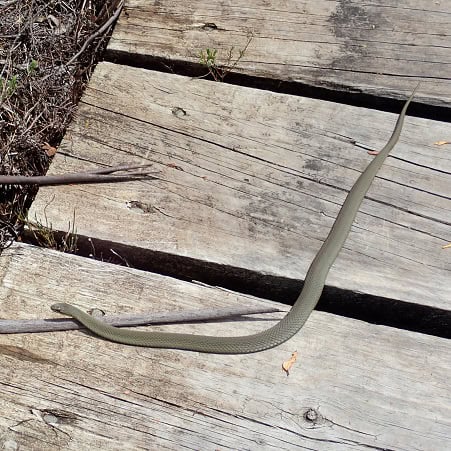
In 2010, a study delved into the history of the Drysdalia genus. Not the recent history – the ancient divergences deep in the prehistoric past. It found that the white-lipped snake diverged from the mustard-bellied snake (D. rhodogaster) an estimated 4.2 million years ago. The next to split were the white-lipped snake and Masters’ snake (D. mastersii), which diverged 2.3 million years ago.
The study also found deep genetic separation within the white-lipped snake itself. There were three distinct genetic lineages: one confined solely to Tasmania, one solely to New South Wales, and another split between the two. The oldest lineage diverged 1.25 million years ago, followed by the next lineage splitting off 1.1 MYA.
The scientists even believed that other undiscovered genetic lineages could exist in Tasmania. The splits were partially down to sea level changes during the ice ages of the Pleistocene epoch, allowing Drysdalia coronoides to spread to new landmasses, before becoming isolated again. Glaciation of Tasmania’s mountain ranges may also have been involved, isolating populations within the island itself.
| 10 | How they survive chillier locations |
As Australia’s most cold-adapted snake, the white-lipped snake understandably has several adaptions to allow the magic to happen. One is unusual for snakes – continuing to feed during pregnancy.
White-lipped snakes lay live young rather than eggs, and mothers will hunt skinks just as frequently during gestation. Most snakes stop hunting completely while pregnant. During warm conditions, the likes of common keelbacks can feast to their hearts’ content, allowing them to cease feeding later and completely devote their bodily stores to their developing young. But white-lipped snakes cannot afford this, particularly in cool areas like Mount Kosciuszko. They have no time to relax, and must keep hunting, forever.
Another adaption is delayed sexual maturity. While the golden crowned snake of western Australia matures at age 1.5, white-lipped snakes take 3 years to become capable of breeding. This is another adjustment to reduced availability of prey, in their cooler climes, particularly given that cold-blooded reptiles almost entirely comprise their diet.
There’s also a difference between location, as mainland mothers breed every year, while those on Tasmania seem to reproduce every two years. The cooler climate and thus lack of food availability on Tasmania might be why. Even laying live young is an adaption itself, as juveniles stay warmer when inside a mother’s body, rather than exposed to the elements in a fragile egg.
| 11 | Coexists peacefully with tiger snakes |
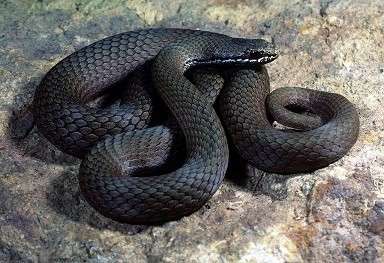
The white-lipped snake is an elapid, like a vast amount of Australian snakes. Australia is the only continent on Earth not to contain a single viper (excluding Antarctica). Even the death adder is actually an elapid, unlike every other snake colloquially dubbed an adder.
Worldwide, the elapids have the most toxic venom drop for drop, easily outstripping the vipers for raw potency. They include the black mamba, coral snakes, and sea snakes, as well Australia’s most lethal killers like the brown snakes and mulga. But a few are gentler, and the white-lipped is one of the mildest elapids of all. The red-naped snake is another particularly mild elapid found in Australia.
Finding a tiger snake or lowland copperhead doesn’t necessarily mean that the snake neighborhood is taken. White-lipped snakes are often found in the same locations as their more dangerous Tasmanian brethren, including grassland near marshes, which tiger snakes also favour.
The reason is relatively low competition. Lowland copperheads also prey on skinks, but derive over half of their calories from frogs such as the spotted grass frog, which white-lipped snakes mostly ignore. Tiger snakes almost never eat reptiles, except maybe as juveniles, preferring to feast on mammals. There’s easily room for 3 snakes on Tasmania, although if an eastern brown snake decided to swim across, they’d probably team up and kill it instantly.
| 12 | Places you may find them |
In 1995, researchers headed to the Mornington peninsular in Victoria, not far from Melbourne. They examined the Tootgarook wetlands for various forms of reptile, and came across 4 white-lipped snakes. They were found in the following locations:
One – in dense grass at the edge of a swamp.
Two – basking in a grass tussock in swampy terrain.
Three – under a sheet of tin near a drainage ditch.
Four – moving near a grass tussock on the edge of a swamp.
White-lipped snakes don’t require protected reserves to exist either. In 2023, one was recorded in the Maroondah suburb of eastern Melbourne, which had a reddish tint. Other confirmed locations in Melbourne include the Jawbone Marine Sanctuary of the city’s south, and Currawong Bush Park of the northeast, which are well within the city limits.
On mainland Australia, white-lipped snakes have a continuous range covering most of Victoria, and a decent area of southern New South Wales. However, there’s also a few isolated pockets further north in New South Wales.
This cold-tolerant species dislikes extreme warmth, and gradually disappears in the lowlands further north. But northeast NSW is home to the New England Tablelands, a high altitude plateau which often breaks through 1000 metres. Here, white-lipped snakes cling on in a separate piece of territory, with one confirmed location being the Little Llangothlin Nature Reserve, at an altitude of 1380 metres.