
| 1 | White-lipped pitviper |
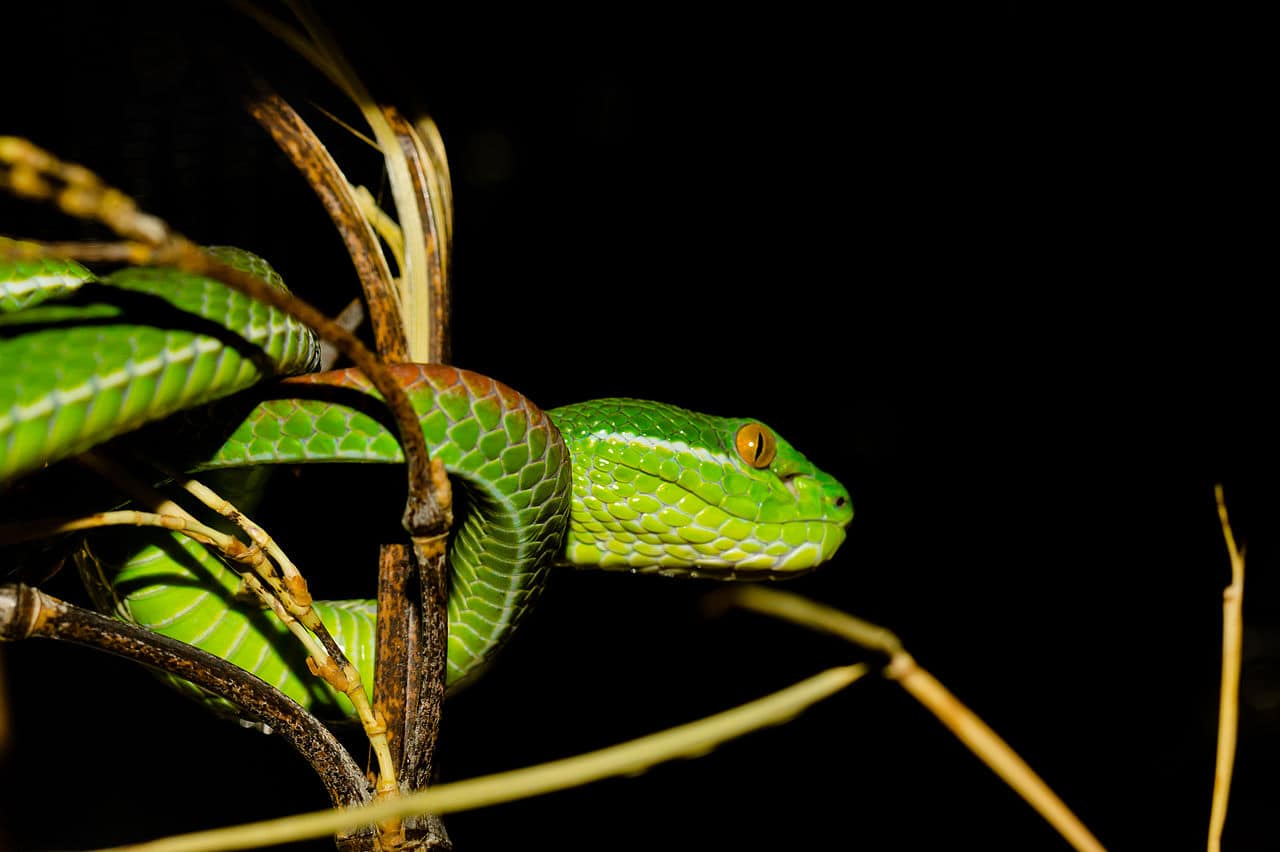
Maximum length: 104cm.
Trimeresurus is a genus of snakes collectively called the green pitvipers, which has over 40 members in India and southeast Asia, with the latest added in 2023 (the limestone eyelash viper). They’re ambush predators which are united by clinging to branches 1-2 metres high, by a superficially similar appearance, and by being dangerously venomous, but usually survivable.
In this article, we will discuss 12 members, and where better to start than with the member responsible for the most bites: the white-lipped pitviper (Trimeresurus albolabris). This species inhabits virtually all of Thailand, including suburban Bangkok. They’re also abundant in Hong Kong, Vietnam and Cambodia.
White-lipped pitvipers caused 95% of venomous snakebites in Hong Kong in 2009, and 95% of snakebites in Bangkok when combined with their close relative, the large-eyed pitviper. Most bites strike the arms, due to their liking for branches and bushes 1 metre high. Thai villagers carrying piles of leaves and cuttings to the backs of their gardens are especially vulnerable to meeting this disguised pitviper.
Luckily, deaths are rare, as like most Trimeresurus members, they lack the neurotoxins responsible for respiratory failure. Rare exceptions included two elderly people who suffered intracranial haemorrhage, due to the venom’s action on blood vessel walls. Typical effects include severe swelling and necrosis surrounding the bite wound, painful and possibly disfiguring, yet survivable. The Thai Red Cross Antivenom uses this species, and is stocked in virtually all Thai hospitals.
| 2 | Sumatran pitviper |
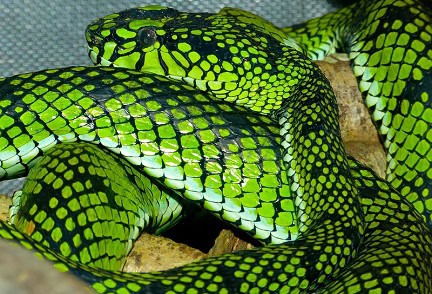
Maximum length: 160cm.
Another relatively widespread Trimeresurus pitviper. This species inhabits both peninsular Malaysia and eastern Malaysia, as well as Sumatra and extreme southern Thailand. While they cover a large territory, they’re more rarely sighted than their white-lipped cousin. Sumatran pitvipers (Trimeresurus sumatranus) usually exceed 1 metre, and are found in rainforests, mangrove forests, swampy forests and sometimes human-controlled plantations.
Many Trimeresurus pitvipers closely resemble each other, but this species is easily separable due to the strong black edge to each scale, with the occasional fully black scale. Their face also has these black markings, although juveniles are a purer green, as they tend to grow blacker with age.
Sumatran pitvipers are one of the largest members, easily exceeding 1 metre. But if you think this makes them easier to spot, think again: their green-black colours absorb completely into Sumatra’s rainforests.
Their venom, meanwhile, has strong haemorrhagic activity. Bites are relatively uncommon, as one study analysed pitviper bites in Malaysia from January 2017 to December 2020. The chief offender was the mangrove pitviper, causing 124 bites (23.7%), followed by the Bornean keeled pitviper at 121 (23.1%). Sumatran pitvipers ranked only in 9th, causing 15 bites over the 4 years, accounting for 2.9% of the total.
| 3 | Chinese green pitviper |
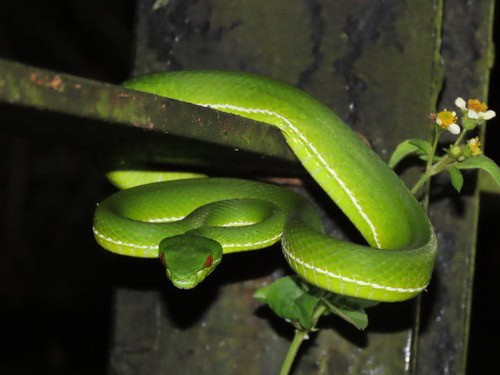
Maximum length: 112cm.
As the name suggests, this Trimeresurus pitviper rules the forests and rural gardens of humid southern China, as well as Taiwan. They also spread to extreme northeast India and northern Vietnam, though they aren’t found in Thailand at all. Chinese green pitvipers (Trimeresurus stejnegeri) are another branch-clinger, and are medium in length.
This is ordinarily a sluggish snake, moving slowly along its branch perches. But they can lunge extremely quickly if victims are within biting range. Chinese green pitvipers lack neurotoxins, but can cause brain damage due to cerebral infarction in severe cases. Luckily, this species has its own dedicated antivenom available, produced by the Taiwan government.
This species is pure green with a pair of thin white lines, though if you’re lucky, you may stumble across a rare fully blue morph. In a study on 185 Chinese green pitviper victims from Taiwan, there was 1 death, with common symptoms including swelling, necrosis, and blood clotting disruption. All patients received antivenom, so there would have likely been more deaths otherwise.
Chinese green pitvipers appear down to sea level in Taiwan, but are most common from 800-1800 metres. They have a similar diet to the white-lipped pitviper: mostly amphibians with a side helping of lizards. A 2002 study gathered 229 individuals, of which 183 had food in their stomachs. Of these, 79 contained unidentifiable mush.
Of the remaining 104, 88 Chinese green pitvipers contained only amphibians, with one species being Swinhoe’s frog. Two snakes contained only mammal prey, and 10 contained only lizards. Another 3 contained both amphibians and mammals.
| 4 | Lesser Sunda pitviper |
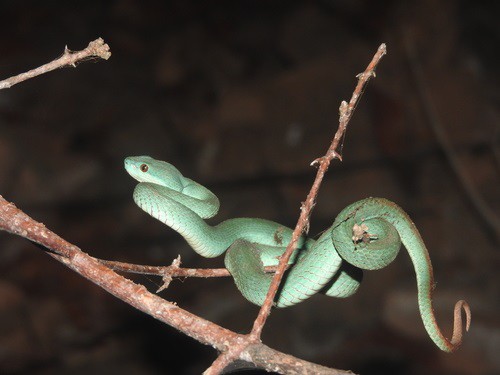
Maximum length: 93cm.
An exclusively Indonesian Trimeresurus pitviper. You can find this dangerous species on Komodo, Sumbara, Sumba, Bali, and the heavily populated island of Java, though they’re not found near the Indonesian capital of Jakarta.
Lesser Sunda pitvipers (Trimeresurus insularis) are relatively small, yet they have one special feature to boast: the strongest tendency to be blue in the genus. In fact, Lesser Sunda pitvipers rank at least in the top 5 for blueness for the whole snake kingdom.
The image above is intermediate, while this image and this image show an extreme rarity, a snake that is completely sky blue, not just with the occasional blue patch. Elsewhere, many individuals are the usual green, while they also have a red tail, which they wiggle mesmerizingly to lure in amphibians, which mistake the tip for hovering insects.
Lesser Sunda pitvipers have a varied diet, which includes fellow snakes like Boulenger’s keelback. A 2019 study found that their venom was very similar to fellow Trimeresurus pitvipers, with haemorrhagic and cytotoxic effects. In fact, it was easily neutralised using an antivenom designed for the white-lipped pitviper of Thailand. Lesser Sunda pitviper venom also varied little between the 8 Indonesian islands.
| 5 | Andaman pitviper |
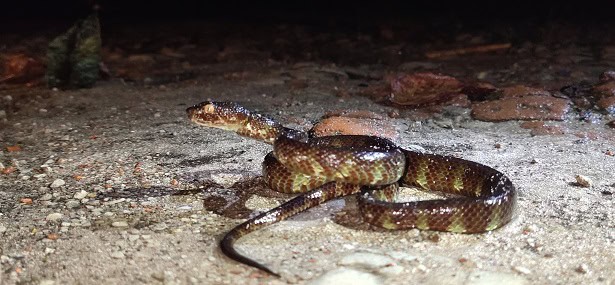
Maximum length: 110cm.
This pitviper is confined solely to India’s Andaman and Nicobar islands, where it’s a fairly widespread species. This is easily one of the least green members of the genus. Andaman pitvipers (Trimeresurus andersonii) mainly inhabit the islands’ rainforests, but are often seen on nearby trails. They were formally described in 1868, and were probably one of the first snakes that British naturalists encountered there.
Knowledge is thin for such a common snake, but Andaman pitvipers are confirmed to prey on Coryphophylax lizards. While mainly an ambush predator, they also climb stems and branches slowly, to creep up on oblivious reptiles. They sometimes descend to the ground for search for prey, making them a relatively flexible and adventurous pitviper species, compared to the white-lipped pitviper, which can go days without moving.
Genetically, this species is most closely related to Trimeresurus cantori, AKA Cantor’s pitviper, which lives only on the Nicobar islands. They’re also closely related to the red-tailed bamboo pitviper (T. erythrurus) of northeast India and Bangladesh.
| 6 | Kanburi pitviper |
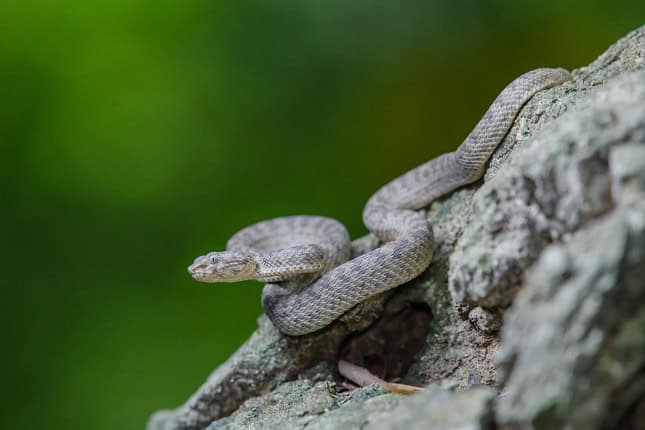
Maximum length: 66.7cm.
This rare pitviper is found only in the limestone hills of Kanchanaburi province in western Thailand, though it’s possible that they just cross the border into Myanmar.
The Kanburi pitviper (Trimeresurus kanburiensis) is a rarely sighted species. For example, a survey from September to November 2020 put in over 100 hours, and only discovered one individual (a male). They have a brown-greyish pattern overlaid with complex blotches, which easily makes them stand out from other Trimeresurus members. Their branch-dwelling ways are largely similar, though they’ve also been seen straying to the ground. One of their more unusual traits is hiding in termite mounds, and they don’t shy away from paved roads.
Trimeresurus kanburiensis was originally believed to be part of the beautiful pitviper (Trimeresurus venustus) species, but was officially separated in 2004, due to its dull rather than dark green colours. Kanburi pitvipers can be found at 2 metres high on braches, and are exceptionally difficult to find, as their bodies reflect torchlight poorly.
Nothing is known about this species’ diet or venom. Kanburi pitvipers have been spotted in ambush posture during both day and night, so they’re likely less strictly nocturnal than other Trimeresurus pitvipers. This species is one of the rarest of the whole genus.
| 7 | Nepalese pitviper |
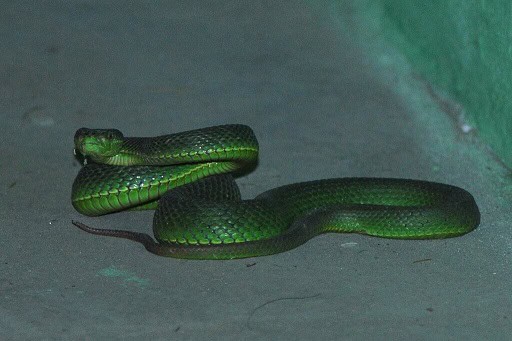
Maximum length: 73cm.
The Lesser Sunda pitviper reaches the furthest southeast of the Trimeresurus family (east Timor), while the Nepalese pitviper (Trimeresurus septentrionalis) is the opposite. Of the 40 members, it occupies the most extreme northwestern territories, appearing in Himalayan foothills along a large stretch of Nepal and far northern India.
Trimeresurus septentrionalis is found from 900 to 3050 metres, and looks very similar to Thailand’s white-lipped pitviper, but has more sharply keeled body scales. At a maximum of 73cm, this is one of the smallest Trimeresurus members. This is a widespread snake which is believed to cause many snakebites in the Nepalese foothills, yet few medical case studies exist.
Nepalese pitvipers can be found in forests, scrubland, agricultural land and bamboo thickets. At a maximum of 3050 metres, this is one of the highest Trimeresurus members, though they’ll only bother Everest trekkers on the initial jungled treks.
As they gain elevation and the air thins, trekkers are much more likely to meet the Himalayan pitviper (Gloydius himalayanus), which has been found at 4900m. As a whole, the Gloydius pitviper clan is far better adapted to colder temperatures than Trimeresurus pitvipers.
| 8 | Maya’s pitviper |
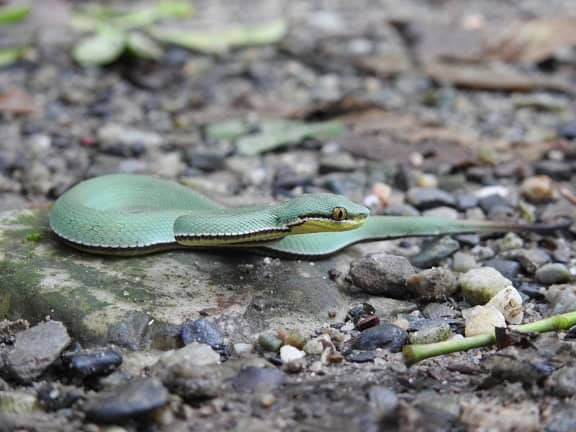
Maximum length: 75cm.
After all this time, it’s surprising that such a memorable snake group is so poorly researched, but Trimeresurus still holds many mysteries. Since 2019, 10 new species have been identified and added to the genus. A 2022 addition was Maya’s pitviper (Trimeresurus mayaae), found in northeast India in the states of Mizoram and Meghalaya.
Characteristics of the new snake included a thin, white-red stripe along each flank, and black interstitial skin between each scale. There were gender differences too, as males had rust-coloured eyes, versus green for females. Males had a fluorescent green belly, versus green-yellow for females.
The original Maya’s pitviper was found in Champhai, one of Mizorum state’s largest towns. This is an area with a relatively mild climate, with winter temperatures of 10-20C and summer temperatures of 20-35C, and only 2000mm of rainfall annually.
So far, all Maya’s pitvipers have been found at above 900 metres. Several individuals were found by a forested stream during the early hours of night, and another crossing a track, meaning that this snake may be skillful at blocking people’s paths. Their diet is unknown, but they happily accepted amphibians (twin-spotted flying frogs) in captivity.
| 9 | Sabah bamboo pitviper |
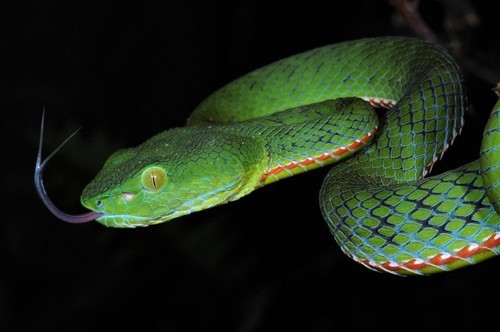
Maximum length: 86.8cm.
A species split mainly between Malaysia and Indonesia, which is scattered over several islands. Sabah bamboo pitvipers are a classically green tree-dwelling snake, with a purple tongue and green eyes.
This species has a red-white line on its flanks similarly to Maya’s pitviper, but the skin between its scales is electric blue instead. Sabah bamboo pitvipers cause slightly more snakebites than the Sumatran pitviper, as in the same study from earlier, they caused 30 snake bites in Malaysia over 4 years, and 5.8% of the total, versus just 2.9%.
Sabah’s pitviper is split into 5 subspecies, specific to certain landmasses. For instance, those in southern Thailand and adjacent peninsular Malaysia belong to Trimeresurus sabahi fucatus. In western Sumatra, you can find T. sabahi barati.
These subspecies are leading to an epidemic of confused scientists. For example, Trimereusu toba on Sumatra was declared to be an independent species in 2009, but then found to have minimal divergence with the Sabah bamboo pitviper, and downgraded to a subspecies once again.
Sabah bamboo pitvipers are very poorly researched, especially their venom, but they possess the usual branch-dwelling habits. You won’t find this species in a palm tree forest by a beach, as they mainly dwell in mountain forests above 1000 metres.
| 10 | Schultz’s pitviper |
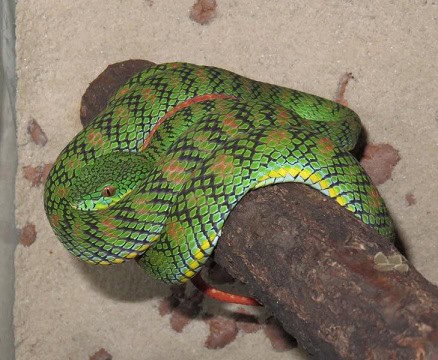
Maximum length: 130cm.
A Philippines snake which again has a poorly researched venom. Schultz’s pitvipers are relatively long for their group, and are found in seasonal rainforests which receive 2000-3000mm of rainfall annually, less than the more extreme Indonesian rainforests at 3000-4000mm. They avoid high mountains, preferring elevations from 0-800 metres.
As ever, this species has a prehensile tail capable of gripping branches as effectively as a hand. Schultz’s pitviper is found exclusively on the Philippines island of Palawan. However, they’re far from rare, as they cover most of the island, including all 5 of Palawan’s major mountain ranges.
Schultz’s pitviper is most closely related to the Sumatran pitviper, which is evident from its black marking bordering each scale. Scultz’s pitviper also has shades of blue visible, and yellow, and red, covering almost all colours. That said, green still predominates, and this allows them to blend into rainforests effortlessly, whether resting on a mossy log or on a tree branch disguised by overlapping leaves.
This pitviper is a commonly encountered snake on hiking trails in low hills. If you’re lucky, they’ll announce themselves with a hiss first. If you’re unlucky, they’ll remain deathly quiet. This species has the typical Trimeresurus diet of frogs and lizards.
| 11 | Ruby-eyed pitviper |
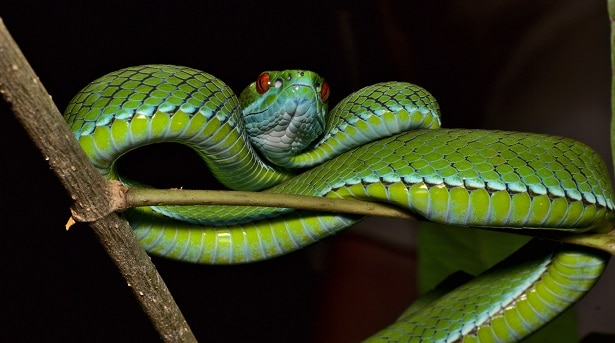
Maximum length: around 60cm.
One of the most recently discovered Trimeresurus pitvipers. There are large gaps in this species’ scientific record – diet, venom potency, and exclusivity of its home territories. What we do know is that the ruby-eyed pitviper (Trimeresurus rubeus) is southern Vietnam’s main version, also straying into far southeastern Cambodia.
This is a species that Vietnamese soldiers definitely encountered, whether huddling in the rainforest waiting for the Vietcong to ambush them, or huddling past during raids of enemy camps. Today, it’s more commonly encountered by peaceful villagers and hikers exploring ecological zones such as Dong Nai Culture And Nature Reserve.
The ruby-eyed pitviper (Trimeresurus rubeus) was only discovered in 2011, as it was split from the similar large-eyed pitviper in Thailand, the clear difference being the namesake red eyes. This species is as arboreal as ever, clinging to branches, and waiting calmly for prey to walk past. Species they overlap with include the white-lipped pitviper, plus the unrelated Asian vine snake, which is also extremely green, but far thinner, and with a smaller, less bulky head.
| 12 | Large-eyed pitviper |
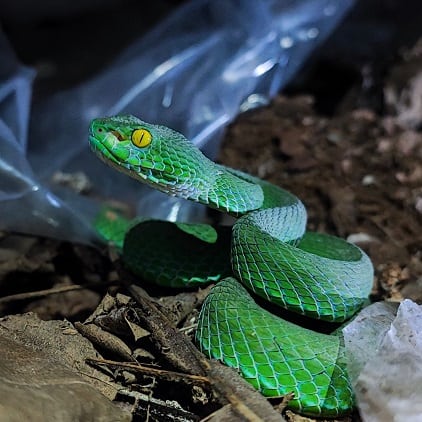
Maximum length: 74.1cm.
This hyper-green species is most common in central and eastern Thailand, skipping the southern areas and Malaysian peninsular. They also inhabit Cambodia and Laos, inhabiting 3 countries in total.
Alongside the white-lipped pitviper, the large-eyed pitviper (Trimeresurus macrops) is the most common pitviper in Bangkok. They’re also leafy green, and also appear on low vegetation, but have larger eyes, and a more sharply triangular head than their cousin. Large-eyed pitvipers have a relatively mild venom, though are still dangerous, triggering swelling and thrombocytopenia, a fall in the platelet cells which stick together to bind wounds.
This species spends 48.8% of its time in the ground story layer (0-1 metres high), 22.5% of its time in the understory (1-3m), and 13.8% above 3 metres. They also spend 11.5% on the ground, making them fairly flexible. This species has a strong gender separation, as males keep their two white stripes into adulthood, while all females lose their white stripes.
Like the white-lipped pitviper, this species is confirmed prey for the king cobra. Scientists had been radio-tracking a large-eyed pitviper in Thailand’s Sakaerat biosphere reserve, when the tracker suddenly became stationary. The scientists followed the signal on foot, until they arrived at a resting, satisfied-looking king cobra.