
| 1 | Common wolf snake |
Maximum length: 76cm.
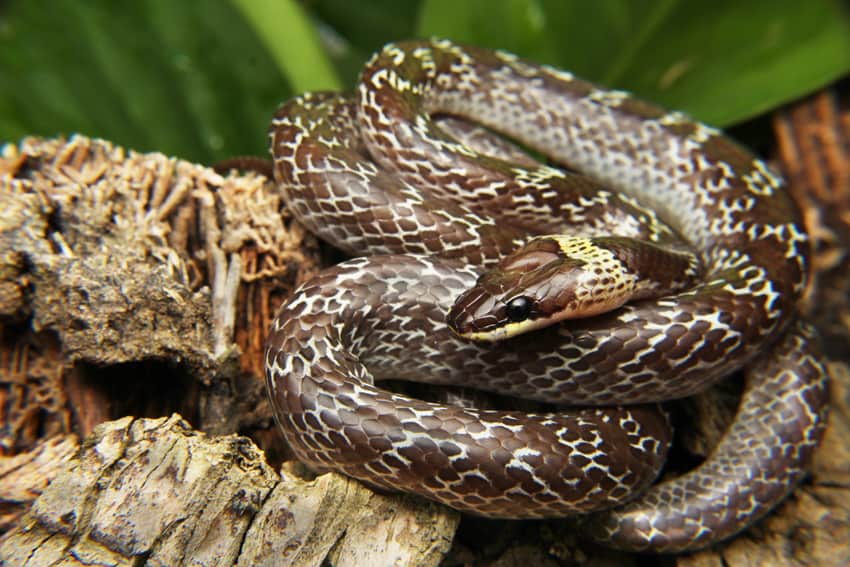
A completely non-venomous species which cannot kill a human being. Common wolf snakes (Lycodon capucinus) are found mainly on the forest floor, or on low bushes within forests. They’re found throughout the whole of Thailand, from north to south, and are always common wherever they appear.
Common wolf snakes often inhabit bungalows directly adjacent to forests, and have a tendency to fall into shipping crates and be transported hundreds of miles to outlying islands by boat. Confirmed prey of this species include the common sun skink and flat-tailed house gecko. Their own confirmed predators include the king cobra.
The most unusual feature of the common wolf snake is its enlarged front teeth, which act as a jail, preventing lizard prey from escaping their mouth like a pair of prison bars. Their rear teeth are blade-like, in order to slice through and weaken the captive lizard via blood loss. Between the rear and front fangs, they have smaller yet equally jagged teeth, which grip small gaps between the lizard’s scales.
Common wolf snakes also eat frogs and mice, but are so dependent on reptiles that when they were accidentally introduced to Christmas Island (located south of Java), the local lizard population plummeted. Having such large teeth gives their head a more rounded appearance than other wolf snakes.
This is a chocolatey brown snake, covered with numerous snowy white speckles. In certain remote forest spots, common wolf snakes can also be albino coloured.
| 2 | Painted bronzeback |
Maximum length: 125cm.
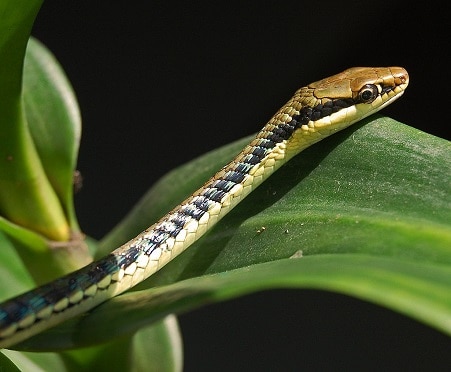
This harmless species is found across the whole of Thailand. Painted bronzebacks (Dendrelaphis pictus) feed on reptiles such as common house geckos and amphibians such as copper-cheeked frogs. They’re an energetic forager rather than a lazy ambusher, and they seem to fleck their tongue virtually nonstop.
Painted bronzebacks stay away from the densest forests. Instead, they’re a forest edge species, and this has made them naturally adaptable to a wide variety of manmade habitats, as long as some trees are standing. Painted bronzebacks can be found in gardens, parks, villages and bushland. They’re day-faring (diurnal) rather than nocturnal, and all this combines to make them one of Thailand’s most commonly encountered snakes.
Painted bronzebacks are twitchy, and will normally flee at high speeds if humans approach. If cornered, they typically open their mouth wide and loll out their bright red tongue, which is especially long. They also rear up and stretch their neck scales, and reveal a sudden patch of turquoise beneath, which aims to startle predators and send them fleeing.
Painted bronzebacks have large eyes, though not quite as massive as their fellow Thai family member, Wall’s bronzeback. You can identify this 60-100cm species by the following characteristics: a dark brown back, creamy belly, brown irises with round pupils, and a black stripe running through the eye.
| 3 | Sunbeam snake |
Maximum length: 125cm.
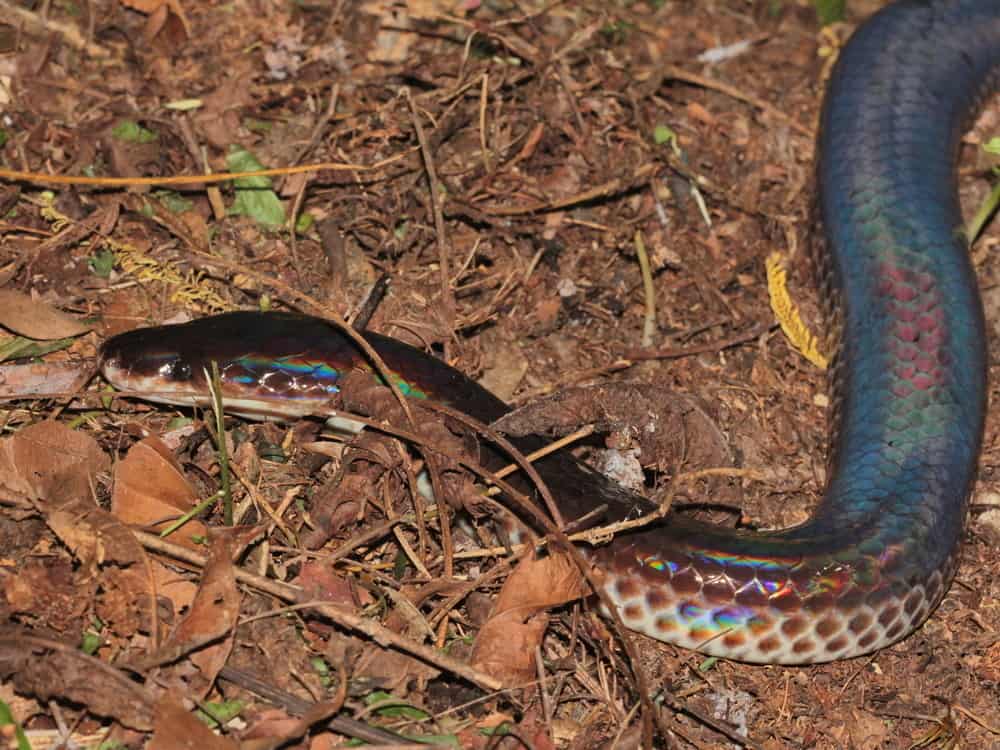
A contender for the most fabulous snake in Thailand. The sunbeam snake (Xenopeltis unicolor) is famous both for its colourful iridescent scales, and being on a very distant perch of the evolutionary tree, not just within Thailand, but the whole world. Their closest living relative is believed to be the Mexican burrowing python halfway across the planet. Sunbeam snakes are chocolatey brown, but under bright lights, every colour of the rainbow starts swirling.
If they were venomous, this would be a decent strategy for mesmerising their awed prey while they lunge. Fortunately, sunbeam snakes don’t possess one drop of venom. They’re a constricting snake instead, which takes 5 minutes to asphyxiate and swallow a toad, occasionally up to 30 minutes.
Sunbeam snakes mainly come out after, not during heavy rains. They often appear in rice paddies and guava plantations, or paths adjacent to them. In 2018, a new length record was broken for this species – 1.25 metres. This was discovered in an evergreen forest in Thailand’s Nakhon Ratchasima province.
Sunbeam snakes rarely bite even when picked up. Their main defensive trick is to coil themselves up tightly and vibrate, sometimes so hard that they produce a buzzing sound. Every so often, people are lucky enough to stumble across this colourful snake, and luckily, it’s perfectly safe to stare at them.
| 4 | Oriental ratsnake |
Maximum length: 3.7 metres.
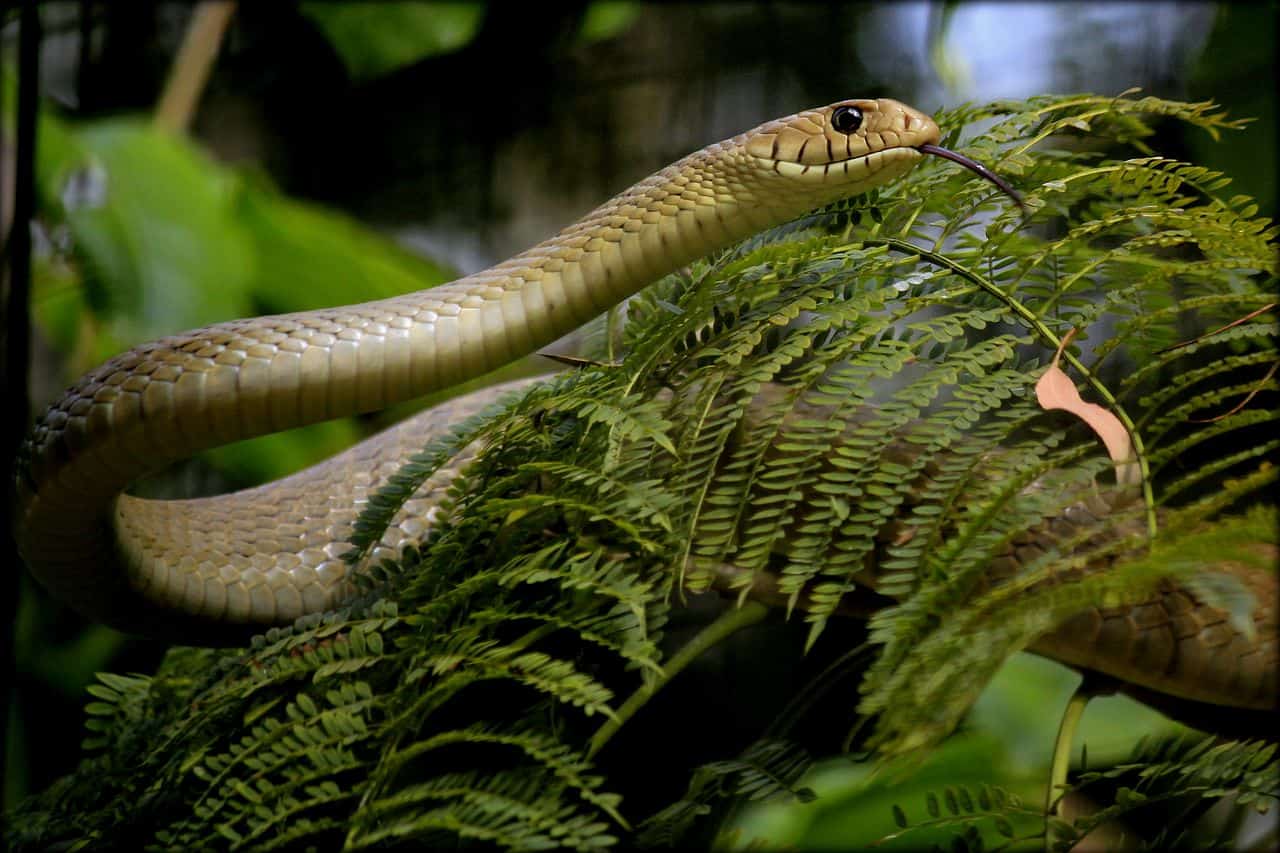
One of Thailand’s most common snakes. The largest oriental ratsnakes can grow to 3.7 metres, making them Thailand’s third biggest snake, after the reticulated python and king cobra. They’re found in countryside areas and cities alike; walking past this snake in Thailand is about as noteworthy as walking past a field full of sheep.
The oriental ratsnake (Ptyas mucosa) is extremely adventurous, and doesn’t understand the concept of caution. They slither down pavements as though they have just as much right to as you, and even eat onions and tablecloths without thinking.
Fortunately, this manic activity doesn’t come with a nasty helping of venom. In fact, they lack even the slightest drop of venom. Oriental ratsnakes have various myths surrounding them, such as being the wife to the king cobra’s husband. They’re also believed to whip people with their tails and cast a dark spell over farmland, causing crops to wither, but we don’t have to tell you that those rumours are false.
Oriental ratsnakes do have a particularly demented method of killing their mammal prey: sitting on them. However, given that they only weigh 5.5 pounds at a length of 2.3 metres, there’s no need for us humans to worry.
This fast, agile snake has a diet split between mammals and amphibians. The only real danger is if you pick one up, forcing them to thrash and bite to free themselves.
| 5 | Red bamboo snake |
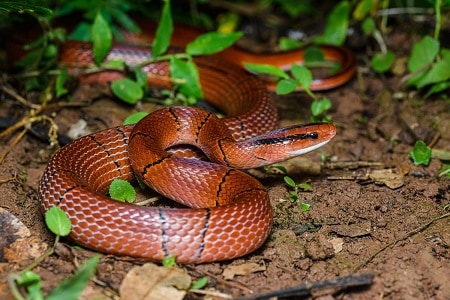
Maximum length: 125cm.
The kukri snake genus has 20 members in Thailand, but red bamboo snakes are the sole member of the genus Oreocryptophis. This 70cm species appears in thick, mulchy forests, where the floor is heavily strewn with decades of moss and leaves. They can appear at high altitudes of 2600 metres, and compared to other Thai snakes, they prefer significantly cooler conditions.
This is a shy, retiring snake, which is usually found resting under natural shelters like rotting logs or forest rock piles. Its Latin name of Oreocryptophis translates to “secretive mountain snake”.
Red-bamboo snakes kill their prey via constriction. They’re recognisable by two narrow black lines stretching vertically down the head, until the neck. Afterwards, the bands become horizontal, encircling their thin body. The colour pattern varies, as the underlying pattern is always a bright red, but the colour between the thin black bands can either be a paler red, or a dense black, as though instantly filled in using Microsoft Paint.
This is a sought after snake in captivity, for its docile temperament, happiness to swallow endless mice, and bright red colours. This snake is totally non-aggressive, rarely biting even when picked up.
| 6 | Dark wolf snake |
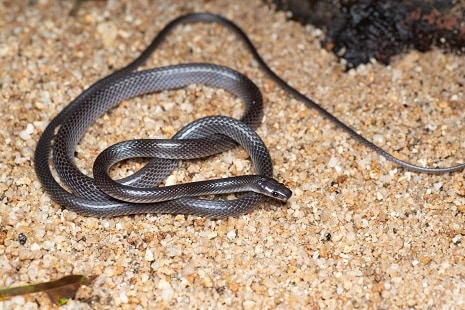
Maximum length: 207cm.
This harmless snake belongs to the same Lycodon genus as the common wolf snake, but is far less widespread. Some claim that this species reaches 207cm, others a whopping 270cm, but in either case it’s one of the largest wolf snake members.
The dark wolf snake is mainly confined to the forests of southern Thailand. Until 2011 when new records were added, there were only 2 confirmed locations in Thailand, with more in Malaysia.
Dark wolf snakes (Lycodon albofuscus) are neither restricted to trees nor the ground – forests are the only lifeblood they need. However, they have a vague connection to streams, and are normally found within 500 metres of one. In national park areas such as Panan forest, they’ve been spotted foraging along sandy riverbanks, overshadowed by canopies. This is a nocturnal snake whose diet mainly consists of lizards and amphibians. Its belly is creamy, while its near black body barely has any patterns at all.
The dark wolf snake has strongly keeled (rough) scales to touch, and a super-thin tail. They have vertical pupils, but their scales and eyes are so dark that you’d be pushed to tell.
| 7 | White-spotted slug snake |
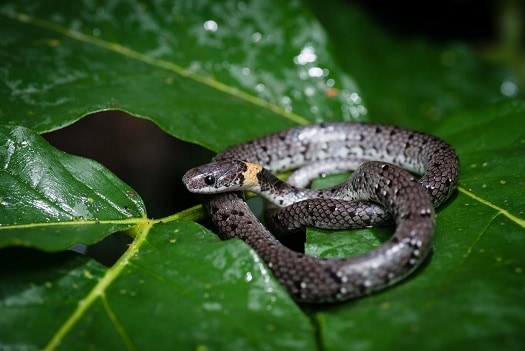
Maximum length: 47cm.
The Pareas slug-eater genus has 27 members, and the white-spotted slug snake is the most common member in Thailand. Spotted slug-eating snakes (Pareas margaritophorus) are easy to recognise thanks to their round, black eyes, and a neck collar that varies from cream to light orange. They have a pink tongue, but elsewhere, they’re a pure stony colour, with grey, black and white alternating like a dark mosaic.
White-spotted slug snakes are spread across the entire country, particularly on moist forest floors and at altitudes below 900 metres. The one exception is cities, including Bangkok itself. In a large 2020 study, the longest individual measured was 39.2cm from head to tail tip. The maximum length ever was 47cm.
Pareas margaritophorus is normally found on low vegetation, like its slug prey. This snake also feeds on snails, and has a special jaw for extracting them from shells. The teeth on their right side are more developed than the left, as the snails they prey on have shell entrances curving to the right.
This harmless snake is often found near water bodies, but doesn’t actually enter the water, preferring to stick to dry land. This is a nocturnal species which moves slowly and cautiously, and lacks even a weak venom.
| 8 | Ridley’s cave racer |
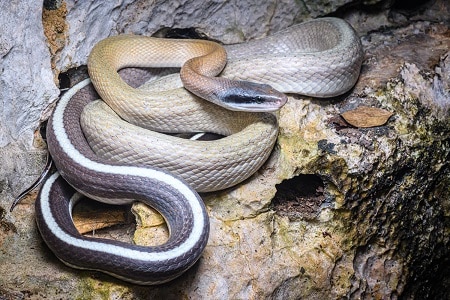
Maximum length: 126.8cm.
One of the spookiest snakes on Earth. Caves might be claustrophobic, and there’s the ever-pressing fear that a tunnel will collapse and leave you stranded, but they’re generally free from snakes. There’s a handful of exceptions worldwide, such as the yellow-red ratsnake of Guatemala, or the Cuban boa of Cuba. But very few snakes are fully adapted to live in caves, and two of the main exceptions are the Gua Wang Burma snake of the Malaysian border, and Ridley’s cave racer (Elaphe taeniura ridleyi).
This snake is a subspecies of the beauty ratsnake, which ordinarily lives in villages and crop fields, hoovering up rats for farmers. This subspecies is far whiter than usual, and inhabits Thailand and peninsular Malaysia. It’s a constant presence in the region’s caves, lurking on the walls, amid constant dripping noises and mysterious footsteps. By night, they slither out of their cave mouths to hunt, before retreating into the comforting darkness during the day.
Has a family member ever relayed a story of serpent eyes glaring at them from a dark tunnel in Thailand? It may well have been Ridley’s cave racer.
This snake is thankfully harmless to humans, with no venom at all. They seem to have a relatively docile personality compared to the main beauty ratsnake subspecies as well. Unsurprisingly, a large portion of their prey consists of bats.
| 9 | Yellow-striped trinket snake |
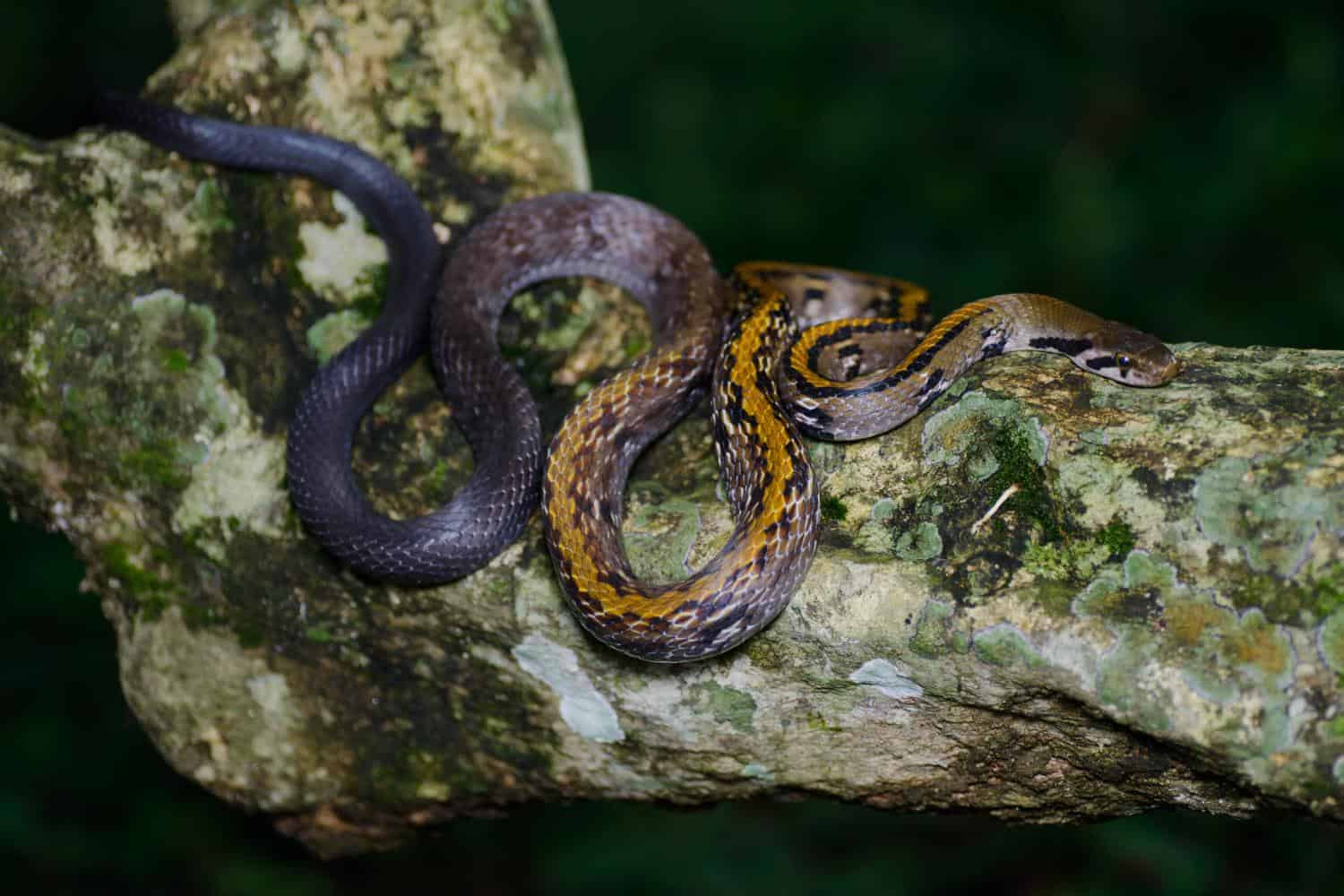
Maximum length: 180cm.
The southeasterly cousin of the trinket snake, a common non-venomous snake in India. Yellow-striped trinket snakes (Coelognathus flavolineatus) are most abundant in southern Thailand, but have a smattering of sightings around the centre. They also inhabit Malaysia, Cambodia, Vietnam and Myanmar.
Coelognathus flavolineatus is easy to identify, thanks to a vivid yellow stripe following the line of its spine. They also have two jet black stripes starting from each eye: one pouring straight down, and one at an 8 o’clock angle. They can reach 180cm, and their body darkens as the tail approaches.
Yellow-striped trinket snakes possess no venom at all, although they might snap aggressively as a warning. This snake can climb trees, but mainly sticks to the ground, as evidenced by the fact they’re often found as roadkill with tyre marks over their back.
On the Andaman and Nicobar Islands, Coelognathus flavolineatus was once spotted being eaten by a king cobra, and this almost certainly happens in Thailand too. But being a yellow-striped trinket snake has advantages as well. They’re a flexible snake in both diet and habitat, which can dine on rodents, lizards and birds alike, and zoom around parks, forests, or gardens to their heart’s content.
| 10 | Elegant bronzeback |
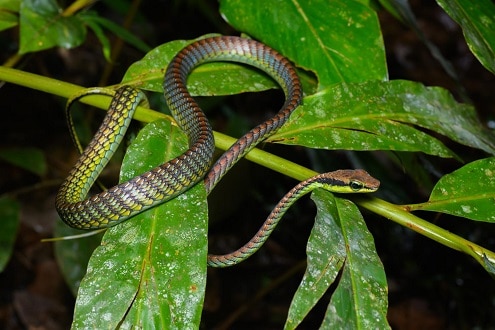
Maximum length: 147cm.
Another bronzeback genus member, this is easy to tell apart from the more common painted bronzeback. Elegant bronzebacks (Dendrelaphis formosus) have established their serpent stronghold in the south of Thailand, skipping the central areas near Bangkok.
This snake measures 60-100cm, and preys primarily on lizards. While thick forests are their home, they stray to the forest edges as well.
Their appearance is an easy giveaway once you know a couple of simple ID signs. Elegant bronzebacks share the brown-bronze back of their cousin, but their belly is a bright green, rather than the painted bronzeback’s cream. Their irises are green, instead of brown, while their tongue is juicy red with a black tip. Finally, elegant bronzebacks have particularly large eyes.
The elegant bronzeback mainly lives in forests, especially lowland rainforests below 600 metres in altitude, rather than misty mountain rainforests. They lack any form of venom, not even a secret anticoagulant hidden in their saliva. They’re also easy to handle when picked up. They might snap briefly, but tend to calm down rapidly.
Elegant bronzebacks are semi-arboreal, hunting on the ground, but sleeping on branches or the tops of large bushes. Rather than balancing precariously, elegant bronzebacks curl their thin bodies around the branch at multiple points.
| 11 | Collared reed snake |
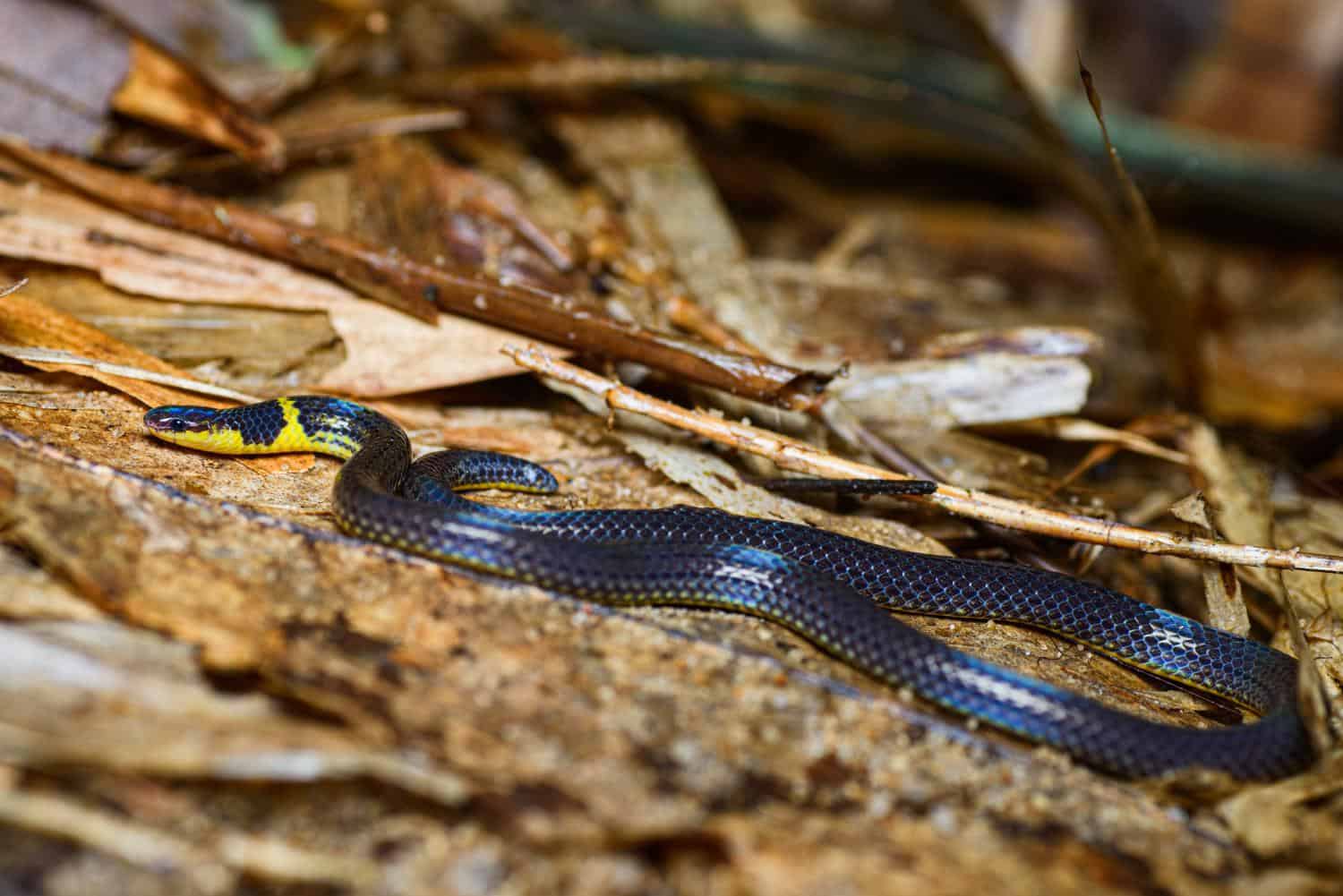
Maximum length: 49cm.
This non-venomous snake is rarely seen, yet appears across the whole of Thailand. Collared reed snakes are burrowers, which only occasionally climb into trees and stick to the ground almost exclusively. Their main habitats are hilly forests, and while they dislike water, they’ve been spotted near rocky areas of waterfalls, such as Sungai Buweh waterfall in Malaysia.
The collared reed snake (Calamaria pavimentata) has complex yet ordered patterns, with a mildly iridescent sheen, with shades of green and blue manifesting under bright lights. Before the neck, a random creamy patch begins. At the neck itself, a dense brown patch kicks in, before the creamy colour returns on the snake’s chin, and brown on top of its head. Their belly is also creamy, contrasting against the brown/bluish back.
Calamaria pavimentata has beady black eyes, and belongs to the same Calamaria genus as the pink-headed reed snake, a classic coral snake mimic. Around southeast Asia, collared reed snakes are also found in Vietnam, Laos, Taiwan, Malaysia, etc.
This is a species which is everywhere, yet flies under everyone’s radar because of its secretive habits. Even with modern science, we know little about the collared reed snake – hence why we’re mainly talking about their appearance.
| 12 | Khasi Hills keelback |
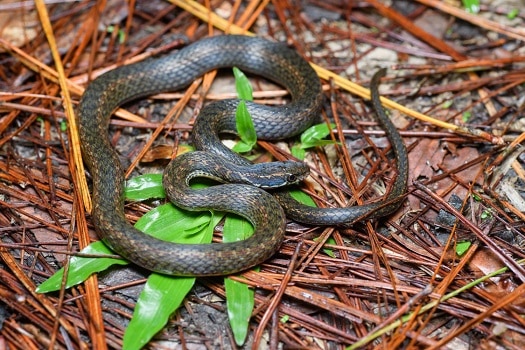
Maximum length: 67.3cm.
This species lives nowhere near the ocean, and instead inhabits obscure evergreen forests in northern Thailand, with high annual rainfall totals. Hebius khasiense ranges from 900-1400 metres in elevation, and prefers standing pools within forests rather than fast-flowing rocky streams.
Khasi Hills keelbacks are harmless, but may bite if picked up. They live in scenic spots far away from humanity, rather than in urban drainage ditches in towns (like the red-necked keelback).
Khasi hills keelbacks have a long tail, making up almost a third of their body. A typical adult measures 60cm, with a tail 19cm long. The all-time record was 67.3cm. Hebius khasiense has a thin body which looks dull from a distance, but has rich, complex patterns when viewed up close. Its diet is poorly researched, but believed to consist of toads.
Southern Thailand has a similar species called Hebius inas, the Malayan mountain keelback. The populations in northern Thailand were originally thought to be part of this species, but were eventually re-analysed and deemed to be Khasi Hills keelbacks after all. Hebius khasiense also inhabits southern China, Laos and northern Myanmar.