
| 1 | Yellow anaconda |
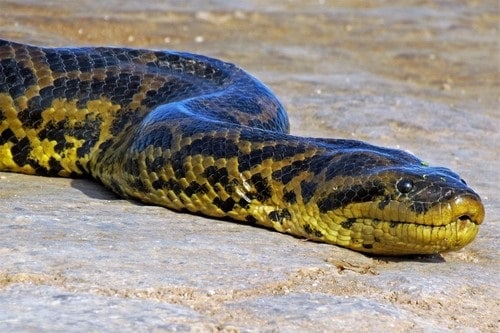
Maximum length: 4.6 metres.
The yellow anaconda is the slightly smaller, yet still enormous cousin of the green anaconda, reaching a maximum of 4.6 metres, with a thick body for merciless constriction. This species lives further south than the green anaconda, primarily following the Paraguay River and its tributaries. This means that Paraguay itself is at the centre of its domain, alongside northern Argentina and Bolivia.
Yellow anacondas are found in wet areas of Paraguay, most likely lurking in shallow waters, or at the edges of marshland, hoping to seize passing mammals, even dragging them underwater to drown them like a crocodile. Yellow anacondas are unusual among snakes in that a huge portion of their diet consists of wading birds, including Muskovy ducks and neotropic cormorants. If you send a stork carrying a letter to Paraguay and never get a response, then the yellow anaconda is probably to blame.
While yellow anacondas require water, they cope well with urban areas, even appearing in the Paraguayan capital of Asunción. This is an abundant snake in Paraguay, and is estimated to number several million worldwide. Virtually any large marshland in Paraguay could contain a yellow anaconda, and with their golden-black tones, they’re fairly easy to notice.
| 2 | Two-coloured mussurana |
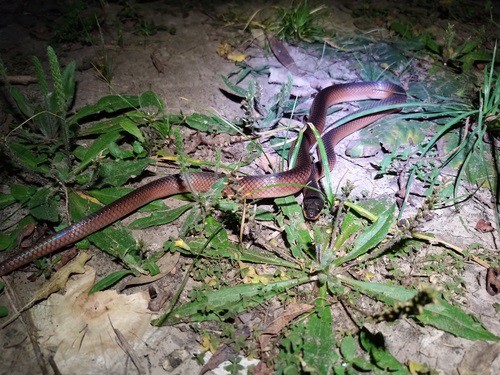
Maximum length: 99cm.
A nocturnal snake with powerful constricting abilities. The two-coloured mussurana (Mussurana bicolor) is a harmless species, which shares many of its habitats with the yellow anaconda: the Paraguay River, its various tributaries, and its drainage basin. In fact, the two snakes often appear close by to each other.
The two-coloured mussurana is a non-venomous species, which humans can safely walk past without worrying about a surprise savage attack. The most they can achieve is squeezing your arm tightly if you pick them up. Two-coloured mussuranas are flexible in their habitats, appearing in riverside gallery forests, swamps and dry topical forests. Their diet is wide, including frogs, fellow snakes, small mammals and lizards, with a specific prey being the pointedbelly frog (Leptodactylus podicipinus).
This species often bites its prey while constricting, to secure an extra hold, and prevent a sudden burst for freedom. One two-coloured mussurana was spotted raiding a bat colony in the roof of a hostel, 2 metres high. Generally though, this species sticks to the ground.
Two-coloured mussuranas were originally placed in the Clelia genus, alongside Clelia clelia, South America’s most infamous snake-eating snake. But in 2009, they were moved to the 3-member Mussurana genus. Another study from eastern Argentina found a diet of 63% frogs and toads, and 37% lizards.
| 3 | Yellow-bellied liophis |
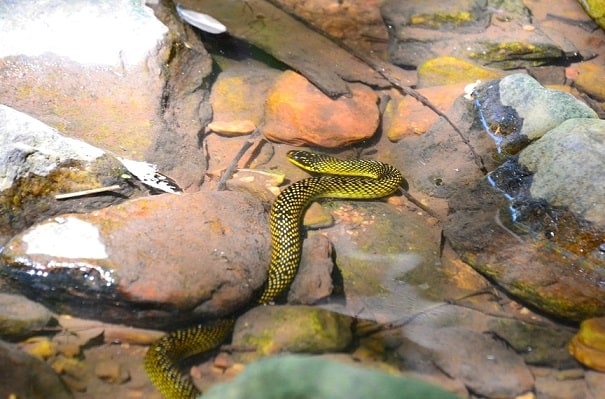
Maximum length: 150cm.
Part of the the huge, 55-member Erythrolamprus snake genus, and probably the most common overall member. The yellow-bellied liophis (Erythrolamprus poecilogyrus) measures 70cm, and ranges from northeast Brazil to central Argentina, placing Paraguay squarely in the middle.
This is a venomous species, though not a dangerous one. A bite to a 1.71 metre tall victim in 2010 caused a swollen right hand lasting 7 hours, and muscular pain spreading up the entire arm, which began to subside within 3 days. No antivenom exists, but the annual terror quotient of this species is very low.
Yellow-bellied liophises occupy many habitats, including grassland, marshes, forests and occasionally urban areas. However, they always require a water source, as this is a semi-aquatic species, like its close relative, the golden liophis of Uruguay.
Wherever it lives, this is a very common species. During a survey of southern Brazil’s Pantanal wetlands, scientists detected 33 snake species. Yellow anacondas and Brazilian smooth snakes ranked 2nd and 1st for abundance, but the yellow-bellied liophis was close behind in 3rd. According to a 2015 study from Argentina, over 98% of this species’ diet consists of frogs and toads, with the tiny remainder being lizards. The yellow-bellied liophis apparently tastes good itself, as it’s feasted upon by neighbouring snakes like the painted lancehead.
| 4 | Leopard keelback |
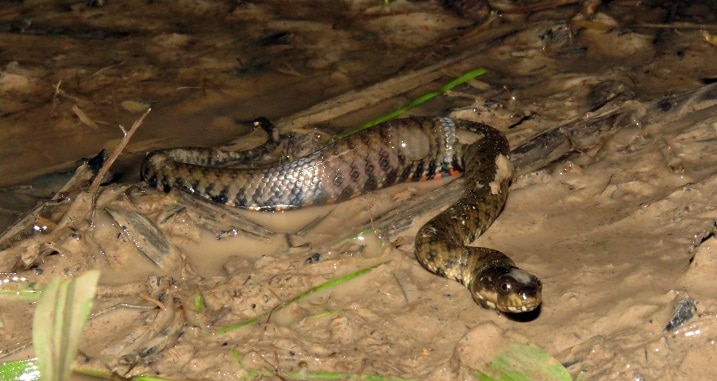
Maximum length: 92.5cm.
A nocturnal aquatic snake, which is a particularly strong swimmer, able to withstand fast-flowing currents. Leopard keelbacks (Helicops leopardinus) are particularly common in watery areas with plenty of floating vegetation. Their colours are complex and boggy, as though they’ve absorbed the very essence of the swamp. They lack a deadly venom, but are considered by herpetologists to be aggressive.
Leopard keelbacks have dots all over Brazil, but their real heartlands are far southern Brazil, northern Argentina and most of Paraguay. This snake would die within minutes if dropped into the Mojave desert, and it’s very rare to find them on land without water dripping off their back.
This is a very common snake in certain locations. In the same study from Brazil’s Pantanal wetlands where the yellow-bellied liophis ranked third, the leopard keelback was the 5th most abundant of 33 snake species. Their diet is what you’d expect from a diehard water-lover: 62% fish and 38% frogs and toads. They’re able to hunt these prey at a variety of water depths.
Specific amphibian prey of the leopard keelback include the lesser snouted tree frog and pointedbelly frog, also a prey of the two-coloured mussurana. All 20 Helicops members live in South America, and the leopard keelback is one of the more common. The furthest afield is Daniel’s keelback (Helicops danieli), which just falls short of Panama (though hidden populations could lurk there).
| 5 | South American rattlesnake |
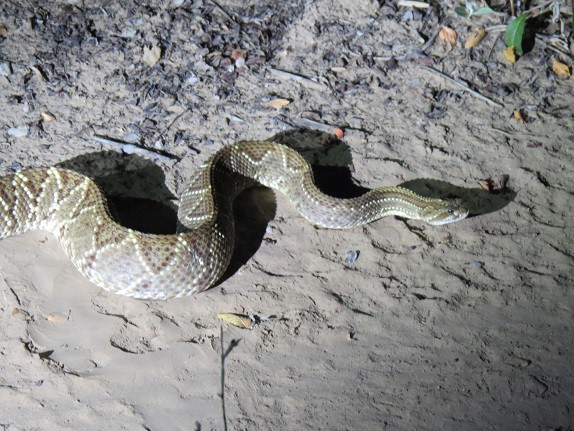
Maximum length: 180cm.
The only rattlesnake to inhabit South America. The South American rattlesnake (Crotalus durissus) covers thousands of miles from north to south, beginning in Colombia and ending in central Argentina. Paraguay isn’t exempt from its lethal ways, and this species is easily one of the country’s deadliest snakes. This viper barely warns its victims before unleashing a strike, and can easily kill via kidney failure.
The image above was actually taken in Paraguay, so know what to look for – a thick viperid body and beige-grey viper patterns, with triangles that morph into a stripe along the neck. Keep an eye out for rough, crinkly scales.
There are sightings of South American rattlesnakes from all over Paraguay – no region appears to be exempt. Though this snake covers almost the entire continent, we have a report from a Paraguayan individual specifically: a herpetologist who suffered respiratory failure and only survived following antivenom administration. He also experienced a rise in bloodstream creatine kinase, a marker of muscle tissue damage.
Crotalus durissus is rare among the 50+ rattlesnakes of the Americas in that it’s highly neurotoxic. Most specialise in haemorrhaging and necrosis, but this species can hijack brain signals and trigger limb paralysis and respiratory failure. Tiger rattlesnakes and Mojave rattlesnakes are another rare duo with this profile.
| 6 | Wagler’s snake |
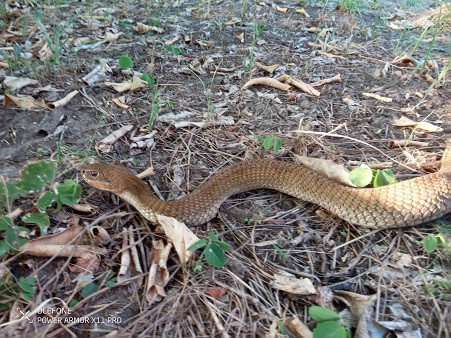
Maximum length: 127.5cm.
A copycat snake, which attempts to mimic venomous crossed pitvipers in order to survive. This snake has the skill of eating poisonous amphibians like the common lesser toad, with enlarged adrenal glands which prevent the heart rate slowdown from defensive bufotoxins.
Wagler’s snake (Xenodon merremii) is common all over Paraguay and southeast Brazil, and reaches a maximum of nearly 1.3 metres. This species can inhabit forests or damper open areas, but always requires water, as frogs are their main food source. This is a snake you can walk past without any worries. Their interest in amphibians is about 97%, and their interest in humans around 2%.
Within Paraguay, Wagler’s snake has 4 distinct morphs: 1) a banded pattern, 2) smooth (like above), 3) slightly marked, and 4) heavily marked, with the latter being the main viper-mimicking pattern, and the most common. All juveniles possess this heavily marked pattern.
Analysis of its venom reveals toxins normally found in vipers, such as three finger toxins (3FTx) and snake venom metalloproteinases (SVMPs). However, a study tested 123 Wagler’s snake bites from São Paulo, Brazil, and found only non-lethal effects such as erythema, mild edema and pain. According to the scientists: “most accidents caused by X. merremii and X. neuwiedii present mild local symptomatology“.
Wagler’s snake was also milder for swelling than its easterly cousin, Xenodon neuwiedii (common in southeast Brazil). Its venom is clearly targeted towards small prey rather than deterring large predators – hence why it must use copycat tactics instead.
| 7 | Rio tropical racer |
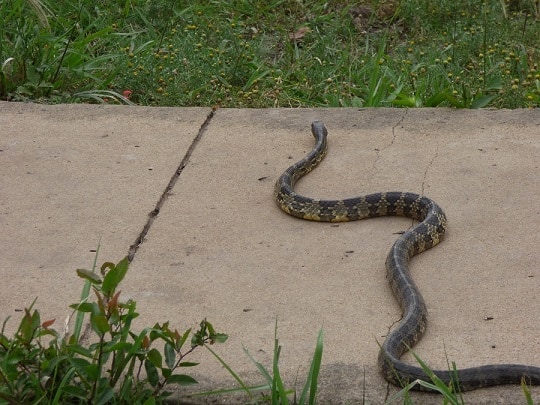
Maximum length: 197cm.
This fast-moving snake is the sole member worldwide of the Palusophis genus. Originally, it was categorised in the same Masticophis genus as the salmon-bellied racer of central America, but in 2018, it was split off into an all new group.
Rio tropical racers (Palusophis bifossatus) range from Bolivia to southeast Brazil, with the vast majority of Paraguay potentially containing them. Moist forests are their realm, particularly swampy areas, as another of their local names is the swamp racer. It’s common to see Rio tropical racers swimming through swamps with their heads bobbing up and down. They can reach nearly 2 metres in length, and lay 4-24 eggs per batch.
This is a fast and adventurous snake, not a lazy one which lurks for hours under boggy swamp vegetation. Rio tropical racers choose from an ultra-varied menu, as according to a 2007 study, their diet contained 44% frogs, 32% mammals, 16% lizards, 4% birds and 4% fellow snakes. Specific snake prey included a Patagonian green racer, and a 31cm black-headed snake (Tantilla melanocephala).
That said, this species is far from invincible. Rio tropical racers have a particular tendency to lose their tail in adulthood, due to it ripping off in predators’ claws. A 1998 study on 119 museum specimens found that 46.7% were missing a portion of their tail.
| 8 | Guibe’s flame snake |
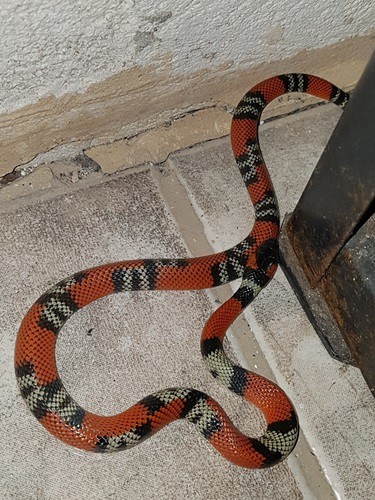
Maximum length: 125cm.
A common species in southeast Brazil and Paraguay. Rather than forest depths, Guibe’s flame snakes prefer forest edges, and more open areas. They don’t shun humanity, as their eggs have been found in house backyards in chicken enclosures, and beneath rocks by entrances to farmland.
Guibe’s flame snake (Oxyrhopus guibei) is a mildly venomous constrictor, which poses no threat to humans, and asphyxiates its prey. At under 40cm, they eat reptiles exclusively, whereas rodents dominate at over 40cm. In a 1995 study, they skipped constriction for lizards, and swallowed them alive, headfirst. Meanwhile, their own predators include laughing falcons, plush-crested jays, and Aesculapian false coral snakes.
Guibe’s flame snakes have no time for stealth and patience. They simply pursue rodents as they move, before applying a sudden hold of coils. They occasionally eat geckos, but struggle to see through their carefully crafted camouflage.
This species mimics coral snakes for its protection, with alternating black-white bands followed by wide spaces of red. It almost gets every detail correct, but seems to have made one critical error: the black-white bands don’t always match up on either side of its spine. Still, the bright colours are probably enough to fool hungry birds part of the time.
| 9 | Chaco sepia snake |
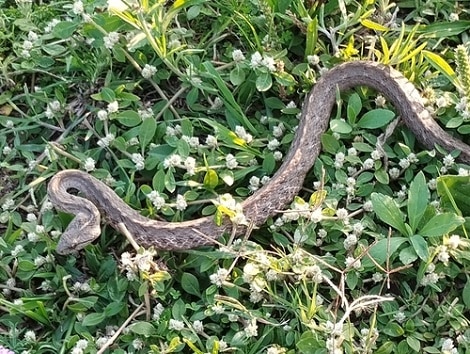
Maximum length: around 80cm.
A mostly harmless snake, with round pupils and an equally rounded snout. The Chaco sepia snake (Dryophylax chaquensis) is one of Paraguay’s shier, yet smarter snakes. Rather than charging around wildly, this species prefers to lurks under the surface and hope that nobody notices its existence. This snake is also known as the Chaco mock viper, for its grey-brown alternating patterns, which lack any trace of bright colour.
This species feeds exclusively on frogs and toads, and will turn up its nose at geckos or mice. Chaco sepia snakes seize frogs by their backs, then keep them in a tight mouth hold for 15-20 minutes. They gradually inject a weak venom, causing their prey to gradually weaken, before finally swallowing.
This snake dislikes having live frogs hopping around in its stomach (unlike the Indian checkered keelback), and always kills its prey first. Confirmed meals of this species include the Matto Grosso oval frog and Chaco tree frog. Chaco sepia snakes are believed to opportunistically grab whichever frogs are most abundant in any particular area.
Top locations for this snake include dry forest (51% of sightings), wetlands (16%), wet savannahs (14%) and marshes (10%). They have a tidy, moderately sized range, including southwestern Brazil, far northern Argentina, and most of Paraguay.
| 10 | Brongersma’s worm snake |
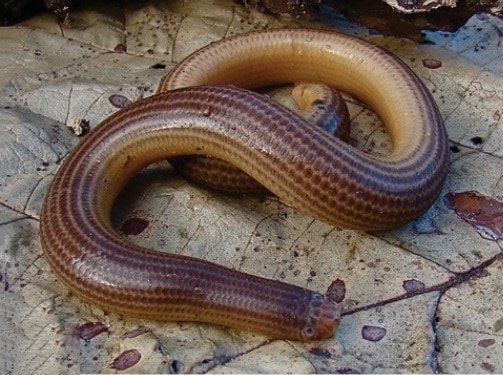
Maximum length: 32.5cm.
One of the most widespread and successful blind snakes in South America. This species is found in semi-deciduous forests and Atlantic forests, but also thrives in deforested areas.
Brongersma’s worm snakes (Amerotyphlops brongersmianus) have tiny eyes, like all blind snakes, but these are shriveled and can only detect small light intensity changes. Their realms include Brazil, northern Argentina, Bolivia, and most of Paraguay. They’re not commonly observed by normal people, but they’re still widespread, lurking quietly below everyone’s feet.
A study found that this is one of the ultimate ant-hunting snakes worldwide. 14 Brongersma’s worm snakes were followed, and their stomachs contained all four potential food items from the ant world; adults, pupae, larvae and eggs. Adults were found in 4 of 14 stomachs, while eggs were found in 6 of 14. The most commonly detected was ant larvae (12/14), while pupae appeared in 6/14.
As a top burrowing snake, this species is far better equipped for hunting ants than the yellow anaconda, which would look confused and worried if you asked it to raid an anthill. Brongersma’s worm snake is never a flashy species, as its brown-grey patterns are designed to blend in with soil. A yellow underbelly or vivid pale neck band means that you’ve found a different species.
| 11 | Lichtenstein’s green racer |
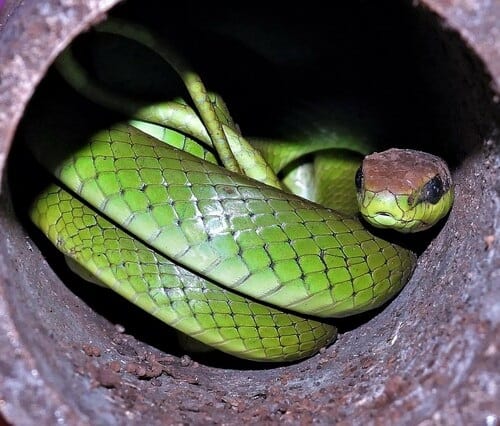
Maximum length: 147.6cm.
If you’re trying to enter your car on a rural road in Paraguay, fiddling with your keys, and a flash of green suddenly whips past your feet, vanishing into the undergrowth, then you’ve probably just met Lichtenstein’s green racer, AKA Philodryas olfersii. This energetic species is also found in a swathe of Brazil, and is common in Paraguay.
Lichtenstein’s green racer is a moderately venomous species which has killed one human on record (a child), and is capable of painfully swelling up an arm. It’s a species of forest edges and open grassland intermingled with tree clumps, as opposed to dense forests.
Lichtenstein’s green racer is an actively foraging snake, with an amazing memory. It’s capable of remembering trees where its bird prey set up nests, and returning to them year after year. They don’t always succeed, as the birds sometimes team up and mob them in a squawk of flapping feathers, but this is one of Paraguay and Brazil’s more intelligent snakes.
Lichtenstein’s green racers have a diet consisting of 61.7% mammals and 12.8% birds, according to one study. They also invade bat roosts, and they’re strongly diurnal rather than nocturnal. While not aquatic in nature, they’ve been recorded to dash into streams and vanish underwater when cornered by humans.
| 12 | Brazilian smooth snake |
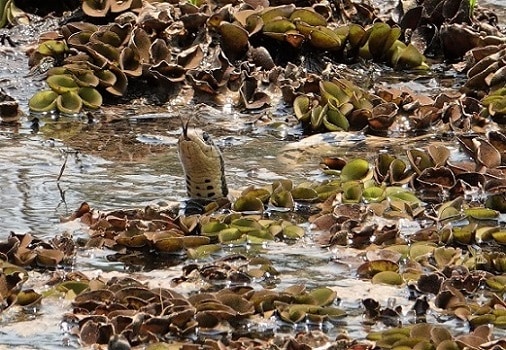
Maximum length: 300cm.
A river-cruising snake, which swallows any meal that accidentally strays across its path. The Brazilian smooth snake (Hydrodynastes gigas) is a mildly venomous species which can swallow up guinea pigs, yellow-bellied liophises, Rococo toads and marbled swamp eels to equal effect. It’s one of the largest species in South America, possibly exceeding 3 metres in certain corners of the rainforest. This is a energetic species which actively hunts for its prey rather than remaining in ambush.
Brazilian smooth snakes appear further north in Brazil as well, in the centre of the Amazon rainforest. But their real heartlands lie further south, along the course of the Paraguay river and its various tributaries. Consequently, this species is everywhere in Paraguay and northern Argentina, often sharing its territory with the yellow anaconda, even in the same shallow rivers.
Brazilian smooth snakes have a venom, but one which has never led to a confirmed human death. For such a large brute of a snake, they have a surprise defensive tactic: playing dead.
When in fear for its life, a Brazilian smooth snake will gape its mouth, loll out its tongue, and flip over in theatrical fashion. Most death-faking snakes worldwide are far smaller. Brazilian smooth snakes have plenty of aggression as well, with vicious tearing fangs, but this is a particularly unpredictable snake.