
| 1 | Patagonian lancehead |
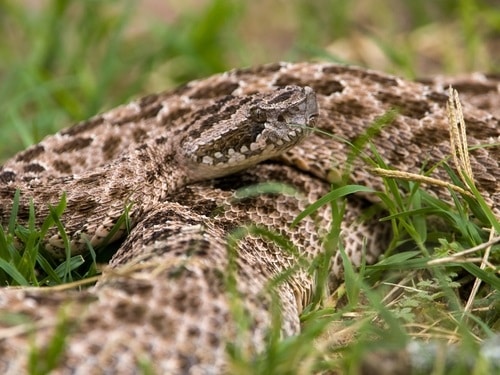
Maximum length: 75cm.
The official most southerly snake on Earth, among nearly 4000 species. The Patagonian lancehead (Bothrops ammodytoides) is endemic to Argentina, appearing in no other country. This venomous species plunges deep into Argentina, reaching a latitude of 47°, and climbs to high altitudes of over 3000 metres in the foothills of the Andes.
Patagonian lanceheads belong to the 48-member Bothrops pitviper genus, which also includes the deadly fer-de-lance and jararaca. They’re recognisable by an upturned snout, which is rare among their Bothrops cousins. Their habitats are varied, including forests, mountains and fields. They also appear in a variety of temperature extremes, from 40C to -10C.
Patagonian lanceheads are relatively short for the Bothrops genus they belong to, but their venom is potent, with strongly haemorrhagic and necrotic properties. While they don’t kill scores of people, they should never be approached lightly.
This species has no sexual dimorphism in colour, AKA variation between males and females. However, there’s significant variety within the species. Some Patagonian lanceheads are paler, with a mostly clean beige belly. Others are a far darker grey, almost near black, and these individuals usually have a heavily dotted underside.
| 2 | Arrow ground snake |
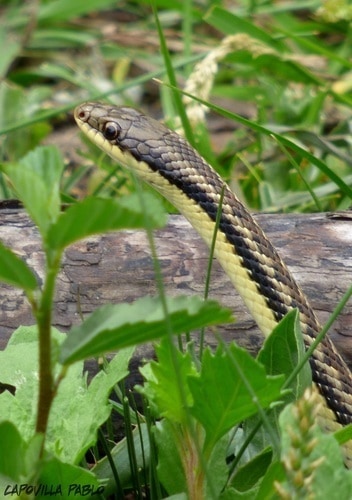
Maximum length: 102cm.
This harmless species inhabits a swathe of Argentina, especially the west, and crosses into Paraguay and Bolivia to the north. Arrow ground snakes (Erythrolamprus sagittifer) live in dry Cacho regions, typically in a mixture of bushland and dry forests. They have an especially creamy belly, but more variable patterns on their backs. Some are brown with a black stripe on each flank, while others are covered with large black circles.
Arrow ground snakes may possess a mild venom, but they pose no threat to humanity whatsoever. They fall victim to birds such as white-tailed hawks, and themselves mainly feed on reptiles and amphibians.
Rather than all-out assault, this species specialises in death-feigning. When scientists found an arrow ground snake in an open Chaco forest in 2014, it slowly went floppy in their hands. When they deposited the snake on the ground, it contorted its body into an unnatural shape and went completely limp, not releasing its corpse-like deception even when poked and prodded.
After a few minutes, the snake reactivated again, and slithered off, sensing that the danger had passed. Arrow ground snakes can also spread a small cobra-like hood when threatened, using false intimidation tactics to stay alive.
| 3 | False tomodon snake |
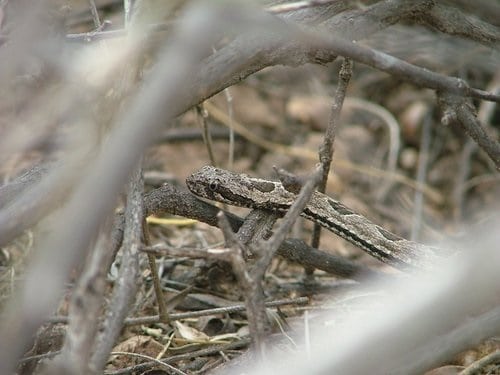
Maximum length: 55cm.
A small, humble snake which belongs to the obscure Tachymenis genus, which contains just 3 members. False tomodon snakes (Tachymenis trigonatus) typically measure 45cm, and reach a confirmed maximum of 55cm. This is another snake which is endemic to Argentina, as it’s the southernmost of the 3 members.
The false tomodon snake has a distinctive pattern of small alternating triangles down its spine. It colours are beige-grey overall, similarly to a viper, rather than juicy jungle green. Its venom, meanwhile, is a complete mystery. All 3 Tachymenis members are mildly venomous, and the Peruvian slender snake (Tachymenis peruviana) has caused one confirmed fatality. However, none are confirmed for this Argentinian species.
False tomodon snakes lay live young rather than eggs. While poorly researched, we do know one important fact – that this species ranks in the top 5 most southerly snakes worldwide.
In fact, the false tomodon snake may be the second most southerly snake, and therefore the most southerly non-viper. This 2023 report mentioned how it was found on Isla Valdez, a small Atlantic island off the Argentinian coast. This observation extended its known range 100km to the south. But the legions of amateur iNaturalist users have gone one better, as this map shows the species even further south.
The false tomodon snake is actually the southernmost snake on the giant iNaturalist map of all snake observations, though it doesn’t reach the southernmost confirmed observations of the Patagonian lancehead by scientists. In all likelihood, the false tomodon snake ranks third or second, unless there’s a shy underground blind snake which nobody has noticed.
| 4 | South American hognose snake |
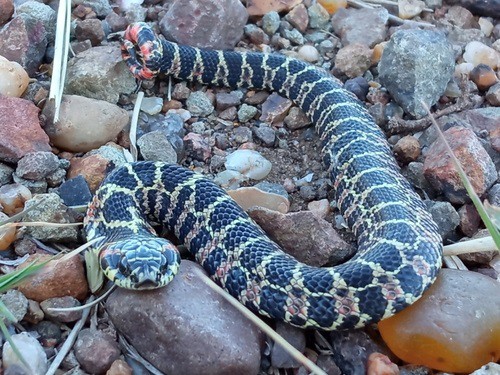
Maximum length: around 60cm.
A thick-bodied snake which appears in open grasslands, and savannahs with loose, sandy soils. South American hognose snakes (Xenodon dorbignyi) measure 40-50cm, and are mildly venomous, with an unresearched toxin profile.
This species relies on mimicry for its survival, copying the beige-grey tones of the Pampas lancehead and crossed pitviper. The exception is a bright red underside of the tail, which is used for a different defensive tactic: distracting birds from their head, using rhythmical wiggling.
South American hognose snakes inhabit a swathe of northern Argentina, as well as far southern Brazil and most of Uruguay. This is a day-faring snake, which is most active from October to March, and preys mainly on frogs and toads, occasionally lizards. Unlike the pitvipers this species copies, its pupils are mainly round.
South American hognose snakes can also be found on sand dunes along the Atlantic coast. Their other defensive strategies include fleeing into bushes, hiding their head below coils, and shifting bones in their skull to triangulate their head, in order to resemble a pitviper even more closely.
| 5 | Painted lancehead |
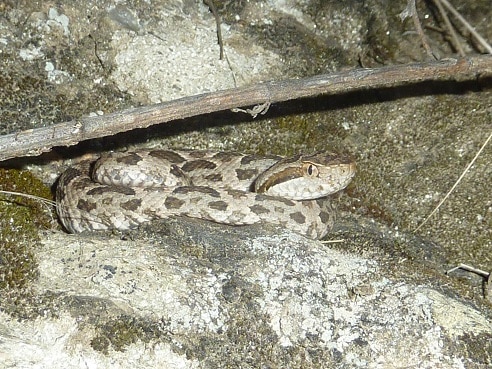
Maximum length: 110cm.
The venomous snake in Argentina responsible for the most bites, most hospitalisations and most deaths. Like the Patagonian lancehead further south, painted lanceheads (Bothrops diporus) belong to the 48-member Bothrops pitviper genus. However, this species is much more likely to inhabit farmlands, villages, roadsides, parks and areas of Argentina close to humanity. Painted lanceheads cover virtually the entire upper half of Argentina, and are common within that realm.
Painted lanceheads are weaker for swelling than other Bothrops pitvipers. But they’re especially strong for haemorrhaging, defeating the jararacussu, jararaca and crossed pitviper in a 1998 study.
Generally, painted lanceheads gravitate towards drier areas, like grassland, savannah and deciduous woodland. They’re the number one Argentinian snake which a tourist or dog walker should be wary of stepping on. Their diet is varied, consisting of 25-50% mammals, depending on location. Confirmed prey include Cururu toads, many-fingered teiids, and fellow snakes such as Tucuman threadsnakes and central sipos.
Painted lanceheads rarely kill their victims, but any deaths are usually caused by kidney failure. Luckily, the threat is so grave that Argentina manufactures its own antivenom against this species, which has a high effectiveness.
| 6 | Mousehole snake |
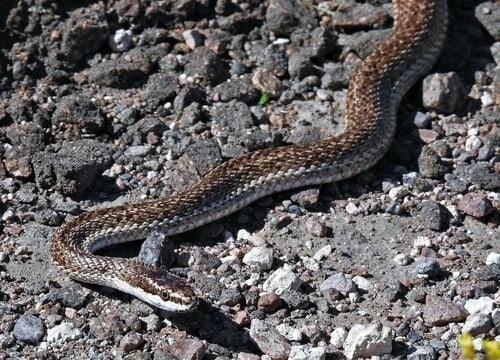
Maximum length: 200cm.
A fast-moving brown snake, which is recognisable by thin parallel stripes running down the length of its body. This species is never bright and flashy – if it’s green or neon orange, you’re staring at a different snake. Mousehole snakes (Philodryas trilineata) are almost completely confined to Argentina, with scattered records in Bolivia to the north. They extend a decent way into central Argentina, but are less southerly than the Patagonian lancehead or false tomodon snake.
Mousehole snakes regularly reach 160cm, and prey on mammals such the southern mountain cavy. They also snatch the fledglings of birds such as straight-billed earthcreepers. This is a egg-laying species, with one captive snake producing 16.
Mousehole snakes have brown eyes with round pupils. This is an adventurous snake, rather than a lazy ambusher. Their favourite activities include crossing roads with no regard for cars, climbing up garden doors, and effortlessly climbing trees.
Despite regularly falling victim to car tyres, mousehole snakes are widespread enough that IUCN lists them as “least concern”. One of the original museum specimens was destroyed in the final days of World War 2, sometime from March 31st to April 5th 1945.
| 7 | Brown mussurana |
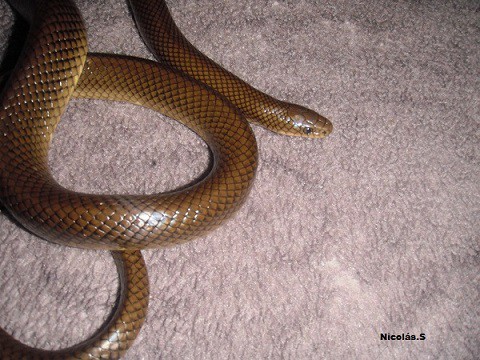
Maximum length: 158.3cm.
This constricting species is widespread, but most common in eastern Argentina, particularly the outskirts of Buenos Aires. Brown mussuranas (Paraphimophis rustica) are non-venomous, and eat a mixture of mammals, lizards and fellow snakes. They regularly exceed 1 metre, and generally appear at lower levels, with a maximum altitude recorded so far of 1100 metres.
Recognisable features include black dots of eyes like a cartoon character, with round pupils, and a head with no separation from the neck. This is a very brown snake, with a slight black edge to each scale, creating an appearance like a dark net. All this contrasts against a pale, creamy underside.
Originally, brown mussuranas were thought to belong to the Clelia genus, which contains the notoriously snake-eating mussurana, a snake with total venom resistance. But in 2012, they were moved to their own genus: Paraphimophis, of which they’re the sole member.
The brown mussurana has a sneaky tactic for securing its offspring: laying its eggs in leafcutter ant nests. Younglings hatch with a similar appearance to adults, except for a slight pale neck collar. Brown mussuranas are also abundant in Uruguay to the northeast. Their habitats vary from damp grassland to wet forest.
| 8 | Gunther’s striped snake |
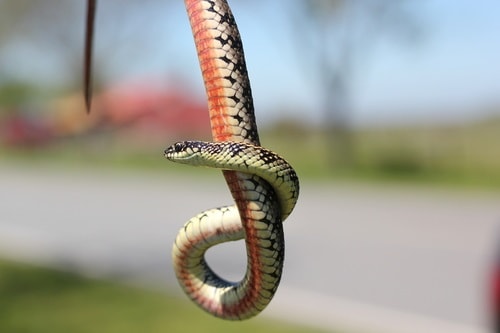
Maximum length: 74.4cm.
A common, harmless snake which measures 40-60cm and poses no threat to humanity. Gunther’s striped snakes inhabit similar regions to the brown mussurana, as they’re extremely abundant in eastern Argentina, including near Buenos Aires. This species roughly follows the course of the Paraná river and its many tributaries, and also inhabits the whole of Uruguay.
Gunther’s striped snakes (Lygophis anomalus) have some of the most spectacularly detailed patterns of any Argentinian snake. They’re not neon bright, but richly detailed like an ornate rug.
Their patterns include a pair of fine white lines down their back, with red splashes of colour inbetween. Their belly is pale with more red splashes, and their eyes are reddish with a round pupil. A handful are far darker than the norm, but the two white lines always remain. The record length in males was 66cm, while females are longer at a maximum of 74cm.
Gunther’s striped snakes overwhelmingly prey on frogs and toads, keeping the occasional reptile as a backup. A study on 444 preserved museum specimens found prey species such as two-coloured oval frogs, Bella Vista toads and Montevideo tree frogs. The latter is also confirmed prey for snakes such as Lichtenstein’s green racer.
| 9 | Golden liophis |
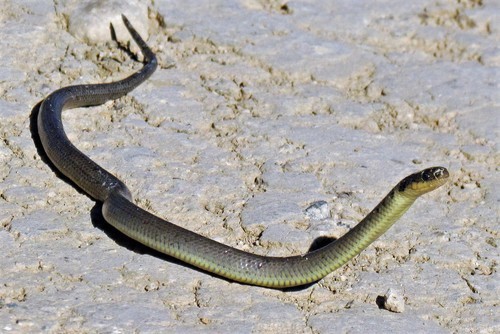
Maximum length: 123.2cm.
A snake of Uruguay, southern Paraguay, and a large swathe of northeast Argentina. The golden liophis (Erythrolamprus semiaureus) is a predominantly aquatic snake, which swims through tributaries and opens its mouth wide in order to catch small frogs and fish. The rivers they inhabit are so swarming with life that this simple strategy is bound to succeed eventually.
This is a docile and calm snake, which rarely exceeds 1 metre. Golden liophises belong to the same Erythrolamprus genus as the arrow ground snake earlier on this list, yet are far more aquatic overall. According to a 2015 study from eastern Argentina, nearly 60% of their diet consisted of fish, the remainder being frogs and toads.
The golden liophis indulges in one of the most popular snake preys of South America: the marbled swamp eel (Synbranchus marmoratus). This is an inland eel found in rivers above large waterfalls, which reaches 150cm, and can even move on land if stranded in small forest pools when waters recede.
The golden liophis has heavy competition, as other snakes known to prey on marbled swamp eels include Brazilian smooth snakes, aquatic coral snakes, Allen’s coral snakes, and American pipe snakes. Something about this eel just tastes amazing for snakes.
| 10 | Argentinian coral snake |

Maximum length: 124.1cm.
The Argentinian coral snake is a common member of the huge, 82-strong Micrurus coral snake genus, most of which are dangerously neurotoxic. It inhabits a large swathe of territory, including Paraguay, Bolivia and southern Brazil, but Argentina is undoubtedly its heartland.
Argentinian coral snakes (Micrurus pyrrhocryptus) typically live at low elevations of 100-500 metres above sea level. Compared to many coral snakes, which are typically rainforest lovers, they prefer drier habitats, such as deciduous tropical forests, grassland, shrubland and savannah.
Like most coral snakes, Argentinian coral snakes feed heavily on fellow snakes, and apparently aren’t that fussy. A captive male was successfully fed Bolivian snail eaters, a banded hognose snake, Guibe’s flame snake and a banded cat-eyed snake over an 8 month period. Their proven wild prey include La Villa’s slug-eating snakes and Brongersma’s worm snakes.
A 2001 study found that this species’ venom was clearly specialised against snakes, where it achieved the strongest LD50 toxicity score. It was also tested against a white mouse, two fish, and a legless lizard (amphisbanean), where the venom was still deadly, yet weaker. The venom was weakest in the two fish. Argentinian coral snakes also have a proven nemesis of their own: the laughing falcon.
| 11 | Gunther’s green racer |
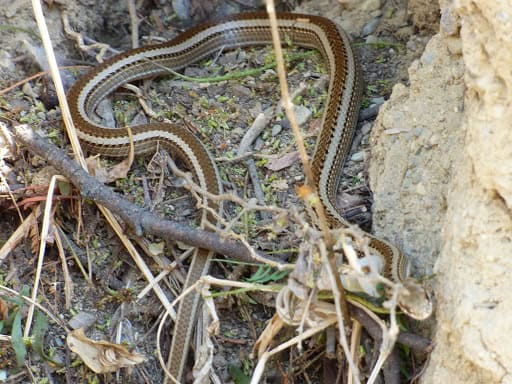
Maximum length: 128.5cm.
One of Argentina’s fastest snakes. Gunther’s green racer (Philodryas psammophidea) is a somewhat venomous species which has never been recorded to kill anybody.
Gunther’s green racers mainly live in drier areas, not fully fledged deserts, but areas with parched soil and various bushes and shrubs dotted around. They avoid lush, grassy meadows, and are terrified of rainforests. Their venom is poorly researched, but believed to contain toxins capable of swelling up a victim’s hand.
This species is a generalist predator, consuming mammals, reptiles and frogs alike. Confirmed meals so far include the Juliaca four-eyed frog and pale leaf-eared mouse, although research is scarce here too.
Gunther’s green racers are mainly found in western Argentina, as they have no presence in Buenos Aires province. To the north, they also appear in Bolivia and Paraguay. Despite the name, this species barely has any green on its body at all. Its patterns consist of lengthways stripes in grey-brown and white colours. The proportions of these colours vary, as in some individuals, the white will push the brown back, while in other members they’re more equal, like above.
| 12 | Crossed pitviper |
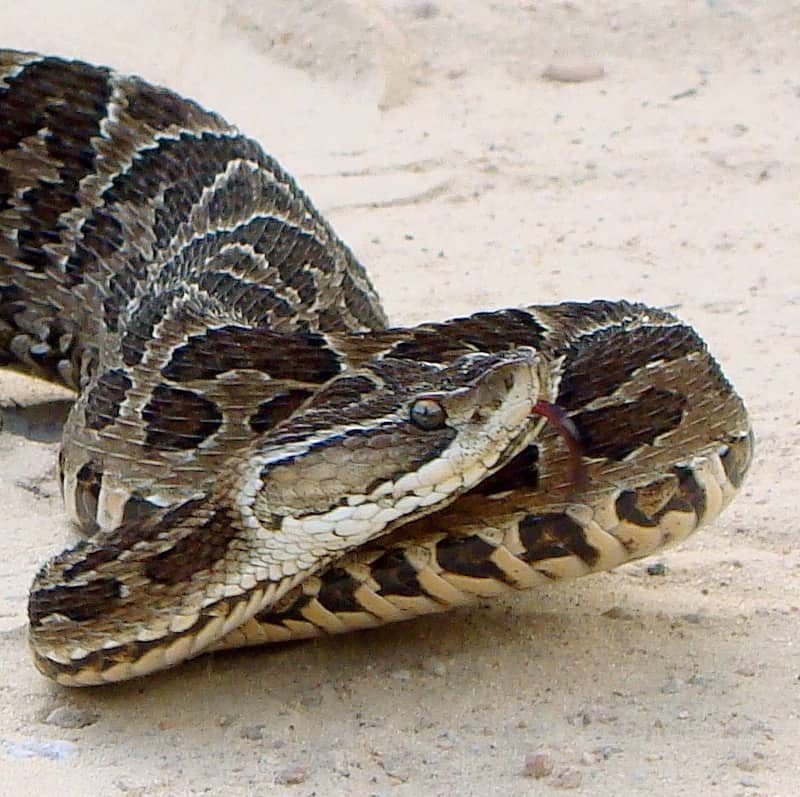
Maximum length: 169cm.
The final of the three main pitvipers found in Argentina. This potentially lethal species is usually found in grassland, and always in open areas rather than claustrophobic forests.
Crossed pitvipers (Bothrops alternatus) are found in southern Brazil, but cover a huge swathe of central and northern Argentina, where they’re regularly observed. Their diet consists of 100% mammals, and bites in humans typically lead to disrupted blood clotting and organ damage (though rarely death). Crossed pitvipers are difficult to distinguish from painted lanceheads, which they overlap with in many provinces of Argentina, but your course of action is always the same: observe from a safe distance.
Another fun fact is that Bothrops alternatus is the only pitviper found in Buenos Aires. They’re most common in the Reserva Ecológica Costanera Sur, in the city’s east. Meanwhile, Patagonian lanceheads are only found in the south of Buenos Aires province, far from the capital. Painted lanceheads aren’t even found in the province at all, appearing further north in Argentina.
That said, crossed pitvipers can’t compete when it comes to reaching colder southerly latitudes. Patagonian lanceheads (the world’s most southerly snake) plunge deep into Chubut province, while crossed pitvipers barely enter Rio Negro province directly to the north.