
| 1 | Borneo pitviper |
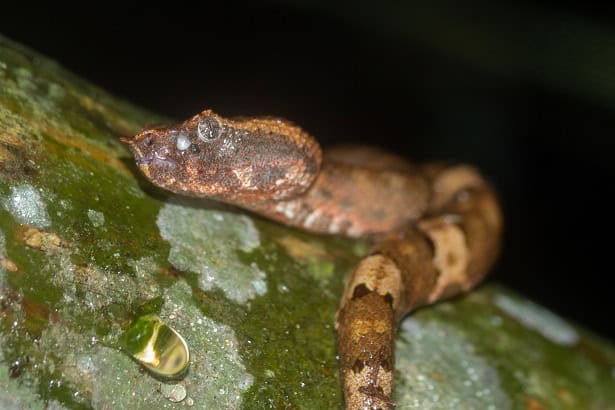
Maximum length: 87.4cm.
This dangerous pitviper is endemic to the island of Borneo, occurring nowhere else. Borneo pitvipers appear mainly in forests, at lower altitude areas of between 25 and 1130 metres. This species is found in all areas of the island, including the Indonesian and Malaysian sections, as well as the small kingdom of Brunei.
Borneo pitvipers vary significantly in colour, with the one caveat that they’re never green. They range from grey to tree trunk brown, to even a cheesy orange, with vertical pupils and complex forest patterns. Though potentially lethal, this snake is no brute, with an all-time record of just 87.4cm.
Borneo pitvipers (Craspedocephalus borneensis) are relatively flexible in habits, as they’re often found on branches or coiled up on juicy rainforest vegetation, yet are equally comfortable on the forest floor. Their confirmed prey includes Draco maximus, AKA the great flying dragon, according to an observation from 2013. The pitviper hunted this reptile on a tree branch 4 metres away from a small stream, but regurgitated its meal when it noticed the scientists watching.
Borneo is full of remote forests and villages, and exactly how many people the Borneo pitviper kills is unknown. However, a 2005 study found that its venom contains PLA2s with anti-coagulant and edema-causing activity. Like most pitvipers, this species probably causes local symptoms and spontaneous bleeding, but death less commonly.
| 2 | Borneo python |
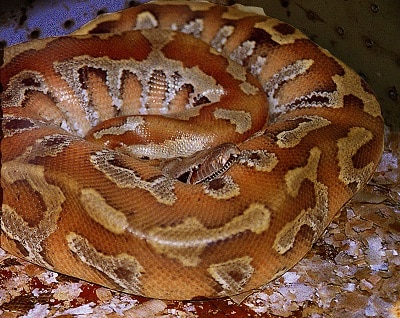
Maximum length: 200cm.
A glistening tank of a python, which lurks in the swampiest Borneo rainforests and waits patiently in ambush, cunningly moving its eyes and little else. This species is part of a 4-member blood python subgroup, all found in southeast Asia. The Borneo python (Python breitensteini) is found exclusively on its namesake island, covering the entire landmass, from Malaysia and Borneo in the northern half to Indonesia in the south.
Borneo pythons are moderate in length, but extremely thick, and capable of crushing lunges. They mostly prey on mammals, including mice and rats, which they take down using one massive pounce, knocking the wind out of their prey. They spends hours without moving, simply waiting for small creatures to wander past.
Forests and palm oil plantations are the main habitats of this species, rather than suburbs or grassy fields. If you stay away from the jungles of Borneo, then you won’t meet this species, but if you do, then be prepared. Borneo pythons share their island with the reticulated python, but the latter is far longer (almost reaching 7 metres), and looks far thinner as a proportion of its length.
| 3 | Smooth slug snake |
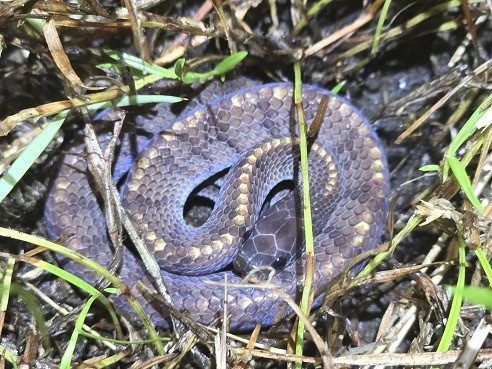
Maximum length: 60cm.
A totally harmless species, which has no ability to hurt human explorers, or villagers, or hard-working farmers. The smooth slug snake (Asthenodipsas laevis) reaches a maximum of 60cm, and resides in both primary and secondary forests. This species is nocturnal, and often found resting on low bushes, or giant rainforest leaves dripping with rainfall.
Smooth slug snakes are widespread in Borneo, appearing in both the Malaysian and Indonesian sections. They also appear in peninsular Malaysia and Sumatra. This is a classic snail-slurping snake, with features such as an imbalanced jaw designed for gripping shells and sucking the snail free simultaneously.
This species varies massively in colours. There’s endless morphs, including orange, stone grey, or grey with neon blue tinges like above. This makes them difficult to recognise, but one consistent feature is a series of thin, dark bands encircling their entire body. Another ID feature which is commonly found, but not always, is a pale stripe extending down their entire spine (like above).
Smooth slug snakes have round, black pupils rather than vertical. They’re particularly common in northwest Borneo near Kuching, the largest city in the Malaysian state of Salawak. Meanwhile, their cousin on Borneo is the dark-necked slug snake (Asthenodipsas borneensis), which also possesses the thin bands, but has a huge black patch on its neck which you can’t possibly miss.
| 4 | Malcolm’s pitviper |
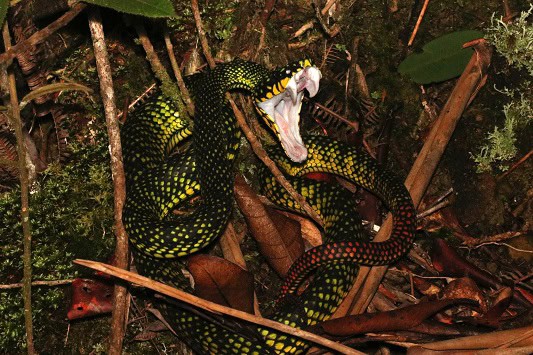
Maximum length: 133cm.
A pitviper found not just exclusively on Borneo, but exclusively in the far northeast. Malcolm’s pitviper, AKA Trimeresurus malcolmi might be the most terrifying snake found on the entire island. They only inhabit a small portion of Borneo, but in that region they’re extremely common, with scores of sightings.
The image above reveals several features of this snake: 1) an immensely green colour palette, to blend with the forest, 2) a white mouth lining, which is probably designed to scare enemies, similarly to the US cottonmouth’s, and 3) a red tail, which may be designed for luring in amphibian prey. Finally, the fangs of this species are absolutely brutal.
Malcolm’s pitvipers seem less dependent on tree branches compared to other Trimeresurus members, as several have been found lurking on roadsides, or even dead on the road. Their wild diet is mysterious, but in captivity, they’ve swallowed up squirrels and rats. They appear at altitudes ranging from 915 to 1600 metres.
Worldwide, this species is most closely related to the Sumatran pitviper (Trimeresurus sumatranus). If there’s ever a reason to rip up your holiday tickets to Borneo and go to Venice or Paris instead, Malcolm’s pitviper is it.
| 5 | Striped dwarf tree snake |
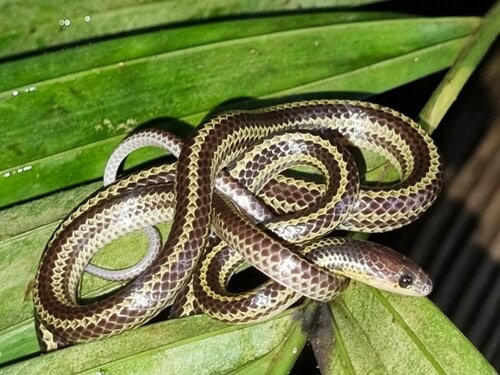
Maximum length: 65.5cm.
This non-venomous species is mainly found on Borneo, but also on the Natuna islands west of Borneo, and the Philippine island of Palawan. The striped dwarf tree snake (Lycodon tristrigatus) is most commonly found in forests, where it moves by night. It seems to enjoy coiling itself into a random ball of coils, as the image above shows.
This snake is skilful at coiling around uber-thin branches, and weaving along fallen tree trunks without the claws of gravity dragging it down to the forest floor. Slithering vertically up trees is one of its specialities, as this snake has excellent gripping abilities. It can slither up trunks covered with moss, or those with great strips of bark peeling away from them.
Nothing is known about the striped dwarf tree snake’s diet. We do know that the closely related Lycodon nympha of India eats eggs, by slicing the shells open using enlarged teeth, while constricting them, before drinking their contents.
This snake was once dubbed Dryocalamus tristrigatus, but the Drycolamus genus (which had 6 members) was declared in 2016 to actually be non-existent, and this species was switched to the huge Lycodon genus containing the wolf snakes. A paper argued in 2020 that Drycolamus was a legitimate group, as Drycolamus members had a wider head, more protruding eyes, and more keeled scales, versus completely smooth scales for Lycodon members. The debate continues, but for now, this species remains part of the Lycodon genus (which currently has 73 members).
| 6 | Schmidt’s reed snake |
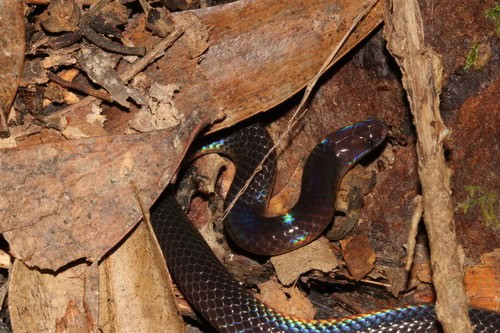
Maximum length: 28cm.
A species which is endemic not just to Borneo, but the northern tip of Borneo. This is Sabah state, a Malaysian region which is especially abundant in tropical rainforest, and is sparsely populated relative to its size, with most humans concentrating in towns along the coasts. The interior is a vast paradise of exotic creatures, and Schmidt’s reed snake (Calamaria schmidti) is one of the least researched.
We know a few facts; Calamaria schmidti is one of the more iridescent snakes in the world, with a clear rainbow shimmer when light is shined on it. An earthworm was found in one individual’s stomach, which is similar to other members of the Calamaria genus (which has a huge 66 members). In a cross-section, they have a cylindrical body shape, and they have few actual patterns.
Mount Kinabalu National Park is one place where you’ll find this secretive serpent. This is one of the only places on Earth where their population density seems fairly high. But even this hotspot is covered with forests, and with the accumulated layers of decades of forest mulch, which Schmidt’s reed snake loves to burrow through.
This species appears under rotting logs as well, and is mainly found at altitudes of 1370-1570 metres. All these features combine to make Schmidt’s reed snake a very tricky species to track down.
| 7 | Dark-headed Sabah ground snake |
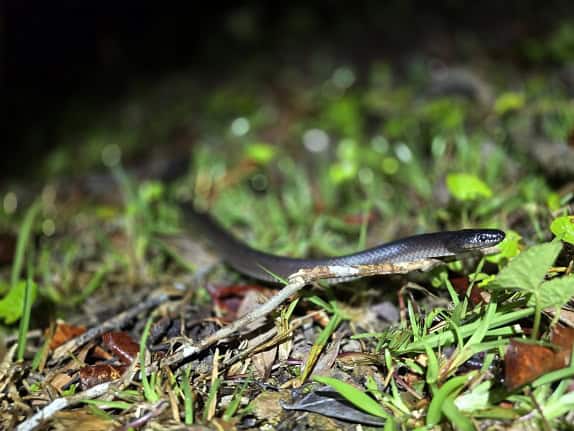
Maximum length: 125.9cm.
This non-famous snake lives in virtually the same areas as Schmidt’s reed snake. It’s endemic to Sabah state in northern Borneo, and has the highest density of sightings in Mount Kinabalu National Park.
At 4095 metres, Mount Kinablu is the highest mountain not just in all of Borneo and Malaysia, but between the Himalaya and New Guinea (whose highest mountain reaches 4509 metres). The national park was established in 1964 and declared to be a world heritage site in 2000. It’s a high, jungled place, as even the official Kinabalu Park Headquarters lie at an altitude of 1,866 metres. This national park is also where the dangerous Malcolm’s pitviper hangs out in high numbers.
As for the more peaceful snake that clings to these mountainous slopes, the dark-headed Sabah ground snake (Stegonotus caligocephalus) is a shiny snake with few patterns, which ranges from brown to an oily blue-black. It can exceed 1 metre, and its belly is yellowish. This snake has only been found at altitudes of 1300 metres and higher. So far, the only dietary observation was an attempt at preying on a gecko, namely the Balu bow-fingered gecko.
The Stegonotus genus is fairly widespread, with 24 members worldwide. The most common member is easily the slatey-grey snake (Stegonotus australis) of Australia, but the dark-headed Sabah ground snake has become stuck in one narrow region of Borneo. Borneo is the furthest west the Stegonotus genus reaches; none exist in peninsular Malaysia, Sumatra or Thailand.
| 8 | Everett’s kukri snake |
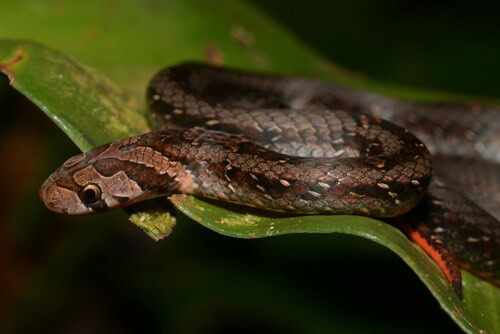
Maximum length: at least 42cm.
Part of the huge, 88 member kukri snake genus, and one of the more mysterious. Everett’s kukri snake (Oligodon everetti) is a non-venomous creature which is incapable of ending your life. This isn’t a mountainous species, as it prefers lowlands ranging from 0 to 1000 metres. Primary forests are its domains, and it’s reported to feed on reptiles and reptile eggs.
Overall, this is a species which has existed for millions of years, with endless millions of individuals existing in that time, engaging in all sorts of wacky forest exploits. Yet as of 2024, we can only tell you a handful of facts about Everett’s kukri snake, mostly relating to physical appearance.
To find this species, search for a bright orange belly contrasting sharply against a browner, blotchier back. There’s no gradual fading in, but a sharp delineation between the two colours. Everett’s kukri snakes have round pupils, with a dark brown stripe running diagonally through the eyes.
Everett’s kukri snakes (Oligodon everetti) are mainly found in eastern Borneo. You won’t find them in northwest Borneo near the populous Malaysian city of Kuching, but they do appear in Sabah state and southeast Borneo in the Indonesian portion of the island. The jeweled kukri snake is another name for this species, because of its richly detailed patterns.
| 9 | Malaysian spotted keelback |
Maximum length: 100cm.
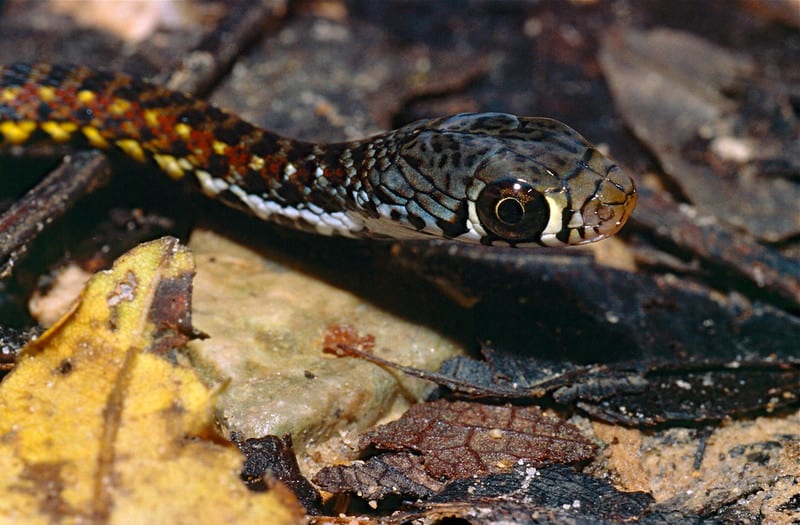
A water-loving snake which poses no threat to humanity whatsoever. To find this snake, you simply need to dock in Borneo and venture to a forest stream. The problem: there’s thousands upon thousands of forest streams in Borneo…
Luckily, this species is fairly common. The Malaysian spotted keelback (Xenochrophis maculatus) is significantly more widespread than some entrants of our list. Java is out of bounds for this snake, but they successfully inhabit Sumatra, peninsular Malaysia, extreme southern Thailand, and Borneo, which is probably their main stronghold. Malaysian spotted keelbacks are most likely to be spotted in sunny weather after a previous day of heavy rains.
This snake moves in a stop-start fashion; it slithers very slowly and cautiously one moment, before rapidly speeding up and covering large distances. Two Malaysian spotted keelbacks were even seen dancing together once, which was possibly a male-female seduction ritual, but possibly for fun – who knows.
Big eyes are one of their classic characteristics, which look like they would pop like bubbles if you touched them. This is one of Borneo’s main frog-eating snakes, with a confirmed meal being the Malayan giant frog (Limnonectes malesianus). Malaysian spotted keelbacks are most closely related to the striped keelback (Xenochrophis vittatus), an entrant on our Javan snake list.
| 10 | Painted mock viper |
Maximum length: 55cm.
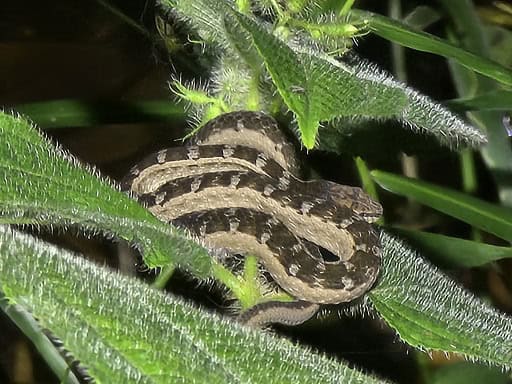
A common species on all of Borneo, as well as Sumatra and peninsular Malaysia. This is a mildly venomous snake, which delivers its toxin elixir only via rear fangs, making it hard to inject. Painted mock vipers (Psammodynastes pictus) are usually found near rivers in forest areas, typically along the shorelines within a few metres of water. This snake is capable of fishing, by waiting along river shores with its neck coiled in an S-shape, and unloading the coil the moment it sees a shadow move past in the depths.
The painted mock viper is variable in appearance, with beige, brown, and even red morphs appearing. It’s an intricately patterned species, and the most complex patterns run directly down its spine, bordered on each side by pale stripes.
This species only reaches a maximum of 55cm, versus 77cm for its cousin the common mock viper (Psammodynastes pulverulentus). The painted version also lives further south generally, while the common mock viper reaches Taiwan and even northeast India, while also inhabiting Borneo and coexisting with their cousin.
A study from Malaysian Borneo found that common mock vipers prefered smaller, shallower streams, and appeared more commonly away from streams. Painted mock vipers were more common near deeper rivers, and were always found within 150cm of water. The two species had subtly differing habitats, in order to avoid heavy competition with each other.
| 11 | Speckle-headed whipsnake |
Maximum length: 169cm.
A tree-dwelling species which moves mainly by day. The speckle-headed whipsnake (Ahaetulla fasciolata) hunts on branches 2 metres high, sleeps on branches 2 metres high, and surveys its forest calmly from branches 2 metres high. This species is rarely observed, but appears all over Borneo, as well as Sumatra, Singapore, peninsular Malaysia and far southern Thailand.
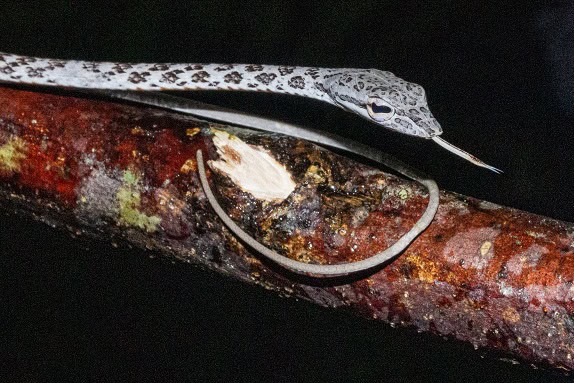
This species has an ultra thin body, to support their arboreal lifestyle, and a tongue which mimics their body colour closely. They struggle to cope with human habitats, appearing in rainforests, as well as patches of remnant rainforest near housing estates. Without trees, the speckle-headed whipsnake cannot survive. Their diet is poorly researched, but probably consists heavily of reptiles.
This species overlaps with the far more common Asian vine snake (Ahaetulla prasina), even appearing in the same forests side by side. At first glance they look similar – extremely thin with strange pupils. However, only the speckle-headed whipsnake has a series of dark speckles on its head (as you’d expect). This differentiates them from all other southeast Asian Ahaetulla members too.
Speckle-headed whipsnakes are never green, usually brown or silver, which is a decent ID sign, though not infallible, as the Asian vine snake also has paler morphs. They nearly always have a series of black blotches on their upper half, whereas Asian vine snakes are usually cleaner, but can still have these blotches occasionally. These are secondary ID signs, but the only infallible ID sign is the speckled head.
| 12 | Paradise flying snake |
Maximum length: 150cm.
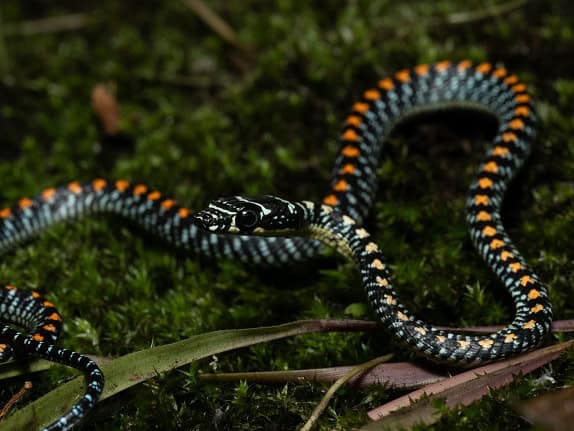
The most likely Bornean snake to land on your head from a great height. The paradise flying snake (Chrysopelea paradisi) is one of 5 confirmed flying snake species around the world, and the joint most common with Thailand’s golden flying snake. They actually fly further than the Thai version, travelling over 4 times in horizontal distance compared to vertical after a leap, achieving a horizontal/vertical flight distance of 4.2, according to one study.
Paradise flying snakes are found in almost all of Indonesia and Malaysia, the Philippines, southern Thailand and Singapore. As is necessary for their lifestyle, they’re able to climb 15-20 metres high in trees, not ascending branches like a ladder, but simply slithering up the trunk vertically.
This species has a mild venom, but its exact effects in humans are unknown. A 16 year old student from Malaysia was bitten in 2010, and experienced a small increase in bloodstream creatine kinase, an indicator of muscle destruction, but the effect was only mild. Paradise flying snakes seem to prey mainly on reptiles, with several confirmed prey species, including the Borneo skink, Horsfield’s flying gecko and spotted house gecko.