
| 1 | Madurai shield-tail snake |
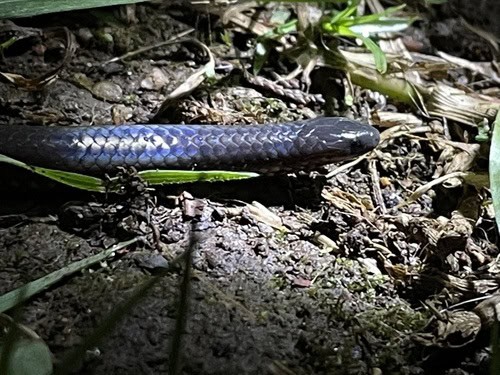
Maximum length: 44cm.
The Western Ghats is a mountain range found in southwest India, which is renowned for its long list of rare and often bizarre species found nowhere else. There’s so many endemic snakes in the Western Ghats that scientists simply don’t have the manpower to research them all, and one massive blind spot is the Madurai shield-tail (Platyplectrurus madurensis).
Madurai shield-tail snakes inhabit the Western Ghats exclusively, and even then, just a small portion of them. They’re confined to the Palani Hills, directly east of the Anaimalai Hills, which contain southern India’s highest peak.
The Madurai shield-tail was originally found near Kodaikarnal, a scenic town which lies at 2000 metres above sea level. This snake is a glistening purplish-brown, contrasting vividly against a bright yellow underside. This is a small species which peaks at just 44cm, and only appears above 1200m in elevation. Madurai shieldtails are shy, and are usually found below some sort of cover. They’ve been found below rocks in mountainous shola forest patches, under rocks in mountainous grassland, and below fallen logs.
Despite being so secretive, the Madurai shield-tail has been known to scientists for a long time. The first member to be discovered was Platyplectrurus trilineatus in 1867, and Platyplectrurus madurensis followed a decade later in 1877. Progress rapidly ground to a halt, as the Platyplectrurus genus still has 2 members as of 2024. Both species remain extremely mysterious.
| 2 | Black coral snake |
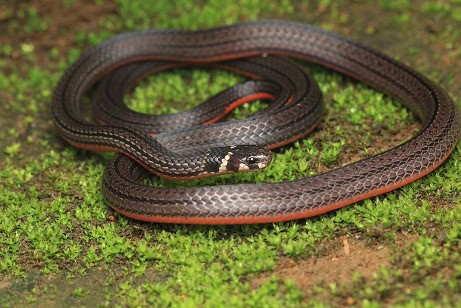
Maximum length: 115cm.
This venomous snake averages at 55cm, and is barely heard of around the world, yet still not to be underestimated. The black coral snake (Calliophis nigrescens) lives at altitudes of 1000-2300 metres, usually in wet forests, occasionally on tarmac in the form of roadkill.
This is a red-black snake, arranged in parallel lengthways stripes, with some morphs having more red than others. One of their special features is the underside of their tail, which is bright white and red, like a candy cane. Resist the urge to suck it though. Like all Calliophis members, black coral snakes have a neurotoxic venom, and touching them is the only instance in which they might bite. Black coral snakes are timid creatures, and prefer rapid flight to engaging in conflict.
There are no confirmed human deaths from this species, or even severe bites, with one reason being its mainly underground habits. When encountered in forests, black coral snakes are nearly always half-buried in a mixture of soil, fallen leaves and rotting branch debris. Most of their diet consists of fellow snakes, supplemented with lizards.
Their exact venom potency is a mystery, but you don’t want to be the first person to find out. Their relative the Malaysian blue coral snake also causes virtually no bites, yet once killed a showering man in Singapore within 5 minutes. Be cautious of any red-black striped snakes you encounter in the Western Ghats mountains.
| 3 | Malabar pitviper |
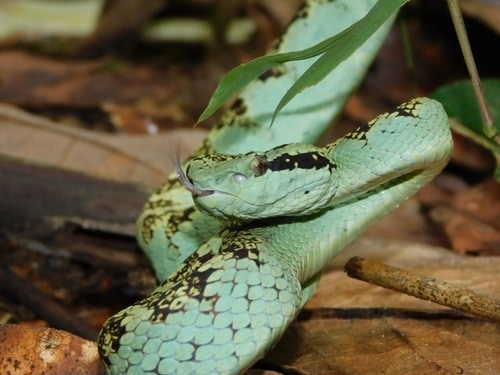
Maximum length: 89cm.
The most likely pitviper to strike at you from a branch. Malabar pitvipers (Craspedocephalus malabaricus) are endemic to the Western Ghats, where they cover a large territory. They average at 40-80cm, and spend virtually all their lives on branches. It’s extremely rare to find them on the forest floor, slithering through leaves, though they do occasionally enter streams and coil around submerged branches, not realizing that they’re underwater.
Malabar pitvipers rarely kill their victims, but have a dangerous venom which can unleash painful swelling and haemorrhaging. The vast majority of their prey are frogs, of which they can swallow multiple individuals at once. Confirmed prey include Malabar gliding frogs and Indian bullfrogs.
Like the best ambush predators, Malabar pitvipers can spend weeks at a time on a single branch perch without moving. If you disturb them, the immediate consequence will be a rapid lunge, with bared fangs that get steadily larger as they approach your face.
Whether you spot them first depends on their exact morph, for this is an incredibly variable snake. Malabar pitvipers range from bright blue to jungle green to tree trunk brown to dull brick red. They’re one of the most variable snakes in the world, although the reasons for this polymorphism are unknown.
| 4 | Olive forest snake |
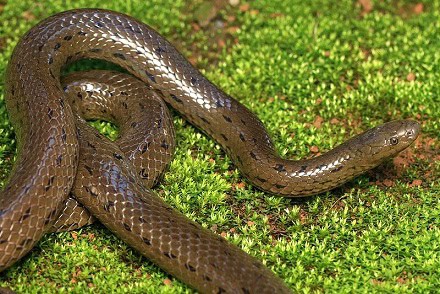
Maximum length: 98.5cm.
An energetic snake which is never found in dry areas, always sticking closely to water bodies. Olive forest snakes (Rhabdops olivaceus) are either non-venomous or mildly venomous, and reach a maximum of 98.5cm.
This is a snake of mountain streams in rainforests, whether flowing gently or in a torrent from recent downpours. They also inhabit more open land, if there’s sufficient rainwater pools to move between. This is a docile snake, which is more likely to stare at you inquisitively than launch a savage assault.
Olive forest snakes have very smooth scales to touch. From above, they have glistening green olive shades, while their belly is a purer yellow, with black speckles along the flanks. Their eyes are also green olive, with round pupils.
This species is most common in forest depths, but can also be found in water bodies near villages and rice paddy fields. Olive forest snakes are common in the Western Ghats, yet remain relatively unresearched.
This is a mainly nocturnal snake, which is still capable of hunting during daylight occasionally. In a 2014 study, 6 individuals were found, and all were resting during the day, always hiding below waterlogged rocks. A 2012 report was contradictory, observing several moving from 8:05 to 14:15 during rainy season. Olive forest snakes rely heavily on seasonal water pools, meaning that they probably become more adventurous during monsoon season.
| 5 | Horseshoe pitviper |
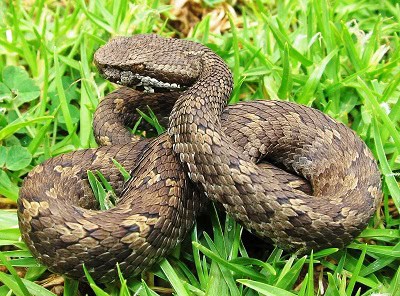
Maximum length: 48cm.
One of India’s rarest pitvipers. The horseshoe pitviper (Craspedocephalus strigatus) is a ground-dwelling species, rarely appearing on branches. This species is found at altitudes of 1100-2400 metres, where they appear in forests, but especially shola grasslands. Within these realms, horseshoe pitvipers are often spotted resting menacingly on large rock slabs.
Horseshoe pitvipers belong to the same Craspedocephalus genus as the Malabar pitviper, their Western Ghats neighbour. But this species is 1) far less colourful and variable, and 2) restricted to a dramatically smaller range. This may be the rarest pitviper in all of India, as horseshoe pitvipers are endemic not just to the Western Ghats, but the Nilgiri mountains subrange of Tamil Nadu and Kerala. Their favoured shola grassland habitats have shrunk by two thirds over the last century, reducing their territories significantly.
Compared to the Malabar pitviper, horseshoe pitvipers have just a tiny fraction of encounters with humans, and they have zero presence in India’s annual snakebite statistics. Their venom is theorized to be haemotoxic rather than neurotoxic.
Rather than blue or green, horseshoe pitvipers have standard brown-grey viper shades. The horseshoe title comes from a single marking atop their head, rather than their body patterns.
| 6 | Anamalai wood snake |
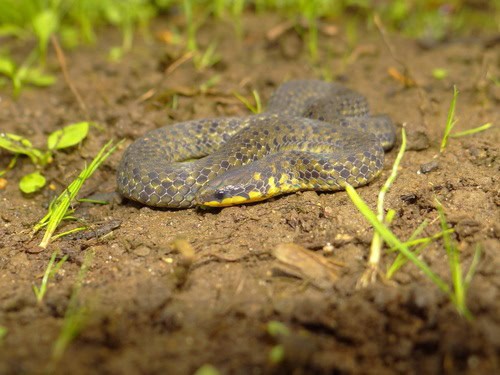
Maximum length: 43.6cm.
One of 5 Xylophis woodsnakes found in India, and the most recently discovered. The scene was Kerala state’s Eravikulam National Park. It was December, and researchers Sandeep Das and K.P. Rajkumar had spent the entire morning trudging up hillsides surveying the local area for snakes. Exhausted, they sat down on the grass, when Das spotted a strange movement ahead. It was a ground-dwelling wood snake, but an odd one, which looked different to the Perrotet’s woodsnake further north.
After 5 years of further study, they announced in 2020 that they’d discovered an all new species: the Anamalai woodsnake (Xylophis mosaicus). It was named after the Anaimalai Hills, home to southern India’s highest mountain, the moderately mighty Mount Anamudi at 2695 metres.
So far, Anamalai wood snakes have been found only at 1500 metres in altitude or higher. They average at 30cm, and have strong burrowing tendencies, meaning that they require soft soils. Unlike Perrotet’s wood snake, they have a complex mosaic of patterns, with rapidly alternating yellow, black and dark olive scales.
The reason for the split is the Palghat Gap, the widest gap in the Western Ghats mountain range at 30km long. This lowland gap was a strong evolutionary pressuriser, forcing many species to separate and diverge, from snakes to bush frogs. Anamalai woodsnakes are non-venomous, and would be a great achievement for any reptile nut to track down.
| 7 | Spotted earth snake |
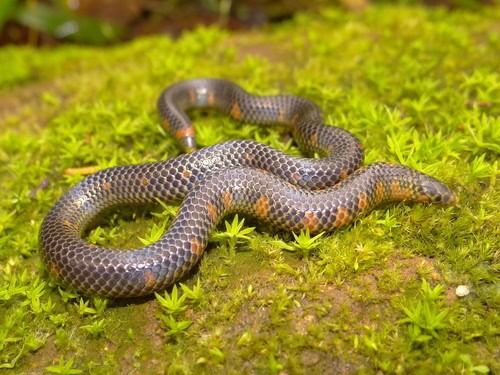
Maximum length: 39cm.
The Western Ghats mountains not only contain wood snakes, but earth snakes too, although no fire or ice snakes have been discovered (yet). The spotted earth snake (Uropeltis maculata) is a rarely seen species which is known from altitudes of 1065-2400 metres. This is part of the 24-member Uropeltis genus, all found in India and Sri Lanka, and all extreme burrowers, with a classic tapering head, which is far more optimised for shifting soil aside than the rounded head of a cobra.
Spotted earth snakes are mainly chocolatey brown from above, in order to blend with soil from a bird’s eye view. But their flanks are more colourful, gaining bright pastel yellow and red, with the latter seperating them from other Uropeltis members. Their underside is a bright yellow.
Like other shield tails, Uropeltis maculata is often mistaken for a worm, as it reaches a maximum length of just 39cm, though this is actually large for a Uropeltis member. Its head and tail are almost identical in shape. Just as their skull tapers to a sharp point, enabling them to burrow, so too does their tail.
Like most Uropeltis members, spotted earth snakes are believed to prey heavily on earthworms. Your chances of meeting this snake are very low, but who knows – perhaps you’re up to the challenge.
| 8 | Whitaker’s boa |
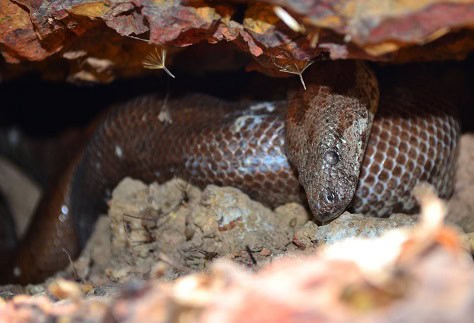
Maximum length: at least 95cm.
A burrowing boa which averages at around 70cm. Whitaker’s boa (Eryx whitakeri) lives only in southwest India, including in Kerala, Karnataka, Goa, and Maharashtra states.
This species avoids the highest regions of the western Ghats, sticking to moderate elevations. However, they’re also found close to shores, including on beaches, where they utilitise their excellent burrowing abilities. This species is a relative of the infamous Arabian sand boa, which digs in the desert sand dunes of Saudi Arabia and Oman, stretching as far as the eye can see, but Whitaker’s boa lives in much less extreme habitats.
Confirmed prey include fellow snakes like the common vine snake, though they mostly feed on small mice, which they pounce on from disguised ambush positions. One of Whitaker’s boa’s confirmed habitats is the campus of Goa University, where an Indian krait (Bungarus caerulus) was once spotted devouring one. The boa measured 45cm and the krait 128cm; the latter eats fellow snakes as a large chunk of its diet.
Whitaker’s boa has very small eyes, with vertical pupils. This species also coexists with a relative, the rough-scaled sand boa (Eryx conicus), which is much more widespread in India, covering most of the nation. The difference is that Whitaker’s boa has far smoother scales, and its blotches tend to be more faded, less vivid.
| 9 | Nilgiri keelback |
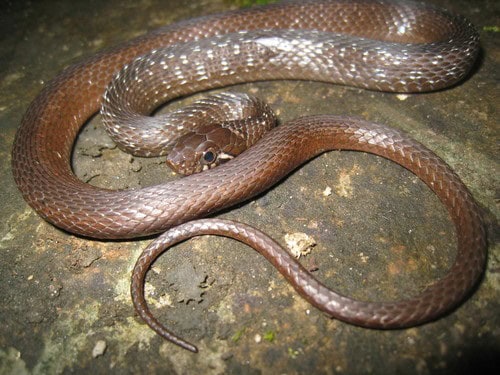
Maximum length: 65cm.
Many entrants on this list are rare, and inhabit one particular set of hills within the Western Ghats, but the Nilgiri keelback (Sahyadriophis beddomei) inhabits virtually the whole range. Their empire is simply a huge spine stretching down southwest India. They occur nowhere outside of these mountains, yet are very common within them.
Nilgiri keelbacks have a toffee brown base overlaid with white and occasionally black speckles. This is a water-loving species, as while not fully aquatic, they’re nearly always found on the banks of streams and forest pools.
Nilgiri keelbacks are most at home in tropical rainforest and tropical moist forests, and the higher the annual rainfall in an area, the more likely they are to appear. Most of their diet is amphibians, with two confirmed prey being Jog’s night frog (Nyctibatrachus jog) and Ghate’s shrub frog (Raorchestes ghatei).
This species originally belonged to the large Hebius keelback genus, but was switched to the smaller Sahyadriophis genus in 2023. Nilgiri keelbacks move by day, and have round pupils. They were first discovered in 1864, and it’s rare to find them climbing trees.
| 10 | Bibron’s coral snake |
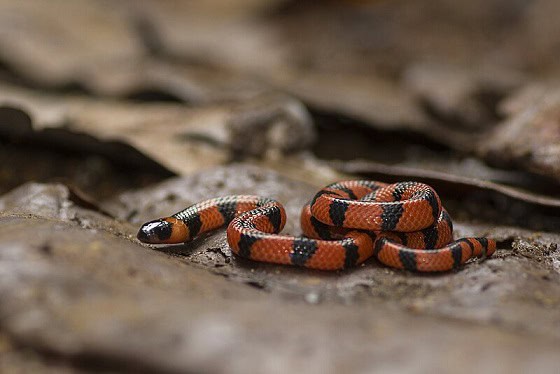
Maximum length: 88cm.
Another coral snake of the lethal Calliophis genus. Bibron’s coral snakes (Calliophis bibroni) occupy the southern half of the western Ghats, appearing at relatively low elevations of 0-1220 metres, rather than towering mountaintops.
Like the black coral snake, this species contributes virtually nothing to India’s annual snakebite totals, and their venom is completely unresearched. The territories of these two cousins overlap, but physically, they’re extremely easy to separate. Bibron’s coral snake has the same red-black colours as the black coral snake, but its patterns are completely different, forming encircling bands rather than lengthways stripes.
Bibron’s coral snakes are medium sized, averaging at 40-60cm. A 2010 study discovered a new record by stumbling across an 88cm male. This was found by a riverside habitat, and was already dead, with puncture wounds on its body, seemingly inflicted by a bird’s talons.
A second large male was found accidentally, while a scientist was digging in the earth for caecilians. A female was found crossing a road within an evergreen forest, while another large male was collected along the main trail of the Anamalai Tiger Reserve. Bibron’s coral snakes have a distinctive belly, with a bright red or pinkish red colour overlaid with black squares.
| 11 | Short-tailed kukri snake |
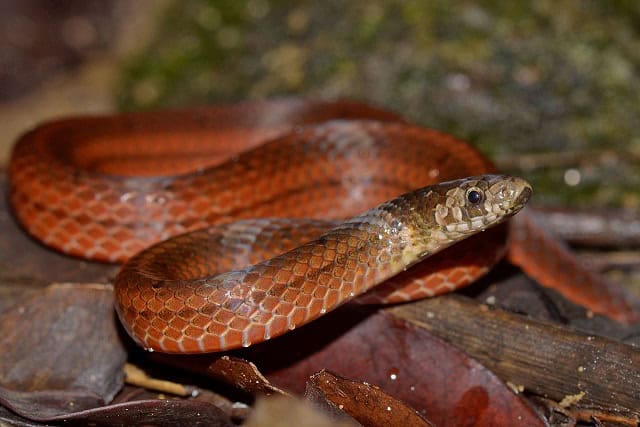
Maximum length: 50cm.
An extremely shy species, which is found exclusively in the western Ghats. This species never exceeds 50cm, and has strong burrowing tendencies, allowing them to vanish underground, disappearing from the sight of human researchers. That’s before they effortlessly blend in using their brown colours, which seem to match both soil and leaves simultaneously.
The short-tailed kukri snake (Oligodon brevicauda) is one of the least researched of all kukri snakes. They have few noticeable patterns, except for faint parallel stripes. They have a modified snout shape to enable their burrowing habits, and their colour ranges from golden brown to brown-grey. Their underside is paler, with black spots, while they have a greyer face than the rest of their body.
Even within the Western Ghats mountain range, short-tailed kukri snakes are barely observed. Their diet and predators are a complete mystery. Other kukri snakes have vicious, tearing fangs, which are non-venomous, but capable of inflicting grisly wounds on human beings. This quality is found in virtually all members, so don’t be seduced by the relatively calm, docile appearance of the short-tailed kukri snake, in the unlikely event that you stumble across one.
| 12 | Günther’s vine snake |
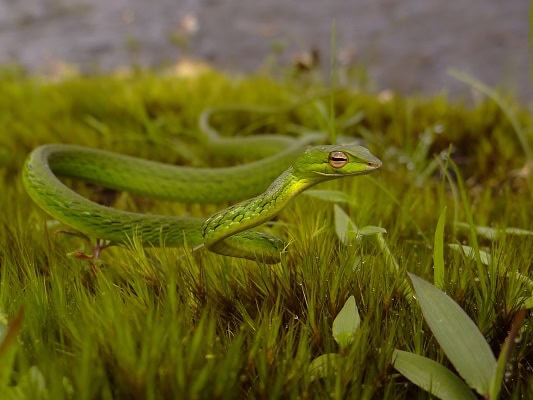
Maximum length: 65cm.
Part of the 21-member vine snake clan, but unlike the Asian vine snake, which inhabits around 13 countries, this species is found only in one narrow mountain range of southwest India. Even within the Western Ghats, Günther’s vine snakes are found exclusively south of the Palghat gap, mainly in the scenic Anamalai hills region.
This is an extremely thin species, which is almost entirely green except for a few black speckles, and its bizarrely shaped black pupils. Compared to their southeast Asian cousins, Günther’s vine snakes (Ahaetulla dispar) are less reliant on trees, as they’re sometimes found slithering through open grasslands. They swing from branches and cross massive gaps to fresh trees with ease, yet can also be found on the ground in forests, slithering over rocks.
Ahaetulla dispar is poorly researched, but believed to feed mainly on frogs and lizards. It’s been known as an official species since 1864, yet little research has been conducted in the 160 years since then.
The Western Ghats is a hotspot of vine snakes in general, as in 2020, 5 new species were separated and made official in their own right. These included the Malabar and Farnsworth’s vine snakes, each found in separate hilly regions of the Western Ghats. The same study split off the Transvore vine snake from Günther’s vine snake, reducing the territory of the latter.
Despite being confined to a small area, Günther’s vine snakes are relatively common in their Anamalai Hills heartlands, and they aren’t shy, exploring their forested hillsides with no caution at all.