
| 1 | Smooth green snake |
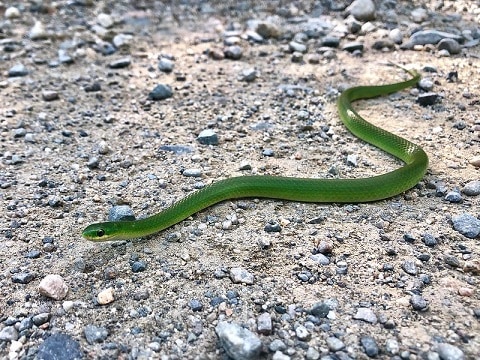
Maximum length: 79.7cm.
Recently, a large amount of disturbing scientific headlines have appeared showing innocent snakes stuck in spiders’ webs. To the amazement of readers, the articles reveal that spiders are actually capable of eating snakes 100 times larger than themselves, by spewing digestive enzymes which transform the snake’s flesh into an easily digestible mush. Fortunately, snakes aren’t just helpless victims in this war, as there’s several species worldwide which turn the tables and feed on spiders heavily.
Perhaps the top US example is the smooth green snake (Opheodrys vernalis), alongside its close relative the rough green snake. These species focus on the eastern US, with the smooth green snake being the more northern of the two, crossing the border into Canada, and occupying a large area of territory including New York, Pennsylvania, Virginia, Ohio, and many more. Smooth green snakes are non-venomous, and inhabit moist grassy meadows and river shores. They average at just 40-60cm, and have never been recorded to reach 1 metre.
The competition for eating amphibians is huge in the northern US – garter snakes have that market sown up. So instead, the smooth green snake has evolved to eat small creepy-crawlies, and spiders rank highly among their meals. A 1939 study found a dietary breakdown of 37% caterpillars, 32% spiders, 20% grasshoppers, 10% ants, and 1% snails and slugs. A 1960 study also found a high percentage of spiders, as well as flies.
| 2 | Great plains ground snake |
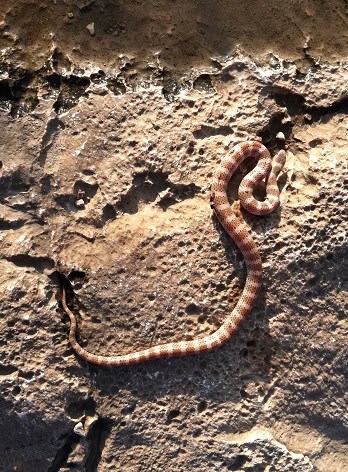
Maximum length: 47cm.
The Great Plains ground snake (Sonora episcopa) is a widespread species of the southern central US, which is most common in Texas, but also inhabits Oklahoma, New Mexico, Colorado and Kansas. This is a harmless snake to human beings – picking one up is completely safe, although tricky to accomplish due to their preference for open, rugged terrain. This is a species of wide open sweeping plains (hence the name), which often appears on rocky slopes and even in semi-deserts.
This species is a death-faking snake, going completely limp and kinking its neck lifelessly in order to appear devoid of all life. The goal is to confuse birds into moving onto a fresher, more alive meal. Another survival trick they use is focusing on relatively small foodstuffs which go ignored by larger snakes. These include scorpions, centipedes and spiders.
A 2024 study revealed this snake’s hunting techniques. For potentially lethal scorpions, the Great Plains ground snake restrained its prize and waited patiently while a mild venom took effect. With spiders, they were far less subtle; they simply seized an arachnid in their jaws and dragged it along the ground to its doom.
| 3 | Burrowing night snake |
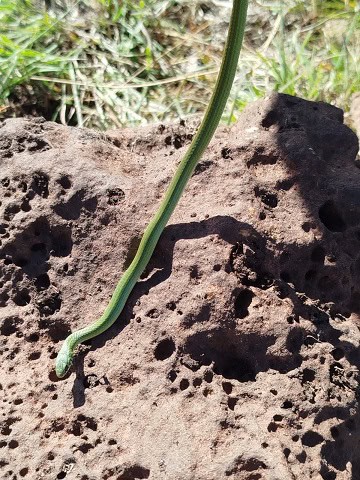
Maximum length: 52.6cm.
A harmless species, found in southern Brazil, Argentina and Paraguay. The burrowing night snake (Philodryas agassizii) is an oddity of a snake, as it was originally placed in the unique genus of Pseudablabes.
These days, it belongs to the larger Philoydras genus (16 members), but still has several strange features within this group. Firstly, it’s a far slower-moving snake, rather than fast and adventurous. It reaches far smaller body sizes, and leads a partially fossorial (underground) lifestyle. The final difference is a Halloween-style diet: feeding mainly on spiders.
A 2006 study examined this species’ lifestyle in detail, and found that the vast majority of its meals consisted of spiders, far outstripping the smooth green snake’s totals. There was only a few exceptions, including scorpions and grasshoppers. The burrowing night snakes were cunning, as they hunted by day, and sought out the subterranean resting places of spiders, using their signature burrowing skills. They primarily hunted members of one spider genus – Lycosa, dubbed the “true tarantulas”.
Philodryas agassizii is only rarely encountered, and lives mainly in sweeping shrubland and grasslands. This is also a variable species in colour, with some being dull brown and others being bright green.
| 4 | Golden kukri snake |
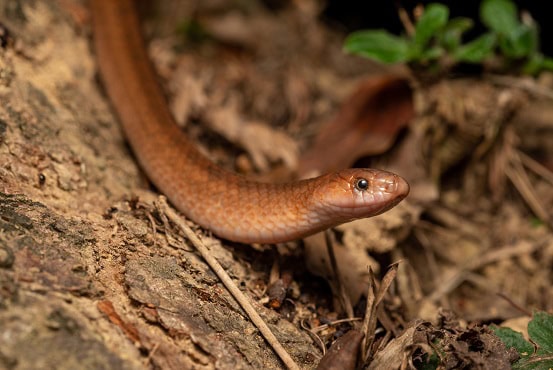
Maximum length: 73cm.
The Oligiodon kukri snake genus is the most enormous in southeast Asia, and the second most enormous worldwide after the Atractus clan. There’s 88 members overall, and not a single member is venomous. However, they do have a large variety in diet, as the small-banded kukri snake of Thailand feeds heavily on frogs, even slashing them open with razor-sharp front fangs. The golden kukri snake goes in a different direction: eating spiders.
This species is one of the more common members, ranging from central Thailand, through Cambodia and Vietnam, all the way to Hong Kong. It’s highly variable in appearance, but is often a plain gold colour, with few patterns.
Golden kukri snakes move along the forest floor rather than climbing branches. They possess sharp fangs, but rather than use these to take down large prey, they’ve delved into the smaller meals of the forest, and devoted themselves to hunting small insects and spiders. This species coexists with the king cobra, which goes in a completely different direction: eating 95% other snakes. Gold kukri snakes are over 7 times shorter than this neighbour, and must adjust their diet to compensate. This species lacks venom, but can be risky to pick up, with an aggressive personality.
| 5 | Meadow viper |
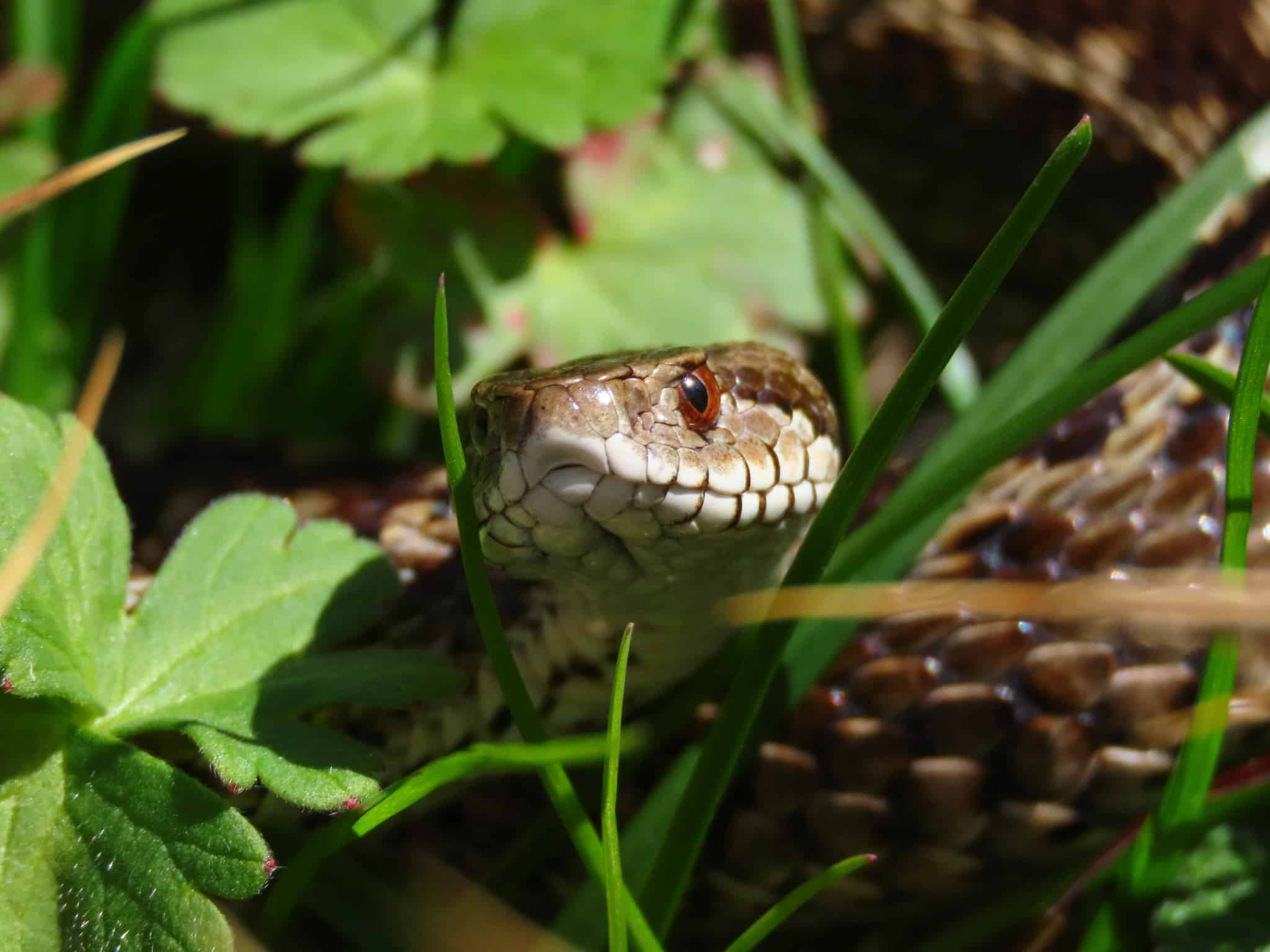
Maximum length: 66cm.
The meadow viper has several unusual features among Europe’s vipers. Firstly, it’s the most endangered, existing in fragmented pockets in alpine areas. Secondly, it’s one of the shortest, generally measuring 40cm rather than over 60cm like an adder. The final memorable feature is their diet, which contains far less mammals compared to the adder or asp viper (common in France and Italy), instead specialising in insects and other small creatures.
A study released in 1992 spent 3 years examining meadow vipers in the Apennine mountains of central Italy. The favourite food group was easily Orthoptera, the insect group comprised of locusts, grasshoppers and crickets, which are plentiful in their grassy realms. However, spiders were detected as well, alongside rodents, beetles, lizards and birds.
A 2025 study also found spiders in this species’ diet, but only in individuals under 28cm, where they made up a decent proportion of meals, alongside Orthoptera insects and butterfly larvae.
While spiders aren’t the main prey of this species, they form a handy backup when grasshoppers suddenly become scarce. Meadow vipers have a medium strength venom, and have never been reported to kill a human. Nevertheless, swelling, necrosis, dizziness and falling blood pressure are all possible symptoms.
| 6 | Degenhardt’s scorpion-eating snake |
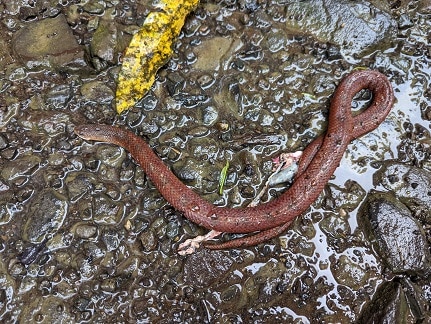
Maximum length: 65cm.
One of the more common snakes of Central America, as well as southern Mexico, Colombia, Ecuador and extreme northern Peru. This is one of two members of the Stenorrhina scorpion-eater genus, but the name is somewhat misleading. Degenhardt’s scorpion-eater is confirmed to prey on scorpions, seizing them and injecting a mild venom repeatedly, while withstanding multiple stinger assaults. But the majority of prey observed so far have been spiders.
Confirmed spiders include those of the mygalomorph and ctenid groups. One study found two Degenhardt’s scorpion-eaters in southwest Ecuador, and inside their bodies were multiple curtain-web spiders. No detailed diet breakdown has been conducted yet – just these anecdotal observations. In fact, this is one of the more mysterious snakes in Central America compared to how common it is.
Degenhardt’s scorpion-eaters tend to avoid thick forests, preferring woodlands and sparser forests. They stick to areas of heavy vegetation, using them as a disguising travel corridor. They move slowly and deliberately, careful to avoid attention. When cornered by a human, they sometimes hide their head and brain under their coils. This species has a venom, but bite reports in humans so far have only involved pain and minor swelling.
| 7 | Lined Tolucan ground snake |
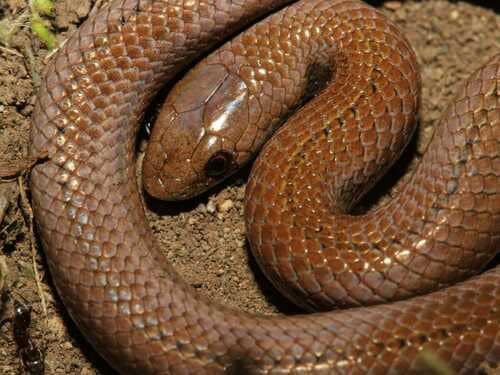
Maximum length: 32cm.
One of southern Mexico’s more common snakes. In fact, this is probably the most common snake near Mexico City overall. Lined Tolucan ground snakes (Conopsis lineata) are small, non-venomous and completely safe to pick up, in the likely event that you stumble across one.
This species cannot fit a rodent in its body, and other snakes are too large, with the possible exception of the smallest blind snakes. So instead, they take their pick from the world of creepy-crawlies. Their diet isn’t ultra specialised, but includes grasshoppers, termites and spiders. One encounter took place in June 2010, when a lined Tolucan ground snake was found under a rock in an oak forest in the state of Guanajuato (northwest of Mexico City). The snake regurgitated a partially digested spider, which proved to be a member of the Zorocrates genus, which are common near Mexico City.
Lined Tolucan ground snakes range from pale beige to tree trunk brown, and never have complex patterns. They’re found exclusively in Mexico, but are common wherever they appear. This species tends to hide under cover objects like logs and rocks, which are a great place to come across their spider prey (or for spiders to come to them).
| 8 | Chihuahuan hook-nosed snake |
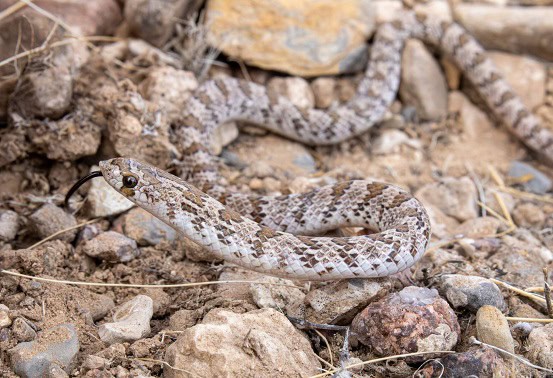
Maximum length: 38.4cm.
The Chihuahuan hook-nosed snake (Gyalopion canum) is a species of three US states: Arizona, New Mexico and western Texas. It’s an inhabitant of dry rocky areas, including barren slopes, rocky areas with shrubs, and even semi-deserts, and poses no threat to humanity whatsoever.
This species is a top burrowing snake of the US south, with a specially adapted snout for shifting debris aside. It prefers areas with sandy soils, usually with some sort of water source nearby, and rocks are essential. If this snake relied on frogs for its meals, then its survival in Arizona would be a great struggle. Instead, it preys on small items like centipedes and small snakes. Spiders are confirmed as well, although dietary information is scant overall.
This species lives in rocky environments, and its grey scales have evolved to match this. Up close, you can see their spade-shaped snout, but with a maximum length of 38.4cm, you’d have to squint to make this out. This is also a high altitude species, reaching 2221 metres in northern Mexico.
| 9 | Calamaria reed snake |
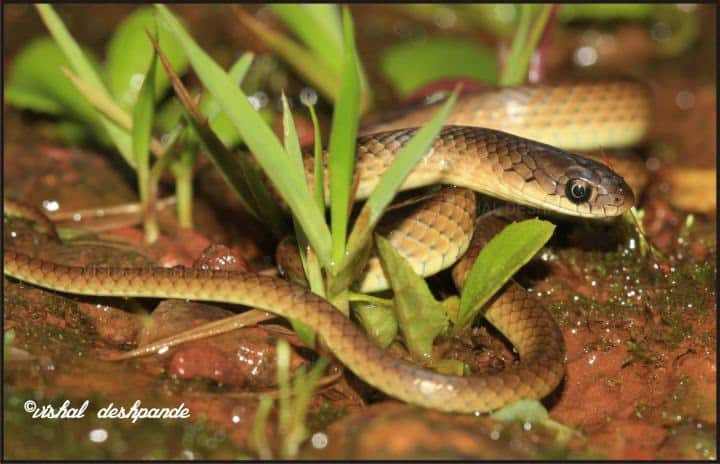
Maximum length: 40cm.
A species of Sri Lanka and central and southern India. The Calamaria reed snake (Liopeltis calamaria) belongs to the 8-member Liopeltis genus, all of which are obscure and poorly researched. It’s fairly widespread in India, yet rarely observed wherever it exists. One of its confirmed habitats is tea plantations.
Before 2019, other Liopeltis members were confirmed to eat spiders, but not the Calamaria reed snake. Therefore, in June 2019, scientists conducted an experiment where a live individual was placed in a terrarium, and offered various food items.
Multiple prey items were rejected, including earthworms, a mantis, frogs, gecko eggs and actual geckos. However, the snake greedily gobbled up all arachnids offered. Multiple types of spiders were offered and accepted, including several jumping spiders. The only other prey type the Calamaria reed snake accepted was a grasshopper.
The scientists thus concluded: “it is certain that spiders and other arthropods comprise an important part of the diet of L. calamaria“. This is one of the only studies conducted on this obscure Indian species so far, but it confirms that the spiders of the Indian subcontinent don’t enjoy a completely free reign.
| 10 | Roth’s dwarf racer |
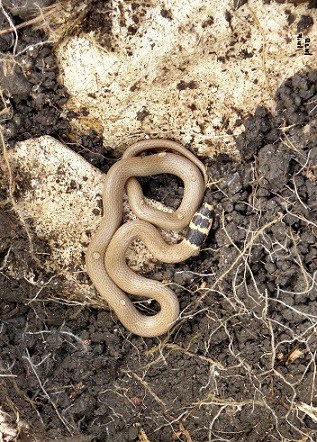
Maximum length: 35cm.
This harmless species appears in areas bordering the eastern Mediterranean sea. That includes Israel, Lebanon, western Syria and a small portion of Turkey. Roth’s dwarf racer (Eirenis rothii) is a shy species which hides under rocks, and has an effortless ability to disappear into dark holes, sheltering not just from the hot sun, but starving predators. They appear in various habitats, including dry hillsides and woodlands. This is a very common species in parts of Israel.
If this species tried to rely on mammals, then it would lose instantly, outcompeted by the venomous Palestinian viper or huge large whipsnake. A craftier diet is called for, and so Roth’s dwarf racer turns to spiders, an 8-legged foodstuff which the large whipsnake would never think of. Roth’s dwarf racers are confirmed to feed not just on spiders, but scorpions, centipedes and small insects.
This species has a plain beige body, contrasting sharply against a black neck, and black facial markings. Though shy, most Eirenis members can move quickly when threatened. Roth’s dwarf racers also hunt snails, which is a common diet worldwide, but extremely rare in the Mediterranean area.
| 11 | Orange-bellied snake |
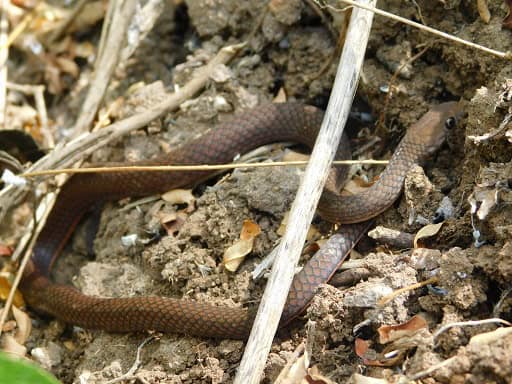
Maximum length: 40cm.
A poorly researched species, which nevertheless covers a sizeable area of land in southeast Asia. The orange-belied snake (Gongylosoma baliodeira) is a resident of the following countries: Malaysia, Brunei, Indonesia and Singapore. It appears across several large islands, including Java, Sumatra and Borneo, yet few facts are known about this stealthy, yet undeniably powerful creature.
On the face of it, orange-bellied snakes are extremely weak, with virtually no weapons, and a short maximum length. Yet something must be allowing them to conquer southeast Asia, and that skill might be eating the rare food source of spiders. One of the few dietary observations of this species arrived in August 2019. It was made in the Central Catchment Nature reserve of Singapore, located in the forested centre of the main island, an area home to many more snakes.
The scientists found an orange-bellied snake on the gravel trail they were exploring, with its jaws clamped onto a small prey. It was a spider, and as the scientists watched, the snake walked its jaws further down the arachnid, until the meal was finally swallowed. The snake didn’t mind that the scientists were watching, but paused in eating every so often, perhaps assessing the situation.
It took 10 minutes for the spider to be swallowed, after which the orange-bellied snake sped off into the surrounding leaf litter. Other confirmed meals of the orange-bellied snake include insects and tiny lizards.
| 12 | Rough green snake |
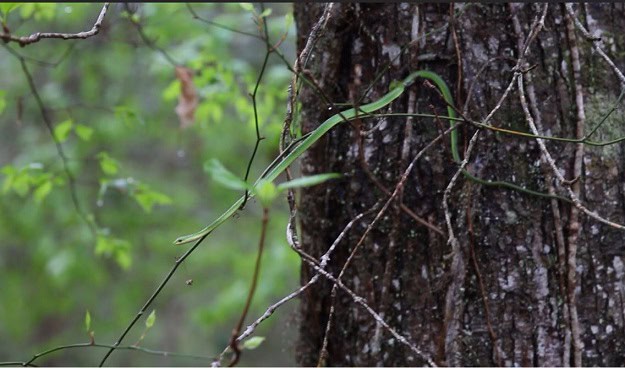
Maximum length: 116cm.
The rough green snake is the southeastern equivalent of its northeastern cousin, and it’s no surprise that this species also eats plenty of spiders. The two are the only members of their Opheodrys genus, and share many similarities, including a green colour and slightly venomous bite. One of the few differences is that rough green snakes are superior tree climbers, often reaching 10 metres high, and tend to appear on the outskirts of forests more than their cousin.
Their diet, meanwhile, is very similar. A 1981 study found that over 85% of their diet consisted of spiders, grasshoppers, caterpillars, crickets and odonates (dragonflies, damselflies, etc). Overall, spiders formed 24.6% of their diet, versus 40.6% for grasshoppers.
There was even a breakdown by type, as 54% of spiders eaten were hunting spiders, while 46% were web-spinners. Like its cousin, rough green snakes are mildly venomous, with virtually no effect on humans, but are more than capable of killing small grubs, and scuttling creatures with eight legs.
Rough green snakes are found in Florida, Georgia, South Carolina, Alabama, Mississippi, Texas and more, even reaching the northern reaches of Mexico. Any hyper-green snake in Florida or Georgia is guaranteed to be this species, as on the east coast, the smooth green snake only reaches as far south as Virginia.