
| 1 | Emerald snake |
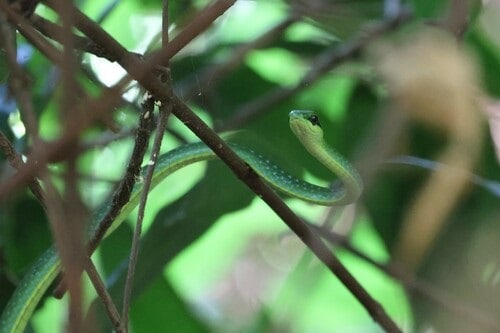
Maximum length: 119.1cm.
A completely harmless snake which often invades gardens, resting on bushes using its light, thin body. Emerald snakes (Hapsidophrys smaragdina) are widespread in central and west Africa, ranging from Gambia, through the Congo rainforest to Uganda, which lies at the eastern extent of its range. This species measures 60-110cm, and lacks any venom that scientists know about. Its hunting strategy is to move slowly through thick vegetation, searching carefully for the bounty of lizards and frogs that lies hidden within.
While green from a distance, emerald snakes have vivid blue visible between each scale. These scales are strongly keeled to touch, though it’s highly unlikely that you’ll get close enough to do so. Emerald snakes have a long tail for extra nimbleness in tree branches, at 33% of their total body length. They also climb manmade structures like metal fences.
The Hapsidophrys genus has 3 members, with just two on mainland Africa. Emerald snakes are overwhelmingly the most common, while Hapsidophrys lineatus has more detailed black patterns, and also inhabits Uganda and the Congo region, but is far more rarely sighted. The final is the Principe green snake (Hapsidophrys principis), found exclusively on the island of Principe off the coast of São Tomé.
| 2 | Butterfly viper |
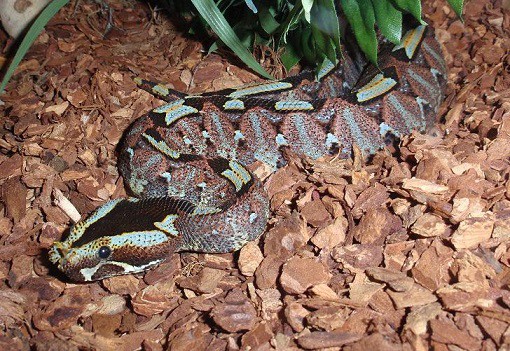
Maximum length: 120cm.
One of the most fantastical looking vipers on Earth. This is a relative of the gaboon adder (Bitis gabonica), which has the same expert camouflage and lazy lifestyle, but takes its colours much further, like a fantastical fungi growing on a tree stump. Then there’s the savage horns sprouting above each eye, and sharply keeled body scales.
Butterfly vipers (Bitis nasicornis) are an abundant species in Uganda, and have a particularly thick and crushing body. The English once dubbed them “river jack”, as they’re commonly found along rivers. Compared to their puff adder relative, which inflicts the most snakebite deaths in the African continent, butterfly vipers are relatively calm. Bites are few and far between. However, a captive butterfly viper inflicted one confirmed death in Dayton, Ohio in 2003.
One 30 year old keeper in Budapest was bitten by a butterfly viper measuring 90-100cm. He arrived at hospital within 1 hour, at which point his symptoms included moderately swollen and tense fingers, slight hypertension, a slight discolouration near the bite mark, and moderate coagulopathy (blood clotting disruption). He recovered with no lasting consequences, without even taking antivenom.
This keeper probably got off lightly, as butterfly vipers are capable of injecting 200mg of venom per bite. One mistake local Africans make with Bitis vipers is applying a tourniquet, which actually compresses the venom into a certain location, allowing the necrosis to worsen.
| 3 | Uganda house snake |
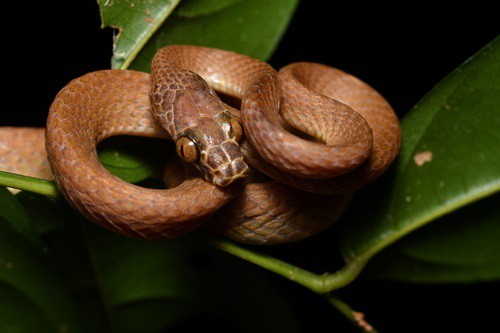
Maximum length: 87.5cm.
In sub-Saharan Africa, there’s a huge group of house snakes called Boaedon with 22 members, which includes the cape house snake, a popular captive pet worldwide. But the Uganda house snake is a weird offshoot, which is the sole member of the Hormonotus genus (Hormonotus modestus). This snake is a toffee brown colour, with vertical pupils and especially bulging eyes. While it has a large empire, spanning Guinea in the extreme west to Kenya in the extreme east, its sightings are very scattered (map).
Uganda house snakes are found on forest floors, where they prefer to lurk out of sight amidst fallen debris. They eat small mammals and lizards, and the record length so far is 87.5cm. There’s vast blank gaps in the research for the Uganda house snake, but it’s rare to find this species away from forests, including the Congo rainforest and more isolated forest remnants.
This snake has few patterns, just a consistent brown, though yellow ones are occasionally spotted. A bulky head relative to the neck/body is a consistent ID sign, and a cracked pattern of scales on its head, as you can see above.
| 4 | Great Lakes bush viper |
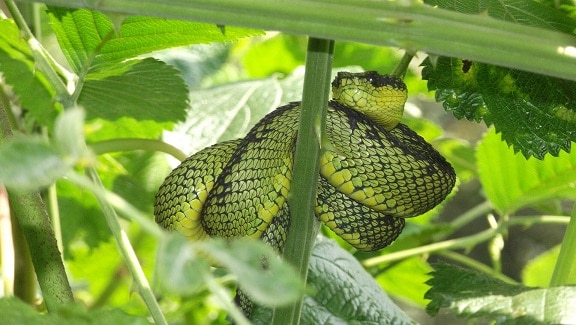
Maximum length: 75cm
A venomous snake which clings to tree branches, which probably won’t kill, but could leave lasting deformities. While common in certain places, Great Lakes bush vipers (Atheris nitschei) aren’t encountered often by humans, as they inhabit regions at 1600-2800 metres above sea level. This viper has a narrow range, including southwest Uganda, Rwanda over the southern border, Burundi, and far eastern DRC.
Atheris nitschei begins life as a dull brown or greyish colour, with a bright tail tip for luring prey. In adulthood, they bloom into full jungle green shades. This is an arboreal snake which is always found in trees, tall elephant grass, or bushes, typically 1-3 metres above ground. Its diet consists of chameleons which it scoops out of trees, as well as small mammals and lizards.
There’s no dedicated antivenom manufactured for this viper. A 2013 report detailed a 30 year old man bitten on his left hand. Swelling rapidly kicked in, as did bleeding from his gums, which lasted for 12 hours post admission to hospital. Blood analysis revealed deficiencies in fibrinogen, delayed clotting and anaemia. Another victim was bitten on the index finger, and experienced swelling spreading all the way to his chest and neck.
| 5 | Large-eyed green treesnake |
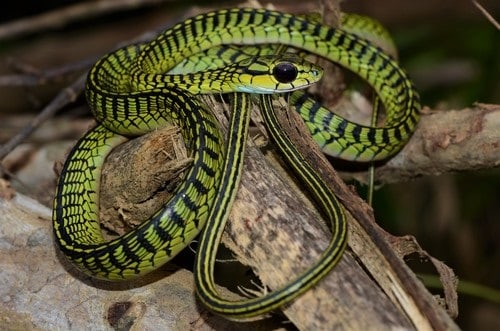
Maximum length: 150cm.
This snake is easily recognisable by its large eyes, and juicy green scales overlaid with dense black lines and patterns. Large-eyed green tree snakes possess a mild venom, which is likely no threat to humans. They inhabit Uganda to the east, Angola to the south, Ghana to the west, and everywhere between, requiring areas with standing trees to survive.
Like other African tree snakes, this snake can inflate its throat to intimidate predators and make them think twice, and to particularly extreme levels. Many large-eyed green tree snakes (Rhamnophis aethiopissa) have electric blue patches on their throats as well. This species has a varied diet, but eats mammals only occasionally. Confirmed prey include rainbow agamas and banded leaf-toed geckos, amphibians such as forest treefrogs and Angolan reed frogs, and birds such as fantail warblers and green crombecs.
Large-eyed tree snakes are able to hunt while weaving across low branches, maintaining their balance and going in for the kill. However, they don’t stick to trees exclusively, as they’re sometimes found killed on roads. At the tail, the messy black patterns switch to consistent parallel stripes. Rhamnophis aethiopissa nearly always has a black stripe running through its eye, starting at the snout and ending at the neck.
The Rhamnophis snake genus contains two members, the second being the rarer Rhamnophis batesii found in Gabon and the Congo.
| 6 | Jameson’s mamba |
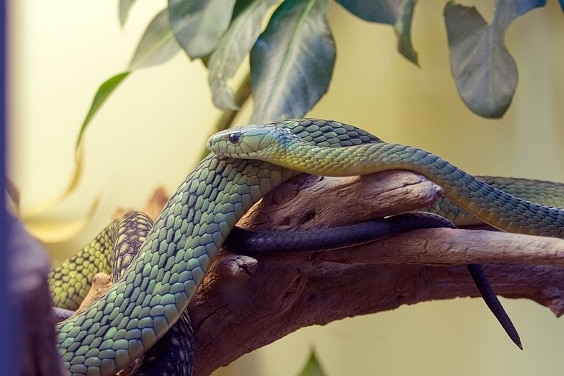
Maximum length: 255cm.
The green mamba and black mamba are famous because they’re two sides of the same coin. Both have a lethal neurotoxic venom, but one is green, the other black. One sticks to trees, the other rolling savannah. Inbetween, you have a less famous member of the clan: Jameson’s mamba (Dendroaspis jamesonii). This is another tree-dwelling mamba, which still strays to the ground regularly. It measures 1.5-2.2 metres, and sticks to forested areas of Uganda.
Jameson’s mamba has a large range, stretching from Nigeria to Kenya, but those in Uganda are a specific subspecies: Dendroaspis jamesoni kaimosae. This has a venom twice as potent as the subspecies in western Africa (D. jamesoni jamesoni). Its bite is heavily neurotoxic, and while slightly less deadly than the black mamba, there’s a report of one child dying within 30 minutes, and other deaths within 3-4 hours. Uganda and Kenya are the hotspot of this eastern subspecies, and 80% of its toxin mixture consists of three-finger toxins (3FTx).
The diet of Jameson’s mamba primarily consists of birds, including the red-eyed dove, and mammals, including Zenker’s fruit bat. Younglings occasionally eat lizards and amphibians, but at over 100cm, warm-blooded prey fully takes over.
Jameson’s mamba has a strong bias towards arboreal (tree-dwelling) meals. While green overall, you can recognise Jameson’s mamba by a darker tail of oil spill blue.
| 7 | Collared snake-eater |
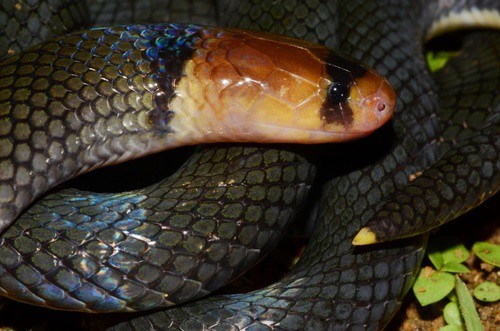
Maximum length: 65cm.
A quiet snake found only in forests, which averages at 40-70cm. The collared snake-eater has small black eyes, and is believed to prey exclusively on blind snakes, particularly those of the Afrotyphlops group.
Collared snake-eaters (Polemon collaris) have an extremely short tail, at just 4-5% of their total length. This tapers into a spike, believed to be for poking predators in self defence. Their body is almost completely black, until the neck begins. This contrasts against a pale white belly, which usually has no patterns.
Polemon collaris has shiny scales which are smooth to touch. Its head is indistinct from its neck, carrying on like a tube. This is a fairly widespread snake, inhabiting Uganda, Zambia and the Congo alike, anywhere where an abundance of tropical and subtropical rainforest remains standing. But they’re seen relatively rarely, due to their shyness and love for rummaging around in forest leaf litter all day.
Because of this elusiveness, collared snake eaters are likely more abundant than anyone realises. This slow-moving snake is nocturnal, and usually found below 1200 metres.
| 8 | Diamondback night stalker |
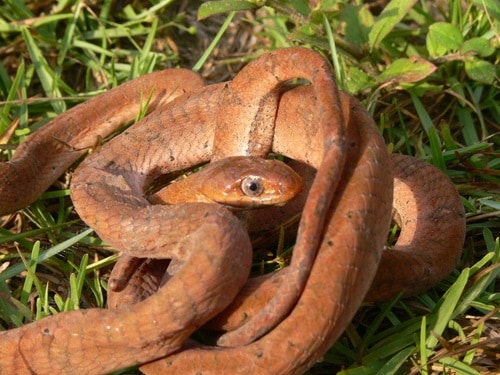
Maximum length: 122.5cm.
Part of the 4 member Toxicodryas genus, all of which cling to branches for most of the 24 hour day, and most of the 12 month year. This slightly venomous species ranges from Niger in the far west to a chunk of Uganda in the east.
The diamondback night stalker (Toxicodyras adamanteus) has an average length of 80-120cm, and appears in forests, woodlands, and savannahs interspersed with tree clumps. Some trees are essential, as Toxicodyras adamanteus never appears in bare hills or grassland. As their savagely vertical pupils hint, this is a nocturnal snake, which climbs its trees slowly and carefully. During the day, eagle-eyed forest explorers can find them curled up in tree hollows, empty birds’ nests, natural joins in branches, or tangles of epiphytes growing on trees.
This species has a red tongue tipped with white. “Adamanteus” is a Latin term for diamond-shaped markings, referring to its patterns. This is the same as the eastern diamondback rattlesnake, AKA Crotalus adamanteus. Diamondback night stalkers are non-lethal, but also non-cowardly. When threatened, they hiss loudly and make repeated mock strikes, or suck in air and inflate their chest.
Originally, this was part of a far-reaching African species: the powdered cat-eyed snake (Toxioydras pulverulenta). The two are similar in appearance, but in 2021, analysis revealed that those east of the Niger River Delta, which forms a natural barrier against migration, were actually an independent species: Toxicodryas adamanteus. To the west, they remained Toxicodyras pulverulenta.
| 9 | Grey beaked snake |
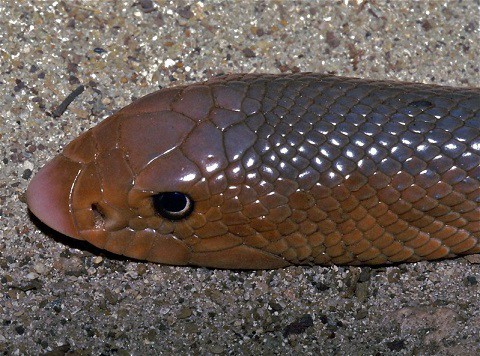
Maximum length: 151.2cm.
A gold-black snake with small, round eyes, and an unusually sharp snout, which is probably used for shifting soil aside in burrows. The grey beaked snake (Scaphiophis albopunctatus) ranges from Kenya and Tanzania to Sierra Leone in the far west, and is part of a small, 2-member genus, the other member being the Ethiopian beaked snake.
This is a snake occasionally of rainforests, but usually open savannah, bushland, thickets and miombo woodlands. The largest male on record measured 115.5cm, collected in Shinyanga District, Tanzania. The largest female measured 151.2cm, collected in Upper Nile Province, Sudan.
The grey beaked snake has an elaborate intimidation tactic. They begin by showing off their deep blue tongue and inside of mouth. Then they launch themselves into the air in a savage strike, with enough force that most of their body leaves the ground.
Their hunting strategies are even more brutal. To acquire fresh calories, grey beaked snakes invade mice burrows and pin them against the wall, suffocating them without actually constricting. They’re also known to take refuge in vacant ground squirrel burrows for shelter. So far, most of this species’ prey observations are of rats or mice. One 38.4cm snake had 4 newborn rats in its stomach.
| 10 | Variable burrowing asp |
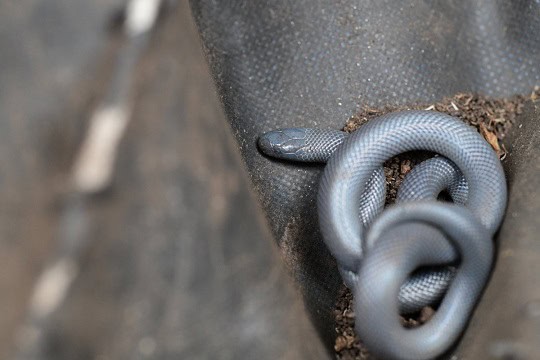
Maximum length: 66cm.
A dangerously neurotoxic species which rarely bites, but is proven to be capable of ending human life. The variable burrowing asp (Atractaspis irregularis) is a creature of forests, woodlands, and moist grassy areas, rather than dry plains. Their diet includes a mixture of lizards and small rodents.
This species is found in central and eastern Africa rather than the south. Variable burrowing asps can show up in Kenya, Uganda, Rwanda, DRC, Tanzania and Ethiopia. They do vary in appearance, as this species can be either black or lighter grey, but they can never be described as colourful. Their hotspots in Uganda include the northwest shores of Lake Victoria and most of the shores of Lake Kyoga.
All Atractaspis species are deadly, but they usually stay well away from humans due to their burrowing lifestyle. Of the 15 members, the variable burrowing asp is one of the few to have caused confirmed deaths. The first victim was a small child, while the second was a grown man who was bitten 8 times, after the snake became trapped in his bedding. In both cases, death occurred within hours, and the first symptoms within minutes.
As ever, our advice is to never pick up any shiny black snakes in Africa, even though there are several harmless alternatives like blind thread snakes and purple glossed snakes.
| 11 | Hairy bush viper |
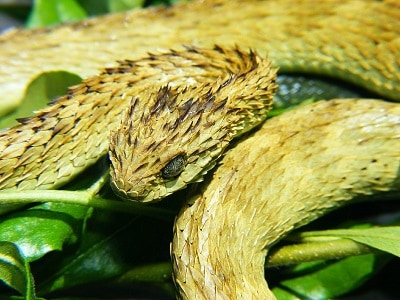
Maximum length: 73.5cm.
The pineapple king among snakes. The hairy bush viper (Atheris hispida) is one of the more bizarre snakes on Planet Earth. There’s plenty of snakes worldwide that have sharpened, elongated scales, but this species takes it to a whole new level. The hairy bush viper looks like your hand would start bleeding if you touched it, and there’s still no conclusive reason as to why these jagged scales evolved.
The hairy bush viper is a rare species, which is extremely difficult to track down. They appear in just 4 confirmed countries: Uganda, Kenya, Tanzania and DRC, and only a few forests in each. Hairy bush vipers cause very few bites in humans, but their venom is believed to be unusually neurotoxic for a viper.
This species varies by gender, as males tend to be olive-greenish, while females are a brighter yellow-olive, still with a few green tinges. The image above is most likely a female (although we doubt anyone got close enough to check).
Hairy bush vipers spend almost all their lives in vegetation, whether in low bushes or higher tree branches. Their diet is also poorly researched, but they’ve been witnessed swallowing rodents and Hyperolius reed frogs, which they assault while still attached to a branch.
This species belongs to the same Atheris genus as the Great Lakes bush viper, but is easily distinguishable, as the latter’s scales are significantly smoother.
| 12 | Brown house snake |
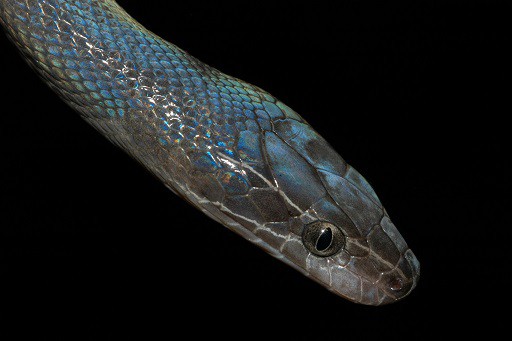
Maximum length: 120cm.
A non-venomous snake which averages at 40-70cm long. A consistent brown-grey colour is a hallmark of the brown house snake (Boaedon fuliginosus). This species is a member of the 22-member Boaedon house snake genus, and has extremely flexible habitats, appearing in forests, woodlands and savannah alike.
Like the cape house snake of South Africa, this is one of most tolerant snakes in Uganda of urban environments, appearing in gardens, and polluted areas where no snake should be able to survive. Some herpetologists consider the brown house snake to be the most common snake in East Africa. They even enter houses in their constant search for rodents. As a nocturnal snake, they prefer to lurk under cover objects during the day, such as rocks, but also assorted junk in your backyard, causing villagers to accidentally step on them.
This species is recognisable by bulging eyes with a vertical pupil, and an eye colour identical to its scales. Boaedon fuliginosus is an extremely widespread snake, whose territory spans thousands of miles. They range from Morocco in northwest Africa to Mozambique in the southeast, with Uganda lying in the centre.
However, it’s believed that Boaedon fuliginosus actually contains 7 species or more, which are “cryptic” species; i.e. they’re virtually indistinguishable to the naked eye, yet may have diverged millions of years ago. For now, those in Uganda are still classified as B. fuliginosus.