
| 1 | Crowned false boa |
Maximum length: 109cm.
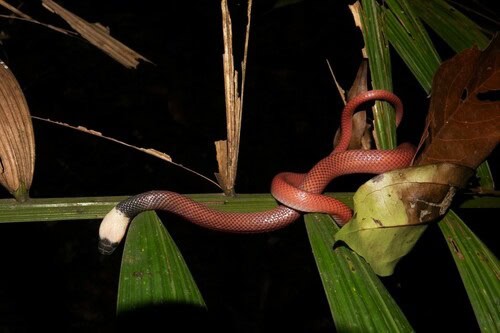
An easily recognisable species, which is common not just in Peru, but the wider Amazon region. The crowned false boa (Pseudoboa coronata) has never killed a human on record, and tends to thrash wildly and wrap tightly around your hand when picked up.
This snake has one feature which allows it to survive in Peru’s swarming jungles: flexibility. Crowned false boas inhabit rainforests, but are also comfortable in disturbed forests and rural gardens. They’re active during both day and night. They’re not restricted to one food type which they might be outcompeted for, as they can prey on lizards, mammals, swamp eels, and fellow snakes alike. Confirmed prey of the crowned false boa include giant ameivas, black-headed centipede snakes, and Cuzco tegus.
Crowned false boas spend most of their time on the ground, amid small rainforest shrubs and rotting logs covered in moss. They also climb onto low branches on occasion, if subtle scent trails lead them upwards.
This species begins life as a bright reddish-pink, before becoming purely red in adulthood, with a vividly black head and white neck collar. Crowned false boas are regarded as only mildly venomous, capable of disabling their lizard prey, but mainly bouncing off humans. However, their Costa Rican cousin Neuwied’s false boa (Pseudoboa neuwiedi) turned out to be surprisingly dangerous in a 2018 study, with proteolytic qualities nearly matching a Bothrops pitviper. Therefore, if there’s any Peruvian snake which could be secretly deadlier than anyone realises, it’s the crowned false boa.
| 2 | Esmarald racer |

Maximum length: 126.8cm.
A strictly forest-dwelling species. The esmarald racer (Drymobius rhombifer) is found across the vast majority of Peru, from north to south. This doesn’t necessarily mean that you’ll get to see them, as esmarald racers stick to the hearts of forests, only occasionally straying to their edges. Here, they generally move across the forest floor, travelling by day, across a thick bed of leaf litter and jungle foliage. At night, they climb up to 2 metres high to rest, but this species is barely a tree snake at all.
Esmarald racers pose little threat to human beings. Their diet consists of reptiles and amphibians, and their own predators include the slate-coloured hawk, a grey-blue species native to the Amazon rainforest.
The esmarald racer has patterns somewhat similar to a viper, but it’s easy to avoid getting confused. Firstly, this species has round pupils rather than vertical, and these pupils are easier to see than normal because their eyes are large overall. Secondly, this species has no dark stripe extending backwards from its eye, like most Bothrops lancehead members.
If an esmarald racer stunned you by appearing in your car passenger seat one day, then you’d have nothing to fear, but there’s little chance that one will.
| 3 | Desert lancehead |
Maximum length: 60cm.
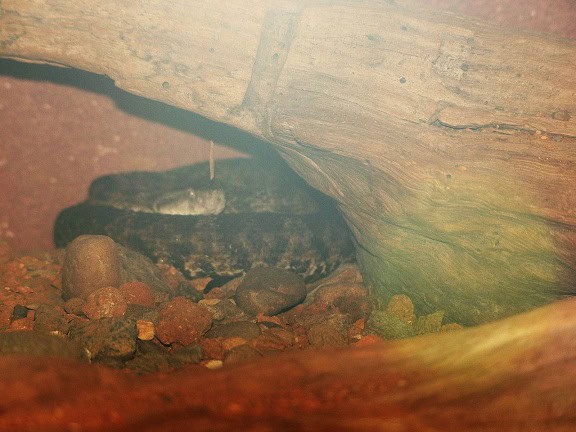
Peru isn’t all swarming jungles, as there’s a large arid zone to the west of the Andes. One of the venomous species you’ll find here is the desert lancehead (Bothrops pictus), part of the 48 member Bothrops genus which includes the infamous fer-de-lance. Desert lanceheads inhabit Peru exclusively, in a large territory stretching down the Pacific coast, up to altitudes of 1800 metres in the western Andes foothills.
Desert lanceheads are found on arid slopes, rocky river valleys and desert areas with plenty of thickets. Despite being a lethal pitviper, they’re confirmed to be preyed on by black-chested buzzard eagles, and must take great care to disguise themselves.
A study from 1990 to 1998 involved 23 bite victims admitted to Cayetano Hospital, and found that swelling, bruising and blistering were the most common symptoms. One patient suffered kidney injury, but none died, with 75% receiving antivenom.
Bothrops pictus has a strongly anticoagulant venom. A 1988 study on dogs found a 40% reduction in fibrinogen, the backbone of healthy blood clotting. Its venom contains a rare enzyme called pictobin, and another new toxin was discovered in 2023 – Pictolysin-III. This cleaved through fibrinogen, and even targeted the mitochondrial core of cells. That sounds horrific, but the scientists deemed the toxin to be promising for cancer treatment.
| 4 | Bate’s tree boa |
Maximum length: 194.5cm.
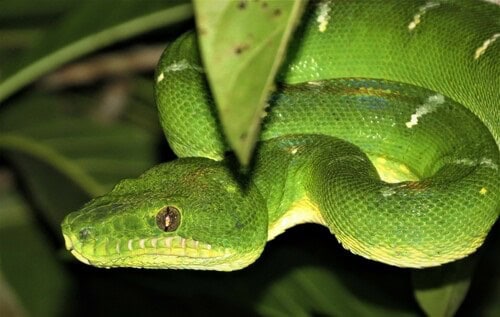
This large boa spends virtually all of its life on tree branches, only straying to the ground in extreme circumstances. This a close relative of the emerald tree boa (Corallus caninus), a very similar species which inhabits northern Brazil, Suriname and Guyana. Bate’s tree boas inhabit a swathe of the Amazon further south, including Peru on the eastern slopes of the Andes.
Bate’s tree boas (Corallus batesii) prey mainly on rodents, which they explode towards in a sudden lunge that contradicts their normally sluggish appearance. Despite being non-venomous, Bate’s tree boas have fangs close to 2 inches long, which they use to hook onto prey, before applying their inescapable coils.
Rainforests are the best place to find this species in Peru; you won’t find them in a hotel garden. Originally, the emerald tree boa was a giant species covering the whole Amazon. Bate’s tree boa was only officially born in 2009, after a genetic difference of 3.1-16.2% was found between the northern and southern populations.
At first glance, they look identical, but there’s several subtle differences. Compared to the emerald tree boa further north, Bate’s tree boa has an increased number of scales on the snout. They sometimes have fused white blotches which form a consistent stripe, which the emerald tree boa never has. Finally, they have a mean of 18.1 (0-38) smudged dark blotches on their sides, while the emerald tree boa has far fewer, at a mean of just 1.3 (0-11).
| 5 | William’s tree snake |
Maximum length: 71.8cm.
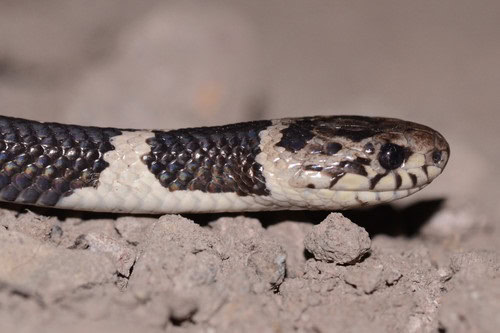
This black and white snake lives to the west of the Andes, and is endemic to Peru, occurring nowhere else. This species is easily recognizable, as it has no colours on its body other than sharply contrasting domino shades.
William’s tree snake (Dipsas williamsi) is most commonly found in dry shrublands, sometimes near well populated towns. It’s mainly found in Lima and Ancash departments, and has a huge elevational range, occurring from sea level up to 2990 metres, and possibly 3626 metres, a larger range than almost any other Dipsas member. At higher elevations, it appears in dry steppe bushland, which is above the fog line from the Pacific ocean, and hence receives less moisture than areas lower down.
This is a fairly small snake (though not tiny), as the largest female ever measured 71.8cm, and the largest male 56.3cm. With a compressed body, William’s tree snakes are believed to be semi-arboreal, perhaps climbing up bushes and resting on their thin fingers of branches.
William’s tree snake was originally part of the Sibonymorphus genus, which ceased to exist when all its members were transferred to the preexisting Dipsas group (which now has over 30 members). Another member in western Peru is Dipsas vagrans, but this is less vividly black and white, with numerous brown tinges. Little is known about this species’ diet, as in the one study conducted, the remains were too heavily digested.
| 6 | Andean pitviper |
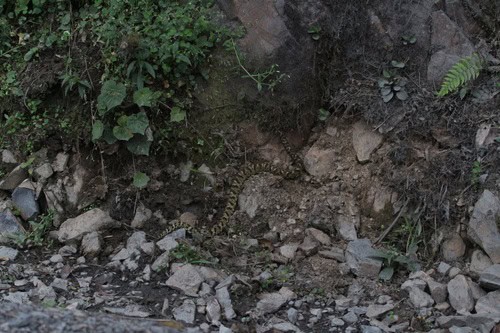
Maximum length: 125.8cm.
Have you ever considered visiting Machu Pichu? There’s been controversy lately over indigenous people blocking the tourist paths, accusing visitors of disrespecting the land, but even if you are granted access, there’s another obstacle to contend with: the Andean lancehead (Bothrocophis andianus). This is confirmed to dwell in the forested outskirts of the ancient historic site.
As the name suggests, Andean pitvipers exclusively inhabit the western slopes of the Andes, at elevations of 1800-3300 metres (Machu Pichu lies at 2430m). They range from southern Peru, through a large stretch of southwest Bolivia, hugging the mountains closely.
Bothrocophias andianus is virtually never found away from forests. According to a 2019 study, it especially favours the darkest, most humid and overgrown forests, while its pitviper neighbor Bothrops monsignifer preferred more open and sunny forests.
Andean pitvipers are mainly nocturnal, though they travel during the day occasionally. They may block your hiking trail, or they may coil up tightly within a hollow log while you walk past unknowingly a few feet away. While they mainly stick to the ground, they’ve also been spotted coiled up on tree trunks 3 metres high.
A 2012 study on mice found typical viper symptoms, including haemorrhaging and swelling, but equal lethality to the infamous common lancehead. Your options are to either jump over the Andean pitviper, or give up and turn back (number 2 is wisest).
| 7 | Striped sharpnose snake |
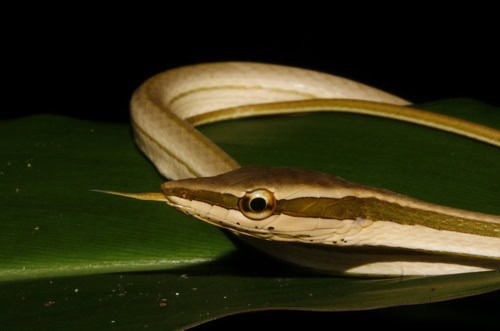
Maximum length: 133.5cm.
Part of the two member Xenoxybelis genus. This forest species is closely related to the southern sharpnose snake of Bolivia, but is easily the more common of the two.
Striped sharpnose snakes inhabit Peru to the east of the Andes, and are also found in eastern Ecuador and a swathe of Amazonian northwest Brazil. This is a greenish, branch-dwelling snake like several of its neighbours, but is easy to distinguish.
The first ID sign is the unusually pointed nose and face. Second is the sharply contrasting grey-green parallel stripes on its body, with the grey often exceeding the green. Their tongue and eyes are also green, with a round pupil.
This species is active by day, and its favoured hunting method is to dangle from a branch with its body fastened, to snag prey from the forest floor. A 2019 study concluded that sharpnose snakes have a positive correlation with tree cover, preferring dense, closed canopy forests rather than human-altered disturbed forests with piles of logs lying around.
To find the striped sharpnose snake, you must battle into the most untouched forests of Peru. This species is equipped with venom, but its exact effects in humans are a mystery.
| 8 | Peru slender snake |
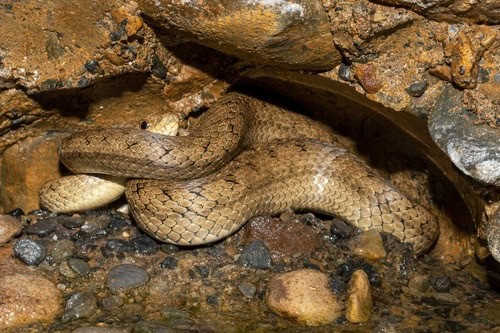
Maximum length: 60-65cm.
The third species of our list to inhabit western Peru. The Peruvian slender snake (Tachymenis peruviana) lives exclusively to the west of the Andes in the dry zone, where sightings are abundant. They’re also found in Chile to the south, where they’re one of just 7 snake species.
Peruvian slender snakes are found down to 1800 metres, but also as high as 4400m, making them one of the highest altitude snakes in the Americas. They have several strategies for survival at this altitude, such as constantly sunning themselves on bare slopes to increase their bodily heat reserves.
Their habitats include open areas like high altitude grassland and shrubland, and the thickly vegetated shores of marshes at lower altitudes. This species lords it over the Bothrops pitvipers in the rainforests below, and may just win a battle with them. They were long assumed to be non-venomous, but at least one human fatality has occurred from a Peruvian slender snake bite. This is one of the easiest Peruvian snakes to underestimate.
Peruvian slender snakes feed on frogs or lizards, depending on location. If their home base is a near a stream, then frogs will dominate. If they reside on rocky mountain slopes, then lizards will rule. Peruvian slender snake are small, averaging at just 40cm.
| 9 | South American elegant racer |
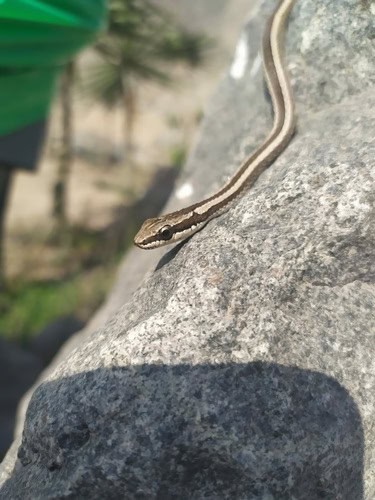
Maximum length: 77cm.
Another western Peruvian species, which just crosses the border into northern Chile, and southern Ecuador to the north. The South American elegant racer (Pseudalsophis elegans) is the only member of the 10-member Pseudalsophis genus not to inhabit the Galapagos islands. Instead, they inhabit arid coastal regions, where they prey on lizards such as the Peru desert tegu (Dicrodon guttulatum).
South American elegant racers are also found in dry woodland and dry savannah areas. They stick to the ground rather than tree branches, and move by day rather than night.
Like the desert lancehead, they’re confirmed prey for the black-chested buzzard eagle. In fact, this bird was once seen hunting a desert lancehead just 4 minutes after swallowing an elegant racer, while perched on a tara tree. Being more arid and open than the jungled east, the snakes of western Peru may have more to fear from swooping birds overhead.
South American elegant racers also feed on Pacific iguanas (Microlophus genus), like their Galapagos Island cousins. This snake often hides in rock crevices, and has large eyes, covering almost half the width of its head. Pseudalsophis elegans is non-venomous, and reaches a maximum of 77cm.
| 10 | Langsdorff’s coral snake |
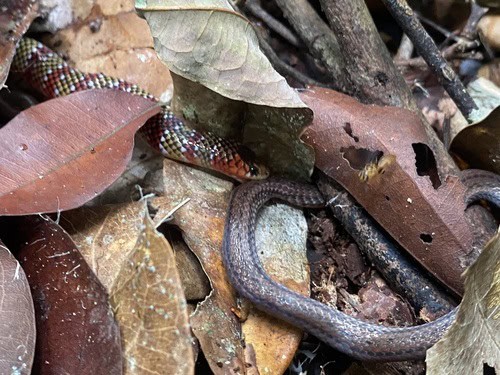
Maximum length: 72cm.
One of the most poorly researched coral snakes in the entire Micrurus genus, across all its 82 members. Langsdorrf’s coral snakes (Micrurus langsdorffi) are only found in the deepest, most inaccessible rainforests. They’re particularly common in northern Peru, adjacent Ecuador and extreme western Brazil, though they’re never regularly encountered.
In appearance, this species is easily one of the most unusual coral snakes. It appears in various strange morphs, including maroon-white, red-yellow-white, and tan-white-pink. Others have more black choking out the red. Depending on the morph, Langsdorff’s coral snake has a strong tendency to grow blacker with age (ontogenetic melanism).
This is a small coral snake, with a maximum so far of 72cm, although longer ones are likely. This snake is barely researched at all. So far, the two prey items recorded in its diet have been fellow snakes, similarly to other coral snakes. The photo above also shows it eating an unidentified snake.
Langsdorff’s coral snake has smooth, glossy scales with round eyes. Coral snakes are best known for their neurotoxic venom, but there’s zero data for Langsdorff’s coral snake. Some of its morphs are truly fantastical. See here, here and here to witness the huge variety.
| 11 | Tschudi’s false coral snake |
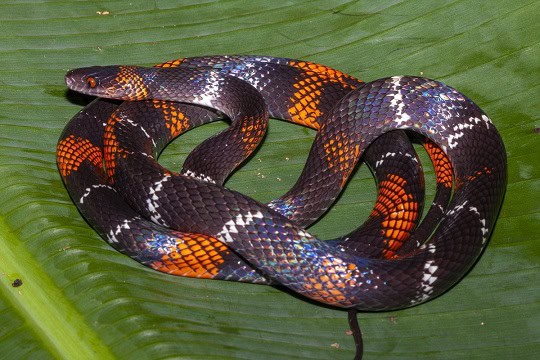
Maximum length: 101.8cm.
A diehard jungle snake, which is found across all of eastern Peru until the Andes mountains begin their steep ascent. This is a non-venomous species which never attacks human beings, even if picked up and manhandled. The most they do is thrash around wildly in your hand and vibrate their tail.
Tschudi’s false coral snake (Oxyrhopus melanogenys) is a highly variable snake in appearance. A large portion have fully red bodies with a black head. Others, including the individual above, mimic the patterns of coral snakes in order to gain a safety shield. Another percentage even have one of the rarest features among snakes: blood red eyes.
This species preys on a mixture of mammals and reptiles, such as spectacled lizards and the glossy shade lizard. They climb vegetation occasionally, but mainly stick to the ground, often resting on thick leaf litter beds.
Tschudi’s false coral snake has a strange hunting method, which was first observed in 2013. After constricting a large mouse to death, the snake struggled to force its meal down. So instead, it applied a new set of tight coils, and squeezed the mouse’s body hard, compressing its meal in order to make it easier to swallow. Consequently, this Peruvian snake can swallow unusually large meals, at over 70% of its own body weight.
| 12 | Common lancehead |
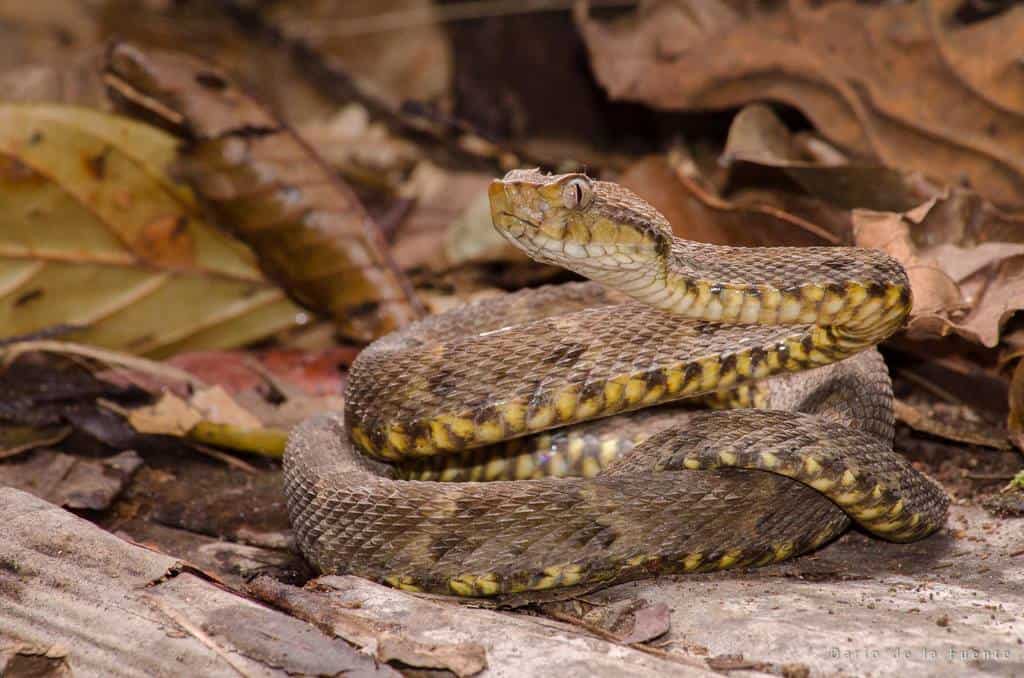
Maximum length: 172.3cm.
The main cause of venomous snakebite in Peru. In fact, this infamous pitviper is the main cause of venomous snakebite in virtually every country it occupies.
Common lanceheads (Bothrops atrox) are the most widespread pitviper in South America, and in Peru, they’re found everywhere east of the Andes mountain range. They appear in untouched rainforests, regenerating forests, and drier forest, but most importantly, this species is comfortable in manmade habitats. They regularly enter villages and take up residence in cocoa and coffee plantations, terrorising the workers there, not least because of their exceptional camouflage.
According to a 1984-1991 study from hospitals in the Peruvian city of Pucallpa, common lanceheads were responsible for 87.6% of venomous snakebites. In second place was Bothrops bilineatus (8.5%), the tree-dwelling pitviper, and the South American bushmaster (3.3%), which is the third longest venomous snake in the world, but relatively docile.
Common lanceheads don’t hesitate to launch themselves at human beings. Each bite can inject 200mg of venom. While lacking in neurotoxins, they possess extremely powerful haemotoxins and cytotoxins, which assault the kidneys and trigger rapid spontaneous bleeding.
| 13 | Short-nosed ground snake |

Maximum length: 47.6cm.
A totally harmless species. This short, grey species ranges from Ecuador in the west to central Brazil in the east, and is a common presence in the lowland rainforests of Peru.
The short-nosed ground snake (Taeniophallus brevirostris) is the king of Peruvian leaf litter, or perhaps the prince. Its colour is optimised not for living leaves on trees, but old, decaying leaves covering the forest floor.
Short-nosed ground snakes bury themselves in these leaves with ease, where they also find themselves tasty rainforest meals. The majority of their prey consists of small leaf litter reptiles, including Coleodactylus geckos and skink tegus (Leposoma). They prey on frogs as well, and insect remains have been found in their stomach, but these are believed to have been ingested second-hand via their frog prey.
This species seems to reproduce slowly, as most females captured so far have contained just two or three eggs. A common lancehead can give birth to 40 newborns at once.
Short-nosed ground snakes only thrash around and discharge a foul smell when picked up, with no genuinely dangerous abilities. Their bodies are purely dull, without a hint of flashy green or blood red like Tschudi’s false coral snake. The one exception is an iridescent sheen they produce when exposed to light (see above).
| 14 | Yellow-tailed indigo snake |

Maximum length: 251cm.
A relative of the eastern indigo snake, which lurks in dark burrows in the eastern USA. The yellow-tailed indigo snake, or yellow-tailed cribo, ranges from Ecuador to Peru to French Guiana to far eastern Brazil. In Peru and Ecuador, they’re found exclusively to the east of the Andes, in forests and more open areas, where they stick to the ground rather than climbing trees, often lurking in underground burrows, where they also lay their eggs.
This species has an extremely varied diet. Confirmed prey include reptiles such as giant ameivas, poisonous Bufo toads, and fellow snakes such as the common lancehead (also native to Peru). Yellow-tailed indigo snakes regularly exceed 2 metres, and are particularly thick-bodied, as this is a constricting species rather than a venom injector.
The yellow-tailed indigo snake (Drymarchon corais) is one of the most recognisable large snakes in Peru. This species doesn’t just have a yellow tail, but a mostly black body which gradually darkens as the lower half approaches. Once the tail arrives, the body is fully yellow, but the change isn’t as sudden as the name implies. Their face is also mainly yellow.
A few individuals also have yellowish areas covering their entire bodies. Colours you won’t find on a yellow-tailed cribo include green, red, blue and pink. In the vast majority of individuals, black and yellow are the only colours.