
| 1 | Blotched-palm pitviper |
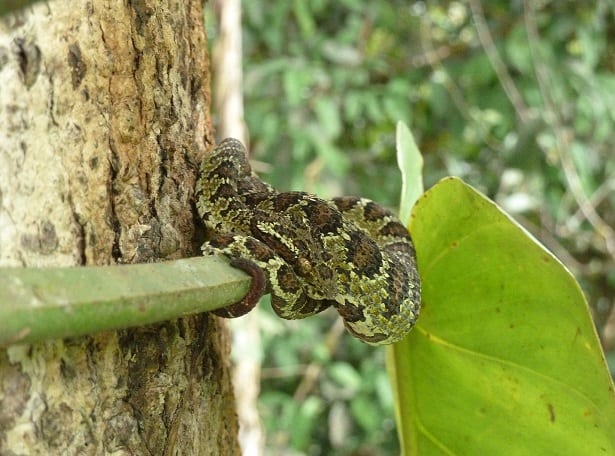
Maximum length: 58.3cm.
This dangerously venomous snake is found exclusively in Costa Rica, except for a tiny enclave in far western Panama. The blotched palm pitviper (Bothriechis supraciliaris) is based in the southwestern regions of Coto Brus and Valle del General, mainly at altitudes of 700-1800 metres.
Rather than lowlands, this is a snake of jungled hills well away from humanity. Blotched palm pitvipers prey heavily on rodents from the forest floor, and the vast majority of their toxins are engineered towards haemorrhaging rather than neurotoxicity, combined with moderate myotoxic (muscle-degrading) properties.
Blotched palm pitvipers reach an all-time record of 58.3cm, with females outstripping males in length. They vary from green to red, with large blotches that vary in shape from circular to rhomboid. There’s also a second morph which has encircling bands instead of blotches. This species is potentially deadly, yet bites are simple to treat with Costa Rica’s standard pitviper antivenom.
Until 1998, blotched palm pitvipers were considered to be a subspecies of the common eyelash viper (Bothriehis schlegelii). However, Bothriechis supraciliaris spends far more time on the ground, lives at higher altitudes, and has a minty-green morph with brown spinal blotches which is especially common. Bothriechis supraciliaris also has smooth colours between its blotches, whereas eyelash vipers are adorned with many fine dots and stripes.
This species is found in extreme western Panama, but is very rare there. They were only discovered in Panama in 2007, and since then there’s been just a handful of sightings.
| 2 | Costa Rican coral snake |
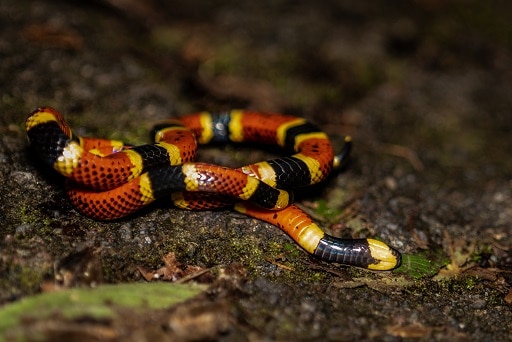
Maximum length: 100cm.
In the forests of Costa Rica, only three things are guaranteed: mist, bananas and coral snakes. Costa Rica has 5 coral snakes in total (out of 82 in the Americas overall), and the namesake species is found in the eastern half of the country, along the Caribbean coast. The Costa Rican coral snake (Micrurus mosquitensis) also spills over the borders slightly into Panama and Nicaragua, but is mainly based in Costa Rica itself.
This colourful species dwells on forest floors covered with fallen leaves and mulch, and has an insidious venom which could easily paralyse a fully grown man. The LD50 toxicity rating is 0.20-0.61mg, just matching the eastern coral snake of Florida (0.20mg).
One ingredient is a rare toxin called MitTx, which intensifies pain across the body, by activating acid-sensing ion channels. This can also cause seizures by blocking GABA receptors, the same brain receptors that alcohol targets to induce relaxation.
Costa Rican coral snakes aren’t even immune to their own venom. One youngling was left in a cage overnight for several weeks, until one morning it was found dead. It had bitten itself at a point 3.5cm behind the head, whether in suicide or an attempt at self-grooming gone horribly wrong. Like all coral snakes, this is a shy species which is in no rush to bite, as long as you don’t step on them.
| 3 | Costa Rica montane pitviper |
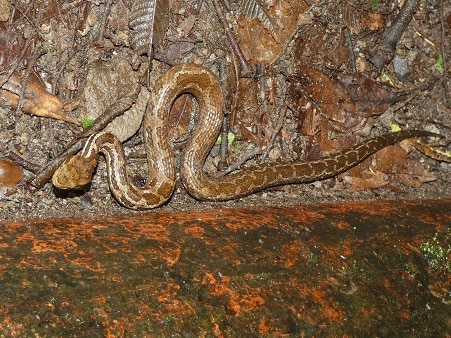
Maximum length: 71.3cm.
This venomous snake is found exclusively in mountainous areas of Costa Rica, at altitudes of 1460 to 2875 metres. They’re especially common in the Talamanca Cordillera range bordering Panama to the south. High altitude forests are their favourite, but they also inhabit open highlands controlled by mankind.
Rather than neurotoxic, Costa Rican montane pitvipers (Cerrophidion sasai) have a strongly anticoagulant venom. Bite victims can expect impaired blood clotting, and random spontaneous bleeding across the body, from the gums to tiny papercuts which suddenly spew copious amounts of blood.
Another claim to fame of this species is being difficult to treat with antivenom. Costa Rica’s main pitviper antivenom is made from 3 species: the fer-de-lance, central American bushmaster, and central American rattlesnake. According to a 2013 study, this worked decently against the rainforest hognose pitviper, as there was a large toxin crossover, but made far less impact against the Costa Rican montane pitviper. This snake has a relatively unique venom, branching off in deadly new directions from its Costa Rican neighbours.
This species was only made official in 2012, as its relative the Godman’s montane pitviper originally covered most of Central America. After fresh genetic analysis, this was split into several independent species, with Cerrophidion sasai taking over Costa Rica and Panama, and Wilson’s montane pitviper being handed Nicaragua and Honduras.
| 4 | Black forest racer |
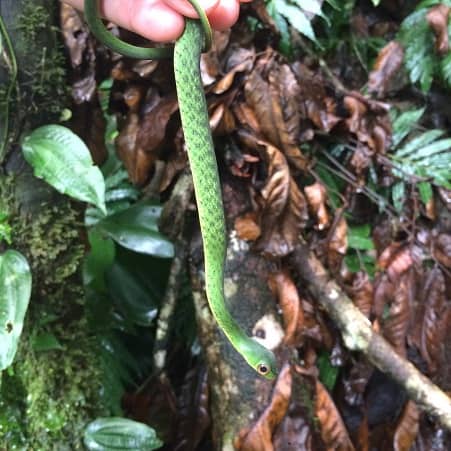
Maximum length: 130cm.
An energetic, fast-moving snake which hugs the Caribbean coast of northeast Costa Rica. The black forest racer (Drymobius melanotropis) is also found in Honduras and Nicaragua to the north, but is by far the most common in Costa Rica. This is a friendly-looking snake, which looks like it would warn you about the venomous snakes nearby if only you spoke its language. While they’re believed to have a mild rear-fanged venom, this snake poses no threat to humans whatsoever.
The black forest racer is highly dependent on frogs, to the extent that if the frogs in one area go extinct, the snakes will also disappear. Its other names include ranera and green frog-eater. Black forest racers are photographed only rarely, but in 2014, an image of one with two frog legs sticking out of its mouth shot to global headlines. Black forest racers can swallow a frog from head to toe in two minutes if pushed, and if they’re not satisfied, they’ll immediately move onto fresh frogs in the vicinity.
Drymobius melanotropis is a medium-sized snake, with a maximum length of 130cm. They have large eyes with a round pupil and brown iris, and their bodies vary in colour from bright green to brown, with the green versions sometimes having a parched brown face.
| 5 | Panamanian dwarf boa |
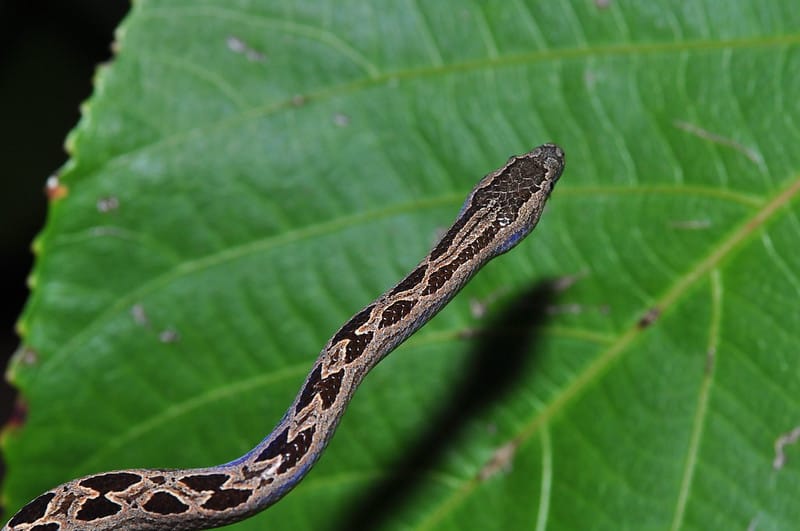
Maximum length: 48.2cm.
One of the most obscure boas on Earth, lying buried in deep corners of Costa Rican forests where humanity’s footprint is barely felt. The Panama dwarf boa (Ungaliophis panamensis) is a shy snake, which is almost never encountered by people.
This species also inhabits northwest Panama, but is most heavily concentrated in Costa Rica (despite the name). This snake is strongly nocturnal, and inhabits only the most remote forests, including lowland rainforests and high altitude cloudforests. The only human structures they enter are crop fields such as banana plantations, and isolated rural buildings within forests, where they sometimes stash themselves in roofs as an alternative to their tree trunks. This 40cm boa (max 48.2cm) has a strong tendency to lurk in tree hollows, where they peer out and watch fellow forest creatures traipse by.
Over 8 years, a series of 258 snake surveys were conducted in the Barra del Colorado Wildlife Refuge of northeast Costa Rica. The Panamanian dwarf boa was encountered just ten times. So far, their diet is confirmed to include bats, birds, and reptiles such as yellow-headed geckos.
| 6 | Black-speckled palm pitviper |
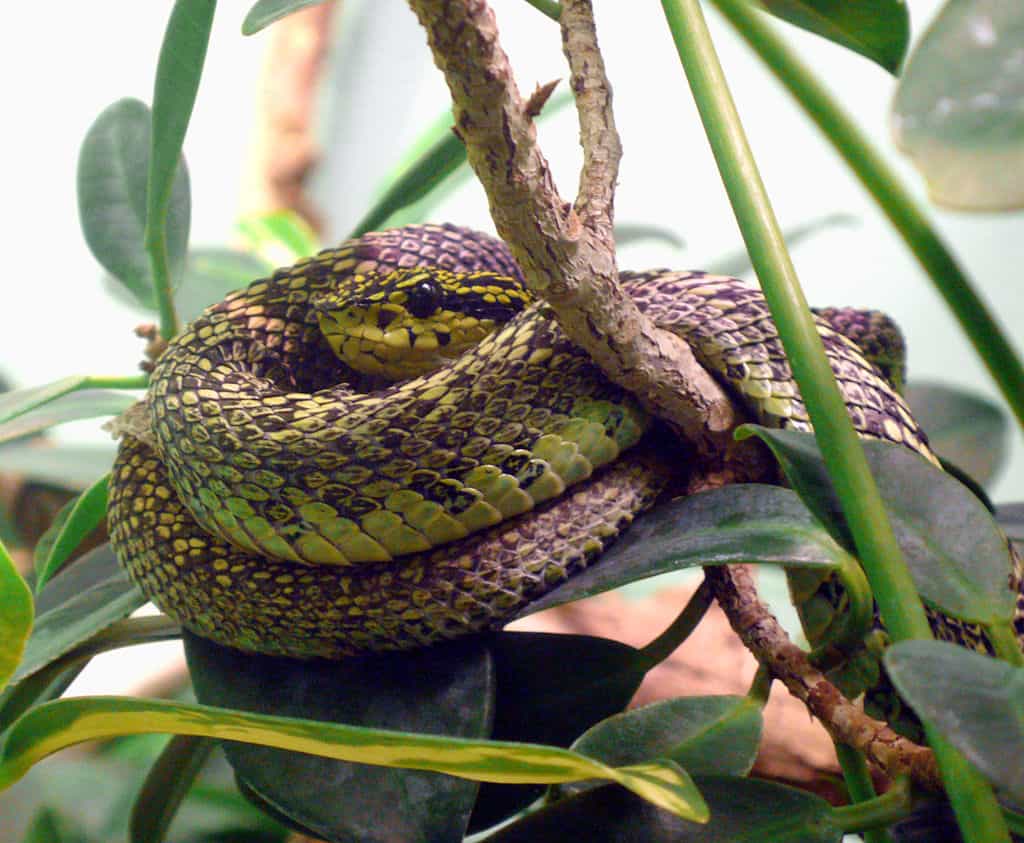
Maximum length: 93.7cm.
This venomous snake inhabits a wide swathe of Costa Rica, sticking to cloudy mountain forests at altitudes of up to 3000 metres. Black-speckled palm pitvipers are found in three of Costa Rica’s mountain ranges: the Tilarán Cordillera to the northwest, the central Cordillera, and Talamanca Cordillera on the Panamanian border. They average at 60cm, with the record so far being a 93.7cm female.
This snake struggles to adapt to manmade landscapes, and vanishes from an area the moment humans begin to cultivate it. Its venom only causes mild haemorrhaging, yet is one of the Bothriechis pitviper clan’s most lethal.
This species possesses an extremely rare toxin called nigroviriditoxin, which is structured similarly to the crotoxin of US rattlesnakes. Nigroviriditoxin has myonecrotic powers, targeting muscle tissue selectively. It’s also a strong neurotoxin, which are rare in the Bothriechis pitviper genus. Intense pain and nausea are two of the earliest bite symptoms.
Black-specked palm pitvipers have an emerald green or yellow-green base, overlaid with numerous mottled black scales. Other physical features include black irises, a black tongue, and a black stripe connected to each eye. This dangerous snake is mainly found in Costa Rica, but has a decent slice of land in far western Panama.
| 7 | Orange-bellied glasstail |
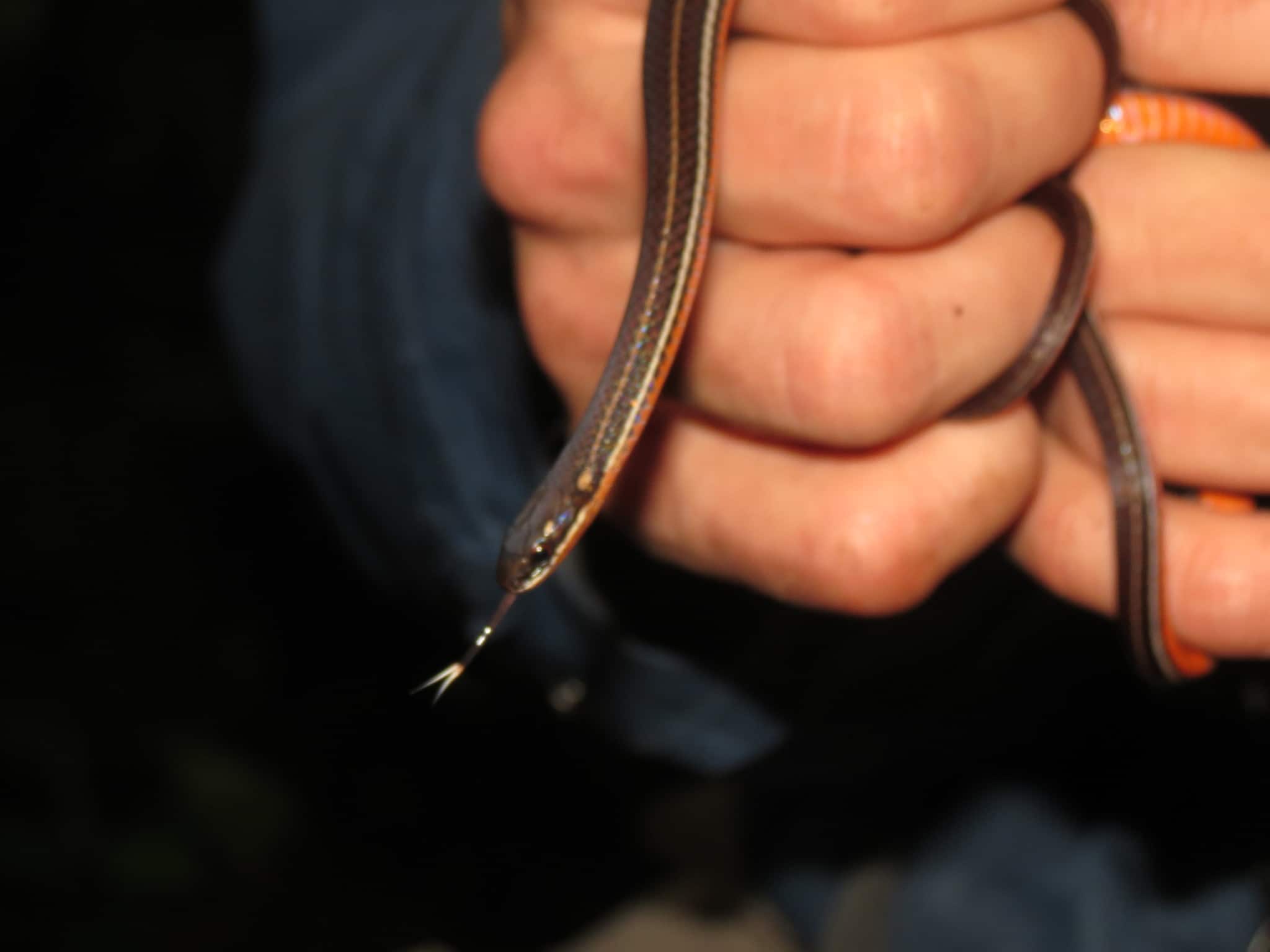
Maximum length: 70cm.
A frog-eating snake which sticks to forest floors, occasionally entering small pools to swallow up tadpoles. Orange-bellied glasstails (Urotheca guentheri) also have scattered records in Panama, but Costa Rica is easily their world capital. This is a rarely sighted species, which dwells exclusively in the most undisturbed forests. Their bellies are indeed orange, with the approximate shade of a citrus fruit. They have a brown back, with the two being separated by a thin white line.
Orange-bellied glasstails grow darker with age, and have round black pupils with a copper-red iris. They’re found in various forested areas, including both sunlit clearings and the deepest, gnarliest sections.
As for its other name, this species is notorious for having a fragile tail. A large chunk encountered in forests have tail ends completely missing, snapping off as they escape from birds’ clutches. Burrowing into leaf litter is another of their strategies for escaping.
This snake has a black tongue and a particularly narrow head, barely wider than its neck. A signature ID sign is a white spot, located slightly behind and above the eye.
| 8 | Black-headed bushmaster |
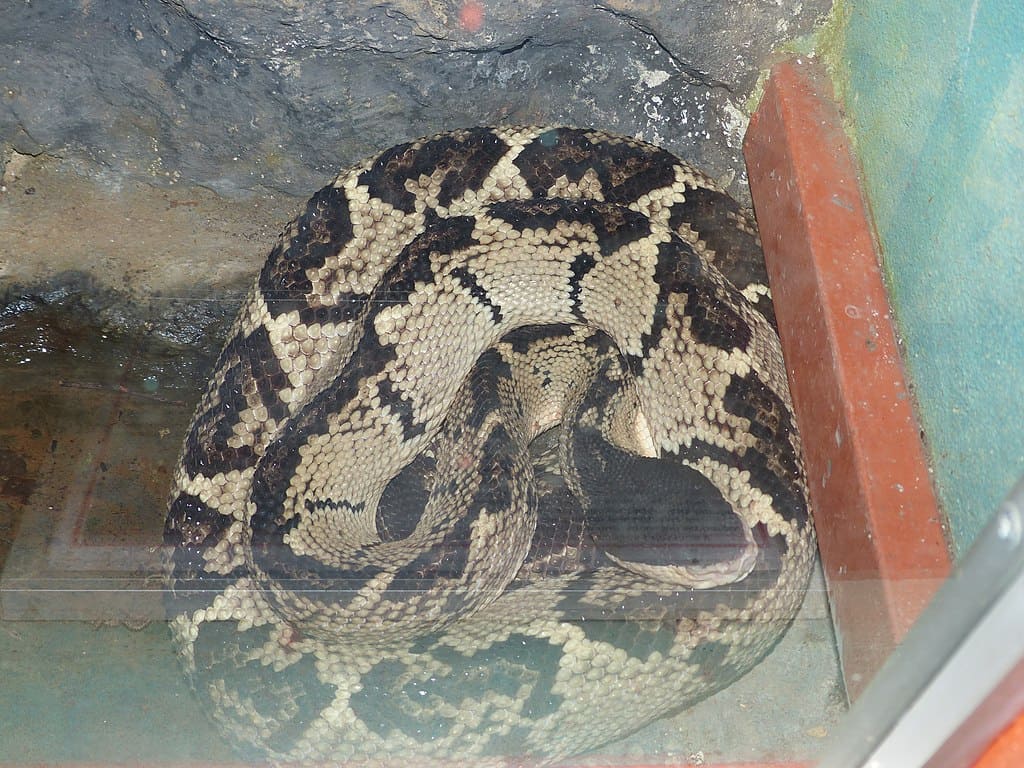
Maximum length: 2.4 metres.
The South American bushmaster is the official longest venomous snake in Brazil, but this species is their more obscure Costa Rican cousin. The black-headed bushmaster (Lachesis melanocephala) resides mostly in the southwestern region of Puntarenas, adjacent to the Pacific ocean. It was debated for years as to whether they also inhabit Panama, but a smattering of sightings have been recorded just over the Costa Rican border.
Black-headed bushmasters love heat and humidity, and stick to low altitude forests, occasionally reaching 1800 metres. This is a venomous ambush snake, which is most commonly sighted lurking at the bases of thick tree trunks.
Black-headed bushmasters are intelligent hunters, as they preferentially opt for fruit trees. When curious rodents investigate the fallen fruit accumulating at their base, the hungry bushmaster devours them. This snake vibrates its tail when frightened, reverberating off the leaf litter to create a low buzzing noise like a rattlesnake.
The black-headed bushmaster reaches a maximum confirmed length of 2.4 metres. Their bodies alternate between grey scales and black blotches, which are random in order, varying between individuals. However, their head is always a dense black, like a special cap, part of the official black-headed bushmaster uniform.
| 9 | Clark’s coralsnake |
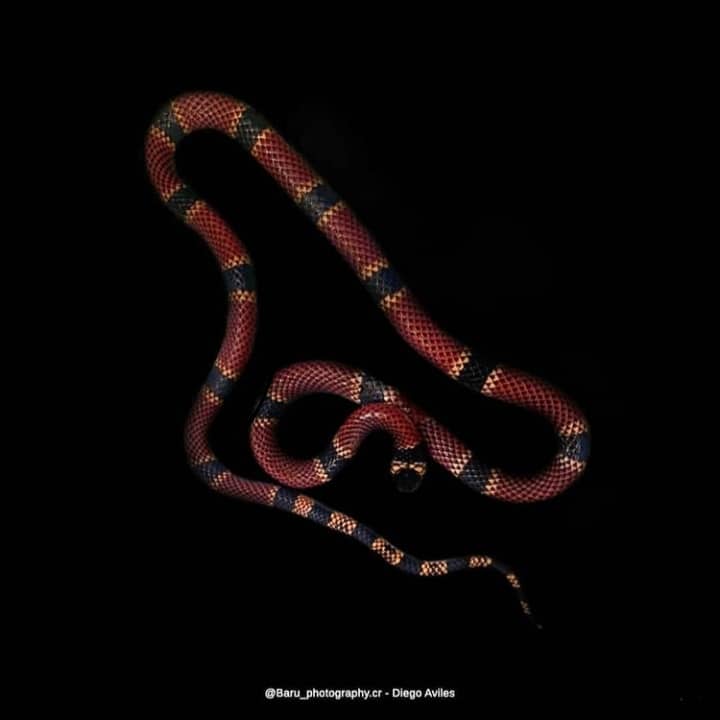
Maximum length: 92cm.
Another of Costa Rica’s native coral snakes, this time mostly inhabiting the southeast, as well as a swathe of Panama. Clark’s coral snake (Micrurus clarki) is a shy forest dweller, which leaves among fallen leaves and sometimes takes refuge in tiny insect burrows. This is a snake you’d be highly likely to meet while crossing the border mountains into Panama illegally.
Clark’s coral snake has beady, black eyes, and a neurotoxic venom which it slowly chews into its victims. One human death has been confirmed in Colombia, where this species also resides. Clark’s coral snake has a highly targeted venom, as 16.1% consists of the rare clarkitoxin-1. This has virtually no effect on lab mice, but strongly targets the reptiles and marbled swamp eels this snake is confirmed to feed on. There’s also a dose of myotoxins, which degrade muscle fibers.
Micrurus clarki could easily be confused with the Costa Rican coral snake listed above. The colouring and ordering of the bands is identical, but Clark’s coral snake has a dramatically shorter black band immediately after the neck. They also tend to have shorter black-yellow-black sections, and longer red spaces inbetween.
| 10 | Talamancan palm-pitviper |
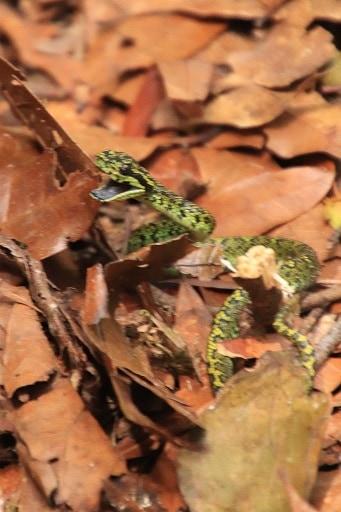
Maximum length: at least 91.1cm.
This venomous snake lives in a narrow, 100km slice of Costa Rica. It was first sighted in 2001, but falsely attributed to the black-speckled palm pitviper, due to its overwhelming similarity. In 2016, it was finally confirmed as an all-new Costa Rican snake species: the Talamancan palm-pitviper, AKA Bothriechis nubestris.
The green-black colour was identical, its typical length of 60cm was similar, and the head shape and eyes were barely distinguishable. Yet genetic analysis showed that the Talamancan palm pitviper diverged from its cousin millions of years ago.
This is called cryptic speciation – where two species have no obvious physical differences, yet are separated by vast DNA chasms. The only physical differences identified were subtle alternations in scale shape, particularly below the eyes, which were more kidney-shaped in the Talamancan palm pitviper.
Bothriechis nubestris has a far smaller empire than its cousin, sticking to the Talamanca Cordillera mountains near the Panamanian border (hence the name). They mainly inhabit cloudy, misty forests, resting on tree branches in tight coils. Being a close relative, they possess the neurotoxic nigroviriditoxin of their cousin, but in far smaller quantities. Not much is known of their diet so far, or even bite symptoms. We’d advise you not to become the first test subject.
| 11 | Yellow sea snake |
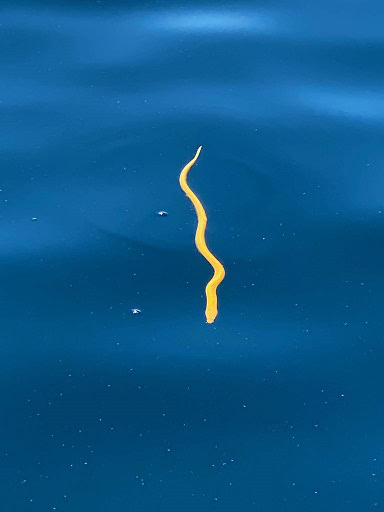
Maximum size: 113cm.
This species isn’t found on the Costa Rican mainland, as it’s a subspecies of the most fully aquatic sea snake in the world. Instead, this docile but dangerously neurotoxic species lives in the Gulfo Dulce, found off Costa Rica’s central west coast. This is the only place in the world where this endemic serpent resides.
The yellow sea snake (Hydrophis platurus xanthos) is an endangered subspecies of the yellow-bellied sea snake, which is far more widespread, ranging from Australia to South Africa to California. The yellow sea snake is yellow all over (except for occasional black spots), lacking the black topside of the main subspecies.
Somehow, this species became trapped in one Costa Rican lagoon, most likely due to ocean currents that prevented it from escaping. The entrance to Gulfo Dulce is also relatively narrow, before suddenly kinking to the west and opening up, making it harder for any snakes that wash in to wash out again.
Over time, the snakes gradually diverged into a unique Costa Rican subspecies. In fact, the yellow sea snake is the only sea snake out of nearly 50 worldwide which is endemic to the Americas.
The only time this sea snake appears on land is after accidentally washing up on beaches. This subspecies is now becoming endangered, due to only appearing in one location. Docks, boats and ship activity, and various chemical leakages into the Gulfo Dulce are putting the stranded population at risk. The subspecies can’t escape either, as it seems to have adapted to life away from the oceans, as their ideal water salt concentrations are now 8.1%, as opposed to 8.5% for the ocean.
| 12 | Cope’s vine snake |
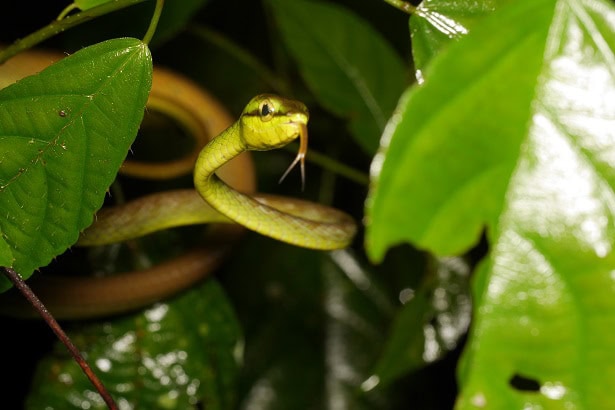
Maximum size: 107.3cm.
Our next species isn’t endangered in the slightest. In fact, this species may be the exact opposite of the yellow sea snake. Cope’s vine snake (Oxybelis brevirostris) is a mildly venomous species found in Costa Rica, Panama, Colombia and Ecuador, with a few sightings in Nicaragua and Honduras.
Rather than bays, this species is mainly found in pristine lowland rainforests, and dwells almost exclusively in trees. They’re occasionally found in manmade plantations, forests edges and in trees near roads as well. Their diet consists heavily of frogs and lizards.
Cope’s vine snake has a few survival strategies, including a demented and aggressive threat display when cornered. Their masterstroke is their immense camouflage, which perfectly mimics a piece of rainforest vegetation, like their close relative the green vine snake (also found in Costa Rica). The green covers not just their bodies, but also their eyes.
From 2005 to 2007, a large study followed 203 Cope’s vine snakes in the wilds of Panama. It found that the species never slept on the ground, always resting on vegetation. There was a tight connection with age, as the older and longer the snakes became, the higher they slept at night. Juveniles stayed much closer to the ground. The vast majority of Cope’s vine snakes slept at branch perches of less than 4 metres, but one rested at 10 metres above the forest floor.
| 13 | Mangrove cat-eyed snake |
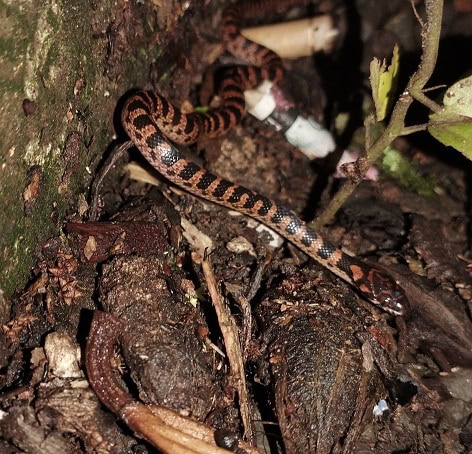
Maximum size: 75cm.
Part of the 15-member Leptodeira cat-eyed snake genus. This species is almost endemic to Costa Rica, but has a handful of sightings in Panama as well.
Compared to other members, the mangrove cat-eyed snake (Leptodeira rubricata) is undoubtedly the strangest. It’s an anomaly, as rather than fully fledged rainforests, it inhabits coastal mangrove areas. It derives a large portion of its calories from crabs and fish, and it often has a red colour, which makes it easily distinguishable from the 3 other cat-eyed snakes in Costa Rica.
This species can climb trees to 3 metres above ground, but much prefers to inhabit a watery world, and is far more common on the ground. Mangrove cat-eyed snakes are very recognisable, though they only appear along Costa Rica’s southern Pacific coast, never the Caribbean coast. They’re relatively mysterious, as new areas of land are still being discovered. In 2019, a new sighting in Costa Rica extended their known territory well to the west. The location was Guanacaste province, where they had never been observed before.
This species has a venom, which is poorly researched, but most likely poses no threat to humans.
| 14 | Picado’s jumping viper |
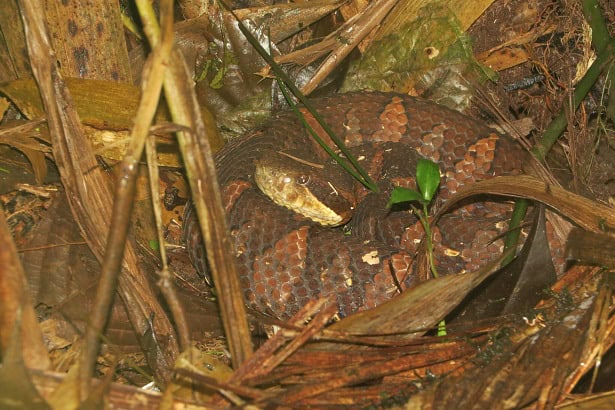
Maximum size: 120.2cm.
A relatively uncommon pitviper, which is easy to miss in the forests, easy to walk right past and never realise how close to danger you just came. Picado’s jumping pitviper (Atropoides picadoi) is a species of forests, the rainier and more humid the better. They appear from 15 to 1750 metres in altitude, and as well as Costa Rica, they also inhabit far western Panama.
Picado’s jumping pitvipers are quite generic for a viper. They have vertical pupils and the usual black-beige shades, making them tricky to distinguish from their local comrades.
One important fact is that they’re virtually never found on tree branches. This species has occupied the niche of a ground-dwelling viper, which blends in with forest mulch and fallen leafbeds, and lunges at small mammals as they walk past obliviously.
This species is not to be underestimated. According to a 2010 study, its venom is rich in metalloproteases with strong haemorrhaging powers. In fact, its venom was estimated to be the most strongly haemorrhagic of all Costa Rican pitvipers. It also differed from the Central American jumping pitviper (Metlapilcoatlus mexicanus), whose venom leaned towards muscular necrosis.