
| 1 | Lanna green pitviper |
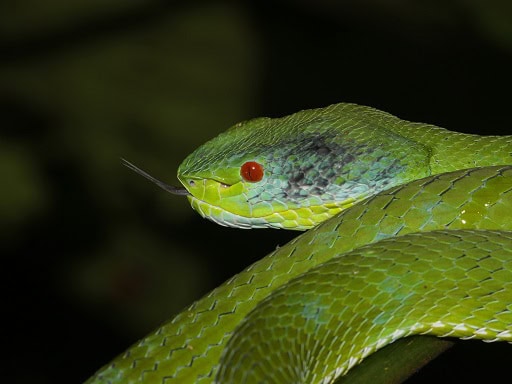
As of 2024, Thailand was still gaining new pitvipers, and the pace shows no sign of slowing. The latest addition was the Lanna green pitviper, AKA Trimeresurus lanna, which was split off from Pope’s pitviper (Trimeresurus popeiorum). The latter once had a much larger territory, but genetic analysis restricted it to northeast India, northwest Myanmar and Bangladesh. It turned out that those in northern Thailand and southern Laos were a new species altogether, with a close but distinct genetic profile.
Like other members, the Lanna green pitviper is a deep green colour. Males had a deep red stripe on the flanks, while females (pictured above) had either a white or yellow side stripe. Both males and females have a deep red eye. Occasional blue patches are visible on Trimeresurus lanna when living, but when preserved in alcohol, the blue completely took over.
Compared to other Thai pitvipers, this is a lover of cooler locations. Lanna’s green pitviper is found at altitudes of 600-2000 metres, in areas where temperatures occasionally fall as low as 5C. They can be found at lower altitudes, but only in unusually cool, misty spots. Like other Trimeresurus pitvipers, they inhabit various forest types, such as evergreen forests, submontane forests and also plantations and bamboo plantations.
This species had one of the coolest Latin name origins as well. “Lanna” referred to Lannathai, or the “kingdom of a million rice fields”, which existed in the 13th-18th centuries and was centred around present day northern Thailand. This eventually combined with the Siamese state in the early 19th century, bringing modern day Thailand a step closer.
| 2 | Vasuki indicus (prehistoric) |
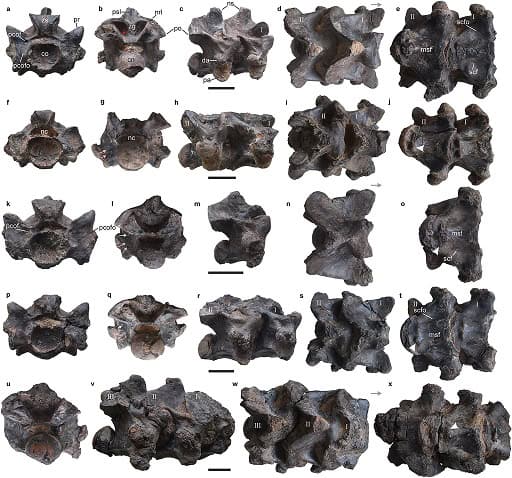
Source: D. Datta & S. Bajpai – “Largest known madtsoiid snake from warm Eocene period of India suggests intercontinental Gondwana dispersal” – CC BY 4.0
For over a decade, titanoboa held the title of largest snake ever known to exist. It may still hold the crown, but in 2024, a colossal new contender emerged: Vasuki indicus. This species was found in Gujarat state in northern India, a relatively dry region known for its fossil finds.
The initial vertebrae was discovered in 2005, with 27 being unearthed in total from the Panandhro Lignite Mine. They were thought to belong to a prehistoric crocodile, but in 2024, they were officially announced to belong to a snake of vast proportions, with an estimated length of 10.9 to 15.2 metres, depending on the extrapolation method.
Vasuki indicus was a land-dwelling snake, and had a close connection to the similarly colossal Gigantophis garstini of North Africa. It lived 47 million years ago, long after titanoboa, which lived 58 million years ago.
Vasuki indicus was found in a fossil bed alongside the remains of ancient crocodilians and turtles, either of which could have formed its diet. 47 million years ago, the Earth was far warmer, allowing cold-blooded snakes to acquire great new sizes. This species was surely near the top of the food chain in prehistoric India, unless the remains of even more colossal beasts haven’t been unearthed yet (which is possible).
| 3 | Ahumada’s alpine garter snake |

North America is home to dozens of Thamnophis garter snakes, mildly venomous snakes which typically live in semi-aquatic environments, and nearly always avoid dry locations. Mexico has plenty, and the most recent addition is Ahumada’s alpine garter snake, AKA Thamnophis ahumadai. The first individuals were discovered in 2019, but the species was only made official in 2024.
Ahumada’s alpine garter snake dwells in the high plateau of central Mexico, and the original male holotype measured 70.5cm. The species is found in only two narrow, high elevation areas of Jalisco state, in environments such as pine-oak woodlands and mixed-temperate woodlands. Others have been photographed in open areas with grassy meadows, flowers and rippling lakes. So far, Ahumada’s alpine garter snake has only been found from 2140 to 2450 metres above sea level.
These areas are rarely protected, meaning that Ahumada’s alpine garter snake faces threats from farming, logging, and general habitat destruction. The study authors believed that it may quality for “endangered” status by the IUCN.
The new species was most closely related to Thamnophis scalaris, AKA the long-tailed alpine garter snake. Yet the two were clearly distinct, as Ahumada’s garter snake had a significantly shorter tail, and a black blotch on the neck rather than brown, as well as subtle scalation differences.
| 4 | Western Ghats king cobra |
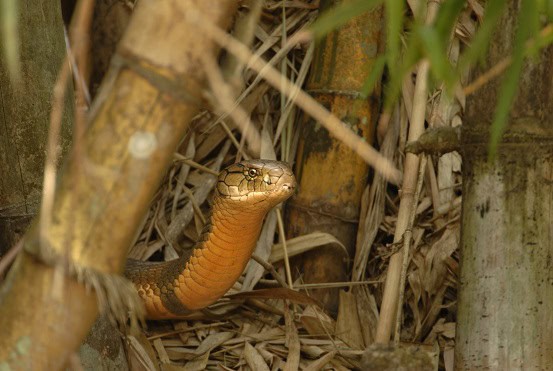
For over 150 years, the king cobra was a single species, the only member of the Ophiophagus genus worldwide, an offshoot of the true cobras. Since the 19th century, it had ruled India, Thailand, Indonesia and the Philippines alike, with a huge empire.
However, scientists had suspected for years that it was actually a species complex. They had already found multiple genetic clades, with divergence times of up to 5 million years ago, and in 2024, it finally became official – those in southwest India were a different species, called the Western Ghats king cobra, or Ophiophagus kaalinga.
The Western Ghats are a range of low, hilly mountains which are home to many endemic species, such as the Malabar pitviper and Anamalai hills wood snake. The king cobras here are separated from other populations by hundreds of miles, with the centre of India containing none, before they restart along the east cost. Therefore, it always made sense that those in southwest India were an independent species, but in 2024, it was officially confirmed.
Physically, the key difference lay in the number of bands. The Western Ghats king cobra populations had 40 bands covering their body, while the king cobras of far northern India, Thailand, Vietnam etc, had 50-70. Another species on the Philippines island of Luzon had no bands, while the king cobras of Indonesia’s Sunda Islands had the most, at over 70 bands.
| 5 | Hussain’s eyelash viper |
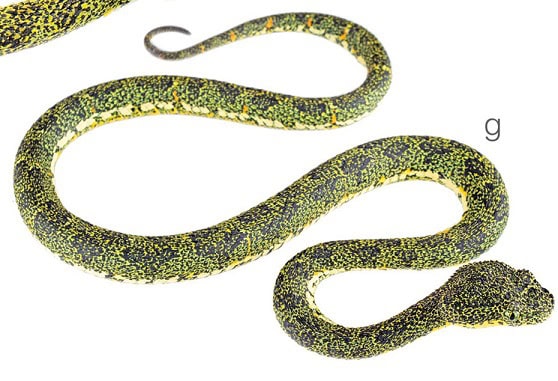
The king cobra wasn’t the only pre-existing species broken into smaller chunks in 2024. In February 2024, the Bothriechis eyelash vipers of Central America underwent a radical transformation. The common eyelash viper was broken down into several independent species, while several new species were found altogether.
One new addition was Hussain’s eyelash viper (Bothriechis hussaini), found in southern Ecuador and far northern Peru. This species had immensely detailed green, yellow and even reddish patterns, perfect for blending with the jungle. Bothriechis hussaini was found not just in cloud forests, but also coffee and banana plantations, putting agricultural workers at high risk.
In the discovery study, Hussain’s eyelash viper was found at 1.2-3 metres high on tree branches. They’ve been discovered at high altitudes, but also lower down, from 1 to 1680 metres above sea level. Scientists estimated that 78% of its natural habitat had already been destroyed, due to constant agricultural encroachment.
Nevertheless, the species was known from 55 localities, and estimated to cover nearly 14,000 square kilometres of land overall. The discovery of Hussein’s eyelash viper also made it the official most southerly Bothriechis member, among 19 overall, and the only Bothriechis eyelash viper to cross the border into Peru.
| 6 | Indo-Chinese banded wolf snake |
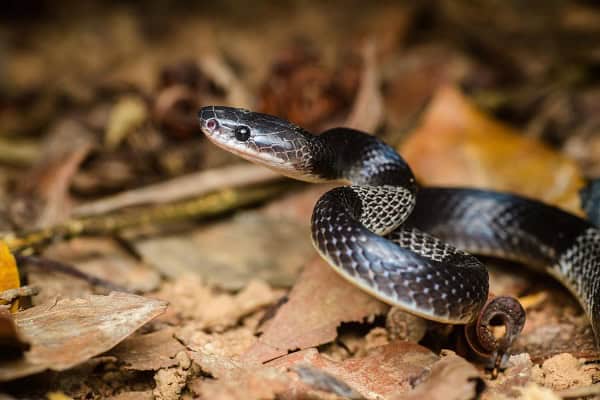
The Malayan banded wolf snake (Lycodon subcinctus) is a black and white species which was previously found from southern China to Indonesia. It was long suspected of having two populations, with those in southern China, Thailand and Vietnam being independent from those further south. These were thought to be a subspecies, but in 2024, genetic analysis proved that they were a fully independent species: Lycodon neomaculatus, AKA the Indo-Chinese banded wolf snake.
The Lycodon wolf snake genus already numbered over 70, but this added yet another species to the tally. The Indo-Chinese banded wolf snake is found in Thailand, Cambodia, Vietnam, southern China, Laos and Hong Kong, reaching as far south as southern central Thailand. It’s a non-venomous species which appears on garden tiles and tree limbs alike. It climbs trees only occasionally, but has been spotted in the crowns of rubber trees and coffee trees. Its main habitat are forests, yet Lyocdon neomaculatus can also appear in rice fields, plantations and shrublands
This species was new, yet because it was a previously known population, it already had several diet observations. Its diet is rich in reptiles, including the many-striped skink, Chinese short-limbed skink and small-scaled water skink.
Be warned, as this new Thai snake is harmless, but easy to confuse with neurotoxic Bungarus kraits. Lycodon neomaculatus is nocturnal, occasionally moving during morning.
| 7 | Arrow-vented krait |
2024 was a busy year for new venomous snakes being born, with king cobras and eyelash vipers appearing on different hemispheres. The neurotoxic Bungarus krait genus also churned out a new member, in the form of the arrow-vented krait (Bungarus sagittatus).
This new snake was found in western Thailand, at altitudes of 834-987 metres. Several individuals were found in the Tenasserim mountains of Ratchaburi Province, in hilly evergreen forests. Diet observations were made, including of one arrow-vented krait hunting a fellow reptile, a Reeve’s smooth skink.
The original holotype (a female) measured 92.3cm, with a head width of 1.68cm. Though superficially tricky to distinguish, the new species had a genetic divergence with other Bungarus kraits of 8.29%, including the Malaysian blue krait (Bungarus candidus), which looked very similar. A new venomous nightmare was born into the mountains of western Thailand, although local villagers would have already been aware of it, just unsure of the exact species.
The Bungarus kraits are some of the most neurotoxic snakes on Earth, and this species was presumably no different, although no detailed examination of its toxin profile is available yet. Like other Bungarus members, the arrow-vented krait was spotted moving at night.
| 8 | Cave kukri snake |
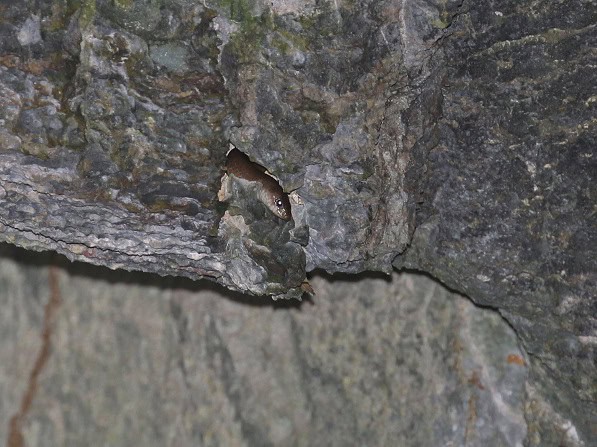
New snake species can be discovered in hilly forests, or grassy, flowery meadows in Mexico, but our latest new snake of 2024 was found in a cave.
The location was southern Thailand, in Satun and Trang provinces, not far above the Malaysian border. Scientists initially spotted a kukri snake clinging to a limestone wall, vertically. It seemed similar to no previously known snake. The team next entered a dark cave, and found a similar snake, stashed in a crevice 10 metres past the cave entrance. Genetic analysis revealed an all-new species, dubbed the cave kukri snake, or Oligodon speleoserpens.
Oligodon speleoserpens proved to be most closely related to the gold kukri snake, AKA Oligodon cinereus, a widespread snake further north. The two had a genetic divergence rate of 2.4%, which was greater than the divergence between some other kukri snake species. It was also connected to the Sai Yok kukri snake (Oligodon saiyok), but had an even greater divergence of 7.7%.
The cave kukri snake is almost completely grey-brown, with subtle yellow patches, and a slight black edge to some scales. In one observation, a cave kukri snake was spotted 12-15 metres high on a cave wall, and disappeared into a dark crack, reappearing in front of the scientists 5 minutes later. The species’ diet wasn’t studied, but theorised to include geckos, or perhaps even arachnids.
| 9 | Bach Ma green ratsnake |
The Ptyas ratsnake genus of southeast Asia numbers 15 members, and unlike the kukri snakes or green pitvipers, new members are rarely added. In fact, until 2024, a new member hadn’t been discovered for 117 years, since the many-banded green ratsnake of China was identified in 1907.
The 2024 discovery was the Bach Ma green ratsnake (Ptyas bachmaensis), a ground-dwelling, fast-moving snake with no venom. The species was found to differ from other Ptyas ratsnakes genetically by 5.7%. Visually, the species was similar to the Chinese green snake (Ptyas major), which eats earthworms and is abundant in Taiwan and southern China. However, the Bach Ma green ratsnake lived further south, occupying Vietnam as well as Hainan province in China.
Compared to its northerly relative, the new snake also had a copper head, contrasting against its leafy green body, and a body which gradually darkened as the tail approached. The first Bach Ma green ratsnake was collected in evergreen forest, near a main road. The second was also collected in evergreen forest, but near a restaurant. Another individual was found on leaf litter in a forest, in temperatures of 16-18C, amid light rainfall.
| 10 | Jenkin’s mountain pitviper |
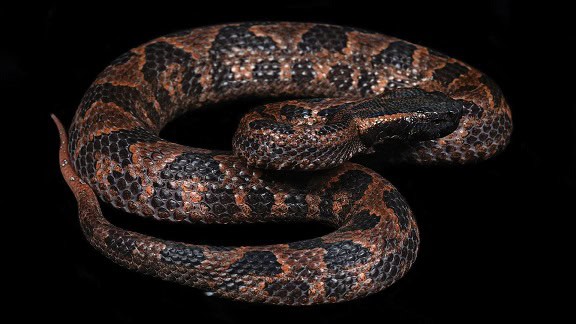
A rare species, known only from western Yunnan province in China (so far). Jenkin’s pitviper belongs to the medium-sized Ovophis genus (9 members), which typically stick to the ground. The initial discovery involved just 5 individuals, which were collected in 2018 and 2023. This included an adult male, two adult females and two juveniles.
The location was a tropical montane rainforest, at an altitude of 1300 metres. The new Jenkin’s pitviper was clearly active nocturnally, particularly during light rain and high humidity, at temperatures of 15-22C. Its dietary habitats were unconfirmed, but its aggressive tendencies weren’t, as Jenkin’s pitviper was eager to attack, and even inhaled air in order to puff itself up and appear larger.
Jenkin’s pitviper has keeled, rough scales, which is visible in the image above. It has a black head like a lump of coal, and a chocolatey brown interspersed with thick black blotches. Its tail is mostly brown, except for one differentiating factor to other species: a smattering of white spots.
Jenkin’ pitviper wasn’t just visually distinct, as it was proven in a lab to be unique, with a genetic distance of 6% to all other Ovophis pitvipers. Its closest relative was Ovophis monticola, or the Chinese mountain pitviper, a common species in the eastern Himalaya.