| 1 | Stejneger’s snail sucker |
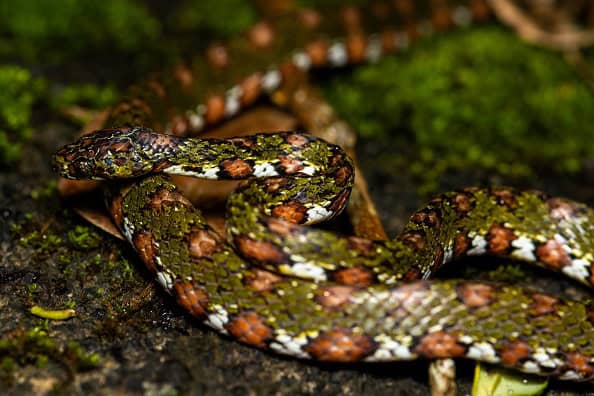
Maximum length: 62.4cm.
A 35cm, branch-dwelling snake which belongs to the 22 member Sibon genus, collectively known as the snail suckers due to their diet, although many also slurp up slugs. Stejneger’s snail sucker (Sibon longifrenis) is a completely harmless if extreme-looking rainforest snake. The overwhelming majority of sightings happen in Costa Rica, although there’s a handful over the northern border in Nicaragua, and over the southern border in Panama.
Stejneger’s snail suckers don’t just inhabit forests, but prefer the deepest, shadiest forests starved of all light. Habitats of Stejneger’s snail suckers include wet lowland forests, premontane wet forests and rainforests. They’re usually found 1-2 metres above ground, and overlap with cloudy and ringed snail suckers, but are much greener than both.
Most Sibon members have a slightly alien, forested look to them, particularly with their bulging eyes, but Stejneger’s snail sucker is one of the most extreme of all. It seems to be covered in moss, as though the longer it stays in the rainforest, the more it absorbs the essence of that rainforest. Who knows – in 1 million years, this species might just be a mossy branch that bites people.
| 2 | Beautiful pitviper |
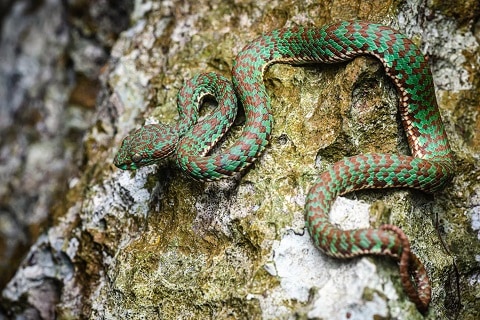
Maximum length: 58cm.
A branch-dwelling pitviper measuring 40-50cm, which both hunts from branches, and launches lunging assaults from branches. This snake also appears on rain-soaked rocks, as the image above shows, but rarely the ground.
The beautiful pitviper (Trimeresurus venustus) is found in middle southern Thailand, as well as the Malaysian island of Langkawi. It was named for its fantastical colours, which are much more detailed than the rest of its Trimeresurus pitviper clan.
Trimeresurus venustus is certainly beautiful on the outside, though whether it’s beautiful on the inside is seriously debatable. Its venom primarily contains cytotoxins and haemorrhagins rather than neurotoxins, and rarely kills, but unleashes painful local symptoms.
According to a 2019 report, its venom is middling for the Trimeresurus pitviper genus. A 60 year old man was bitten when removing one from a box, and experienced a swelling finger, which spread steadily down his hand. The man experienced little coagulopathy or bleeding, but without rapid antivenom administration, it could have been far worse. The man was discharged from hospital within 26 hours, but if you’re in the beautiful pitviper’s domain, the rainforest, the story could be very difficult, particularly if you’re bitten on the trail at the furthest possible distance from your car.
| 3 | Vermiculate snail eater |
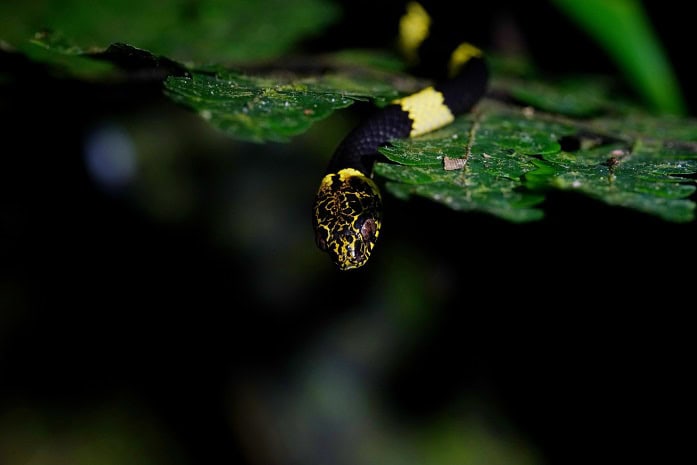
Maximum length: 73.5cm.
The Dipsas genus is the other major snail-eating clan of South and Central America, containing over 30 members, all harmless to human beings. The vermiculate snail-eater (Dipsas vermiculata) resides in the Ecuadorian Amazon, east of the Andes, and measures 60-70cm.
This species never attacks humans, preferring to release a foul smell or triangulate its head to mimic a viper. It lacks offensive weapons, yet is plentiful in eastern Ecuador, and is clearly effective at surviving in the competitive rainforest ecosystem.
In a parched arid plain or somebody’s backgarden, this snake would stand out instantly. But in a teeming rainforest where every lifeform glows with neon fluorescence and practically resembles an alien life form, funky colours are exactly what you need to blend in. Vermiculate snail-eaters also appear in northern Peru, and have been found at altitudes from 210-1690 metres.
Vermiculate snail-eaters typically stay 1-2 metres above ground, and are light enough to weave along even the most delicate of vegetation. Slugs and their snails are brought out by rainfall, meaning that wet weather is a godsend to this snake, and in the rainforests of eastern Ecuador, it rarely has to wait long.
| 4 | Butterfly viper |
Maximum length: 120cm.
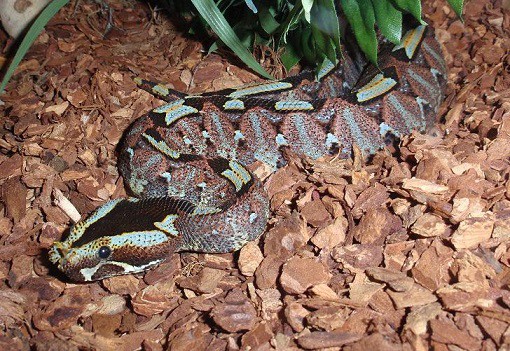
The butterfly viper measures 80-100cm, and is a thick tank of a snake found mainly in central Africa, including Uganda, DRC and Rwanda. It’s the most fantastically coloured of the Bitis adder group, which has 18 members in sub-Saharan Africa. That’s because rather than dry game trails, butterfly vipers are most likely to be found in thick, swarming rainforests.
Butterfly vipers look like they’re covered with poisonous fungi, and if you ate one, you’d probably die just the same. Their scales blend perfectly with the rainforest in all its exotic glory. Back in the colonial era, one of the only reliable ways to spot them was to sail down Congo Rainforest rivers, scanning the shorelines.
The butterfly viper is a relatively sluggish snake, and will never charge you down like a cobra. The problem is its immense camouflage, which makes seeing one almost impossible. You’re likely to brush against, walk 1 metre from, or even step on a butterfly viper, which it won’t take kindly to, particularly given that you’re invading its personal rainforest domain, and not sticking to towns and cities, as per the deal.
While more African locals have doubtlessly died without being recorded, the butterfly viper has only caused one confirmed death: a 48 year old firefighter from Dayton, Ohio, who kept one as a pet and died in 2003.
| 5 | Fire-bellied snake |
Maximum length: 80.5cm.
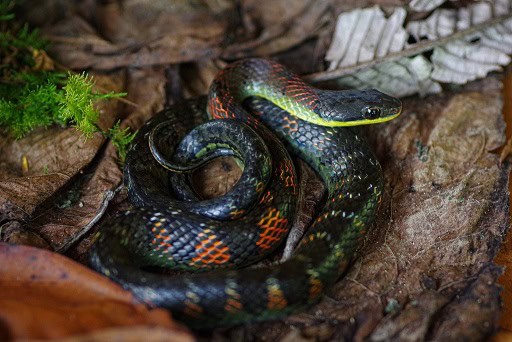
A 45-80cm species found mainly in watery zones within rainforests. The fire-bellied snake lacks a powerful venom, but is the master of subtle rainforest shades. This species lives in Colombia, Costa Rica, Panama, western Ecuador – anywhere to the west of the Andes mountain range.
Compared to its Erythrolamprus cousins like the yellow-bellied liophis, which inhabit water bodies in regular forests, this species is much more common in the crawling, humid domains of rainforests. Consequently, its patterns have grown far funkier over the years.
The fire-bellied snake (Erythrolamprus epinephalus) does have a mild venom, but is relatively harmless. One of its coolest skills is enlarging its neck sideways like a cobra. Various Erythrolamprus members (there’s 55 in total) have this power, but it’s most consistently observed in the fire-bellied snake. This species shares no relation or geography with cobras, so it evolved the skill completely independently.
Another skill is being able to prey on the deadly golden poison dart frog, which would leave a human writhing on the ground in death throes, but has no effect on the fire-bellied snake. Living in a rainforest forces you to adapt to the rainforest and all its lethal, dangerous obstacles.
| 6 | Tropical flat snake |
Maximum length: 143.1cm.
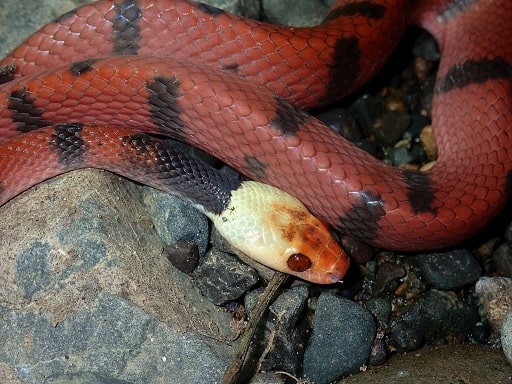
This rainforest species is also known as the red-eyed tree snake (Siphlophis compressus) or mapepire de fe by locals. It’s a mostly harmless species measuring 65-120cm, whose venom probably only causes a slight stinging in human beings. Instead, its venom is targeted towards its mainly reptile prey, which includes green iguanas, common basilisks (not the snake), common stream lizards, lava lizards, and probably rare rainforest anoles which scientists haven’t even discovered yet.
Siphlophis compressus looks like the guardian of the rainforest, which activates with a sudden reddening of its eyes, and begins a relentless search for you the moment you set foot in its domain. It has some of the reddest eyes of any snake, yet don’t mistake this for an evil personality, as you can easily walk past this snake safely while lost in the Amazon rainforest (though the same cannot be said for poison arrow frogs).
Tropical flat snakes are most likely to be found on branches within rainforests, but don’t stick to this rule religiously. In a 2015 encounter, this snake reacted when humans approached by shifting its skull into a triangular shape. Several minutes later, it hid its head under its body fearfully.
| 7 | Chocoan toad-headed pitviper |
Maximum length: 75.6cm.
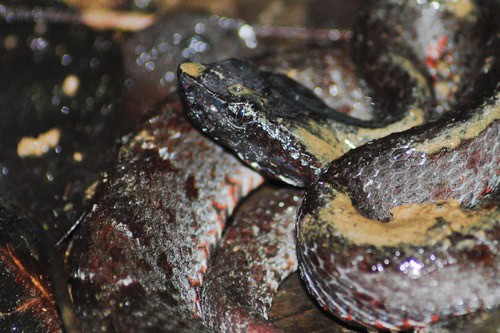
A 45-60cm venomous species which mainly grinds along the ground in rainforests, rather than resting on branches. This snake is severely dangerous, but lives in narrow, humid, dense and overgrown sections of rainforest tucked away in the west of Colombia, and is therefore rarely encountered by mankind.
The Chocoan toad-headed pitviper (Bothrocophias myersi) is a true rainforest snake, as it appears only in areas receiving 5000mm of rainfall annually (London receives 585mm). In fact, Bothrocophias myersi lives in such inhospitable rainforests that it was only discovered in 2001.
Once upon a time, Bothrocophias myersi shared a common ancestor with the rattlesnakes, but their paths wildly diverged. The rattlesnakes headed for the dusty arid badlands of Mexico, turning pale and rattling their tail menacingly at any large animal that strayed past. The toad-headed pitviper entered the rainforests, and sank ever deeper into a quagmire of swamps, poisonous frogs, dangling vines, and swirling clouds of mist.
The first study on its venom came in 2020, and found that it had weaker haemorrhagic and coagulant abilities than nearby Bothrops lanceheads. However, it was especially skillful at causing muscle tissue damage (myotoxicity), as evidenced by an increase in bloodstream creatine kinase. Two antivenoms were tested, and the Costa Rican vial was significantly weaker than the Colombian.
| 8 | Northern woodland racer |
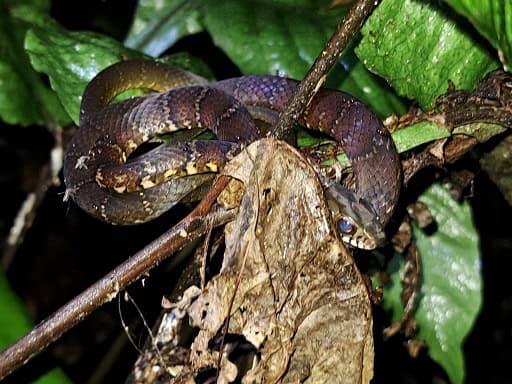
Maximum length: 130cm.
The northern woodland racer (Drymoluber dichrous) has a misleading name. Firstly, it’s found across the entire Amazon region, not just the north. Secondly, it doesn’t just inhabit woodlands; it prefers the most humid, stifling jungles. This is a diurnal (day-faring) snake, which measures 100-110cm and mainly sticks to the ground, rather than resting on branches.
This species preys on a mixture of reptiles and frogs, including the giant ameiva, striped forest whiptail (Kentropyx calcarata), and slender anole (Anolis fuscoauratus). The northern woodland racer is a manual hunter, utilising neither pulsating venom nor stealthy ambush.
Instead, this species prowls the forest floor and creeps up slowly on any reptile it spots. At the last second, it performs a sudden acceleration and charges its prey down, making a well-practised grab.
The northern woodland racer isn’t a superpowered snake, but its well-honed hunting techniques are enough to guarantee its survival in the competitive Amazon rainforest. This is an extremely widespread species, which ranges from Brazil to Ecuador to Suriname to Colombia.
| 9 | Black-skinned parrot snake |
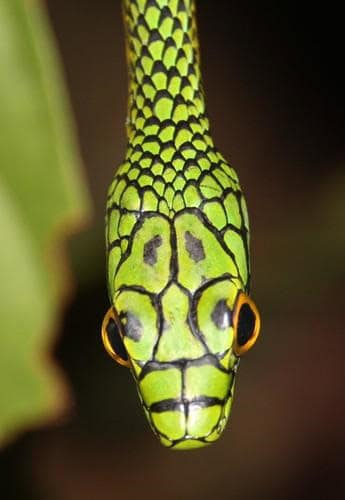
Maximum length: 152.6cm.
This long, thin species averages at 100cm, and is primarily found in the rainforests of eastern Ecuador and Peru, with occasional sightings in Brazil. The black-skinned parrot snake (Leptophis nigromarginatus) mainly sticks to tree branches, where its light weight enables it to move through the rainforest canopy with ease, unlike a clumsy boa constrictor.
Unlike humans, this snake is unable to drive a car or fire a machine gun, but there’s one thing it’s clearly better at than us – surviving in inhospitable rainforests.
As you can see from the image, this species’ eyes are enormous. The black-skinned parrot snake’s bulging eyes aid it greatly in the complex rainforest environment, where every subtle movement and every unexplained flash of red could mean something. Its confirmed prey include turniptail geckos (Thecadactylus rapicauda), anoles and poisonous Osteocephalus spinyback treefrogs.
This version differs from other parrot snakes in its black outline to each green scale. Leptophis nigromarginatus only became an official species in 2022, as it was originally a subspecies of the giant parrot snake (Leptophis ahateulla). There was so much genetic variation across the misty valleys and humid forests of South America that there were clearly several hidden species combined into one, and hence, this was elevated to independence alongside Leptophis dibernardoi of Brazil.
| 10 | Crowned false boa |
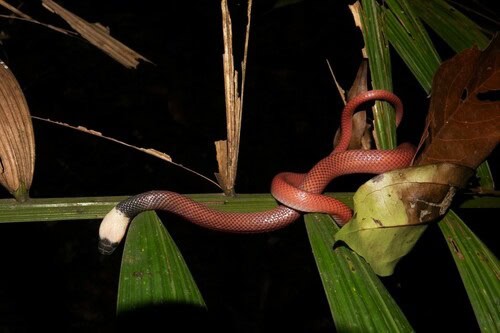
Maximum length: 107.6cm.
A little known yet very widespread species in the Amazon rainforest region. The crowned false boa (Pseudoboa coronata) lacks a mind-melting venom or a ferociously aggressive personality, yet this snake has fought for and maintained its rightful place in the rainforest hierarchy.
This species peaks at 107.6cm, and is found from Ecuador in the west to Suriname in the east, while covering the entire Brazilian Amazon inbetween. Although they’re perfectly comfortable in humid, stifling rainforests, crowned false boas also appear in clearings and disturbed forests, perhaps even villages adjacent to rainforests. They prey on a variety of animal groups, including black-headed centipede snakes, swamp eels and giant ameivas.
Crowns false boas are active during both day and night. In fact, flexibility is the reason they’ve survived so well and actually become more common than pulsatingly venomous creatures like the Chocoan toad-headed pitviper, which appears in one treacherous but thankfully small slice of nightmarish rainforest.
Crowned false boas are never dull in appearance. They typically have a juicy red body like above, with a snowy white neck and sudden transition to a black face. In some, the snowy white neck is missing, while the belly is nearly always a snowy white. Their pupils are black and round.