
| 1 | Most northerly: prairie rattlesnake |
Maximum length: 151.5cm.
Our first record was a tricky one to award, as both the Pacific rattlesnake and prairie rattlesnake extend well over the northern border into Canada. The Pacific rattlesnake hugs the North American west coast, and reaches deep into British Columbia. Prairie rattlesnakes appear to the east of the Rocky Mountains in the US, and penetrate well into Alberta and Saskatchewan. The two species reach very similar latitudes, yet ultimately, the northernmost observation on this iNaturalist map reaches 51.149 for the prairie rattlesnake, versus 50.999 for the Pacific.
The prairie rattlesnake therefore is the most northerly Crotalus rattler on Earth, among 53 members. Prairie rattlesnakes are dangerous to humans, though not exceedingly lethal. Their venom becomes more dangerous with age, gaining a number of muscle-assaulting myotoxins. Their diet consists mainly of mammals, and they’re always found in more open areas.
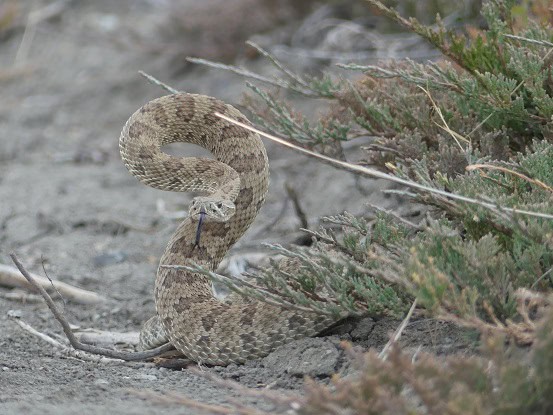
The image above was taken in Saskatchewan, Canada, and clearly shows the patterns you need to search for. The prairie rattlesnake has relatively small light brown blotches against a beige base, and the usual thick body of its kind (despite not being a constrictor).
If you wish to find a prairie rattlesnake in Canada, then don’t hang around by a bus stop. You need to travel to prairie grasslands, dry hills, and rugged areas like the Alberta badlands: a mixture of rocky canyons, prehistoric fossil beds, and old gold mining outposts, with very few trees. The prairie rattlesnake is fairly inflexible in habitat, and is declining in both Alberta and Saskatchewan. One report estimated that the number of prairie rattlesnake locations in Canada declined by 30% from the 1950s to the 1990s, and the decline continues to this day.
Remember, there’s one place you’ll never find a prairie rattlesnake: forests. This is the exact opposite to the timber rattlesnake in eastern USA.
| 2 | Most southerly: South American rattlesnake |
Maximum length: 180cm.
With the most southerly rattlesnake, the competition isn’t even close. The South American rattlesnake (Crotalus durissus) beats all other species by several thousand miles, as it’s the only species to inhabit South America full-stop, unless you count the Aruba rattlesnake off the Venezuelan coast.
South American rattlesnakes skip the Amazon rainforest, as rattlesnakes rarely appear in rainforests as a group. However, they appear in a large swathe of Brazil, reaching Paraguay, Uruguay, and finally Argentina, where they cover most of the north, and reach a decent southerly latitude of 33.18. The most southerly viper (and snake overall) is Bothrops ammodytoides, the Patagonian lancehead.
If you touch a South American rattlesnake, it may end up killing you. Alongside the tiger and Mojave rattlesnakes, this is the most neurotoxic of the clan. Symptoms include drooping eyelids, difficulty breathing, and a bizarrely twisted neck, which appears to be broken, but is actually due to spasming muscle control.
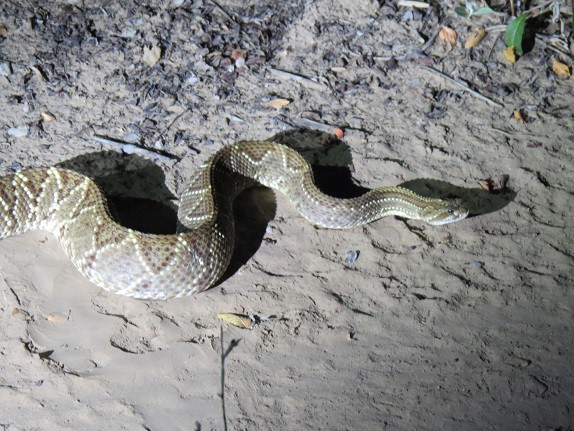
There are no other rattlesnakes close to Argentina or Paraguay, but there are multiple Bothrops pitvipers. The image above was taken in Paraguay, and as you can see, the triangular blotches eventually converge on the neck to become a continuous brown stripe, which extends to the top of the head. The South American rattlesnake’s scales are noticeably rough and keeled, even at a distance.
| 3 | Longest: eastern diamondback |
Maximum length: 251.5cm.
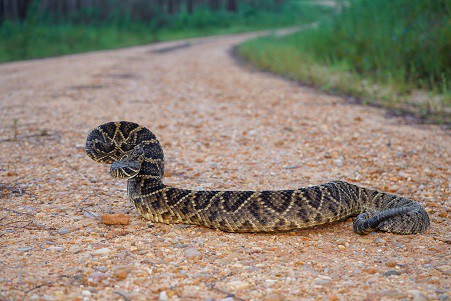
The eastern and western diamondbacks are constantly dueling over which causes the highest number of snakebite fatalities on US soil. Both are among the deadliest US snake species, due to their extremely high venom yields, but it’s the eastern diamondback which is indisputably the longer of the two, and comfortably the longest rattlesnake worldwide.
Eastern diamondbacks are fairly shy in personality. They’re found in Florida, Georgia, South Carolina and Alabama, where they prefer to lurk in secluded woodlands. Longleaf pine forests and palmetto flatwoods are two particular favourites, and within these landscapes, they can spend hours underground in burrows of the nine-banded armadillo and gopher tortoise, minding their own business.
Many crazy tales have emerged of this species’ brute length over the years. They still pop up on Facebook regularly, sparking heated arguments between local snake watchers with years of experience, and more sceptical qualified herpetologists. The term “15 footer” has been thrown around before, and given the vastness of the Florida wilderness, it’s likely that one or two of the smaller unverified records have been completely real (although the 15 footer was a pure photography trick).
But as for the official longest ever, the eastern diamondback rattlesnake holds a record of 251.5cm. This easily exceeds the western diamondback at 233.7cm, and the 3rd longest species, the Mexican west coast rattlesnake (Crotalus basiliscus) at 204.5cm.
Meanwhile, the heaviest eastern diamondback of all time weighed 34 pounds. The species’ brute size allows for a generous venom yield, with the maximum of all time being 1000mg, another record for the Crotalus clan.
| 4 | Shortest: Tancítaro cross-banded mountain rattlesnake |
Maximum length: 43.6cm.
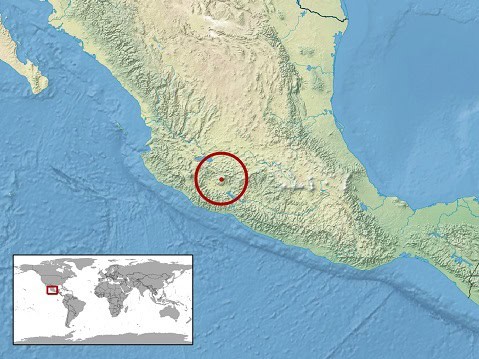
The shortest rattlesnake in the world also has a claim to fame as one of the rarest. The Tancítaro cross-banded mountain rattlesnake (Crotalus tancitarensis) was only discovered in 2004, and is found exclusively in Mexico’s Parque Nacional Pico de Tancítaro, in Michoacán state. Within this park, it’s only known from the slopes of one extinct volcano, the park’s namesake Pico de Tancítaro.
This volcano is believed to have last been active 237,000 years ago. These days, it’s a rich ecological paradise covered with pine-fir forests, deer and armadillo, It reaches a peak of 3840 metres, with snowfall sometimes falling on the upper reaches. The Tancítaro cross-banded mountain rattlesnake is poorly researched, and lives at over 3000 metres, usually in the many pine-fir forests. It’s a particularly dark species in colour, with only black bands overlaying a nearly black body.
In 2007, scientists ventured back to the volcano and examined 9 new individuals of the species. The maximum length of these was 43.3cm, while the longest of the originals from 2004 measured 43.6cm. This falls well below other short species like the pygmy rattlesnake (Florida) and ridge-nosed rattlesnake (Arizona).
The scientists also discovered the species’ diet. They brought one female into captivity, and presented her with mammals, amphibians, reptiles, crickets and centipedes, but she only accepted the reptiles. One common species on the volcano was the graphic spiny lizard, and the team speculated that this formed their prey base.
Otherwise, the Tancítaro cross-banded mountain rattlesnake remains a highly mysterious species. Thankfully, the volcano is dormant, and there’s no sign of it erupting and wiping the species out in one fell swoop.
| 5 | Most social: Arizona black rattlesnake |
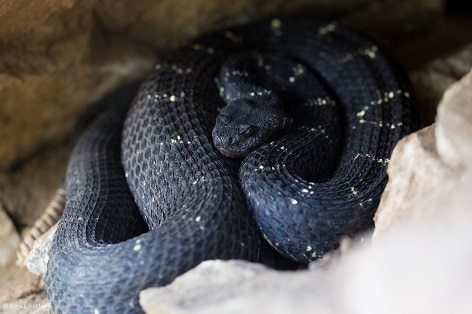
Maximum length: 120cm.
The most social rattlesnake in the world doesn’t appear in a Florida woodland or Nevada desert, but high in the mountains of Arizona. Crotalus cerberus, AKA the Arizona black rattlesnake, appears solely in Arizona, except for a small portion of southwest New Mexico. It appears at elevations of 900 metres or higher, up to at least 2743 metres. Confirmed locations for this species include the Catalina, San Francisco and White mountains, where it usually inhabits forests with plenty of rocky outcrops and crevices to hide in.
Arizona black rattlesnakes are somewhat endangered, and their venom is only moderately potent. Yet this species has the most complex social structures of any snake observed so far, defying the rattlesnake’s vicious reputation. Arizona black rattlesnakes live together in large communities, with males, females and juveniles spending time with each other, and even forming friendship groups.
In one observation, a mother prevented another female’s offspring from entering an exposed, more dangerous spot. The 1st female was pregnant herself, meaning that the tiny juvenile couldn’t have been hers. Nevertheless, when the tiny black rattler began leaving a shaded rock shelter, and moving towards open ground, the other mother quickly blocked its path, with a rigid body formation. The juvenile retreated back into the safe darkness.
In several encounters, the researchers approached neonates which were lying alone on the surface. Suddenly, a piercing rattle emerged from the shadows, as adults warned them against approaching the young. Neonates even retreat to nearby shelters when warned by adults. The neonates have cloudy eyes and poor vision due to being pre-skin shed, making this another piece of team work.
Even adult males protect juveniles. In one observation, two adult males allowed neonates to crawl all over their bodies inside a rookery. Though prairie rattlesnakes can gather in communities of over one thousand, and come a respectable 2nd, the Arizona black rattlesnake seems to have the most complex social behaviors so far.
| 6 | Most toxic: tiger rattlesnake |
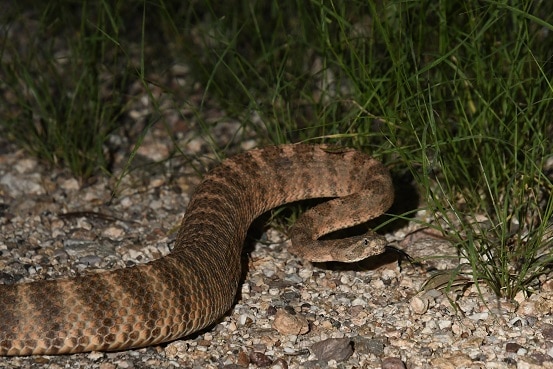
Maximum length: 91.2cm.
The most toxic rattlesnake on Earth lives in a fairly dangerous environment: rolling desert flats interspersed with rocks and cacti, and the occasional desert highway. Tiger rattlesnakes appear in Arizona and New Mexico, but are almost completely separated from the black rattlesnake, appearing in hot lowlands below 1000 metres. They appear mainly in semi-deserts with sparse vegetation, but sometimes edge into rural backgardens in dry settlements.
According to the LD50 count, a measurement of the quantity of venom required to kill 50% of animals injected, the tiger rattlesnake is the most toxic of all 53 Crotalus species. Its venom scores 0.06mg, beating the South American rattlesnake at 0.17mg, and Mojave rattlesnake at 0.18mg.
Not so coincidentally, these are the three most neurotoxic rattlesnakes of the lot. Tiger rattlesnakes have surprisingly simple venom, with just 15 genes driving active toxin production, but they make those toxins count. 66% of its venom mixture consists of the powerful neurotoxin Mojavetoxin, which disables lungs, muscles, and other brain connections.
The tiger rattlesnake also contains powerful procoagulants, which produce clots in the bloodstream, and deplete clotting materials like prothrombin. In fact, according to this 2021 study, the tiger rattlesnake possessed “the fastest pseudo-procoagulant venom ever observed“. The abilities far outstripped the species’ closest relatives, such as the southwestern speckled and Panamint rattlesnakes.
Fortunately, despite this overwhelming display of toxin might, the tiger rattlesnake has never killed a human on record. There’s several reasons, including tiny fangs measuring just 4mm, and a tiny venom yield of 6-11mg, falling well short of the western diamondback’s 200mg+. Tiger rattlesnakes often mingle with humans, but live remotely enough that bites are far fewer than with the western diamondback.
| 7 | Most recognisable: black-tailed rattlesnake |
Maximum length: 152.4cm.
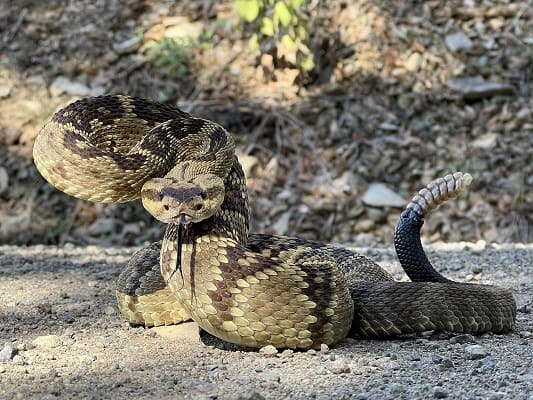
The tiger rattlesnake is fairly easy to recognise, with its tiger stripes, but several others are trickier, such as the prairie rattlesnake and Mojave rattlesnake, which are both beige with fairly indistinct patterns. But there’s one which you could never mistake – the black-tailed rattlesnake.
This species appears across the US south, and has a moderately intense venom, triggering swelling, pain and possibly capillary destruction. Black-tailed rattlesnakes are often found on rocky slopes within deserts and national parks, preferring steeper areas. They often lurk in dark, shadowy crevices, but if you meet one, you’ll probably know about it.
The image above is the clearest you require. This rattlesnake mainly has beige scales contrasting against near black on its main body. Its scales look exceedingly rough, and its head is extremely thick. Until now, you could still confuse this species with another rattlesnake, but when the tail arrives, there’s no way. The tail steadily darkens, gaining ever more melanin pigment until a full midnight black arrives, with no stars shining through either.
When the rattle arrives, this suddenly switches back to beige, creating a sharp contrast. The image above is representative of the species, rather than a fluke anomaly. No other species on US soil possesses such a black tail. The only caveat is that there’s actually two separate species in the USA – the western form found in Arizona and southeast New Mexico, and the eastern black-tail found in Texas and most of New Mexico. Nevertheless, these are extremely similar in nature.
There’s also a Mexican species with a black tail – the Totonacan rattlesnake, but this version lives only in Mexico, and has recognisable diamond-shaped markings on its body.
| 8 | Rarest: Aruba rattlesnake |
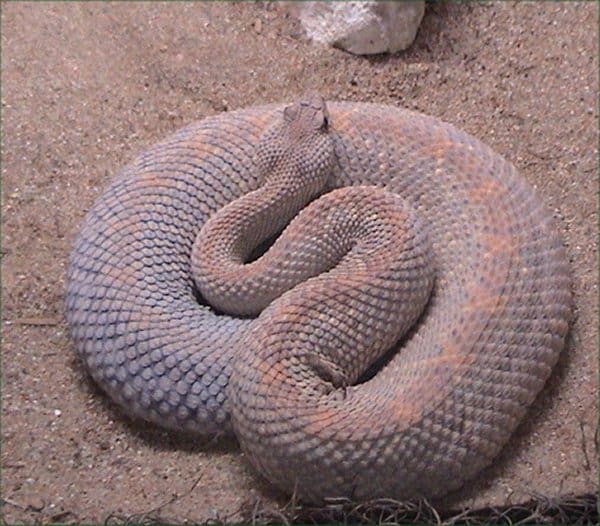
Maximum length: 90cm.
Aruba is a busy tourist island off the north coast of Venezuela, which is gaining new hotels, swimming pools and heavily developed beachfront areas each year, as visitors grow annually. It’s also home to the rarest rattlesnake on Earth – the Aruba rattlesnake (Crotalus unicolor).
This species is recognisable by its lack of most patterns. There’s sometimes faint, alternating blotches of beige and grey stretching down the spine, but this species is often completely plain, sometimes with a pink tinge, as visible above. As usual, it has a triangular head, vertical pupils, and sharply keeled body scales.
The Aruba rattlesnake is estimated to number less than 1000 individuals, perhaps as low as 230 in the wild, and 110 in zoos and breeding programs. It appears in an estimated 12 square miles of protected land, mostly within Arikok National Park, an oasis of pristine land well away from busy tourist developments. Consequently, the Aruba rattlesnake has a rating of “critically endangered” from the IUCN.
Aruba rattlesnakes are generally found on arid hillsides with plenty of rocks and sand. Limestone plateaus and igneous rock formations are a hotspot, including on the slopes of Mount Jamanota, where they appear at up to 188 metres.
Aruba rattlesnakes are believed to have no maternal instincts whatsoever, abandoning their young, and they definitely don’t live in complex communities. The venom of this species isn’t particularly dangerous, and can be combatted by the antivenom of the South American rattlesnake. One advantage they have is skipping hibernation; Aruba is warm enough that its rattlesnake can be active all year round.
| 9 | Most desert-adapted: sidewinder |
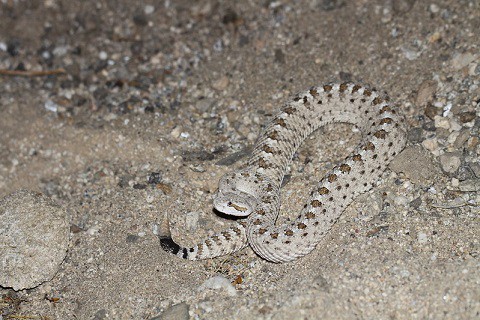
Maximum length: 82.4cm.
Although rock rattlesnakes appear on rocky desert slopes, and tiger rattlesnakes on desert flats with cacti, neither of these compare to the most desert-adapted rattler of all: the sidewinder (Crotalus cerastes). This species appears in 4 states, including Nevada, Arizona, Utah and California. It appears in true deserts, even those with sand dunes, namely the Mesquite Sand Dunes of Death Valley.
Sidewinders move across sand dunes sideways (hence the name), with just two points of their body touching the ground, to minimise contact with the burning desert floor. They have horns above each eye, possibly designed to shield their eyes from the sun. Even their scales are deserted and craggy, with a rough appearance and beige tone.
Sidewinders also have a small presence in far northern Mexico, and are more desert-adapted than any known Mexican rattler. The sidewinder has a more surprising record as well, as among all US rattlesnakes, it moves the highest distances per day. A study found an average daily movement of over 150 metres, compared to 32.9 metres for the tiger rattlesnake, 50.8 metres for the western diamondback, and 42.9 metres for the black-tailed rattlesnake.
The reason is that sidewinders live in open desert territories. They sometimes hide in dark burrows, shielding themselves from the sun, yet the next moment, they might be embarking upon an epic quest to the distant desert hills.
One disturbing characteristic of the sidewinder is forming balls of newborns in underground burrows. The neonates alternate position within the ball, writhing closer to the entrance, before cycling towards the cooler air at the back again, with the goal of temperature maintenance, but achieving a very disturbing appearance.
| 10 | Most US states: timber rattlesnake |
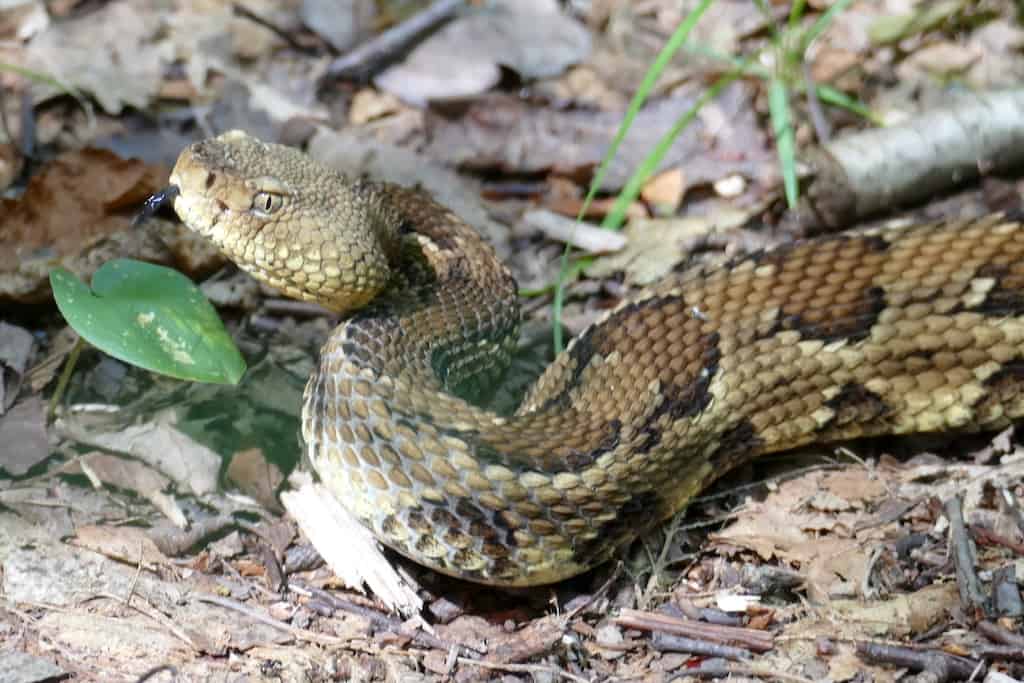
Maximum length: 189.2cm.
The timber rattlesnake (Crotalus horridus) is a species of forests, which holds the official territory record in the US, inhabiting 31 states out of 50. The South American rattlesnake is even more widespread, and the prairie rattlesnake covers just as much raw territory, but tends to inhabit larger western states.
Meanwhile, the timber rattlesnake appears in virtually the entire eastern half of the US. Its western borders lie in Texas, Oklahoma, Kansas and southeast Nebraska. Its northern borders reach Minnesota and Wisconsin, while to the south, they’re plentiful around Houston, Texas.
Most eastern US states are far smaller, allowing the tiger rattlesnake to knock off over 2 dozen. Timber rattlesnakes appear in forests, but are fairly flexible in the exact type of forest, unlike the endangered southern hognose snake, which mainly appears in longleaf pine forests. In fact, they used to be even more common, as they’re extirpated (locally extinct) in a handful of states: Michigan, Maine, Rhode Island and Delaware. A few believe that they may survive in Delaware today. Various local names hint at their former presence, including “Rattlesnake Hill” east of Milton in Sussex County.
In Florida, timber rattlesnakes are only found on the panhandle. This species has a moderately intense venom, capable of triggering swelling and spontaneous bleeding. It’s not a particularly social species, but males and females have been witnessed guarding neonates before, hissing at humans who wander too close to their children.