| 1 | Black racer |
Maximum length: 190.5cm.
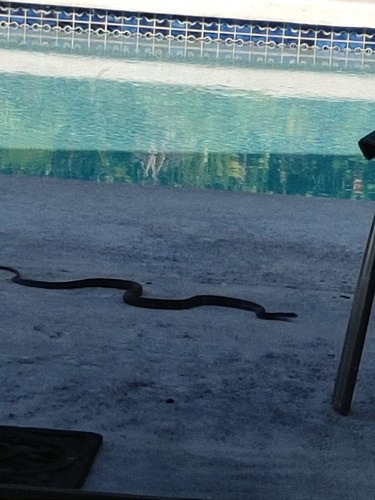
The most likely snake to meet by a Florida swimming pool, and one of the most likely nationwide. The black racer inhabits 47/48 lower US states, and is one of the most energetic species of the entire US. Rather than settling down in one corner of the forest, this species travels far and wide, usually sticking to open areas.
Black racers cover hundreds of metres per day, in woodlands, open fields, playparks and housing estates. Inevitably, this brings them into swimming pools occasionally. In Florida, the black racer is the single most likely snake for you to find in a pool or next to a pool, weaving through deck chairs and causing people to scatter. This snake can rear its head in Walt Disney World and the swimming pool of a 5 star business conference hotel alike.
Though non-venomous, this species is more than capable of spoiling your sunny afternoon. Black racers are aggressive, and willing to bite. Most disturbingly, this species is known to aim for the face above all other body parts. If gripped by the lower body, it can even swing its entire body backwards and still strike the nose or cheek.
Most people will run in fear at the sight of a black racer by a pool, but a select few will laugh, run over and pick the snake up. Neither option is wise. The smartest choice would be to keep swimming and ignore the black racer completely, until it inevitably loses interest and leaves the area (as this is a highly energetic snake).
| 2 | Red-necked keelback |

Maximum length: 1 metre.
Perhaps the most likely snake to meet in a Thai swimming pool. The red-necked keelback combines several of the necessary features for a swimming pool snake. Firstly, it’s a water-loving snake which isn’t fully aquatic, inhabiting drainage ditches, ponds, and puddles which fill up after rainfall. Secondly, it’s more comfortable in urban areas than some of its relatives, such as the rare blue-necked keelback.
Red-necked keelbacks are abundant in Thailand, and have the rare feature of being simultaneously venomous and poisonous. They have a standard venom, but also store lethal toxins in their neck, acquired from amphibians in their diet, which they blast at people from a special neck gland.
Red-necked keelbacks most likely head to pools in search of this frog prey, enter, find none, and then realise that they can’t escape. This is one snake you should never try to rescue from a swimming pool, even if it’s fully bordered by steep sides. A hasty grab for the red-necked keelback’s tail could result in a spray of toad toxins directly to the eyeball.
If a red-necked keelback enters the pool, then evacuate. There’s no time for nonsense with this dangerous species. Fortunately, the signature neck marking makes this snake easy to identify.
| 3 | Banded watersnake |
Maximum length: 158.8cm.
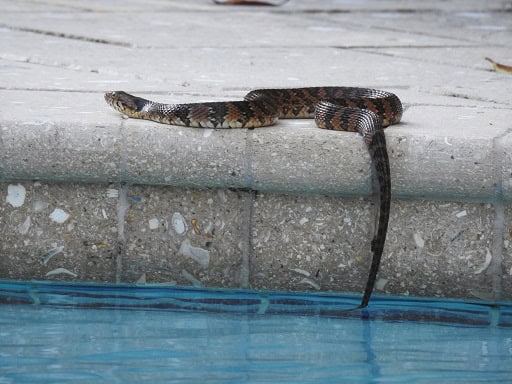
Any member of the Nerodia watersnake genus is a candidate to appear in swimming pools, and the banded watersnake (Nerodia fasciata) is no exception. This species inhabits Florida, Georgia, South Carolina, Alabama and Mississippi, and is recognisable by its repeatedly alternating black and orange (or brown) bands. In a few individuals, the orange dominates and almost takes over the black.
Banded watersnakes prey on a mixture of fish and frogs, preferring fish as juveniles, before shifting heavily towards frogs as adults. Confirmed prey include the gulf killifish, American green tree frog, and southern leopard frog.
If a banded watersnake slithers up a grassy bank and sees a sparkling, clear body of water in front of it, it will probably assume that tasty prey are lurking within. It has no understanding of chlorine, or human swimmers and their fears. Perhaps its lake has been depleted of frogs lately due to pollution. Perhaps it needs a bountiful new source of meals.
So the banded watersnake does the logical thing and enters the pool, oblivious to the panic it has just caused. Compared to a black racer, this species is more likely to inspire terror, as it often has viper-esque patterns (see the image above).
Depending on the morph, it would be easy to confuse the banded watersnake for a rattlesnake at a distant glance. In reality, the banded watersnake is completely non-venomous, though aggressive if manhandled.
| 4 | Carpet python |
Maximum length: 4.2 metres.
The carpet python has developed a strong reputation recently for being one of Australia’s top pool snakes. Firstly, this is Australia’s top urban python. While green tree pythons live only in Queensland rainforests, and woma pythons stash themselves deep in outback cracks, the carpet python can be found by bus stops, police stations, and in people’s backgardens, including in Sydney itself.
Carpet pythons have no special affinity for water, but will happily enter a pool to cool off, or for other mysterious reasons, as the video above shows. One infamous story lately involved a hungry python that dragged a 5 year old boy into a pool in order to drown him. Young Beau Blake survived unharmed, as his father rapidly rushed to the rescue, and while the python wasn’t officially identified, its facial markings closely resembled a carpet python’s.
Another swimming pool tale involved a carpet python which was severely ill. It was covered with around 500 ticks, which were sucking its blood, and had led to the python becoming horribly deformed.
Its swollen skin bulged out of its scales, and when wildlife authorities rescued the underwater python from a backgarden swimming pool, they believed that it was making a last-ditch effort to drown the ticks. The carpet python was nicknamed Nike and moved to a wildlife sanctuary to recover.
| 5 | Golden crowned snake |
Maximum length: 98cm.
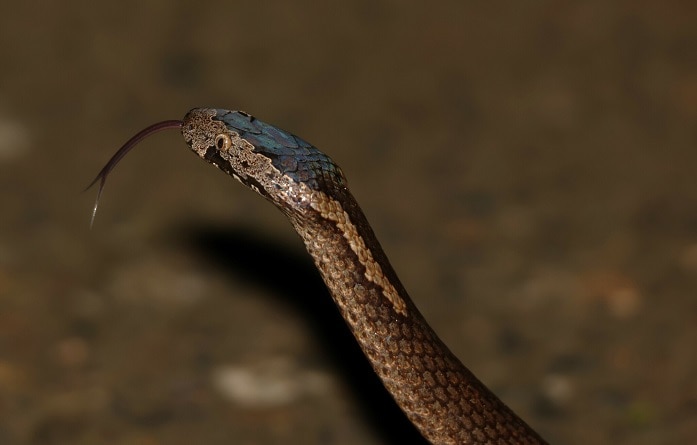
The golden crowned snake (Cacophis squamulosus) is a mildly venomous species of Australia which averages at 50cm. This snake is dependent on moisture rather than dry outback, appearing in rainforests and sclerophyll forests in the wild. In suburban Sydney and Brisbane, it’s usually found close to water sources, and that includes the safe haven of swimming pools.
Golden crowned snakes may fall into swimming pools accidentally, or be lured in by the promise of cool moisture. According to this snake catcher, golden crowned snakes are constantly chasing frogs into backgarden pools, before falling in and getting completely stuck. This species is nocturnal, so there’s no humans swimming back and forth to deter them.
There’s no master plan with this species, as they’re lured to swimming pools opportunistically, and may not realise they’re trapped until it’s too late. Away from swimming pools, golden crowned snakes are particularly common in puddles that form in suburban streets after heavy downpours.
In one case, a golden crowned snake was found in a pool and felt very limp when handled, as though close to death (perhaps due to chlorine). But it suddenly reactivated with a tongue fleck, and all was well again.
| 6 | Pygmy rattlesnake |
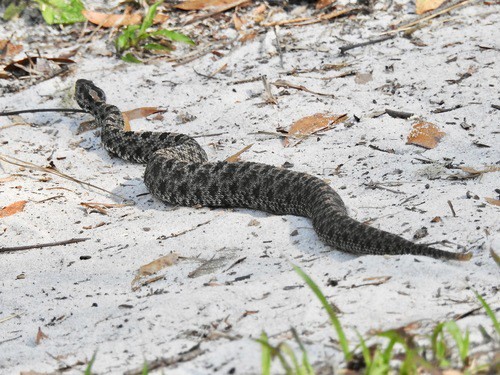
Maximum length: 80.3cm.
If you wish to seek refuge from the millions of rattlesnakes prowling the USA, a swimming pool is undoubtedly better than a forest. But even the most impenetrable fortress isn’t invulnerable against rattlesnakes, and the pygmy rattlesnake (Sistrurus miliaris) proved this in a case from 2012.
Wayne Wilburn and his family of 4 had arrived at the Windsor Hills Resort south of Orlando that afternoon, and went for an immediate swim. They soon encountered a rattlesnake, and Wilburn attempted to fight off the hissing serpent with a stick, but ended up receiving a bite to the thumb. He was taken to intensive care, where he survived, but required 3 vials of antivenom.
Pygmy rattlesnakes generally inhabit forests with plenty of fallen timber, but also gravitate to water bodies within forests. A swimming pool directly next to a forest may be a risk in Florida, perhaps if your gated holiday community is the last in a row of them, and directly borders the area where the Florida wilderness kicks in again.
The pygmy rattlesnake is a relatively lazy species, sometimes moving just 5 metres per day. This could help or hinder – they might not bother leaving their forests, but alternatively, one could set up camp by your pool for hours, or even several days.
| 7 | DeKay’s brown snake |

Maximum length: 52.7cm.
Of all US snakes, DeKay’s brown snake (Storeria dekayi) has to be the most surprisingly common to find in swimming pools. Numerous owners and tourists have scooped this small, 20-30cm snake out and inquired to the internet about which species they’re holding, including citizens of Arkansas, North Carolina and Kansas.
DeKay’s brown snake is a small, humble snake, which is completely non-venomous. It lacks any dangerous teeth, and its main prey is earthworms. This is perhaps the most common snake in urban areas of the eastern USA. DeKay’s brown snake is highly likely to appear in your garden, and this extends to the chlorinated delights of swimming pools.
Unlike the banded watersnake, this species isn’t semi-aquatic, but has no issue with water either. Chlorine is another question, however, as this species could wither and die if not rescued. Always be sure to correctly ID a snake first before rescuing.
Another scenario is that a DeKay’s brown snake enters your pool, and nobody but you realises that it’s completely harmless. Before you realise, the entire pool has emptied, with grandmas and toddlers fleeing as fast as they can, leaving you with the pool all to yourself, having conveniently forgotten to tell everyone which species it was.
| 8 | Red-bellied black snake |

Maximum length: 254cm.
Another likely species for an eastern Australian to find swimming around their pool. This species inhabits a huge swathe of the east coast, and is especially flexible, inhabiting virtually all watery habitats. Red-bellied black snakes are the undisputed rulers of local swamps, and they also made our list of official beach snakes, with a stunning seaside photograph.
In the action-packed life of a red-bellied black snake, a swimming pool is just another obstacle to be brushed aside. They probably don’t notice the scores of panicking tourists fleeing, splitting down the centre of the pool like the parting of the Dead Sea. Red-bellied black snakes just care about their mission of satisfying their hunger for frogs, although they won’t actually find any in the average backgarden pool.
Frogs comprise most of this species’ diet, including the likes of emerald-spotted tree frogs. Red-bellied black snakes are simple to recognise by their black back and vivid red underside, which looks like a volcanic eruption at midnight. Don’t be surprised to see a red-bellied black snake resting calmly in the shallow end one minute, then hurtling towards you at full speed the next.
This is a dangerously venomous species, so approach with caution. According to the photographer above, the same pool had played host to a golden-crowned snake a few days earlier.
| 9 | Ringneck snake |

Maximum length: 85.7cm.
Ring-necked snakes (Diadophis punctatus) are found all over the US, and appear most commonly in local woodlands, lurking under old sheet metal and rotting logs. Yet they also stray to people’s gardens, and even pavements near forests. They’ve been found near Splash Mountain in the Magic Kingdom in Florida before, and another watery place they’ve conquered is people’s swimming pools.
Ring-necked snakes are completely harmless, and only ever bite if their neck is pressed. They prey heavily on ants, and rarely exceed 30cm.
Theoretically, there’s no reason against sharing a pool with this snake. You could train the breaststroke at one end, and the ringneck snake could float harmlessly in the shallow end, pondering its next move.
Fortunately, there are no venomous snakes which ringneck snakes closely resemble. Their plain body and signature neck band make them impossible to miss. Somehow, the image above was miscaptioned as a pygmy rattlesnake, yet it looks nothing like one. There is one risk – that a predatory bird swoops in to eat the ringneck snake while you’re rescuing it, slashing you with its greedy talons.
| 10 | California kingsnake |
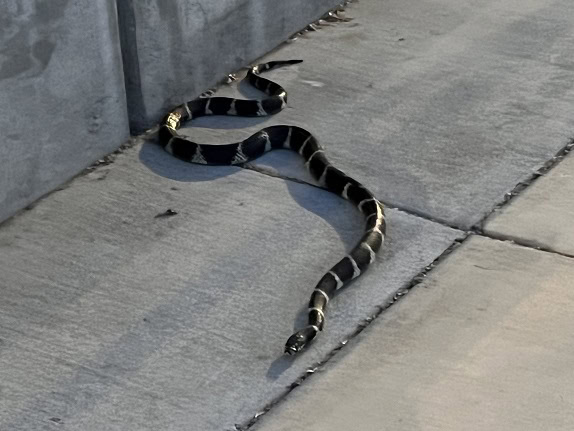
Maximum length: 142.2cm (mainland), 2 metres (islands).
An extremely adventurous species, which eats mammals, lizards and fellow snakes alike. The California kingsnake is an adventurous species which prowls around the lush California countryside, constantly flecking its tongue, and attempting to pick up any scent trail which offers clues. It’s extremely flexible in its habitats, and this flexibility often brings it to the chlorinated waters of swimming pools, or the warm tiles and deck chairs adjacent to them.
California kingsnakes aren’t aquatic, yet are flexible enough to swim across water bodies when need be. This is a non-venomous constrictor, which has the most disproportionately strong constriction powers of any snake in the USA.
Unlike some other pool snakes, California kingsnakes aren’t reliant on frogs for their prey. Instead, they’re so adventurous that they automatically enter swimming pools, due to their constant explorations.
California kingsnakes are also incredibly easy to recognise. There’s no other snake in California with such vividly contrasting black and white patterns. Remember this when people insist that a rattlesnake is floating in your local swimming pool, just waiting for you to dive in.