
| 1 | Black-tailed rattlesnake |
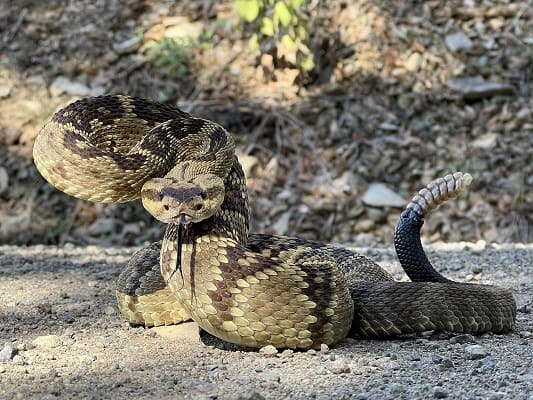
The black-tailed rattlesnake is one of the easiest venomous snakes to recognise in the entire USA. Their scales are beige or grey, and they possess the usual segmented rattles which they shake furiously at people who dare to stray too close. Most importantly, their tail is the colour of midnight, only becoming lighter when the rattle scales begin. Compared to their neighbours in the southern US, including the western diamondback, tiger rattlesnake and prairie rattlesnake, this tail is unique…
However, there’s one small complication: the black-tailed rattlesnake is actually two species. This was only made official in 2012, following detailed genetic analysis. It turned out that the black-tailed rattler had a western and eastern population, which had sufficient DNA drift to become fully independent entities rather than just subspecies.
According to the new update, the western black-tailed rattlesnake (Crotalus molossus) occupied Arizona, western New Mexico, as well as a huge swathe of Mexico. The eastern black-tailed rattlesnake (Crotalus ornatus) was found in Texas, plus most of New Mexico, and parts of far northern Mexico (Chihuahua state). It was estimated that the two had diverged 4.63 million years ago.
Both species have a moderately dangerous venom, which lacks the neurotoxins of a tiger rattlesnake, but is capable of inflicting serious swelling and spontaneous bleeding. Both species possess an equally black tail, and an equally terrifying strike warning pose (see above).
| 2 | Common kingsnake |
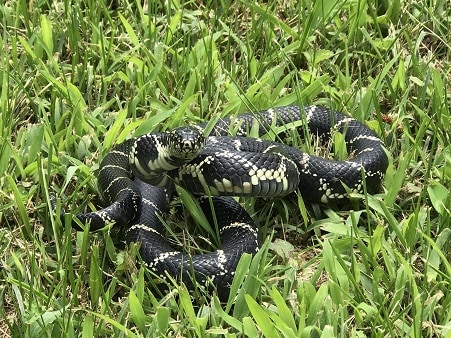
In recent times, few US snake species have been sliced and diced quite like the common kingsnake. This non-venomous constrictor was once one of the most common species nationwide, ranging from Florida in the east to California in the west. It came with a large number of subspecies, such as the California kingsnake and desert kingsnake, each with subtly different patterns, but fairly similar colours of black and pale cream.
Since the year 2000 though, large chunks of the common kingsnake empire have been shaved off, one after another. Over half of its former subspecies have been made independent.
The California kingsnake now controls 4 states of the west, while the speckled kingsnake has been made independent in states like Arkansas and Oklahoma. The desert kingsnake is in control of southern Texas and New Mexico, while yet another species to have been made independent is the black kingsnake, found immediately to the east of the Mississippi.
These days, the original common kingsnake (Lampropeltis getula) is found only along the US east coast, in states like Florida, Georgia and the Carolinas. Since 2000, 4 new snake species have been created from the common kingsnake complex. Though subtly different in patterns, all are extremely powerful constrictors relative to their size, and non-aggressive towards humans.
| 3 | Prairie rattlesnake |
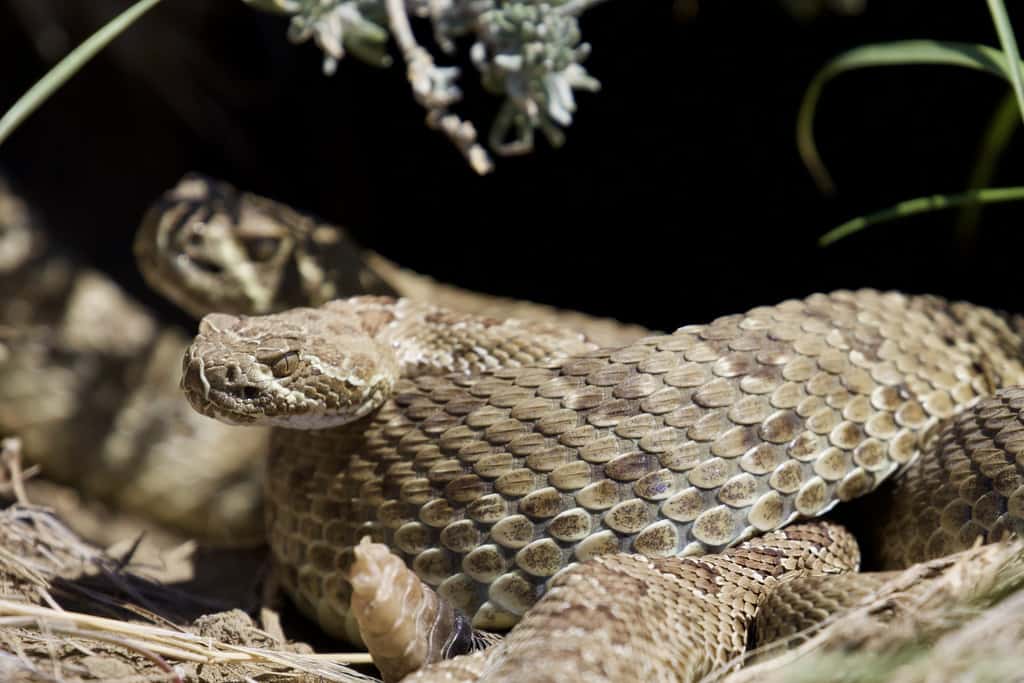
The black-tailed rattlesnake isn’t the only member to have contained undiscovered secrets. In fact, of all rattlesnakes, the prairie rattlesnake (Crotalus viridis) is the member to have been broken down and separated the most. This is a fairly pale species of the mid-west, which covers a huge swathe of land, and blends superbly with dry wispy grasses. Prairie rattlesnakes lack neurotoxins, but become more myotoxic with age, targeting muscle cells.
The first massive change came when those along the west coast became an independent species: the Pacific rattlesnake (Crotalus oreganus). All at once, the prairie rattlesnake lost its entire territories in California, Oregon, Washington state, and even far southwestern Canada.
Then came further breakdowns. The many subspecies of the prairie rattlesnake came under focus, in various sub-deserts and sub-valleys, and even high mountain peaks. For example, the Crotalus viridis members in Arizona’s Catalina and San Francisco mountains were unusually black and existed only above 1000 metres in altitude, avoiding the hot deserts lower down. The result: they were split into an independent species, the Arizona black rattlesnake (Crotalus cerberus) in 2009.
The Great Basin rattlesnake (Crotalus lutosus) of Nevada is also believed to be independent these days. The midget faded rattlesnake (Crotalus concolor) of Colorado and Utah was split away with the Pacific rattler, but then made independent itself. Others are still being examined, such as the Grand Canyon rattlesnake (Crotalus abyssus). Technically, there’s the same quantity of rattlesnakes in the US as there always was, but new species are bursting into existence left, right and centre.
| 4 | Sharp-tailed snake |
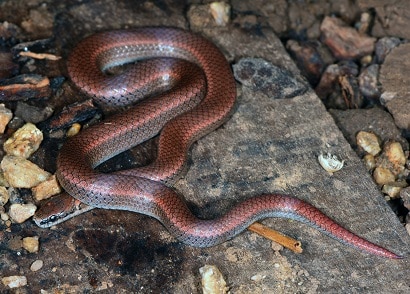
The sharp-tailed snake (Contia tenius) is a shy, non-venomous snake found in California, Oregon and Washington state. It’s a lover of cover objects such as rotting logs and pieces of sheet metal, which averages at just 30cm and is safe to pick up. Its sharp tail is designed not for offence, but skewering slugs, its main prey.
Sharp-tailed snakes are difficult to research, vanishing deep underground during winter, and there’s one pretty huge fact which nobody noticed for over a century – that they actually contained 2 species.
Scientists gathered genetic samples from California in 2002, and following 8 years of analysis, announced a new species in 2010 – the forest sharp-tailed snake (Contia longicauda). These were from previously known populations in the wet forests of California, deeper inland and away from the coast. Due to their vast similarity in appearance, with a reddish body with few patterns, nobody had realised they were independent.
The forest sharp-tailed snake had similarly shy habits to its cousin, and a non-aggressive nature. One giveaway was its tail, which was significantly longer, comprising 20% of its total body length versus 14.5% for its more widespread cousin. The new species also had a less patterned tail underside, with fewer black markings than the regular sharp-tailed snake. The sharp-tailed snake was originally described in 1852, meaning that it took 150 years for this hidden species to be discovered.
| 5 | Cottonmouth |
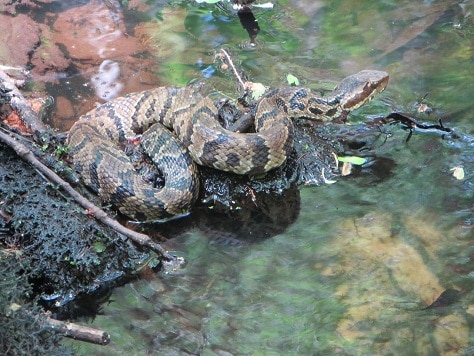
For citizens of the southeastern US, it’s a fact of life that any gloomy swamp or large lake could contain a cottonmouth, just waiting to lunge at people. Cottonmouths have been assaulting people since the early days of European colonists, but something which has only recently become apparent is that the “cottonmouth” contains two species: the northern cottonmouth (Agkistrodon piscivorus) and Florida cottonmouth (Agkistrodon conanti).
The Florida cottonmouth was originally a subspecies, and was only officially separated in 2014. This species occupies virtually all of Florida, appearing in no other state. The northern cottonmouth occupies the rest of the US territories, just extending into northern Florida, where the two species have a slight area of overlap.
Physically, the two species are very difficult to distinguish, which is partly why the division went unnoticed for so long. Florida cottonmouths have cleaner, brighter facial markings overall, yet they also have a specific pattern which the northern form lacks; two vertical stripes on the snout.
Florida cottonmouths also have a slightly longer tail, accounting for 17.4% of tail body length versus 15.9% for the more common cottonmouth. In terms of their swampy habitats, and murky colours, the two species are nearly indistinguishable, yet are genetically separate.
| 6 | Copperhead |
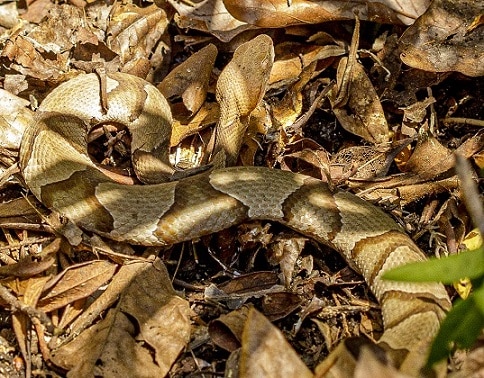
The cottonmouth’s close cousin the copperhead (Agkistrodon contortix) also saw a separation recently, though this time a much more recognisable one. The copperhead is the cottonmouth’s woodland cousin, occupying orange and beige leaf beds rather than gloomy swamps.
Copperheads once ranged from Massachusetts to extreme northern Mexico, yet those in the west turned out to be a completely different species: the broad-banded copperhead (Agkistrodon laticinctus). This species also occupies western Texas, Oklahoma and Kansas, with a small areas of overlap with the eastern copperhead, such as near Fort Worth, Texas.
Physically, broad-banded copperheads are easily separable, due to their namesake patterns. Both species have bright orange and brown patterns, but in the broad-banded copperhead, these are straighter and more orderly. In the eastern form, such as in Georgia or South Carolina, the bands are wavier, sometimes taking the form of hourglass patterns.
Broad-banded copperheads are also significantly shorter, with an all-time record of just 94.6cm, compared to 134.6cm for the eastern copperhead. Similarities of the two species include a stationary hunting style, and a bright green tail tip in juveniles, which usually fades into adulthood.
The broad-banded copperhead has been known about for decades, but was considered to be a mere subspecies. That all changed in 2014, when yet another new venomous snake was born on US soil.
| 7 | Scarlet snake |
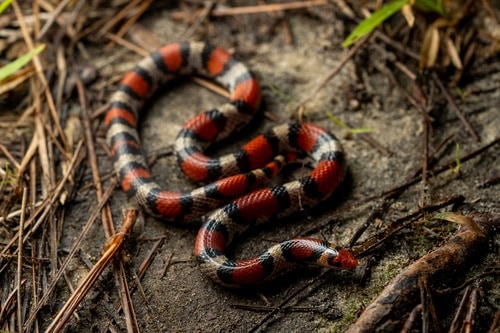
One of the best pressurisers for creating new snake species within a continent is a colossal, freezing ice sheet. Glacial expansions have caused several new species to emerge in the USA, one of which is the Texas scarlet snake (Cemophora lineri).
Originally, the scarlet snake was thought to be one species, found in Florida, Georgia and Alabama, all the way to southern Texas. This is a shy species found on sandy woodland floors, and occasionally beaches, where it hunts for stashes of turtle eggs hidden carefully by turtle mothers, before hacking into them with a severely enlarged front tooth and drinking the egg yolk within. This front tooth is harmless to humans, and the scarlet snake lacks any form of venom.
The scarlet snake was originally though to have a western and eastern subspecies, but in 2017, these were separated into two physically similar, but genetically species: the Florida scarlet snake and Texas scarlet snake. DNA analysis revealed that the two diverged an estimated 1.37 to 4.86 million years ago. The theory was that the ancestor scarlet snake formed one continuous range, until plummeting temperatures and expanding ice sheets forced one population deep into southern Texas, and another deep into Florida.
Initially, the two remained one species, albeit highly separated geographically. But over time, the two diverged enough to be considered independent. The Florida scarlet snakes migrated northwards again when the ice sheets melted, while the Texas scarlet snake is highly rare, inhabiting only southeast Texas. Physically, the Texas scarlet snake has slightly less extensive black marks than its Florida cousin.
| 8 | Eastern coral snake |
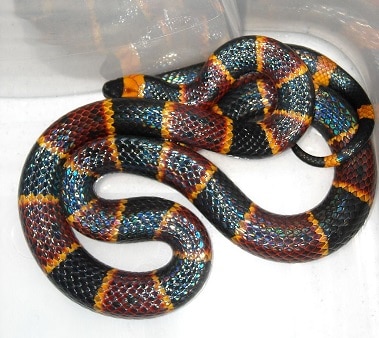
The story of the two US coral snakes is virtually identical to that of the scarlet snakes. The eastern coral snake possesses the deadliest venom on US soil: a neurotoxic mixture capable of disconnecting signals between brains and muscles, triggering weak limbs and respiratory failure. Deaths are thankfully rare, due to a docile nature, although one Hispanic man died in 2006 after being bitten while camping in a tent at night.
The eastern coral snake mainly inhabits Florida, Georgia and South Carolina. The Texas coral snake covers a significantly larger geographical area, ranging from Arkansas in the north, almost to Mexico City in the south.
The two were originally thought to be mere subspecies, but the story was very different, as these coral snake cousins were found to have a separated 0.3-1.8 millions years ago, which according to most theories, is well before humans became the modern Homo sapiens that we are today. This separation was almost certainly caused by ice sheets expanding and retreating, like with the scarlet snake.
Hence, the Texas coral snake officially became independent in the 1990s, adding another highly neurotoxic snake to the US, joining just a small handful such as the tiger rattlesnake and Mojave rattlesnake (the most dangerous rattlers). The two coral snakes are tricky to distinguish, except with one ID feature: the black neck collar extends significantly further up the head in the Texas coral snake.
| 9 | Fox snake |
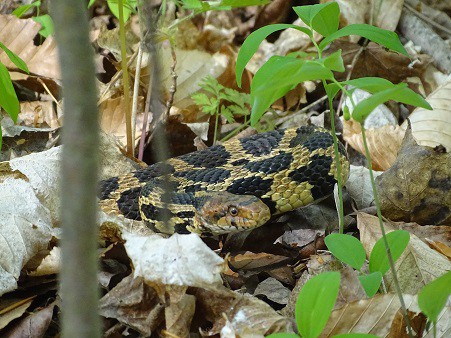
The western fox snake belongs to the same Pantherophis genus as the corn snake and US ratsnakes, but is much rarer. It’s a restricted species in habitat, occupying open marshy areas in Ontario, Wisconsin and Michigan, and disappearing rapidly whenever new houses move in. Fox snakes prey heavily on birds eggs, even the eggs of barnyard chickens. They’re fairly slow-moving, and pose no threat to humanity, lacking even a mild venom.
In 2011, the fox snake family tree underwent a massive change, which was one of the more confusing taxonomic revisions for a snake. Originally, there was thought to be two species: the western fox snake (Pantherophis vulpinus) and eastern fox snake (Pantherophis gloydi). The latter covered a small, separated pocket in eastern Michigan and southern Canada, while the western fox snake covered the rest of the range, on both sides of the Mississippi River. But it turned out that those eastern pockets lacked sufficient genetic separation, despite being isolated, and were hence reabsorbed into Pantherophis vulpinus.
Then scientists examined the western fox snakes to the west of the Mississippi River, and found that these were sufficiently separate to be independent. Pantherophis gloydi completely disappeared, but confusingly, Pantherophis vulpinus was switched from being called the western fox snake to the eastern fox snake. Those to the west of the Mississippi became Pantherophis ramspatti, now called the western fox snake.
Western fox snakes have no area of overlap with their eastern cousin. They’re based most heavily in Iowa, covering virtually the entire state, as well as parts of Minnesota to the north. They also cover small areas of South Dakota and Nebraska, but don’t reach Canada, unlike the eastern fox snake.
Compared to other recently split snakes, these two are easy to separate. Eastern fox snakes have the same black and blotchy patterns, but tend to be yellower underneath, with western fox snakes being greyer. The western version also has slightly more blotches, averaging at 42.8 versus 36.8 for the eastern fox snake.
| 10 | Rubber boa |
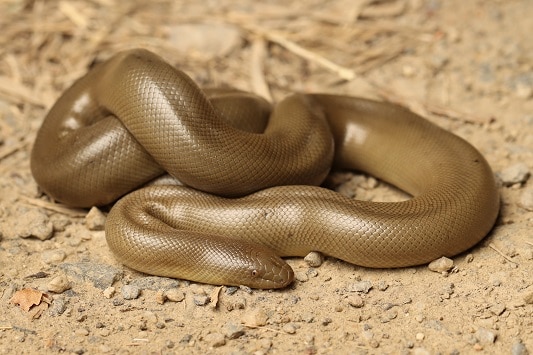
The rubber boa is the most northerly boa in the world, reaching the mountains of Washington state. This is a completely harmless species, which raises its tail high in the air to distract from its head, and if all else fails, coils up into a tight ball and stuffs its head (and therefore brain) in the centre. Rubber boas never reach 1 metre and are found only in mountain ranges, often by the sides of popular hiking trails.
Originally, the rubber boa was just one species, with two confirmed subspecies. In 2001, the southern subspecies was made independent, simply being titled the southern rubber boa (Charina umbricata).
Though the main rubber boa isn’t massively widespread, this new southern form was far rarer. Southern rubber boas are found only in southern California, and confirmed to inhabit just two mountain ranges: the San Bernadino Mountains and Jacinto mountains. They lack any offensive weapons, even a sharp pair of fangs. Their diet is rich in lizard eggs, and all sightings so far have been above 1400 metres in altitude. This is a snake which is completely unable to cope with hotter lowlands.
It’s highly likely that new southern rubber boa populations will be discovered in the years to come, as California’s many mountain ranges are surprisingly poorly mapped when it comes to snake species. Other possible locations for the southern rubber boa include the southern Sierra Nevada and Tehachapi Mountains.
It’s no wonder that the two species were thought of as one for decades, as the two are nearly impossible to distinguish except via subtle scale alterations. One example is the frontal scale, which is semi-triangular in the northern rubber boa versus semi-rectangular in the southern rubber boa.