
| 1 | All-powerful on the east coast |
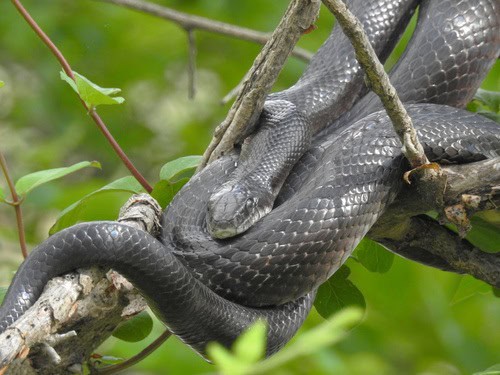
The eastern ratsnake (Pantherophis alleghaniensis) is a large species found in the eastern USA, which lacks any venom, and kills its prey via constriction instead. It’s a fairly long snake, with an all-time maximum of 228cm, and a fairly thick body as well. Although Florida is home to the invasive Burmese python, and the longer pine snake is found in woodlands and forests, the eastern ratsnake is easily the most common constrictor in the eastern US, and definitely the one an ordinary person is most likely to meet.
Eastern ratsnakes inhabit around 17 states in total, and are abundant wherever they live. Their southern territories stretch to the tip of Florida, as they have a presence in virtually the entire state, from the northern panhandle to the glitzy central areas near Orlando.
To the north, eastern ratsnakes are abundant in Georgia, the Carolinas, Virginia, Pennsylvania, and more, only coming to a halt in Vermont. While they don’t quite reach frosty Canada, they inhabit virtually every east coast state, with the exceptions of Maine and New Hampshire.
Rather than aggressive and maniacal, this is a patient prowling snake, which moves around its domains slowly and deliberately. After capturing a mouse or bird, it applies a couple of loose soils, before applying a deathly squeeze, and swallowing its prize headfirst.
| 2 | A regular urban snake |
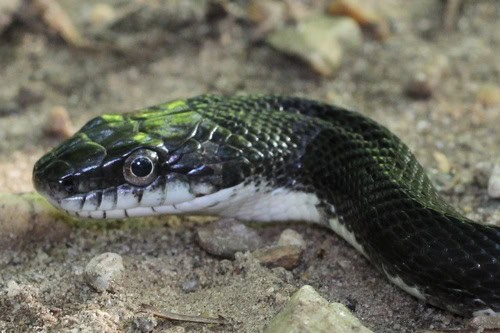
Eastern ratsnakes are completely non-threatening to human beings, and there’s no cause for panic if you meet one. But they do have one great speciality – being one of the USA’s top urban snakes.
In a natural world, the eastern ratsnake’s habitats include deciduous forests and a mixture of thickets and tree clumps near fields. Yet somehow, this species is extremely adaptable to manmade environments, barely suffering when human beings move in and take over. There’s nothing extreme about seeing this species slithering through a backgarden, across a wooden porch, or even crossing a busy road, before possibly ending up as roadkill.
Eastern ratsnakes appear in major cities such as Raleigh, Charlotte, Philadelphia and Gainesville, as well as countless smaller towns in the eastern USA. If you want to find a snake simply by walking out your front door, then this species is one of best candidates. You might not even need to leave your house, as an eastern ratsnake could easily slither through your garden as you sit peacefully drinking a beer in the evening.
Another advantage of eastern ratsnakes is being thick-bodied and slow-moving, making them much easier to spot, whether in a park or leafy suburb. Another common urban snake is DeKay’s brown snake, but this species is much shorter (30cm), and has a tendency to hide under disguising cover objects.
| 3 | Master of nest raiding |
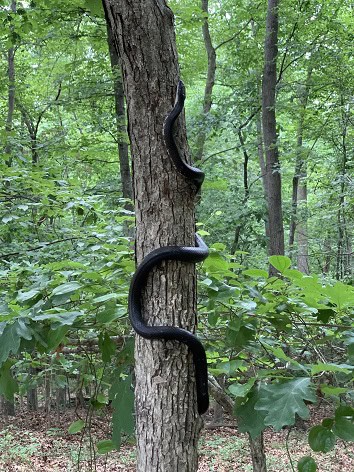
Eastern ratsnakes are longer than the vast majority of US snakes, with an average length of 100-180cm. Another of their specialities is tree-climbing, as eastern ratsnakes can ascend even vertical tree trunks with ease. They ascend trees relatively slowly, rather than zipping up like a maniac, but they always accomplish their goal in the end.
Eastern ratsnakes slither up brick walls as well, before nestling themselves in peoples’ dark attics, amid cobwebs and wooden rafters. The reason is their dietary preference: birds and bats. The eastern ratsnake is the top bird-eating snake of the entire eastern USA. Confirmed prey include American robins, northern cardinals, northern mockingbirds, house finches, blue jays and red junglefowl.
Bats are confirmed as well, specifically the southern myotis bat. Eastern ratsnakes also prey heavily on bird eggs, and it’s perfectly normal to find one resting by your garden fence with a round bulge moving slowly down its throat.
One bizarre incident took place in Brevard County, Florida, when a ratsnake was found to have swallowed a table-tennis ball by accident, mistaking its round smoothness for an egg. This ratsnake had casually invaded the owner’s garden, showing no fear of brick walls, wooden fences, or sharp backgarden tools.
| 4 | Pretends to be aggressive |
As well as birds and bats, eastern ratsnakes derive a large chunk of their calories from small, scurrying mammals, such as rats and mice. Another prey in scientists’ logbooks is eggs of the American bullfrog, although amphibian meals are very rare for this species.
When confronted with large predators or perhaps even a human, eastern ratsnakes are unable to deliver any venom, because they don’t possess a single drop. But they do possess the dark arts of intimidation.
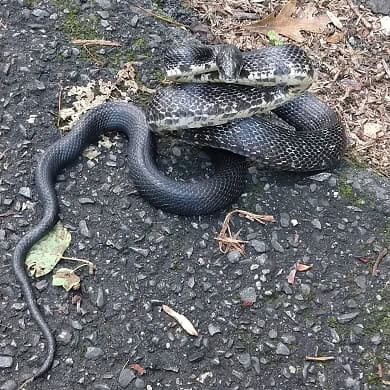
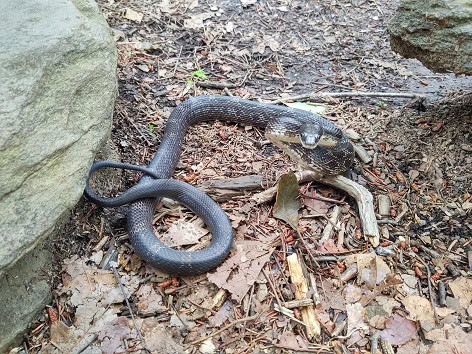
The eastern ratsnake’s strategy when confronted is to throw its entire upper body into the air, and shift itself into a tight S-coil. Its next move is a piercing hiss, followed by several mock lunges, designed to convince the predator that this snake is deadly serious.
When coiled into an S-shape, eastern ratsnakes always face the predator head on – see the image above. The one weakness of this species is a tendency to lose all aggression when gripped. If its bluff strike fails, then the eastern ratsnake will go completely floppy in your hands. Eastern ratsnakes are perfectly safe to pick up, unlike the black racer, another non-venomous Florida species, which is not just viciously nippy, but aims for the face preferentially, often drawing blood.
| 5 | Hibernates with other snake species |
Eastern ratsnakes are semi-communal in nature, as underground hibernacula have been discovered containing several unrelated species: eastern ratsnakes, black racers, and even venomous species like copperheads and timber rattlesnakes. These species coexist perfectly peacefully, without even snapping at each other or growing nervous in each other’s presence.
Don’t bother trying to find this snake in mid-winter, as eastern ratsnakes typically enter their hibernation dens in October, and only emerge in March or April. Their favourite areas are shadowy underground chambers, often in rock formations within woodlands. The copperhead also favours these rocky outcrops, which is why the two species are often found side by side.
South-facing slopes are also hotspots for hibernating eastern ratsnakes, in order to maximize the sun’s warmth during its weaker months. Like many snakes, eastern ratsnakes are somehow able to sense precisely which slopes face a certain direction. In Virginia or North Carolina, there’s a legitimate chance that a sheer rock face in a hilly woodland contains a few hibernating eastern ratsnakes, perhaps a rocky outcrop which you walk past every day, as leaves crunch underneath your feet.
Obviously, there’s one thing we never recommend – poking your arm in. Eastern ratsnakes may rarely attack human beings, but that doesn’t mean their secret hibernation buddies feel the same way.
| 6 | Two morphs: black and yellow |
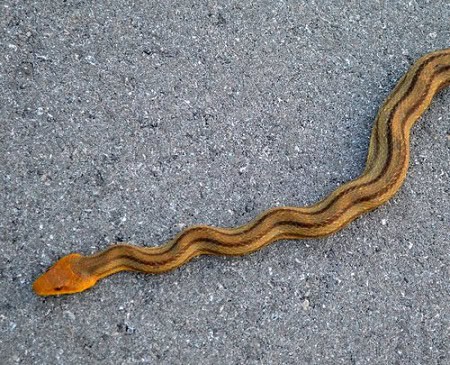
Eastern ratsnakes lay eggs, typically in batches of 5-27. Their favourite stash zones include sawdust piles, compost heaps and decomposing logs. These eggs hatch from July to September, unleashing a fresh batch of baby eastern ratsnakes into the world, not all of which survive.
One characteristic of this species is that at birth, eastern ratsnakes look very different to adulthood. They begin life as a stonier grey with darker blotches, more closely resembling a grey ratsnake (found further west).
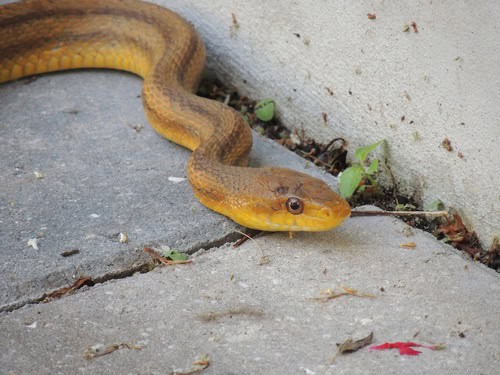
Into adulthood, the grey vanishes and is replaced with either yellow or grey, which are morphs found within the same species. The yellow morph is most common in Florida, and is an orange-yellow overlaid with parallel lengthways stripes. The tongue always remains black, regardless of body colour.
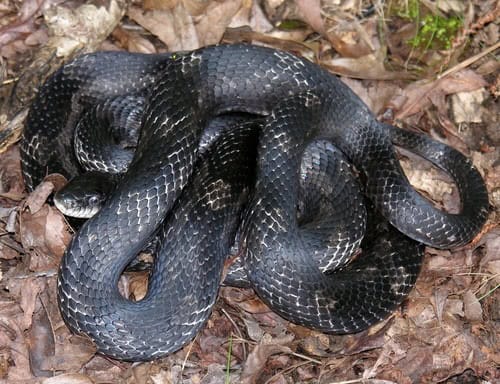
The more common morph, especially further north, is a pure black – hence the alternative name of black ratsnake. This version is interspersed with occasional white markings, which is actually skin visible between its scales.
Eastern ratsnakes always have round pupils, with medium-sized eyes. Like the corn snake, their body is adapted for tree climbing. In a cross section, their body is not round, but shaped like a loaf of bread, with a flattened belly, which has keeled scales to enable gripping in soft tree bark.
| 7 | Resting place: flooded logs |
The forest is full of possibilities, and eastern ratsnakes have many places they can take shelter in. Overgrown brush, cracks in tree trunks and hollow logs are all likely. But they have one favourite above all: hollowed-out branches submerged in water.
Eastern ratsnakes are especially common in thick branches which have detached from their parent tree, landed near water, then rotted away starting with the core. They can rest peacefully in these watery shelters for 1 day, 10 days, or up to 34 days. Some of these branches have had an opening just 5cm thick.
Eastern ratsnakes often rest inside these flooded branches with fellow species members, whereas they share space less commonly in dry refuges. This included males with females, and females with females. Scientists have noticed that pregnant females are the most likely to rest in submerged branches, hinting that they offer some advantage for egg-laying, perhaps superior shelter against roaming predators, given the tiny 5cm openings.
When scientists created 56 artificial submerged cavities, and left them around woods in South Carolina, the ratsnakes ignored them. Only one ratsnake entered a fake shelter over 2 years, whereas when 45 eastern ratsnakes were tracked over 4 years, 22 of them rested in submerged logs. Eastern ratsnakes aren’t idiots, and have very specific natural characteristics they search for. Summer was the most likely time to find them in submerged logs.
| 8 | Nest-raiding tactics |
In 2015, a study compared the three main nest-raiding snakes of the eastern US: eastern ratsnakes, corn snakes, and the unrelated black racer (Coluber constrictor). The site was Savannah River country in South Carolina, right in the heart of eastern ratsnake territory.
All 3 were skillful at slithering directly up tree trunks and raiding nests. Only black racers ate adult birds, but all three favoured nestlings above all, sometimes just 6 days old.
Black racers preyed on nests exclusively during daylight, while corn snakes did so only at night. The eastern ratsnake was the only species to raid nests during both day and night, though its peak hours were between 20:00 and 22:00. Corn snakes raided nests later in the night, including as late as 02:20.
The ratsnakes were also less aggressive than their corn snake cousin. In 11 cases, corn snakes approached defensive adult birds closely enough to make contact. In 6 cases, they actually shoved the parent aside to access the nestlings beneath. Meanwhile, eastern ratsnakes only struck at adult birds 3 times, and never made actual contact with adults.
Overall, eastern ratsnakes were the highest ranked bird predator, accounting for 28% of nest failures, versus 15% for corn snakes, and 12% for black racers. Coachwhips contributed a small share at 5%. Eastern ratsnakes preyed on 6 eggs and 32 nestlings across the study.
| 9 | Prefers forest edges to centres |
Another finding was that eastern ratsnakes almost always (96%) ate their nestlings at the nest, as did corn snakes. Meanwhile, the black racers often dragged nestlings away from the tree before swallowing (36% of the time). This is probably because black racers are much nimbler and faster, whereas ratsnakes are slower.
Failure was common, as the eastern ratsnakes fell from branches sometimes while creeping up on nests, landing on the ground below. In an April 2012 incident, scientists heard the distress call of a white-eyed vireo. They discovered an eastern ratsnake fleeing from a nest, with three adult vireos in hot pursuit and launching aggressive attacks. The nest contained 4-5 nestlings.
The nestlings were apparently saved, but later that day (20:05), a different eastern ratsnake arrived and ate them. The parents had apparently let their guard down and left on a hunting trip.
There were difference in habitats too. Corn snakes raided nests much deeper within forests, while the black racers and eastern ratsnakes hunted primarily along forest edges. Additionally, eastern ratsnakes were more likely to hunt birds when close to a secure retreat structure, such as a log, tree stump or overgrown brush. The eastern ratsnake may be a cagier, more cautious snake, because the black racers didn’t care about refuges at all. Occasionally, both corn snakes and eastern ratsnakes pinned nestlings with their bodies, which black racers never did.
| 10 | Uses bird feeders for ambush |
Eastern ratsnakes are unbeatable on the east coast when it comes to bird hunting, and they get inventive in pursuit of their morbid goals. The location was a garden in James City County, Virginia, containing an iron pole 1.25 metres high with two arms at the top: one with a bird feeder dangling and another holding a flower pot.
Scientists watched as an eastern ratsnake entered the garden, coiled around the pole like a piece of spaghetti, and wound its way slowly upwards over 16 minutes. All the while, hummingbirds were coming and going. The snake clambered onto the flowerpot, then turned its attention to the plastic bird feeder opposite, with its tongue flecking.
The hummingbirds noticed the hungry snake, as they stopped dead when 10cm in front of its face. Yet this didn’t faze them, and they continued to pick up sugar water from the feeder. Apparently, their decision was wise, as the ratsnake made several lunges but failed.
The ratsnake then grew impatient, and slithered directly over the iron arms of the pole, bringing it closer to the bird feeder. Finally, it gave up after 57 minutes of failed hunting, and retreated to the grassy ground.
While this ambush was a failure, hummingbirds are confirmed prey for eastern ratsnakes. This was a manmade bird feeder, so rather than waiting by flowers, eastern ratsnakes are intelligent enough to simply identify areas where they’re congregating.
| 11 | A relatively weak constrictor |
Meanwhile, a 2017 study compared ratsnake constriction powers to those of 3 kingsnakes, with all 6 species originating in the USA. The eastern ratsnake was one of 3 ratsnakes used, along with the corn snake and western ratsnake. The eastern ratsnake was significantly stronger than the former, and slightly stronger than the latter, yet all 3 were dwarfed for raw constriction strength by the kingsnakes.
When the ratsnakes and kingsnakes applied equal numbers of coils to their prey in the laboratory, the kingsnakes somehow exerted greater constricting force. This was in spite of the 3 ratsnakes’ longer lengths. The eastern ratsnake reaches a confirmed maximum of 228cm, while California kingsnakes peak at just 142.2cm (except on remote islands).
Rather than brute size, the secret lies in the kingsnake clan’s superior muscle fibres, and finely tuned instincts for arranging the utmost crushing coil. For example, the 3 kingsnakes were found to have a more uniform coil posture than the ratsnakes.
It was found that the ratsnakes and kingsnakes had similar cross-sectional muscular area, and in both groups, this scaled similarly when the body sizes of the individual snakes increased. It wasn’t raw muscle quantity that made the kingsnakes superior.
The test was fairly conducted, as both groups were given the same prey: the globally widespread house mouse (Mus musculus), which both kingsnakes and ratsnakes regularly prey on in the wild.
| 12 | Hawk wars |
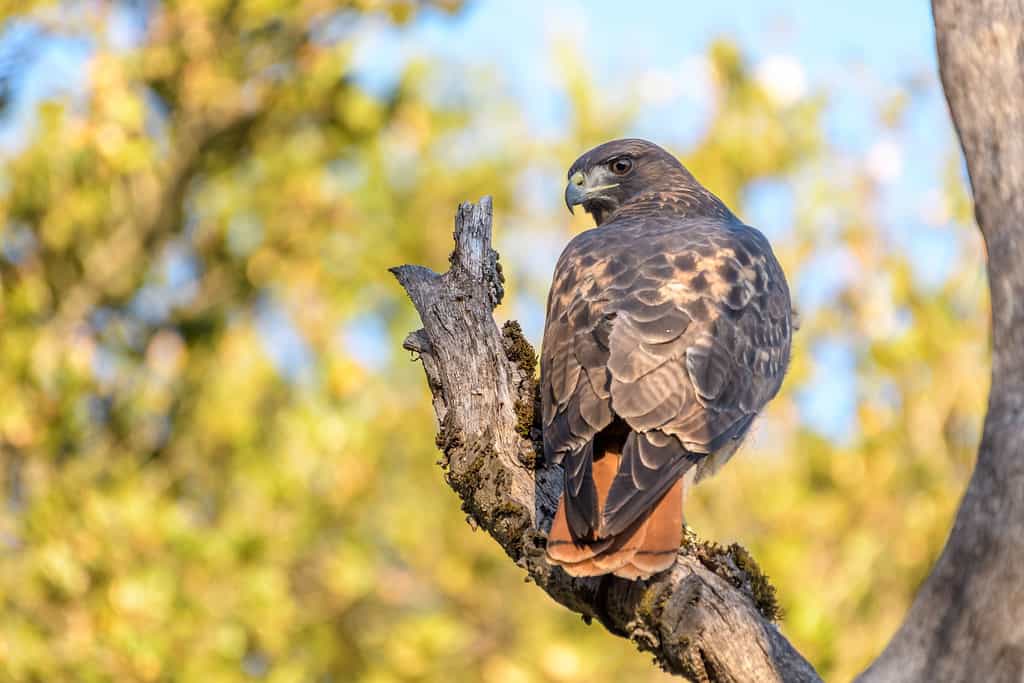
Eastern ratsnakes not only constrict their prey, but use constriction defensively against predators. On April 24th 1998, a battle was observed with a red-tailed hawk (Buteo jamaicensis), which is probably the most snake-addicted bird in the entire USA, with a particular tendency to prey on gopher snakes.
Scientists were exploring a forest access road in South Carolina, when they found a ratsnake and bird interwined in a struggle on the ground. The ratsnake had visible talon wounds, and its lower body was wrapped tightly around the hawk’s neck and chest.
The scientists knew that the ratsnake hadn’t initiated the battle, as it was blue-eyed and therefore shedding its skin, a time when snakes rarely hunt. The hawk was also far too large to be a meal.
As the ratsnake squeezed, the bird’s beak opened and its tongue protruded. The longer the struggle continued, the more the hawk lost strength, and it gradually sank to the ground. The ratsnake continued to squeeze and constrict even 10 minutes after the bird was clearly dead. Furthermore, the ratsnake noticed the human observers while squeezing, and struck at them several times.
Similarly, the western ratsnake has also been seen fighting off a red-shouldered hawk, again coiling immediately around the neck, this time in Monroe County, Arkansas.
| 13 | The confusing family tree |
The Pantherophis ratsnake genus is constantly chopping and changing. Overall, the clan has 8 members, including the corn snake, which inhabits the whole eastern US and is easily distinguishable from the others. The confusion lies with three closely related species, which were long switched between being subspecies, one giant species, and completely independent.
As of 2024, the species are divided as so. Western ratsnakes (Pantherophis obsoletus) lie exclusively to the west of the Mississippi River. Eastern ratsnakes (Pantherophis alleghaniensis) inhabit all of Florida, and the rest of the eastern seaboard up to Vermont, closely hugging the coast. Grey ratsnakes (P. spiloides) lie inbetween, beginning at the western panhandle in Florida, and covering all states on the eastern shores of the Mississippi.
According to a 2020 study, grey and eastern ratsnakes are estimated to have diverged 0.65 million years ago. It’s theorised that eastern ratsnakes became stranded in Florida by rising sea levels, diverged, then recolonised the north when global temperatures cooled. The Appalachian Mountains may have also acted as a barrier; these hills spread from Georgia all the way through Maine. Meanwhile, the western ratsnake and the grey/eastern pair diverged 1.08MYA.
Because of the separating Mississippi River, the eastern two species are most easily confused. Grey ratsnakes and eastern ratsnakes sometimes intermingle in Georgia and northern Florida, but the former is obviously grey, while eastern ratsnakes are either dense black or striped yellow.