
| 1 | A mysterious Amazon rainforest snake |
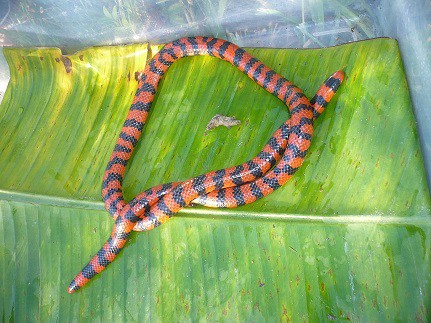
The Amazon rainforest is a place where death can strike from multiple angles. There’s neurotoxic coral snakes slithering across the forest floor, there’s cunning caimans watching you hungrily, and there’s golden dart frogs lurking completely unseen amidst the foliage. However, there’s a few creatures which are less dangerous than they look, one of which is the American pipe snake (Anilius scytale).
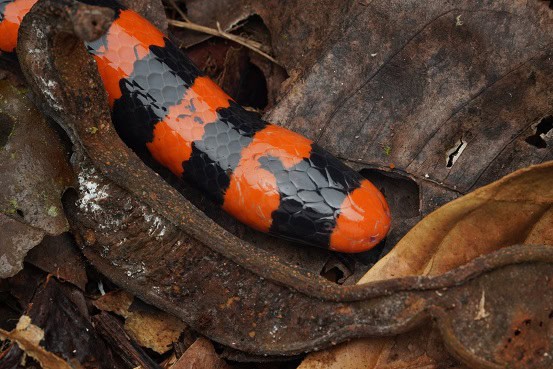
This species has no venom whatsoever, and kills its prey mainly using constriction. It has no means of attacking a human being, and would be completely safe to pick up, if you could penetrate its thick rainforest habitats. American pipe snakes are instantly recognisable, due to their rapidly alternating black and red bands. Except for a whitish underbelly, these are the only colours on their body.
American pipe snakes are widespread, covering much of Brazil, plus Venezuela, Colombia, eastern Ecuador, eastern Peru, French Guiana and Suriname. They don’t inhabit Central America, inhabiting only southeastern Colombia and failing to get close to Panama.
Most importantly, the American pipe snake is a highly isolated snake on the evolutionary tree. This species is the sole member of the Anilius genus worldwide, with no living relatives.
| 2 | The most archaic snake on Earth? |
The American pipe snake is a relic among snakes, which couldn’t be further from the advanced and futuristic coral snakes it closely resembles. This species is a like a peek back in time at the dinosaur era, with archaic physical features that mostly died out long ago.
Firstly, the American pipe snake has a skull which is a halfway house between modern snakes and ancient lizards. While its jaws partially unhinge, they do so far less than modern pythons or boas. This even limits the size of meals they can eat, as American pipe snakes generally swallow long amphisbaenians or fellow snakes, with a small diameter.
American pipe snakes also have pelvic spurs – the vestigial remnants of hind legs. Worldwide, these are mainly found in pythons and boas, such as the scrub python of Australia.
These vestigial limbs have no function (probably), but are leftovers of ancient lizard ancestors which failed to fully disappear. Even respected herpetologist William Beene simply wrote “This is a strange snake” back in 1946.
| 3 | Predates T-rex? |
Of all 4000 snakes worldwide, the American pipe snake may be the single most isolated. It’s an equivalent to the tuatara of New Zealand’s north island, an evolutionary relic, and the last member of its Aniliidae family, which bears no close relationship to any living reptile on Earth.
The American pipe snake is estimated to have diverged from all other snakes an astonishing 90 million years ago. This was an age when the continents were far from their current positions, when the Atlantic ocean had formed, but was dramatically narrower. Flowering plants were just beginning to cover the land, and Antarctica was a lush paradise. Most snakes were basic constrictors, and the T-rex hadn’t even evolved yet.
Other highly isolated snakes worldwide include the sunbeam snake of Thailand, believed to have separated 73 million years ago. The Mexican burrowing python separated from all other snakes 40 million years ago. Yet the American pipe snake has them all beat for isolation.
Its closest relatives worldwide are still being debated, but are believed to be the Tropidophiidae dwarf boas of the western hemisphere. These include the eyelash boas of Ecuador, e.g. the northern eyelash boa, which lures in insects using a bright green tail. Then there’s the numerous dwarf boas of the Caribbean, including the Cuban dwarf boa, which have up to 33 members. However, even these diverged from the American pipe snake an extremely long time ago.
| 4 | Lifestyle of the American pipe snake |
American pipe snakes are widespread, and far from rare. They plunge deep into Brazil, and while a lover of rainforests, they’re not completely restricted to them like the branch-clinging emerald tree boa.
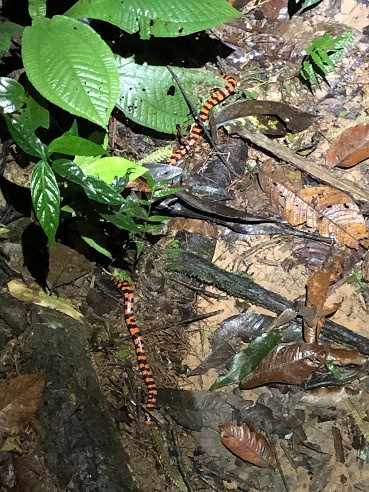
American pipe snakes have also been found in cerrado landscapes in Brazil’s Caatinga state, and deforested areas. In rainforest regions, they’re often found in human-modified microhabitats such as unpaved roads and forest trails, making them fairly easy to encounter, particularly when combined with their bright colours.
The precise lifestyle of Anilius scytale is slightly mysterious, as we mostly have scattered observations to combine an overall picture from. This species partially lives a burrowing lifestyle, disappearing underground, with smooth scales to prevent soil from clinging. However, they’ve also been spotted hunting in aquatic environments, including manmade ponds. Their popular amphisbaenian prey are most active when on the surface, hinting that American pipe snakes hunt on the surface as well.
American pipe snakes aren’t heavily reliant on tree branches, although they climb occasionally. Thick beds of leaf litter are one of their favourite places to lurk.
| 5 | Only eats legless prey |
Diet is one area where this species is well researched. Despite being archaic and isolated, the American pipe snake’s diet is fairly normal, and similar to many coral snakes.
A 2010 study tested 162 American pipe snakes kept in storage at the Museu Paraense Emílio Goeldi, in the city of Belém, northern Brazil. This included 79 males and 83 females, all of which were originally collected in the Brazilian Amazon. The frequency of food in stomachs was relatively low, at just 12.9%, but this still produced 21 food items for examination.
5 prey consisted of unidentifiable scales, while 16 were identified down to the genus level. Of those, 13 were amphisbaenians, elongated, legless reptiles, with the most common being the black-and-white worm lizard (Amphisbaena fuliginosa), with 7 records. 2/16 were snakes, including a fellow American pipe snake and a black-headed snake (Tantilla melanocephala). The final prey was a caecilian, a legless amphibian.
Despite being a great great grandfather among snakes, this species is more than capable of competing for food with local Amazon rainforest snakes. All 16 prey were elongated and legless, and this is all due to their small gape width, due to their primitive skull.
| 6 | The most primitive constrictor? |
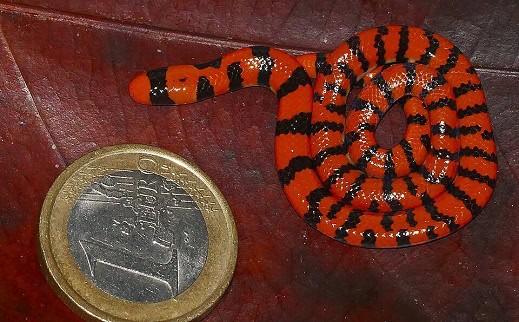
In 2008, a study proved that the American pipe snake is a constrictor. An Anilius scytale was captured near a hydroelectric dam in Tocantins state, Brazil. It was placed in a secure container and offered a loach, a type of elongated fish.
Initially, the American pipe snake grasped the fish and began to apply a coil, but then it abruptly released the fish. Something about the fish’s scent had proved unappetising. The scientists didn’t give up, and next used a different American pipe snake gathered from near the same dam. They gifted it an amphisbaenian, which was proven above to be overwhelmingly their favourite prey.
The pipe snake made the first contact with its jaws. It bit the amphisbaenian for 25 seconds, after which it applied the first coil. From then on, the pipe snake always remained coiled around the amphisbaenian, yet strangely, it repeatedly loosened its grip, before reapplying full constriction force. It resembled a coiled piece of spaghetti like many constrictors, but was far more haphazard than many constrictors like the California kingsnake (one of the strongest constrictors worldwide).
The scientists theorised that this was another archaic feature, like their skull. They theorised that the American pipe snake dated from a time when constriction wasn’t fully evolved in snakes yet, and hadn’t yet reached peak efficiency. Therefore, their hunting style may be yet another relic of the dinosaur era.
| 7 | Extremely short tail |
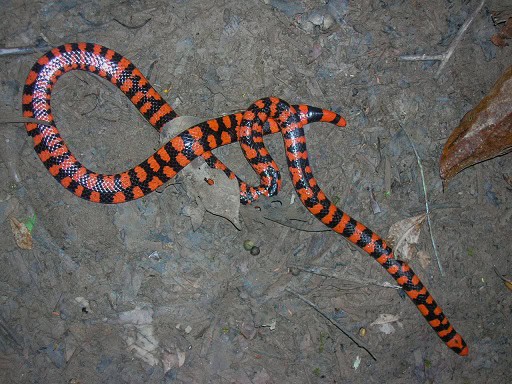
Anilius scytale is a decently sized snake, reaching an all-time confirmed record (so far) of 118.4cm. Their eyes are incredibly small, and their tail has no change in colour from the rest of the body. Their tail is extremely short as well, as the record individual of 118.4cm had a tail measuring just 3.6cm.
The American pipe snake has another characteristic which you should know about – an extremely low variation in physical appearance. On iNaturalist, there’s a vast amount of amateur photographs, yet virtually all individuals look exactly the same, from Suriname to Brazil to Ecuador.
Bizarre morphs are virtually non-existent with this archaic species. There’s minor colour variation, as the red bands vary from properly lava red to moderate orange. However, the basic pattern of black and red/orange is nearly always consistent, with a whitish underbelly.
The only slight variation is a couple of iNaturalist photos with dramatically thicker bands. Both red and black are far wider than the usual razor thin rings, and consequently, these snakes have far fewer bands overall, compared to the normal range of at least 60.
| 8 | The strangest morph so far |
So far, the only truly bizarre morph was spotted in Tocantins state, central Brazil in 2017. This snake had a total length of 57cm, and initially hid its head in its coils in fear.
The snake was instantly striking by its vast reduction in the usual black bands. Instead of fusing at the spine, they disappeared on the lower flanks, with barely more width than a dash on a keyboard. Virtually the snake’s entire body was a fiery red. Its underbelly was the usual creamy colour, but this time, had a greater number of black bands than normal.
The scientists briefly considered whether it was a new species, but the location in Tocantins was near a hydroelectic dam which had been heavily surveyed for native wildlife. Many Anilius scytale had been discovered, none with the unique colouring, and therefore, this was believed to be a freakish individual rather than a rare species restricted to one tiny local enclave. The scientists found that its ventral (underside) scales numbered in the normal range – 235, with a species average of 215-254.
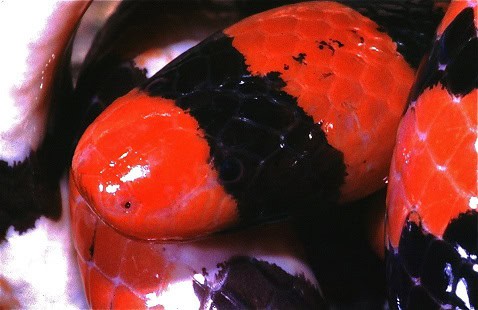
Because of the vast reduction in blackness, this individual had one “cute” feature which isn’t normally visible – tiny black dots for eyes. Ordinarily with the American pipe snake, a thick black band covers the eyes, like a bank robber, while the snout and mouth are fully red.
| 9 | Any dangerous lookalikes? |
The American pipe snake’s goal in life may be to confuse local predators into thinking they’re a dangerously venomous coral snake, and skipping over them in favour of a less lethal meal. Given how ancient this species is, it may have evolved the colours completely independently – rapidly alternating neon colours can also aid in camouflage against the rainforest floor, by breaking up predators’ vision.
If the American pipe snake is mimicking fellow snakes, then which species does it resemble? Thankfully, not many, for one simple reason – this species completely lacks yellow or white, except on the underbelly. The vast majority of Micrurus coral snakes possess red, black and pale sections, with the pale ranging from white to yellow. The ordering of the colours varies considerably, but the basic three colour sections are usually present.
There’s a handful of exceptions. One is the Carib coral snake of Venezuela, but this species lacks any red, with rapidly alternating black and gold – not a match for the American pipe snake. The variable coral snake (Micrurus diastema) occasionally has morphs where the yellow mostly disappears, appearing mainly on the tail. But this species lives in Central America and southern Mexico.
Worldwide, the lethal species which mostly closely resembles the American pipe snake is the Roatán coral snake (Micrurus ruatanus). This species also lacks any yellow, with rapidly alternating black and red, making it a rarity among coral snakes. Fortunately, this species lives solely on the Honduran island of Roatán, nowhere close to Anilius scytale. In fact, this species is one of the rarest coral snakes in the world. The ordering is different, as the Roatán coral snake has a black snout rather than a red snout.
| 10 | Defensive strategies |
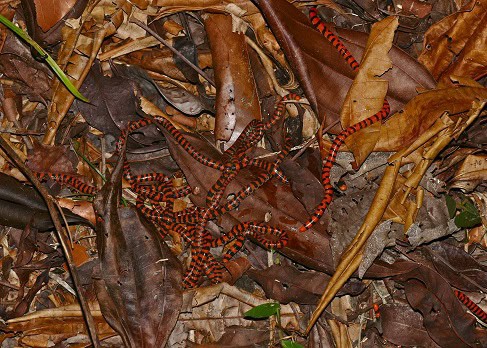
The American pipe snake has one surprising weapon: an extremely powerful bite, like the amphisbaenians it hunts. This may be designed for preventing its slippery, limbless prey from escaping its grip.
Fortunately, this bite is non-venomous, and they almost never use it on humans, even if picked up. Its use is most likely hunting rather than self defence. Their actual self defence strategies include fleeing into underground tunnels, or raising their tail high in the air to distract from their head. American pipe snakes also have a tendency to hide their head beneath their coils, and occasionally flatten themselves to produce an illusion of size.
American pipe snakes also preemptively defend themselves while hunting. In the first diet study, all prey had been swallowed by the head, or antero-posteriorly. Amphisbaenians have surprisingly strong bites, and therefore, the American pipe snake was theorised to be removing the head from the battle as quickly as possible.
| 11 | Sticks to the Amazon region and outskirts |
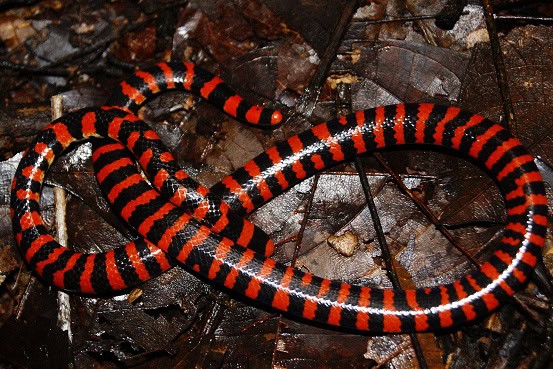
American pipe snakes lay decently high totals of eggs, with the highest clutches numbering 33. Males have an interesting method for securing females in place; they bite them by the head.
Outside of the study above, American pipe snakes have also been recorded to prey on marbled swamp eels, another limbless prey, and the neckband ground snake (Atractus torquatus), a small non-venomous snake. One of their own confirmed predators is the ribbon coral snake (Micrurus lemniscatus), which was recorded in 2011 in a rural area in Amapá state, far northern Brazil. The coral snake was found as roadkill, and the dead American pipe snake tumbled out of its belly.
American pipe snakes inhabit around 50% of Brazil, particularly the Amazonian region, but also a few drier regions. Areas they don’t inhabit include virtually the entire Atlantic coast, including anywhere close to São Paulo and Rio de Janeiro.
American pipe snakes are also missing from Uruguay, Paraguay and Argentina, skipping more southerly realms. In Ecuador, Peru and Colombia, they’re found exclusively to the east of the Andes, with no presence along the Pacific coastline. They’re also found on Trinidad, while one of their ultimate hotspots is French Guiana.