
| 1 | The greenest of all boas |
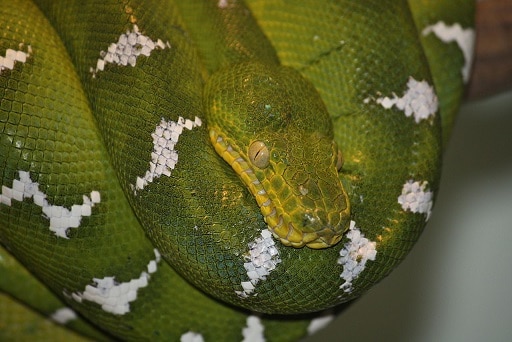
If you ever needed to infiltrate the Amazon rainforest by stealth, which colours would you choose for camouflage? The ultimate choice would have to be bright green to disguise yourself against the jungle foliage, combined with small white or grey spots to mimic the beams of light shining through the canopies.
This pattern is exactly what the 2 metre emerald tree boa (Corallus caninus) has evolved. This species is found across the vast majority of the Amazon rainforest, and is a non-venomous constrictor which spends nearly all of its life on tree branches.
The emerald tree boa belongs to the same boa (Boid) family as the boa constrictor, but rather than beige and brown, this boa has adapted to be almost exclusively a light yet rich shade of green. It has thin stripes or patches of white on its body, which cover a small surface area. The only exception to the all-consuming green-white is a 3cm blue-black marking under its chin, to mark the point where its mouth stretches to swallow prey.
This species’ colours wouldn’t be out of place in a McDonald’s ball pit, but up close, it looks like a savage predator. The emerald tree boa has a thin neck, followed by a large, bulky head. It has vertical pupils, and a hungry, crinkled face with strong hints of crocodile. This actually makes sense, as the boas are a relatively primitive family of snake, like pythons.
| 2 | Exclusively a rainforest dweller |
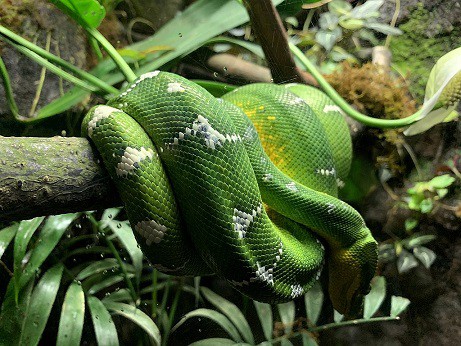
The epicentre of the emerald tree boa’s range lies in Brazil, but to the southwest, its range crosses into Peru and Bolivia. To the northwest, it crosses into Ecuador, Venezuela, Colombia, Guyana, Suriname, and French Guiana. This coincides perfectly with the humid, ever-twisting expanses of the Amazon rainforest.
Unlike the surprisingly flexible boa constrictor, emerald tree boas spend virtually all their lives in rainforests. You’ll never find them eating rodents on a sugar plantation or curled up in your toilet at 1am at night. They can be found at elevations of 0 to 1000 metres, but the key is rainfall; emerald tree boas require an annual precipitation total of 1500mm or more.
Emerald tree boas live a life surrounded by swarms of insects, bright-coloured lizards, and small scurrying rodents making rustling sounds through the bushes. They spend their days curled up on branches, particularly mid height branches 2.5 metres above ground. Their favourite branches of all are ones overhanging small bodies of water (which probably isn’t water you’d want to drink from).
| 3 | A sloth in serpent form |
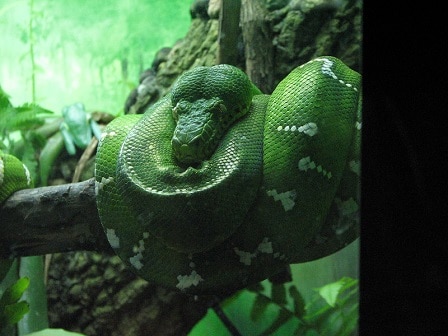
The emerald tree boa is not just an ambush predator, but one of the most immobile snakes on the planet, sometimes going months at a time without eating. The corn snake of the USA needs to eat every 10 days, but the emerald tree boa has an exceptionally slow metabolism. This is the serpent equivalent of a sloth, spending almost its entire life coiled around a tree branch, which it grips using an unnaturally strong prehensile tail.
By day, the emerald tree boa rests its head in the centre of its tightly wrapped coils, like a comfortable seat of expensive green cushions. Night-time is hunting time, when the species extends its green head downwards to the forest floor in search of scurrying rodents. The emerald tree boa swings slowly like a vine, keeping its body totally rigid and still. It occasionally seizes small creatures running along nearby branches, but take the majority of its prey from the forest floor.
Unlike the more active blunt-headed tree snake nearby, emerald tree boas are hardly ever spotted on the ground. When they are, it’s usually a sign of severe distress, such as fleeing a hungry crested eagle.
| 4 | Finely tuned for eating mammals |
The emerald tree boa was first described in 1758 by Carl Linnaeus, and was long believed to feed exclusively on birds. In 1993 though, Dr Joel Hendersen analysed the stomach contents of 11 wild emerald tree boas. 10 contained small mammals, many of which were the rice rat.
This rodent also dwells in jungle trees, running along the branches skittishly, and is now believed to be the emerald tree boa’s main prey. A young boa had a reptile in its stomach, which was probably a turnip-tailed gecko.
Their mammal-munching habits make perfect sense when you analyse their vision, because emerald tree boas have 42 eyes. Not literally, but the species possesses 40 heat sensing pits behind its 2 regular eyes.
These pits provide minute infrared sensing, and are found in many snake species, but this number is higher than in almost all fellow boas. Herpetologists have noticed how these sensors are poor at hunting flying birds, or even nesting ones. Birds are ectothermic creatures, but give off significantly less body heat than mammals.
| 5 | Ultra efficient teeth |
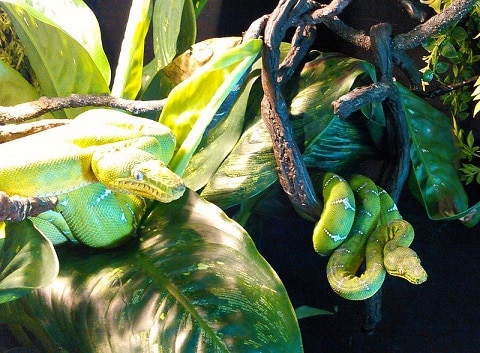
The emerald tree boa is well known for its brutal front teeth, which hold the global record for most disproportionate length among non-venomous snakes. The goal is to grip its prey without shifting much from its branch, but the workings are more subtle than a pierce and hold manoeuvre.
The emerald tree boa has front teeth pointing highly posteriorly (backwards). The angle between the roof of the mouth is smaller than in any other boa species. The teeth aren’t pointing straight to the floor like human teeth, and this allows the emerald tree boa to slide its entire mouth over a struggling rat and hold it in place with an unbreakable iron clamp. The sharp fangs only penetrate the rat’s skin if it thrashes its body too much.
Being lazy and loving it, the emerald tree boa needs to conserve valuable energy. It depletes a portion in the initial rapid strike, and pursuing an escaping rat down a tree trunk and across the thick rainforest would be way too much to cope with.
| 6 | Uses gravity to its advantage |
The emerald tree boa is a constrictor, squeezing its prey’s blood vessels and asphyxiating them, rendering them unconscious within seconds. It almost always squeezes using its muscular upper body, which can move around the air freely while the lower half remains glued to a branch. Next, the emerald tree boa uses one of its special tricks: swallowing the deceased prey with its head moving upwards, to take advantage of gravity.
Despite these hunting instincts, the emerald tree boa isn’t quite at the top of the food chain. There’s one feathered friend which has objections to that: the crested eagle, a large white bird with a wingspan of a whopping 6 feet.
This species has multiple confirmed snakes in its diet, and has been witnessed taking a chunk out of team emerald boa several times. In fact, the first image on the species’ wikipedia page shows it holding an emerald tree boa while sitting on a leafy branch and looking proud of its catch.
| 7 | Newborns are red instead |
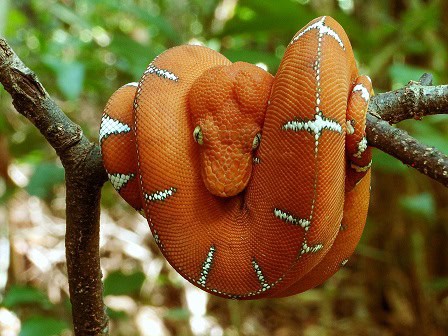

Mother emerald tree boas give birth to live young, usually 6-12, and occasionally as much as 20. This is significantly lower than the boa constrictor, which produces an entire football team of 10-64 babies.
After birth, newborns are a completely different colour. They’re a squelchy-looking red instead, not brick red or a bright neon red, but red like a freshly cut steak. The reason is unknown, but it’s believed that younglings mimic venomous rainforest snakes, until it becomes more advantageous as adults to utilise camouflage.
The change begins at 6-12 months, when green scales appear at their sides and slowly spread. Newborns only have small white marks on their posterior zone, but the moment the green scales first appear, the white ones begin to appear closer to the head. Next, the head shifts from orange to a green-orange colour, followed soon after by the body.
The last stage is a skin shedding, which finally removes all traces of orange, before the newborn emerges in all green and white, like a phoenix from the ashes. This colour transformation can take as little as 6 weeks from start to finish.
| 8 | Ultra patient, never in a rush |
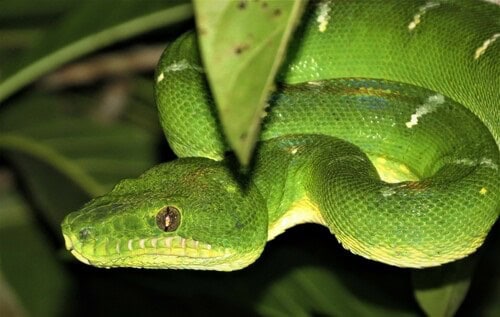
Emerald tree boas usually remain completely still when explorers approach them. They don’t sweep their upper bodies up and bare their viciously long front teeth, and they never flee along the branch. They remain still until the very second they’re touched, at which point they burst into life, coiling around the aggressor’s arms with surprising speed, and constricting his bones and muscles with all their might.
This only causes mild pain, and afterwards, the emerald tree boa usually calms down and accepts captivity. This species can live for 20 years in good conditions, and its lazy lifestyle translates well to a reptile enclosure.
Introducing another male is another story, particularly if there’s a female involved as well. Such a faceoff inevitably leads towards a full scale duel. Instead of wrestling upright like a cobra, the dominant male usually wraps itself around the rival male’s neck, at which point it submits. This species is all about the wrapping in love as well, as males curl their tails around the female’s tail when courting.
| 9 | Secretly two species |
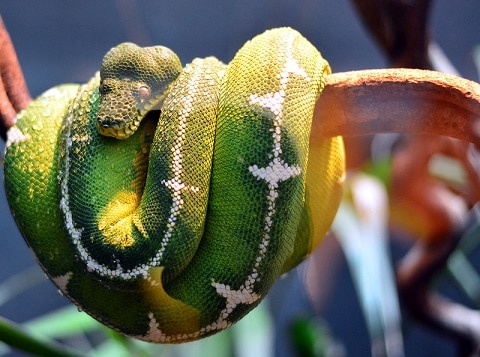
Originally, the emerald tree boa was one monolithic species, but since 2000, it has become apparent that there’s actually two species, with almost identical behaviour and habitats, but a subtly different appearance.
For example, the Guinea shield is a major section of the Amazon rainforest, which includes northern Brazil and the countries immediately above (Suriname, Guyana). This is where the typical green emerald boa lives, but those in the Amazon basin further south sometimes have white markings arranged in an unbroken white line rather than separated lightning bolt symbols. They also have a more docile personality.
Down in northern Peru, the emerald tree boas are significantly darker, which makes the white patches stand out all the more vividly. These patches have more of a tear drop shape as well. The Amazon basin version sometimes has small black marks bordering the white, and the scales on its snout are significantly smaller.
The result is that in 2019, those in the Amazon basin were declared to be an independent species: the Amazon basin emerald tree boa, AKA Bate’s tree boa (Corallus batesii). The only differences known are in appearance – in their lazy lifestyle and reliance on rainforests, the two are identical.
| 10 | The emerald tree boa goes viral |
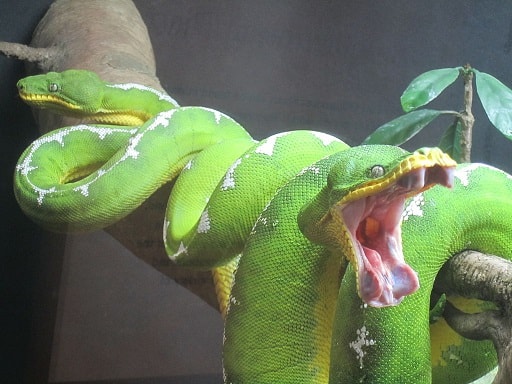
2021 was the year when the emerald tree boa became famous on Reddit and YouTube, with a video showing a captive specimen doing nothing but yawning in extreme slow motion. All the folds and vicious fangs of its mouth were laid bare, and one YouTube edit had the music of Yoshi from the Super Mario franchise superimposed on it.
This video led to great uncertainty within society, as people weren’t certain whether to be charmed or terrified. The snake was yawning as peacefully as any lazy person on a Saturday morning, yet its front fangs were as long as daggers. Some speculated that they’d discovered the original inspiration to Predator from 1987, specifically the ending scenes where the creature is finally unmasked before detonating itself.
This wasn’t the species’ first viral video, as one from 2020 showed a captive emerald tree boa examining a tank full of fish. This video showed the classic movements from the branch position, with its upper body swaying around stiffly, except that its body was wrapped around a plastic frame instead. Fish aren’t known to be part of the emerald tree boa’s rainforest diet, but this snake looked extremely curious about them.
| 11 | Crocodilian assaults |
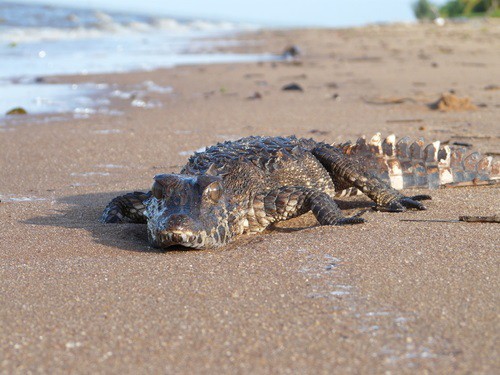
Emerald tree boas aren’t safe in their rainforests, as they’re even under attack from the crocodilian world. The aggressor species is the smooth-fronted caiman, native to French Guiana and averaging at 1.2-1.6 metres long, with a particularly hungry crocodile smirk on its face.
In April 2014, scientists were observing the River Arataye in Nature Reserve Les Nouragues, when a caiman appeared from underwater near the sandy bank. It had a whole emerald tree boa in its jaws, which was either dead or barely alive. There was no clue as to how it acquired the snake. The smooth-fronted caiman then disappeared underwater, emerald tree boa still in its jaws, leaving the scientists to wonder.
Compared to a Nile crocodile, this caiman prefers shadowy, well-vegetated areas. It lurks in obscure rainforest rivers, and is rarely visible by day. Even when this crocodilian strays 100 metres from a river, it remains hidden in tangled areas of vegetation where the sun’s rays only feebly penetrate.
This was the first record of a smooth-fronted caiman preying on an emerald tree boa. The crafty crocodilian must have got lucky and grabbed the snake on a rare occasion it strayed to the ground.