
| 1 | Sri Lankan hump-nosed pitviper |
Maximum length: 38.7cm.
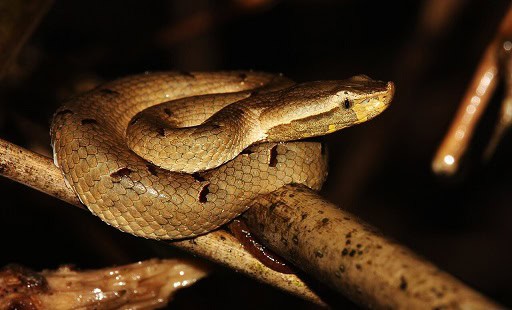
A venomous viper found in the forested central hills of Sri Lanka, at altitudes of 900 metres or higher. This is one of 3 hump-nosed pitviper species in Sri Lanka, and the one found at the highest altitudes. Sri Lankan hump-nosed pitvipers (Hypnale nepa) move by night and inhabit forests almost exclusively, lurking under leaves and in forest rock formations. They shun mammals, preferring to eat lizards and fellow snakes, including snakes of the harmless Aspidura clan.
This species has no reluctance to bite innocent passers-by, but its venom is relatively minor. In a study involving 14 confirmed Hypnale nepa bites, every patient experienced local pain and swelling, but systemic symptoms like haemorrhaging and organ damage were non-existent. Nobody came close to death.
This mildness is partly down to its small size, and corresponding small venom yield. Hypnale nepa ranges from 30-35cm, and the all-time record was a mere 38.7cm. This makes them perhaps the smallest viper in the Indian subcontinent, and one of the shortest worldwide, with the Namaqua dwarf adder of Namibia holding the record.
Weirdly, 8 of the 14 bites occurred in tea plantations. Hypale nepa may be found staring at forest intruders from a log, or crossing a forest trail and blocking your path. Alternatively, you may see a pair of floating golden eyes open up in a pile of leaves, before realising that there’s an entire body blending in.
Like most snakes on this list, Hypnale nepa is endemic to Sri Lanka, occurring nowhere else.
| 2 | Sri Lankan pipe snake |
Maximum length: 35cm.
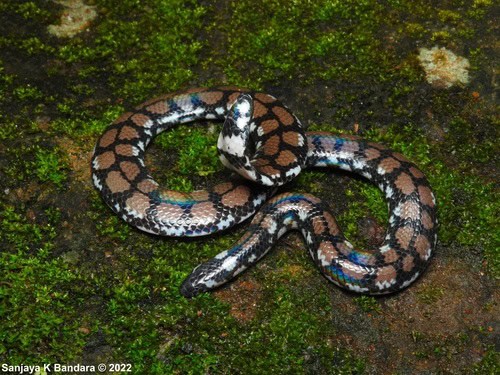
This snake looks like no other on Sri Lanka. Sri Lankan pipe snakes (Cylindrophis maculatus) belong to the 7 member Cylindrophis genus, of which they’re the only member on the island. They’re famed for a defensive display, where they raise their lower body, and display a snowy white underside. Simultaneously, they hide their head, to draw attention to their tail.
Sri Lankan pipe snakes also have snowy white patches on their head, contrasting vividly against black. Their patterns include two rows of reddish circles on their sides, separated by the spine. This is an easy snake to recognise even while they’re perfectly calm.
This species appears in Sri Lanka’s forested lowlands, below 1000 metres in altitude. Typical locations include below rotting logs, within rock piles, and amongst leaf litter. Numerous native snakes have been discovered in their diet, including Dumeril’s kukri snakes, Gunther’s rough sided snakes and Schneider’s earth snakes, the latter being confirmed as prey only in 2015.
Their strategy is to deliver a savage bite to the head, and maintain this rigidly, not relinquishing one iota of pressure to the skull. They then wrap their thick body around the struggling snake and constrict, before swallowing whole. As they prefer moist conditions, Sri Lankan pitvipers are more common in the southern half of Sri Lanka where annual rainfall is higher.
| 3 | Sri Lankan pitviper |
Maximum length: 130cm.
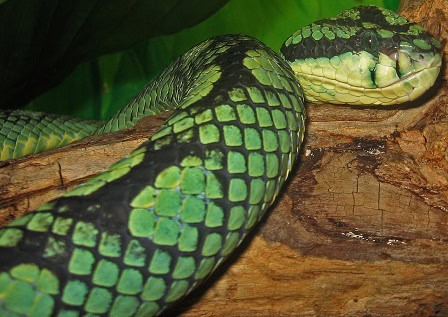
The greatest threat to Sri Lanka’s cinnamon plantation workers, as well as tea and coffee farmers. This is an arboreal ambush predator, which spends the majority of its day on branches 1-3 metres high, rather than on the forest floor like hump-nosed pitvipers.
Sri Lankan pitvipers (Craspedocephalus trigonocephalus) are extremely common in Sri Lanka’s south, growing sparser in the drier north. There’s a large size difference between males (75cm) and females (up to 130cm), and they even vary by rainfall totals. In wetter areas, the black markings overlaying the green have a sharper contrast.
Naturally, Sri Lankan pitvipers inhabit rainforests, but cinnamon and tea plantations are a perfect mimic of their natural habitat. Hands and feet are the most common places to be struck. This snake has no neurotoxic effects, instead specialising in local symptoms like pain and swelling, and particularly blisters. Systemic symptoms affect 8-24% of patients, according to one survey.
Deaths are very rare – the World Health Organisation classifies this as a Category 2 snake within Sri Lanka (with the lethal Russell’s viper achieving category 1). Sri Lankan pitvipers were originally part of the large Trimeresurus genus, but were switched to Craspedocephalus in 2014, the same group as southern India’s Malabar pitviper.
| 4 | Common rough-sided snake |
Maximum length: around 40cm.
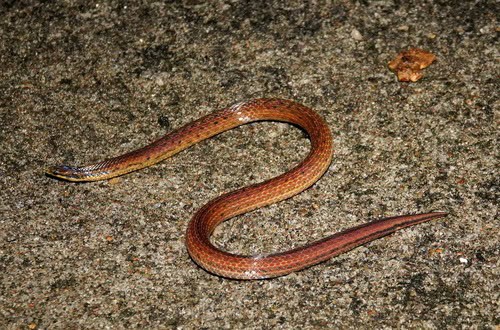
Sri Lanka not only has many endemic snakes, but an entire genus of snakes found only on the island. The Aspidura snake genus has 9 members, and common rough-sided snakes (Aspidura trachyprocta) are the most frequently encountered.
This species is common in central Sri Lanka, where it appears in hilly forests at elevations of 750 metres and higher. They’re often found in piles of hummus and timber within agricultural land, or below leaves, where they hide from predators which they know they can’t possibly combat.
This is a non-venomous species which can be handled without worry. Aspidura trachyprocta inhabits the forest floor, and also below the forest floor, as they’re expert burrowers due to their pointed snouts (a signature of the Aspidura genus). While research is lacking, their diet is believed to consist of earthworms and ants. Aspidura trachyprocta is a snake whose patterns gain more and more complexity the closer you get, with subtle yellow and orange scales manifesting seemingly from nowhere.
The snake secrets of Sri Lanka aren’t close to being fully uncovered yet. New Aspidura members are still being discovered, such as Ravana’s rough-sided snake in 2017, and De Silva’s rough-sided snake in 2019.
| 5 | Boulenger’s keelback |
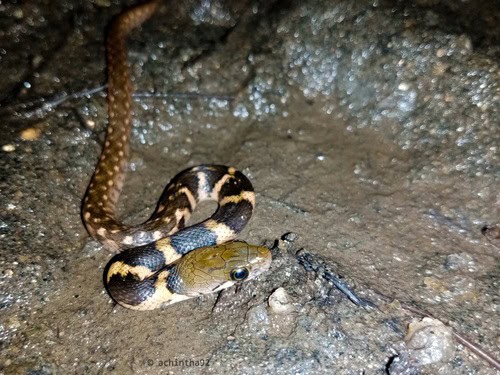
Maximum length: 89cm.
A semi-aquatic species which is abundant in Sri Lanka’s lower half, particularly near Colombo, Sri Lanka’s largest city. Boulenger’s keelbacks can be found swimming stealthily through marshy areas, infiltrating drainage ditches, and resting as still as a statue on the shores of ponds. This species belongs to the same Fowlea genus as India’s ultra-common checkered keelback.
At 40-70cm, Fowlea asperrima is shorter than its Indian cousin, which reaches a maximum of 175cm. But their hunting tactics are similar, actively patrolling their ponds until they spot a fish or frog, then slowing down until they can make a close quarters leap.
Boulenger’s keelback is a species to stay well back from. While this Sri Lankan serpent lacks venom, they’re capable of almost anything else. If cornered, they’ll bite viciously, fully intending to rip your flesh. They’re capable of releasing a vile snake odour to force predators to flee, and they sometimes flatten their heads to appear larger like a cobra, by shifting bones in their skull.
In May 2014, scientists made the first observation of caudal autonomy: when a snake deliberately detaches its tail in order to escape. This is why we advise against gripping a Boulenger’s keelback, as you might force them to sacrifice their precious tail. As it doesn’t regrow, they’ll lose the chance to use this against real Sri Lankan predators.
| 6 | Lowland hump-nosed pitviper |
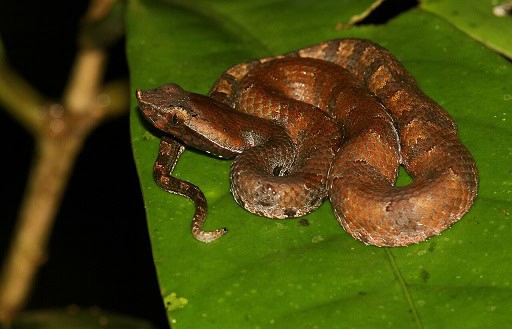
Maximum length: around 45cm.
This species occurs at much lower elevations than its upland cousin, Hypnale nepa. The lowland hump-nosed pitviper (Hypnale zara) is most common in the rainforests of Sri Lanka’s southwest, and is completely absent from the north.
This species has more variable colours than its cousins, and one more obvious difference: a straighter snout, as the namesake hump-nose is slightly less upturned. Its habitats are fairly similar, preferring forests with a thick beds of leaves it can blend into, to confuse its prey (and predators).
A 2021 study gathered 105 confirmed victims of Hypnale zara. The rate of dry bites was especially low at 5 victims, with 100 being successfully envenomated. Males accounted for 62% of bite victims, and 43% were bitten in their home garden, compared to tea plantations for Hypnale nepa. As for the symptoms, 100% of patients experienced swelling and pain. 19% experienced bleeding, and 10% bruising.
Most worryingly, 2 patients suffered acute kidney injury, which can kill in severe cases, though these patients survived. 9% suffered necrosis at the bite site, and 8% blistering. A Hypnale zara bite isn’t a death sentence, but still cause to run for a hospital instantly.
| 7 | Dumeril’s kukri snake |
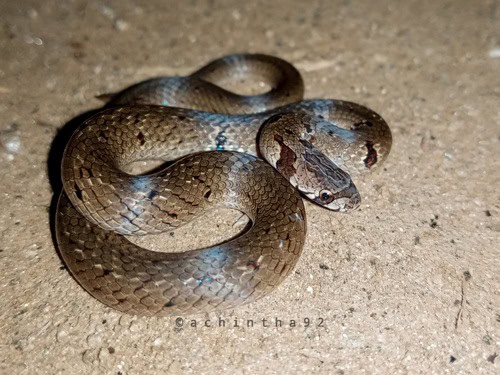
Maximum length: around 35cm.
The Oligidon kukri snake group is the second largest snake genus, with nearly 90 members as of April 2024, with the latest discovery being the cave kukri snake in Thailand. All members are non-venomous, but the genus is famous for its serrated, blade-like teeth, which are either used for slashing through leathery reptile eggs or more gruesomely, slashing open toads’ bellies to extract their internal organs.
Sri Lanka contains four members, including 2 endemic members. The more common is Dumeril’s kukri snake (Oligodon sublineatus), which is recognisable by an olive base, overlaid with chocolatey brown markings, which are particularly prominent around the face, and pass through its eye.
Dumeril’s kukri snakes inhabit forests, but not strictly, as they regularly stray to human dwellings. All signs suggest a relatively non-aggressive personality, as this species rarely bites, instead coiling up into a ball to protect its head, or fleeing rapidly into leaf litter.
Dumeril’s kukri snakes inhabit almost the entire southern half of Sri Lanka, preferring lowlands up to 1200 metres rather than mountaintops. They’re known to live alongside lowland hump-nosed pitvipers, while their diet includes common house geckos (Hemidactylus frenatus) and other reptiles. One of their more unusual tendencies is to stash themselves in termite mounds. Dumeril’s kukri snakes usually stick to forest floors, but climb trees to 1-2 metres high during floods.
| 8 | Olive keelback |
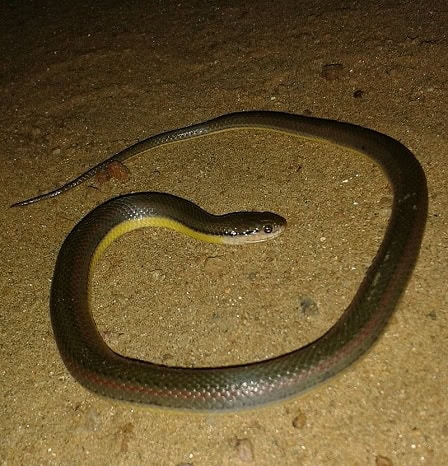
Maximum length: 87cm.
A harmless, peaceful species which swims around lakes not bothering anybody. This species has nothing in common with the glaring hump-nosed pitvipers looking for any excuse to spring at you.
Olive keelbacks lack a deadly venom, and are semi-aquatic to the core. They’re mildly discerning about their habitats, as rather than flowing rivers, they prefer mostly stationary water bodies such as ponds, marshes, swamps and flooded agricultural land. One of their main obstacles in life is a tendency to turn into gory roadkill.
Olive keelbacks (Atretium schistosum) are also found in India, but Sri Lanka is a hotbed of sightings, especially the lower half. Round eyes and a friendly face are an ID sign of this species, and an olive brown body divided sharply against a paler (typically yellow) underside.
Other features include a short snout, and nostrils placed relatively high on their head, similarly to other aquatic snakes, allowing them to breathe while partially submerged. Their diet includes the likes of tadpoles, frogs and fish. Further afield, this species inhabits virtually the entire eastern half of India, and the western portions of Sri Lanka.
| 9 | Schneider’s shieldtail |
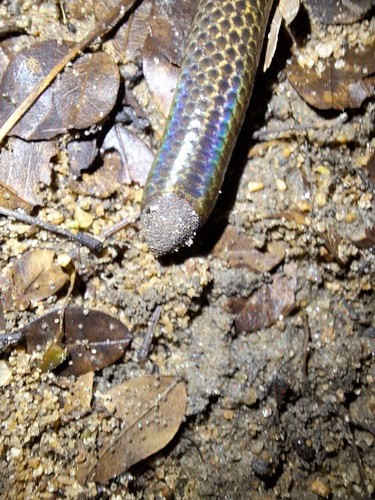
Maximum length: 43cm.
Part of the 24-member Rhinophis shieldtail genus, a group whose heads are very difficult to distinguish from their tails. Of the 24, 18 members are found in Sri Lanka. None are seen often, due to their shy habits, but Schneider’s shieldtail (Rhinophis oxyrhynchus) is one of the few that comes anywhere close to being common.
Unlike the majority of our list, Rhinophis oxyrhynchus primarily inhabits northern Sri Lanka. Its habitats include evergreen forests in the Sri Lankan dry zone, particularly those with soft soils where it can easily burrow.
The Rhinophis genus is so odd in appearance that early researchers didn’t realise they were snakes, attributing them to the Anguis group of legless lizards instead. The freakiest feature is a tail that appears to have been sliced off at a 45 degree angle. Like most Rhinophis members, Schneider’s shieldtail has a snout which is far pointier than its tail, granting it incredible burrowing abilities.
At first glance, Schneider’s shieldtail looks like the typical docile forest burrower, but its venom is actually packed with PLA2 neurotoxins. In chick nerve tests, its venom was capable of blocking acetylcholine receptors in muscle cells, similarly to a black mamba. Additionally, tests on rats revealed “hypotension with subsequent cardiovascular collapse”, which doesn’t sound like fun.
| 10 | Indian python |

Maximum length: 4.6 metres.
Many of the snakes on the list are endemic to Sri Lanka, occurring nowhere else. Many are peaceful forest dwellers which bury themselves under leaves and mulch and are rarely seen by humans. But it would be remiss if we didn’t discuss one super-common serpent which is found all over the Indian subcontinent, and isn’t shy in the slightest – the Indian python (Python molurus).
This brutish species is found all over Sri Lanka, from north to south, just as it occupies almost all of India. It’s a giant constrictor which regularly exceeds 4 metres, and often lurks in shallow water zones, leaping out in an explosion of aggression when it senses a mammal walk past, perhaps even a small deer.
Indian pythons are closed related to, but distinct from the Burmese python which has invaded Florida’s everglades. Originally, the Indian pythons in Sri Lanka were considered to be a subspecies, known as Python molurus pimbura. The individuals on Sri Lanka were slightly shorter, and had a higher colour contrast than the Indian mainland, but nowadays, scientists believe that they’re not genetically distinct enough to be separate.
| 11 | Schokar’s bronzeback |
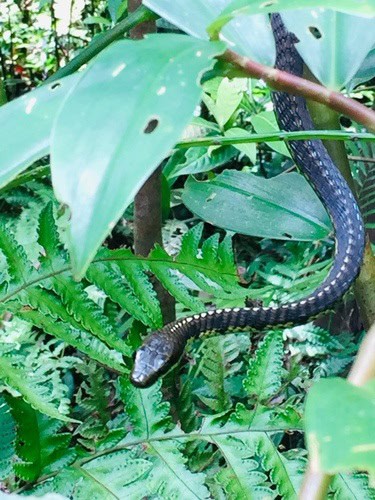
Maximum length: 119cm.
The bronzebacks are another huge snake genus, with 49 members, and Schokar’s bronzebacks (Dendrelaphis schokari) are endemic to Sri Lanka. They’re found from 0 to 750 metres above sea level, and are recognisable by a sharp contrast between a yellow belly and chin, and a darker back and forehead.
While Schokar’s bronzebacks occasionally venture to the forest floor, they’re nearly always found on tree branches. This species has round pupils, and reaches a maximum length of 119cm. Like most branch-dwellers, they have a thin, near weightless body. One of their skills is making huge jumps between tree branches, and spindly branches at that. This is like a baseline skill that the flying snakes (Chrysopelea), their close relatives, took to the next level by actually learning to glide.
According to this author, a Schokar’s bronzeback he met in Kalutara District, western Sri Lanka was incredibly relaxed, and happy to pose in various photographs they arranged it for. This snake was originally spotted 7 feet high on a branch.
Schokar’s bronzebacks must be careful when heading downwards, as in 2014, one was spotted in the jaws of a freshwater crab by a small forest stream, proving that they have lethal predators. The bronzeback was writhing its body in an attempt to escape. This event happened in the Ritigala Strict Nature Reserve of northern central Sri Lanka, so if you wish to find this species, that’s a great place to head to.