
| 1 | India’s most common snake |
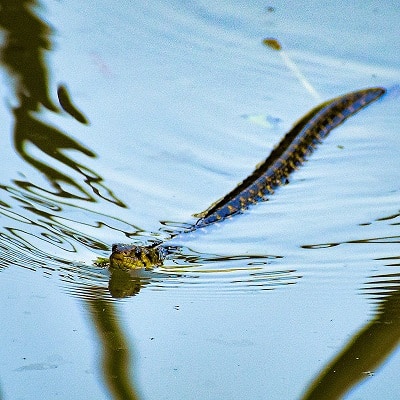
Though the Indian cobra is far more famous as an icon of terror, and the Russell’s viper kills by far the most people, neither of these are India’s most common snake by headcount. Instead, the master of numbers is the checkered keelback (Fowlea piscator), a non-venomous water inhabitant.
This species averages at 1-1.5 metres, with a record of 175cm, and is absolutely everywhere in India. Checkered keelbacks appear in a variety of locations, including rice paddies, lakes, ponds, swamps, marshland – virtually anywhere with a healthy mixture of water and moist countryside. They even appear in major cities such as Bengaluru and Hyderabad.
Checkered keelbacks are aggressive and confident, with little fear of human beings. They slither quickly, swim quickly, and acquire their prey using grappling and sheer determination. They’re usually classified as non-venomous, but it’s believed that they secrete a weak venom in their saliva. No human has ever come close to death, but bites often itch and swell slightly.
This species is found in almost every corner of India, particularly the central states. Rice paddy farmers meet them every day, as do weekend tourists exploring lakes. They’re also common in urban areas like universities, coping well with sewers and industrialised canals. Virtually any rice paddy in India has a chance of containing this wildly successful snake.
| 2 | No venom, but knows how to jump |
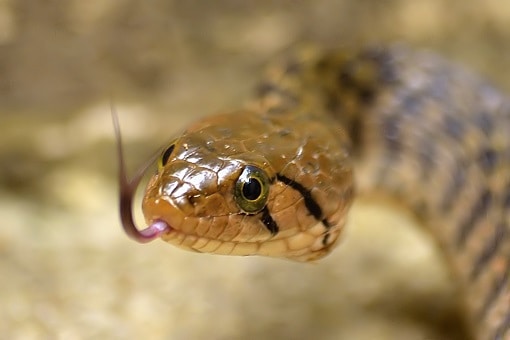
Some water snakes are small, humble creatures which peacefully eat small fish. Not the checkered keelback. This is an aggressive species which defends its lake or rice paddy with a passion. Checkered keelbacks don’t hesitate to bite people, and picking one up is a terrible idea. They have multiple rounded teeth, which are designed for gripping slippery fish, but can easily cause a bleeding gash.
The checkered keelback is a snake of a thousand skills, a serious venom being the only one lacking. The first is a bizarre ability to jump. Using a sudden application of pressure to various points of its body, the checkered keelback can propel itself off the ground while thrashing in mid-air. The eastern brown snake of Australia also possesses this ability.
Despite being semi-aquatic in nature, checkered keelbacks are also strong tree climbers. In 2017, one was spotted 7 metres high in a neem tree, the tree whose bark is popular in skincare. This species is also able to mimic a cobra, by raising its neck straight and spreading its upper ribcage slightly to look larger.
Checkered keelbacks rarely stray far from water, and you’ll never find them on an arid, rocky plain. But they’re perfectly comfortable on dry land, as long as the comfortable refuge of a lake is close by.
| 3 | Steals chicken from universities? |
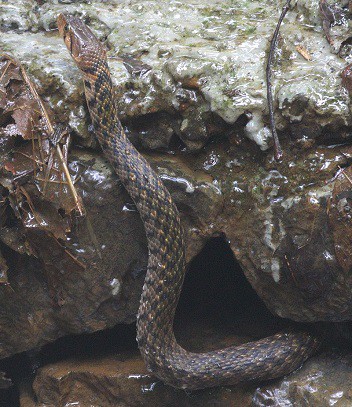
Though they require water, checkered keelbacks are highly flexible snakes, even to the point of being maniacs. In April 2015, one was observed stealing boiled rice and chicken from Jahangirnagar University in Bangladesh. The items were pinched from the student canteen, and the next day, the keelback returned for seconds.
Cooked chicken is a weird meal for a snake, but rice is stranger, as all snakes are carnivores. It was believed that industrial spillage into the local lake had wiped out their traditional frog prey.
The checkered keelback’s diet consists of a healthy mixture of amphibians and fish. Many species are confirmed in its diet, such as Asian common toads, common skittering frogs, Indian bullfrogs, and marbled balloon frogs. Checkered keelbacks are neither constrictors nor sit-and-wait ambush predators. They’re active foragers, which prowl energetically around their lakes, which they know every corner of.
When they locate a frog, they simply grab it and attempt to swallow, by laboriously rearranging the slippery amphibian inside their coils. Despite lacking hands, checkered keelbacks are experts at manipulating objects using their serpentine bodies alone.
| 4 | Swallows prey while underwater |
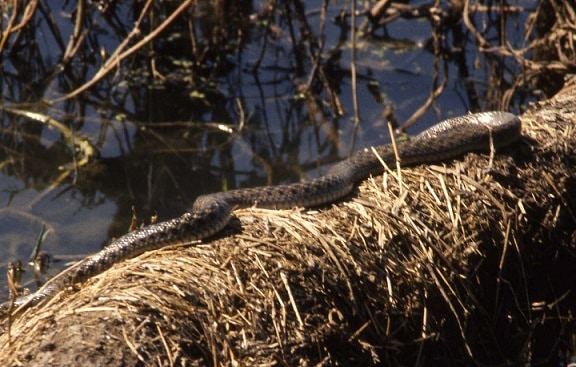
Checkered keelbacks are extremely cunning hunters. In India, rice paddies are often drained from one field to the next, through canals which allow proper distribution of water. Congested backups occasionally form with huge gatherings of fish, and checkered keelbacks have been observed to head for these congregations greedily.
Checkered keelbacks are also capable of swallowing prey while underwater. In Dhaka, the capital of Bangladesh, a checkered keelback was observed grabbing an Asian common toad in Dhanmondi Lake. The toad desperately inflated its body, but the checkered keelback had a plan, and confidently submerged its entire body. When it resurfaced 4 minutes later, there was a large bulge in its stomach.
Though normally steady swimmers, checkered keelbacks are able to produce huge bursts of speed when threatened. Their normal hunting strategy is to swim up to a frog slowly and cautiously, keeping still, and making no unnecessary movements. Once within striking distance, they explode towards their oblivious prey in a sudden darting lunge.
| 5 | Fakes its own death |
One reason checkered keelbacks are so common is their advanced defensive tactics, like severing their own tail. In 1993, scientists located a checkered keelback in Dac-Lac province, Vietnam. While holding its tail carefully, the keelback suddenly began trashing from side to side, rotating on its axis. Its tail then snapped off, between the 19th and 20th vertebrae, in a deliberate severing of its own body part. Tail severing (caudal autonomy) is found in dozens of snakes, and is an emergency resort for escaping a predatory bird, but highly effective.
Another checkered keelback trick is faking death. This happened in 2007 in Gujarat state, India. At first, the checkered keelback thrashed and bit, but over 2 minutes, it gradually calmed down. Soon, its entire body was limp, its eyes were wide and unseeing, its muscles slackened, and its tongue lolled out of its mouth lifelessly. The keelback was playing dead, in a trick used by fellow species like the eastern hognose snake.
Creepily, its eyes continued to move the whole time, following the scientists around the room menacingly, while its body was statue-esque. With so many varying skills, it’s no wonder that checkered keelbacks dominate the lakes of India.
| 6 | The checkered keelback empire |
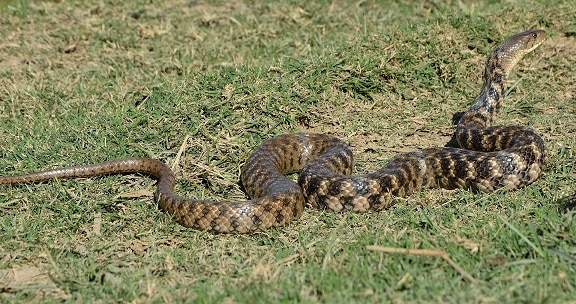
Checkered keelbacks (Fowlea piscator) belong to the 9-member Fowlea genus, of which they’re easily the most common. They inhabit all of India, except the desert region of Rajasthan bordering Pakistan, and the high peaks of the Himalaya. Their range also includes Bangladesh, Myanmar, western Thailand, and Nepal. They were originally thought to live in Sri Lanka, but in 2022, those populations were split into a new species: the Tikiri keelback (Fowlea unicolor).
Despite those breakaway rebels, checkered keelbacks still possess a colossal territory. The second most common member is the yellow-spotted keelback (Fowlea flavipunctus), occupying Taiwan, Hong Kong, and Vietnam.
At birth, checkered keelbacks measure 17-19cm, while the longest individual ever recorded measured 175cm. Checkered keelbacks have round pupils, and their eyes are mainly brown, but with a gold ring around the pupil.
Several freaky morphs have been spotted around, including a leucistic version. This is similar to albinism, with pigments such as melanin massively decreased, except that the eyes are normally coloured. This was found in Mizoram, northeast India, and true albinos have also been spotted.
| 7 | Outsmarted by frogs |
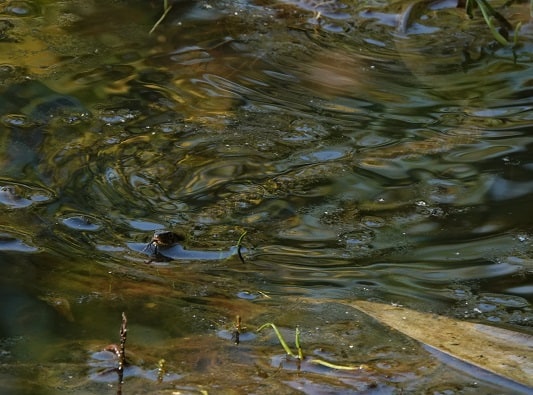
Checkered keelbacks don’t bother sticking to one time period. They dislike being restricted by the moon or sun, and can be found slithering during both day and night. This is an energetic species which can grab a frog from the stone wall of a well, before jumping into that well to swallow in peace.
Checkered keelbacks can also appear in suburban backyards, as long as they’re relatively moist. But not all their exploits end in success. Frogs don’t roll over and accept their fate, and in May 2019, an epic tail happened in Karnataka, India.
A 75cm checkered keelback seized an Indian bullfrog by its hind legs, on the edge of a small manmade swamp. The frog struggled valiantly, and began inflating its body, to form a huge balloon which the keelback couldn’t swallow. The keelback didn’t give up, and began forcing the frog’s body against a concrete wall for leverage.
After 1 hour, it swallowed the frog’s head, but was now unable to breathe, with a round balloon lodged in its throat. The bullfrog’s forelimbs continued to grip and grasp at vegetation. Finally, the annoyed keelback gave up, regurgitated the bullfrog, and swam away, just as hungry as before.
| 8 | Frogs recognise their scent |
Science has also proven that local Indian frogs recognise the scent of the checkered keelback. Being such a dangerous predator, a bully which won’t quit until forced, evolution has given the local frogs a healthy detection radar.
In a 2018 study, larval skipper frogs (a confirmed prey of checkered keelbacks) were exposed to various scents. With dragonflies and Mozambique tilapia, they didn’t respond. But when exposed to walking catfish, Jerdon’s bullfrog, Indian bullfrogs and checkered keelback scents, the frogs reacted with alarm.
Life is hard for a checkered keelback in other ways as well. They’re often collected in fishing nets, crushed under the weight of fish above them. They can be run over on roads directly next to rice paddies, while the 20-50cm younglings are scooped up by wading birds, monitor lizards, cats or even large fish. They’re even eaten by fellow snakes such as the many-banded krait.
Pollution is another problem, particularly pesticide and herbicide runoff into lakes. Checkered keelbacks often survive this toxic sludge spillage, but their frog food base can be decimated. Many old wetlands are being converted to housing estates, removing their habitats.
| 9 | Lays over 100 eggs |
Despite these problems, checkered keelbacks are so widespread that they’re nowhere close to going extinct. Maybe in the occasional village, but across India, they’re simply too powerful.
One backup they have is laying a vast egg total, one of the highest of any snake. Totals of 8 to over 100 have been observed. No matter how many younglings perish in the competitive Indian wilds, there’s always a handful to fulfil the next generation.
Checkered keelbacks are also unusual in that the males stay with females for several months, perhaps for an entire summer of love. They lay their eggs in March and April, in a variety of locations: termite mounds, rotting vegetation, manure piles, crevices in walls. Each egg measures 1.5-4cm, and the mothers often guard them.
The presence of checkered keelbacks correlates closely with the weather. Though they’re always nearby still, they appear to vanish during the hottest, driest weather. When monsoon season explodes into action, the checkered keelback reappears in force.
| 10 | ID signs to remember |
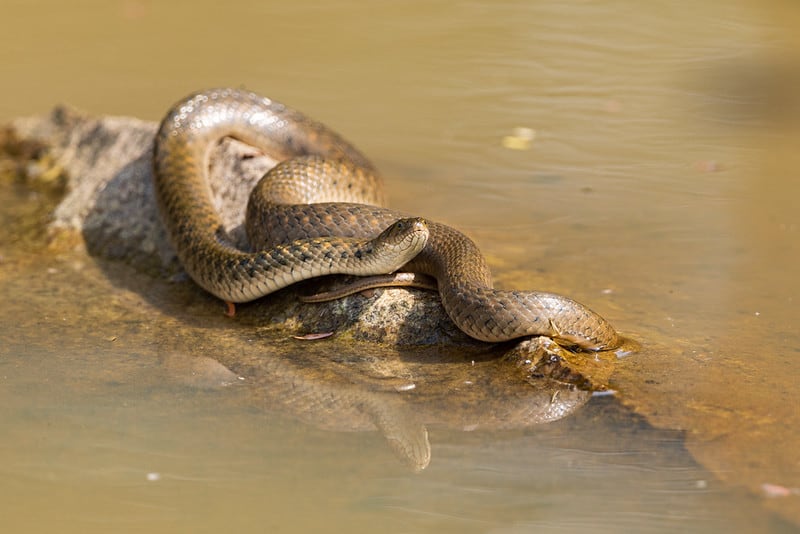
Checkered keelbacks vary in colouration, but are usually a mixture of yellow and black. Rather than huge blotches, they have complex patterns, with rapidly alternating lines and squares.
A consistent ID feature is two thin black lines on each side of the face. The first begins below the eye, while the second starts just behind the eye. Checkered keelbacks have a dark grey tongue, which grows darker towards the tip.
Many snakes have ecological parallels around the world. A black mamba occupies a similar niche to the Australian coastal taipan, while the peaceful UK grass snake acts similarly to a US garter snake.
A great parallel of the checkered keelback, halfway across the world, is the Brazilian smooth snake. Both are water snakes with a very slight venom, which reach 1.5 metres and prowl aggressively through marshland, rather than hiding in reeds timidly. Both prey heavily on amphibians, and they even share an ability to play dead, and an angry reaction when bothered by humans. Both are energetic active foragers as well, rather than ambush predators. The main difference is that Brazilian smooth snakes are more flexible eaters, with the ability to swallow mammals as well.