| 1 | Dugite |
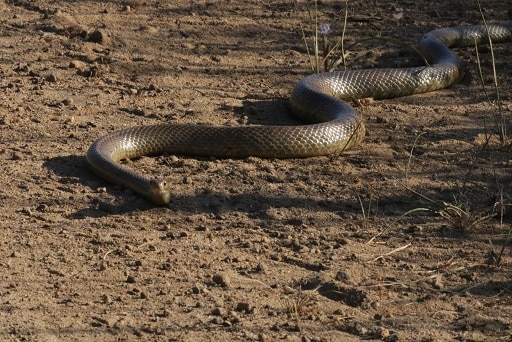
Maximum length: 212.5cm.
A large venomous snake, which belongs to the same Pseudonaja genus as the eastern brown snake of Sydney. Dugites are found in the southern half of western Australia, and are encountered commonly during the day. Their habitats are manifold, and include coastal dunes, woodlands and shrublands. They’re also comfortable in manmade habitats, such as golf courses, parks and agricultural fields, and are particularly abundant in the metropolis of Perth.
Dugites have black eyes, and a slender head which is barely separable from their neck. This is a particularly unpredictable species, as their default is to slither away shyly, but they can also attack human beings for no obvious reason.
A few deaths have happened, the most recent being a 2015 woman from Fremantle, who collapsed on the way to her car. In 2011, a 7 year old boy was bitten in bed when a dugite slithered in and curled around his arm, but he survived after prompt antivenom treatment.
Dugites prefer their scaled cousins for prey, but are flexible. According to a 2017 study, their prey consisted of 38.4% mammals and 61.6% reptiles. A decent chunk of mammals were the introduced house mouse. Native Australian prey included the southern marbled gecko, southwestern cool-skinks, and common south-west ctenotus.
| 2 | Desert death adder |
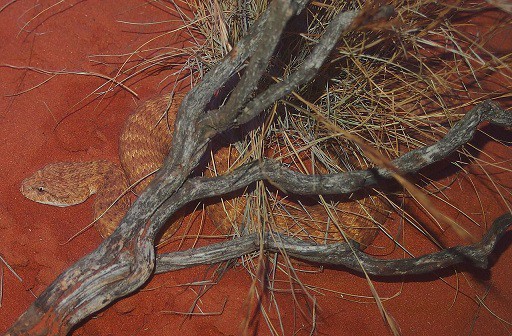
Maximum length: 70cm.
The desert-dwelling cousin of the common death adder near Sydney. This is a separate species called Acanthophis pyrrhus, which inhabits most of the inner regions of Western Australia, skipping civilised Perth. There’s one obvious physical difference, as desert death adders have a pale beige colour, in order to blend with sand. Many have a reddish tone as well, to blend with clay-rich soils.
You won’t find desert death adders by a public bus stop, as they prefer arid regions, where they wait in tufts of spiky porcupine grass, hoping to ambush rodents walking past. Desert death adders rear their heads in rocky outcrops and sandy ridges alike, and reach a maximum of 70cm.
Desert death adders have a negative and positive side. Firstly, they’re difficult to spot, with their supreme camouflage against the arid landscape. But secondly, they only bite if small mammals (or humans) stray extremely close.
Even if you don’t spot the desert death adder, you’ll probably escape untouched, never knowing how close you strayed. This species lays live young, with up to 13 per litter, and eats a varied diet. Adults shift towards mammals with age, while newborns rely on lizards.
| 3 | Desert banded snake |
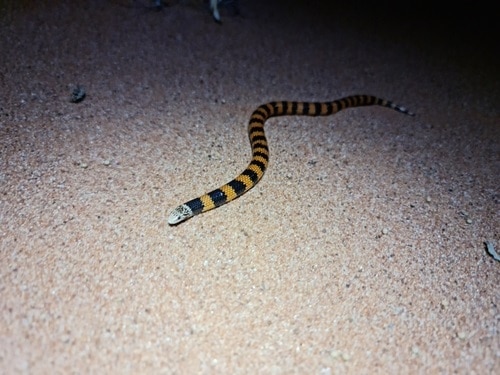
Maximum length: 30cm.
A small snake which poses no threat to humans. Desert banded snakes (Simoselaps bertholdi) inhabit arid areas such as shrublands, but also woodlands, where they lurk under fallen timber. They’re excellent burrowers in dry soils, and will often poke just their head out, watching the world go by.
Desert banded snakes measure 20-30cm on average, and while there’s probably longer ones hiding in the outback which haven’t been measured, more than 40cm is unlikely. This species has alternating orange and black bands, which are evenly spaced. Contrasting against this is a snowy white head, and tip of the tail.
It’s difficult to tell from a distance, but desert banded snakes have vertical, elliptical pupils like a viper. If disturbed by humans, then they almost always flee for cover.
This snake has a very specific diet. 90% consists of lizards of the Lerista group, and in this 2008 study, all were one species: the northwestern sand slider (Lerista bipes). There was also an ant in one snake’s stomach, but this was deemed accidental. The desert banded snake is the most common of the Simoselaps genus, which has 12 members in Australia.
| 4 | Pygmy python |
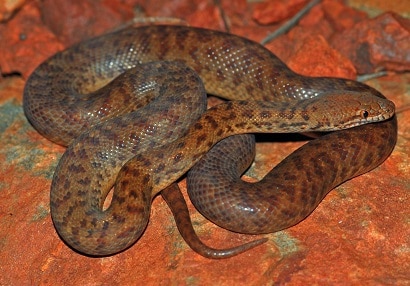
Maximum length: 60cm.
This python won’t be seen by citizens of Perth, as it lives mainly in the bone dry arid region of Pilbara, a former gold mining hub. Pygmy pythons live up to their name, and average at just 40-60cm. They pose no threat to mankind and live well away from human civilisation.
To avoid the burning heat, pygmy pythons (Antaresia perthensis) spend much of their day in termite mounds, resting in the hollow centres. They sometimes share these with other snakes such as black-headed pythons and mulgas.
This species belongs to the same Anteresia genus as the children’s python, but is significantly shorter. Pygmy pythons are popular in captivity worldwide, where they can reach 25 years old. Leading a sedentary lifestyle in the wild translates well to a sedentary lifestyle in an enclosure.
Pygmy pythons eat a mixture of reptiles and mammals. Bats are one of their favourites, and in the many hilly outcrops of Pilbara, they often rest patiently by the dark entrances of caves, hoping to ambush roosting colonies. Some pythons around the world can be found in alleyways or supermarkets, like the reticulated pythons of Singapore, but pygmy pythons prefer desolate areas, in the vast outback of western Australia.
| 5 | Bardick |
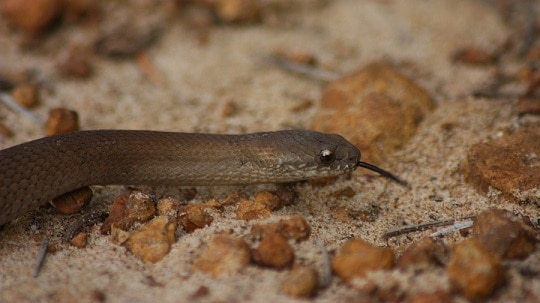
Maximum length: 70cm.
The bardick is a venomous snake found mainly in the southern portions of Western Australia. They’re the sole member of the Echiopsis snake genus, and are recognisable by their almost complete lack of patterns, with a simple olive colour followed by a paler underside.
This species inhabits relatively open areas, usually with some sort of low vegetation to hide in. That means coastal dunes interspersed with grasses, meadows, mallee woodlands, heathland and the edges of pasture land. Bardicks are shy, and like to stay below cover if possible. If disturbed, they sometimes flatten themselves to create a false impression of size. They attack humans every so often, but their default survival method is hiding.
Bardicks are venomous, but pose no real threat to local Australians, with no confirmed human deaths. Their venom is confirmed to contain neurotoxins, but is relatively weak in potency, nothing close to a dugite’s or tiger snake’s.
Interestingly, the bardick’s toxin profile seems similar to a death adder’s, as a dog which was bitten by a bardick recovered well after receiving death adder antivenom. Likewise, a human being who was bitten by a bardick only suffered mild symptoms, and later in the hospital, a snake venom detection kit produced a false verdict of death adder venom.
| 6 | Half-girdled snake |
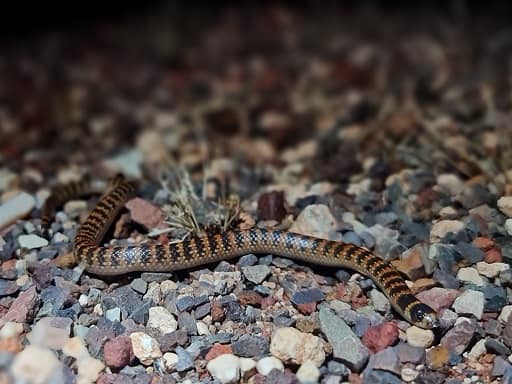
Maximum length: 40cm.
A harmless species which sticks to the ground, and disappears easily into upper layers of soil. Half-girdled snakes (Brachyurophis semifasciatus) average at 25cm, and prey almost entirely on reptile eggs, hidden in secret soil stashes. They have contrasting orange and black bands, which are faded rather than ultra-sharp and vivid. Their tongue has a white tip, and they have round black eyes.
The half-girdled snake might be a snake, but in reality, it’s no more dangerous than a shrew or vole in the English countryside. Half-girdled snakes instinctively dart away if frightened, and they almost never bite. This is a harmless part of Australia’s wildlife, which is of no concern to locals at all.
This species has a colony in Queensland, but Western Australia is their main base, particularly the southern portions and outskirts of Perth. Half-girdled snakes lead a burrowing lifestyle, and have a noticeably pointy snout, which allows them to effortlessly shift substrate aside.
This snake appears in various habitats, including dry woodland, humid forests, arid scrub and hummock grasslands, and coastal dunes. The only constant feature they require is relatively soft soils to dig in.
| 7 | Reticulated whipsnake |
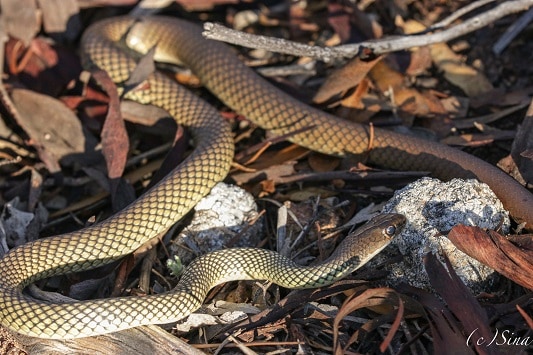
Maximum length: 96.4cm.
The western relative of the yellow-faced whipsnake, which is common near Sydney. The reticulated whipsnake (Demansia reticulata) is just as fast-moving and energetic, but lives solely in Western Australia, covering a huge swathe of the coast.
Rather than alleyways, this species is found in rocky regions, semi-arid plains and coastal dunes. This is a venomous species which is capable of causing swelling and pain, but not death. Unlike a dugite, reticulated whipsnakes never appear in urban environments such as parks.
The reticulated whipsnake is easy to recognise, as it’s a snake of two halves. Their upper body is pale green, with a black netted pattern. Their lower body and tail keeps this pattern, but is red instead. Their personality is also split. Though reticulated whipsnakes try to avoid humans, usually by hiding in dry bushes, they’ll bite aggressively if trodden on or picked up.
Reticulated whipsnakes are also recognisable by a large black patch below their eye. Yellow-faced whipsnakes share this patch, but the two species don’t overlap, meaning that there’s no chance of confusion.
| 8 | Western tiger snake |
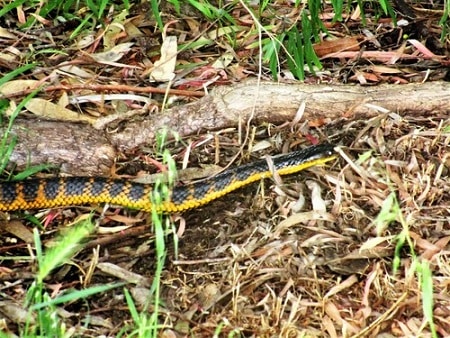
Maximum length: 2.4 metres for the tiger snake overall.
A subspecies of the tiger snake found in western Australia. Compared to eastern forms, the western tiger snake (Notechis scutatus occidentalis) has more vividly contrasting colours, with a jet black base overlaid with yellow stripes. The belly is yellow as well, and this subspecies is generally smaller, particularly those near Perth.
This is one of the most commonly encountered snakes in Western Australia. They’re most common in the southern portions, as they require healthy moisture levels. Western tiger snakes are particularly abundant in the outskirts of Perth, and are confirmed to prey on the quenda, AKA the western brown bandicoot.
Like the eastern form, western tiger snakes generally stick to the ground, climbing trees only rarely. They’re not aquatic, but will enter water bodies without hesitation when necessity drags them there.
One tale took place in September 2019, in Herdsman Lake, 6 kilometres northwest of Perth. Scientists watched as a western tiger snake fled underwater and stayed below for 18 minutes, 36 seconds before surfacing for a breath. A previous observation recorded one holding its breath for 20 minutes.
| 9 | Mallee black-banded snake |
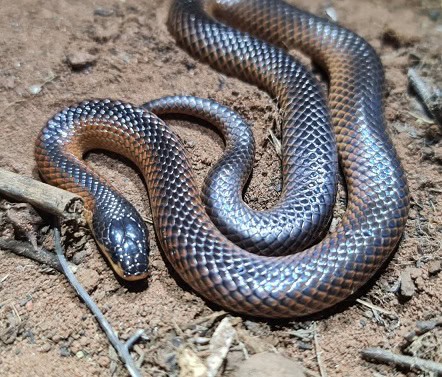
Maximum length: 60cm.
Though Australia is home to the inland taipan, the most venomous snake on Earth, and rampaging mulgas which would swallow you whole and forget about it within minutes, those horrors are giving the country’s other snakes a bad name. Another chunk of Australian snakes are humble, and simply trying to eek out a living in a parched arid landscape.
One of these is the Mallee black-backed snake (Suta nigriceps), which measures 30-50cm and is most common in southern parts of Western Australia. This mildly venomous species gets its name from its spine, which is easily the darkest part of its body. Its flanks are a dark bronze, while its belly is the complete reverse, with a snowy white tone.
Though there’s no virtually no research on the venom’s toxin composition, Mallee black-banded snakes are considered to be harmless to humans. They have a calm and placid temperament, and no bites are confirmed.
Mallee black-backed snakes have round pupils, and a friendly expression when viewed up close. One study found that 41/44 (93.2%) of their prey were lizards, and their favourite group was the Menetia dwarf skinks.
| 10 | Crowned snake |
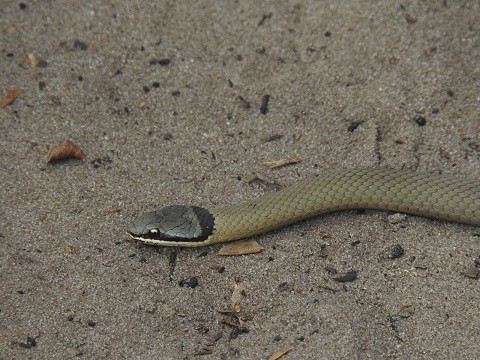
Maximum length: at least 70cm.
An easy snake to recognise, because of their signature crown. Crowned snakes (Elapognathus coronatus) mostly have an orange body with green tinges, and a bright orange belly. This is consistent from tail to head, but at the neck, a black band appears, and on the head, a grey helmet. There’s also a creamy patch just above their mouth, contrasting sharply with the black above.
Crowned snakes are most common in southern Western Australia. They’re common near Perth and reach their northern limit at the town of Muchea, fizzling out afterwards. Rather than scorched deserts, they require moist areas with plenty of vegetation, such as swamps, woodlands, and heathland.
This species is one of the least aggressive snakes in Western Australia. A cornered crowned snake will first freeze, which allows you to approach close. Then they’ll suddenly reactivate and flee for the bushes, squirming madly in desperation to escape.
Crowned snakes move by day, and rely on lizards and frogs for their prey. They need a water source to survive, and if wetlands are removed from an area, due to creeping urbanisation, the local crowned snakes will usually plummet. This is a venomous species, but no research has been conducted. The precise deadliness and toxin profile remains a mystery.
| 11 | Ringed brown snake |
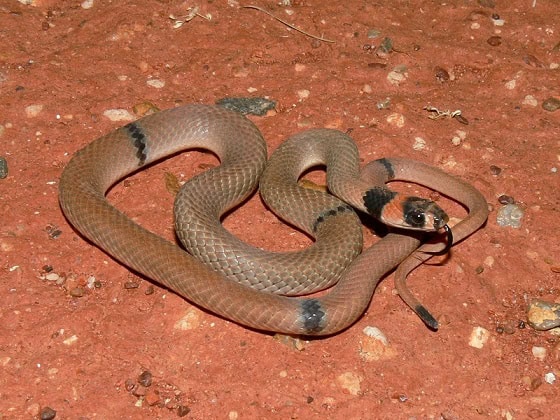
Maximum length: 60cm.
The ringed brown snake (Pseudonaja modestus) is another venomous species, and another fast-moving one which should never be touched.
This species almost inhabits every state of mainland Australia, just missing out on mild Victoria to the south. They’re most common in western and central Australia, and while they just edge into New South Wales, they come nowhere close to populous cities like Sydney and Brisbane.
This is the smallest brown snake (Pseudonaja) member, but also one of the most recognisable. While the gwardar is massively variable, the ringed brown snake is usually the same colour as the eastern brown snake of Sydney, beige with a hint of olive or red. The difference is the widely spaced, thin black bands that encircle their body. There’s sometimes just 5 of these bands, yet they vividly contrast with the underlying beige. The most vivid is their black neck band, and black facial markings.
The ringed brown snake’s venom seems relatively mild, as a human victim experienced no haemorrhaging or paralysis. Compared to other brown snakes, this species lacks any procoagulant powers, the ability to rapidly consume blood clotting elements.
The ringed brown snake is also a burrow snatcher. This was discovered accidentally, as scientists were following a desert skink via a radio-transmitter implanted into its back. Unfortunately, the signal led to a ringed brown snake, which had swallowed the skink whole. The snake then slithered a few metres and vanished into a dark, shady burrow, disappearing from sight. Snakes must do all they can to survive the punishing Australian terrain.