
| 1 | Wilson’s montane pitviper |
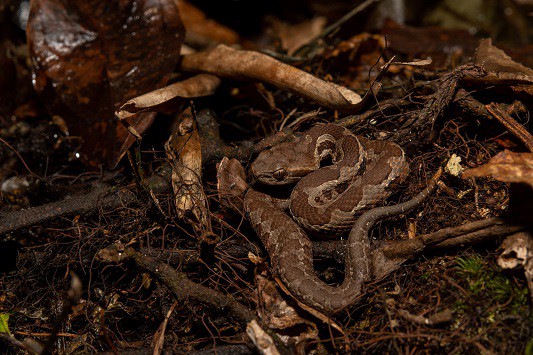
Maximum length: 78.9cm.
One of the last snakes in El Salvador you’d want to meet, unless you specifically like searching for dangerous creatures. This venomous snake is murky and difficult to spot, and has a pale white mouth lining, almost like a cottonmouth’s, which they bare at people when trying to terrify them (sometimes succeeding).
Wilson’s montane pitviper (Cerrophidion wilsoni) is a high altitude species, inhabiting various forest types: lower montane dry forest, high montane forest, cloud forest, pine-oak forest. They’re relatively flexible, and can easily slither across deforested or naturally open areas close by. This viper rarely climbs trees, and has a haemotoxic venom which is specialised against mammals. The exact deadliness of its venom in humans is a mystery, as no detailed studies have ever been conducted.
Wilson’s montane pitviper can reach altitudes of 3491 metres, rarely appearing below 1400 metres. One of their confirmed prey is the giant whiptail lizard (Aspidoscelis motaguae). So far, they’re confined to Honduras, El Salvador, and western Nicaragua, but the highlands of western Honduras also cross into eastern Guatemala, and scientists believe that it’s only a matter of time until they’re found there as well.
Cerrophidion wilsoni is closely related to the Costa Rica montane pitviper (Cerrophidion sasai), and is estimated to have diverged 3.1 to 6 million years ago. Somehow, this ancient split went unnoticed until 2012, when genetics finally proved it.
| 2 | Mexican cantil |
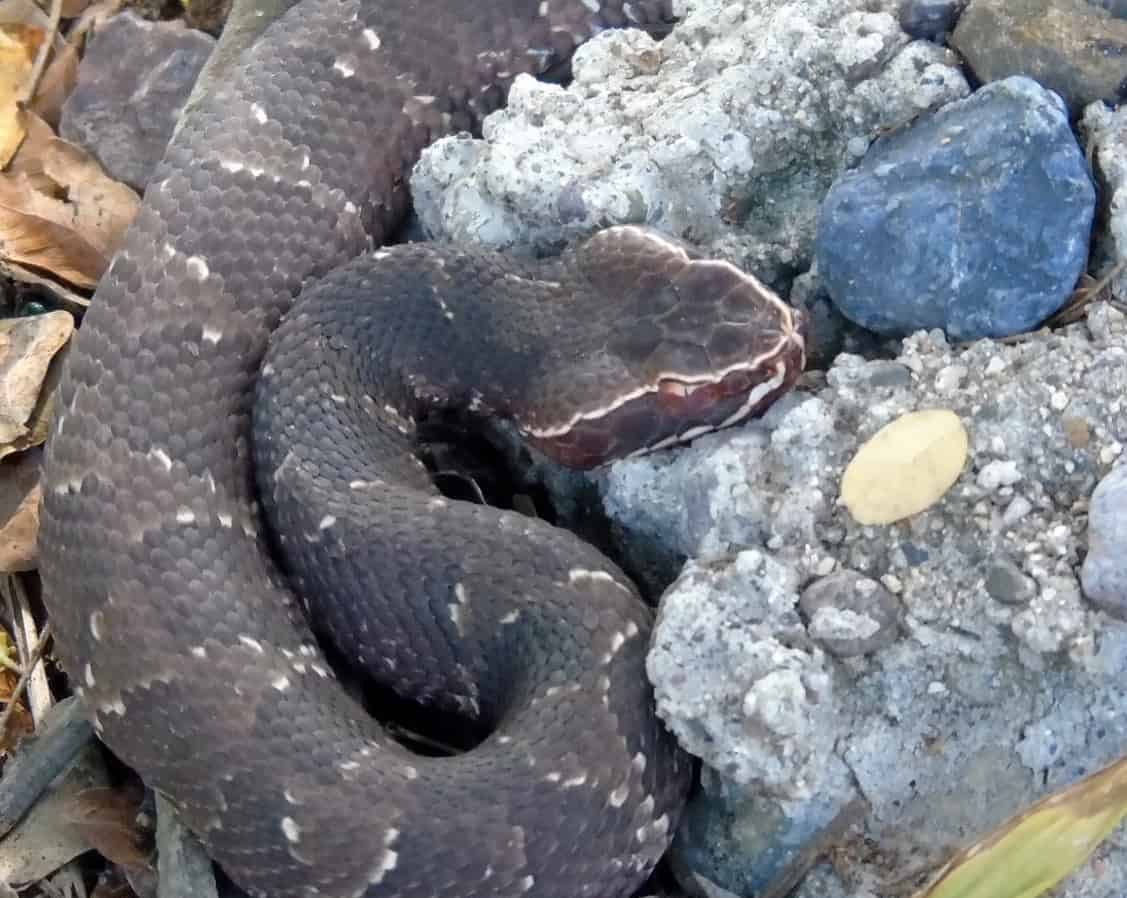
Maximum length: 138cm.
The copperhead and cottonmouth might have their hands full terrifying Americans today, but millions of years ago, a group travelled southwards and transformed into a far blacker version, with thin white stripes. This is the Mexican cantil (Agkistrodon bilineatus), which belongs to the same genus. This version is just as muscular and bulky as the copperhead, and averages at 60-80cm, with an all-time record of 138cm.
Mexican cantils are found in drier thorn and deciduous forests, rather than thick rainforests. Like the cottonmouth, legends speak of a vicious, murderous personality, but this isn’t proven. What is proven is that their venom is significantly more potent than their US cousins.
Mexican cantils have almost no neurotoxic powers, but cause massive damage to skin tissue, destroying so much flesh that white bone is exposed and victims require amputation. A 1983 study even mentioned “spontaneous amputation”, damage so severe that body parts automatically dropped off.
The Mexican cantil empire begins in central Mexico, spreading through Guatemala, El Salvador, and reaching Nicaragua before fizzling out. In Costa Rica, they’re replaced with Gloyd’s moccassin (Agkistrodon howardgloydi), the southernmost member of the group. Their diet mainly consists of mammals.
| 3 | Neotropical whipsnake |
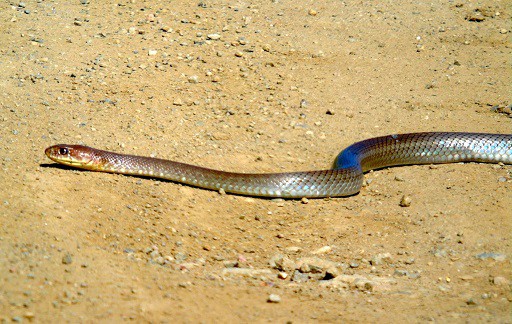
Maximum length: 252cm.
One of the longest snakes of El Salvador, which regularly exceeds 200cm in the largest individuals. This is a widespread species which occurs from Mexico to eastern Panama.
The neotropical whipsnake (Masticophis mentovarius) is a lowland species, which dislikes dense jungles. They stick to open areas such as savannahs or thickets, near areas of dry forests or premontane moist forests. Rather than foggy mountains, they stick to elevations of 0-450 metres, occasionally reaching as high as 1000m.
The neotropical whipsnake is mostly a ground-dwelling snake, and a fast moving one at that. Their diet includes lizards such as silky anoles, and fellow snakes such as road guarders (Conophis lineatus). Rather than instantly injecting venom, the neotropical whipsnake chews the head of its prey for several minutes, allowing a mild venom to gradually soak in. Once their victim stops struggling, they commence swallowing, which can take 15 minutes for fellow snakes.
Neotropical whipsnakes tend not to react to human presence, even if in the middle of eating. They range from grey to light brown in colour, overlaid with faint black lines, while their pupils are round with a bronze iris.
| 4 | Small-spotted cat-eyed snake |
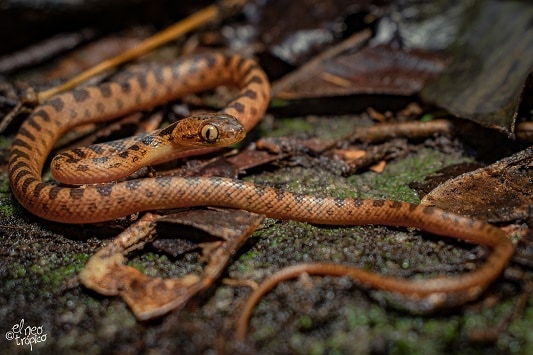
Maximum length: 100cm.
A mildly venomous, thin-bodied snake which is equally comfortable on the ground and in trees. This snake was originally a subspecies of the northern cat-eyed snake, but was broken off into its own species: Leptodeira polysticta, AKA the small-spotted cat-eyed snake.
This species ranges from southern Mexico through to Honduras, and inhabits multiple forest types, including lowland rainforests, pine-oak forests and evergreen forests. The speciality of this snake is being the number one nemesis of El Salvador’s local frogs. The likes of common Mexican tree frogs will start making panicked distress calls to alert their fellows, and inflate their body as a defensive measure whenever Leptodeira polysticta draws near.
Their list of confirmed frog prey is huge: Stauffer’s tree frogs, Morelet’s tree frogs, yellow tree frogs, Mexican tree frogs, etc. They also eat snakes such as the red coffee snake (Ninia sebae).
Small-spotted cat-eyed snakes reach elevations of 2200 metres, and sometimes appear in roofs of rural houses along dirt roads. They vary from light grey to orange, and rather than several huge blotches like a boa constrictor, they have a splattering of much smaller blotches. They have strongly vertical pupils, and the colour of their eyes always matches their body: grey or orange.
| 5 | Forest flame snake |
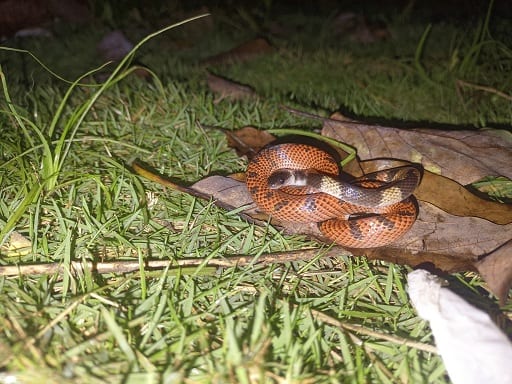
Maximum length: 132.7cm.
A harmless snake which is found across central America, and the vast majority of Brazil. Forest flame snakes (Oxyrhopus petolarius) average at 80-100cm, and are particularly excellent at skirting across thin branches. They appear mainly in pristine forests, including rainforests, cloud forests, gallery forests along riverbanks, and logging roads between forests. As adults, they have red and black bands, but as juveniles, the red areas can be white instead.
The Latin name explains all you need to know about this snake. Oxyrhopus contains the Greek words oxy for “quick”, and rhops for “bush”, likely for its tendency to flee rapidly into the undergrowth when spooked. Petolarius references the Japanese deity petola, who wore a pretty, colourful cloak, and hid in remote, inaccessible parts of the forest when persecuted.
Forest flame snakes are mildly venomous, but this venom has little effect in humans, as it is specially attuned towards cold-blooded reptiles. Dinner items include forest whiptails (Kentropyx pelviceps), yellow-tongued anoles and slender prionodactylus, and birds such blue-black grassquits.
Forest flame snakes are smart enough to vary their hunting methods by prey size. They swallow smaller lizards whole without thinking, but with larger reptiles, they’re more cautious and chew in a mild venom.
| 6 | Mexican parrot snake |
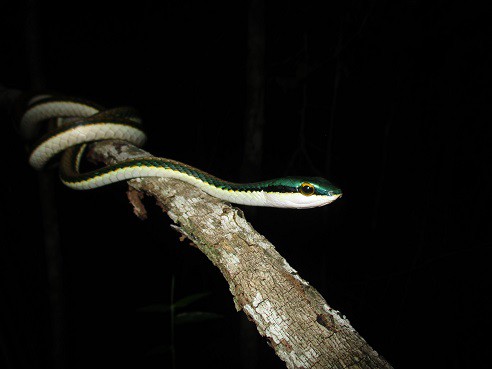
Maximum length: 140cm.
Another snake with a mild venom, which is nevertheless incapable of killing a human. The Mexican parrot snake (Leptophis mexicanus) stretches from eastern Mexico to northwest Costa Rica, occupying most of El Salvador. They’re excellent tree climbers, which use their light weight to skirt along fragile branches with ease.
Mexican parrot snakes normally stick to mid-height vegetation rather than towering treetops. Forests are optimal, but they also inhabit smaller clumps of trees next to villages or scientific research stations.
Leptophis mexicanus is closely related to the giant parrot snake (Leptophis ahaetulla), and shares their bulging bronze eyes. However, Mexican parrot snakes can be separated by one easy ID feature: a large bronze stripe down their back. Their bodies have less green overall than giant parrot snakes, their bellies are a cleaner white colour (no green leaking in), and they have a stronger black stripe running through their eye.
Mexican parrot snakes feast on tree frogs, and reptiles such as Utila spiny-tailed iguanas and bighead anoles. They forage actively, watching branches keenly for the slight flicker of movement that reveals a lizard attempting to disguise itself. They’re even capable of grabbing lizards concealed in dark hollows between tree roots.
| 7 | Central American rattlesnake |
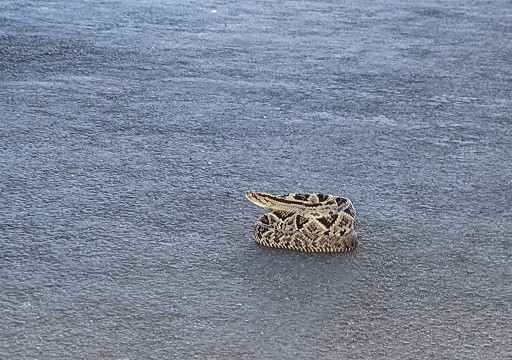
Maximum length: 1.8 metres.
The ruling rattlesnake of far southern Mexico through to northwest Costa Rica. At 1.4 metres and a maximum of 1.8 metres, this is one of the longest rattlesnakes worldwide, easily outstripping such infamous US characters as the tiger or rock rattlesnake.
Central American rattlesnakes (Crotalus simus) stay well away from rainforests. They prefer drier habitats, including scrubland, thorny thickets, dry tropical forests and dry open areas. Their patterns are diamond-shaped, with the standard colours of beige and dark brown, but their scales are especially jagged, with pointed spikes at the end of each.
Crotalus simus is a strange rattlesnake, as bites are actually harder to treat as newborns. Younglings have an abundance of PLA2 neurotoxins in their venom (55.9% of the total). These transition to haemorrhaging toxins in adulthood, namely metalloproteinases (71.7% of total), which are more easily treatable using standard pitviper antivenom. Adult central American rattlesnakes only share 50% of their toxin profile with younglings.
In Mexico, there’s about 20-25 rattlesnake species, but the diversity plummets as you journey further south. In countries like Nicaragua and Costa Rica, as well as El Salvador, this is the sole rattlesnake species.
| 8 | Central American tree snake |
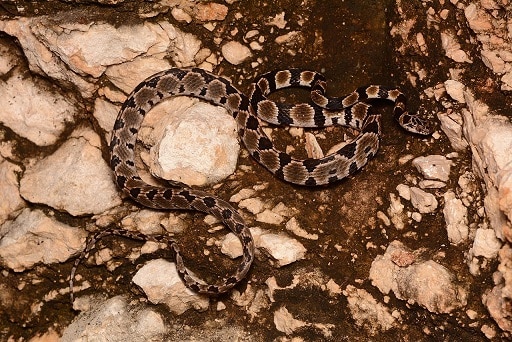
Maximum length: 93cm.
A lesser known relative of the blunt-headed tree snake. The central American tree snake (Imantodes gemmistratus) resides from central Mexico to northwest Colombia, with El Salvador lying roughly in the centre. They have a lightweight body, and like their cousin, they not only live on extremely delicate tree branches, but hunt on them. This snake has an extremely large head, bulging eyes, and a neck barely thicker than a garden twig.
Central American tree snakes are mildly venomous constrictors, which would be safe to pick up if only you could catch them. Their diet consists of Anolis lizards, and after identifying the reptile waiting silently on a branch, their strategy is to extend their thin body over the gaps between, balanced precariously, and seize them suddenly with their jaws. If a Burmese python tried this move, the entire tree would probably snap.
Both Imantodes tree snake members are found in El Salvador. They can be tricky to distinguish, but Central American tree snakes have a higher number of bands, which are also thinner in width. They stray to more open areas, and prefer drier, deciduous forests on Pacific slopes. Blunt-headed tree snakes are found mainly in lowland rainforests, and the wettest, densest, and stickiest ones to boot.
| 9 | Boa imperator |
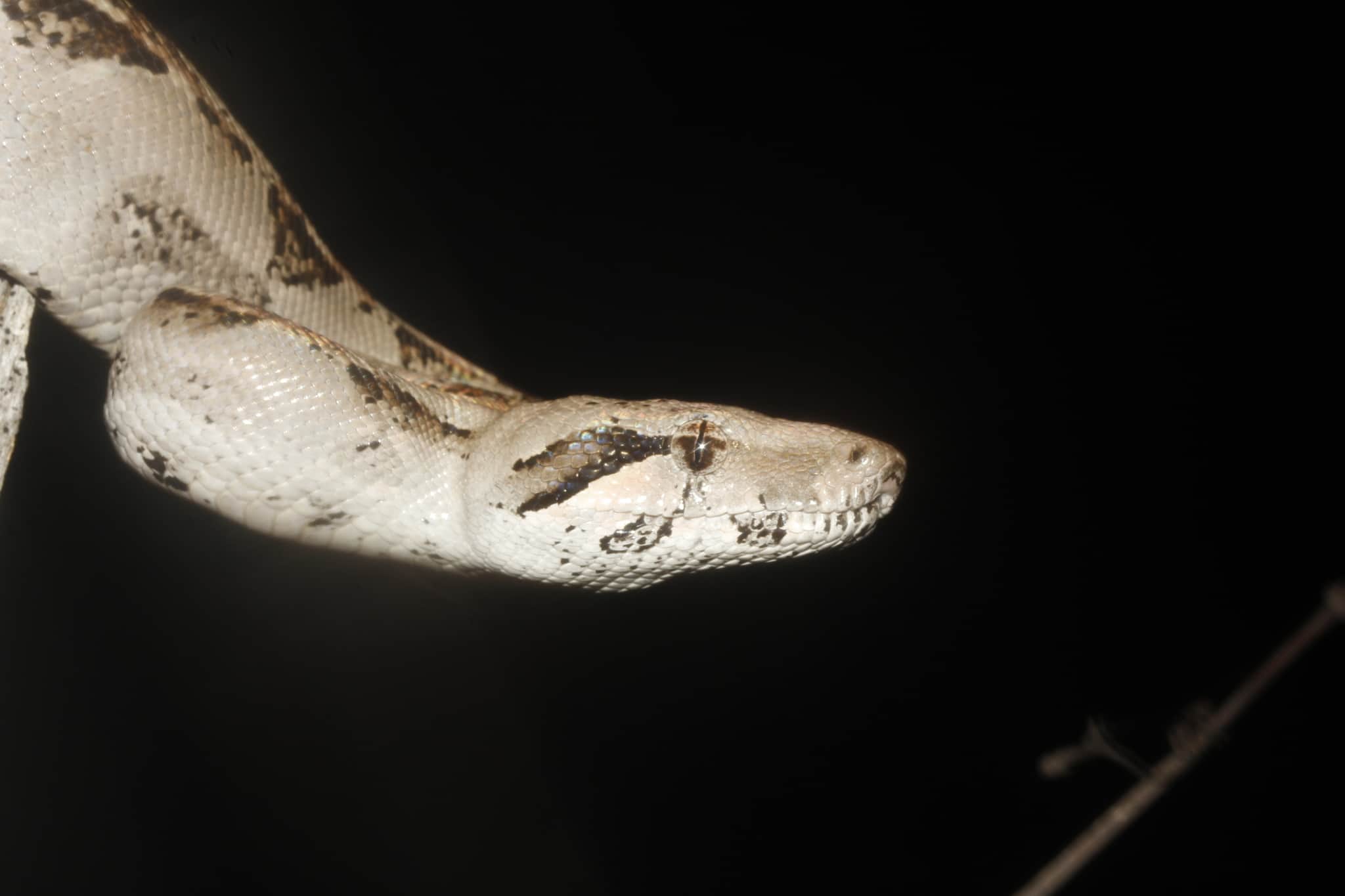
Maximum length: 3.7 metres.
Boa imperator is officially El Salvador’s longest snake, regularly exceeding 3 metres and possibly reaching 4 metres in the wild. It was only “discovered” in 2016, yet is one of the best researched snakes in the world. This is because it was originally a subspecies of the boa constrictor, until DNA analysis proved it to be a full species after all, with a genetic divergence of 5-7%. From then on, all boa constrictors found in Central America were officially switched to Boa imperator.
This version is lighter overall, but with a darker tail. The messy blotches are similar, and they’re just as long-lived as their cousin, reaching 40 years in captivity. Boa imperators share the constricting nature, and the ability to live in endless habitats, such as forests, grasslands, villages, and savannahs.
Boa imperator replaces its cousin in Columbia and Ecuador west of the Andes, before inhabiting all 7 countries of central America, and finally finishing in southern Mexico. Meanwhile, everything in South America east of the Andes is still classed as the boa constrictor, including in the entirety of Brazil.
When the species were split, all food records for Central America were transferred to Boa imperator. Consequently, the amount of confirmed prey for this snake is already gigantic. Mammals are favourite, with hefty helpings of frogs and birds. The list continues to grow, such as in 2022, when a boa imperator was recorded eating a Yucatan squirrel. Other prey include porcupines, monkeys and even small deer.
| 10 | Tiger ratsnake |
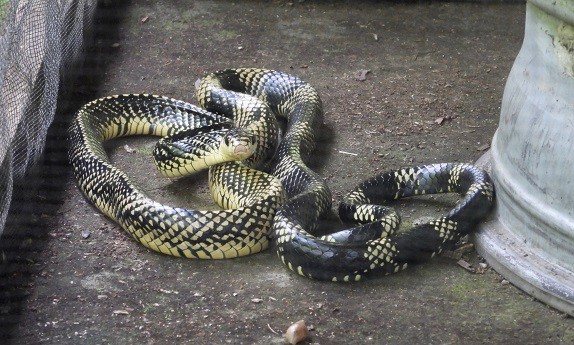
Maximum length: 2.7 metres.
A harmless yet extremely long snake, which regularly exceeds 2 metres, and climbs thin tree branches with ease. Tiger ratsnakes are extremely easy to recognise. Their body features just two vividly contrasting colours: creamy yellow and night-time black. The yellow comes in vague stripes, but there’s also yellow scales dotted around as if by random.
Tiger ratsnakes (Spilotes pullatus) are one of the most successful snakes in the world, with a vast range stretching from Mexico to the heart of South America. They’re a strongly muscled snake, which can poke their upper bodies leagues beyond the branch supporting them, as though floating in thin air. Branches are easily their main hangout, 2nd is by a thick tree trunk preparing to climb, while their 3rd main hangout is in the roofs of village houses searching for bats.
Tiger ratsnakes are relatively uncommon in dense rainforests. They prefer forested areas interspersed with clearings, which commonly brings them into contact with people.
Tiger ratsnakes have an unfussy diet, focussing on mammals, but also reptiles, birds, and bird eggs. They may be slightly too unfussy, as one tiger ratsnake was spotted swallowing an adult Mexican tree porcupine, before dying when its spines pierced its body.
| 11 | Road guarder |

Maximum length: 131cm.
The road guarder (Conophis lineatus) is a fast-moving species which ranges from southern Mexico to Costa Rica, covering most of El Salvador in the middle. This species varies in appearance, with a large proportion being easily recognisable due to their repeated black stripes. Another portion are completely missing these stripes, but one feature which is always present is a black stripe directly behind each eye.
Of all “mildly” venomous snakes in the Americas, the road guarder might be one of the more serious. They technically only possess a rear-fanged venom which must be slowly chewed into victims, but victims have experienced numb fingers, a tingling head, free bleeding, and even a grotesquely swollen and inflated arm. Their venom contains over 50% metalloproteinases, which generally cause local tissue damage or haemorrhaging.
Road guarders have a flexible diet, including mammals, reptiles and amphibians alike. They’re confirmed to be swallowed by our fellow list entrant, the neotropical whipsnake.
Whether they genuinely guard roads is a mystery, but this species does have flexible habitats, ranging from fields to woodlands and dusty villages, generally preferring open areas. It’s possible that villagers noticed a tendency to bask on roads in the sunlight, which combined with superstitious thinking to create a belief that they were deliberately blocking peoples’ way.