
| 1 | Master of rocky slopes |
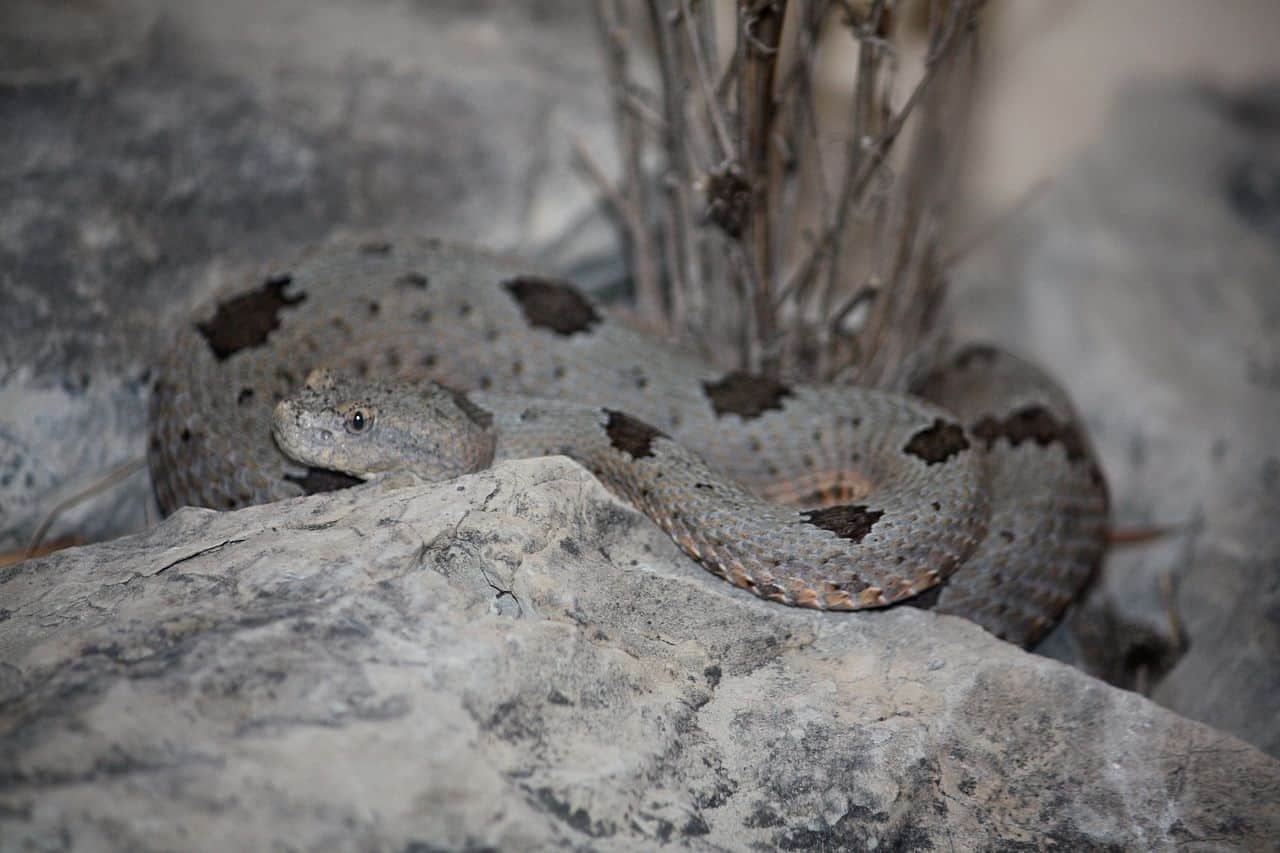
The rock rattlesnake (Crotalus lepidus) is a moderately dangerously species found in the southern USA, as well as northern Mexico. It’s a species of three US states, including western Texas, Arizona and New Mexico, with a fairly short record length of just 82.8cm, and an average of 70cm. It’s possible that you’ve never heard of the rock rattlesnake, and that’s because this species mostly lives nowhere near human beings.
Unlike the tiger rattlesnake, rock rattlesnakes are never found on the edges of sprinkler-fed resorts in Arizona, or near long desert highways. Instead, rock rattlesnakes live far from prying eyes, typically in high altitude forest and woodland areas. They favour not just remote woodlands, but those with an abundance of rock formations and talus slopes, which they lurk in quietly and stealthily.
Of all rattlesnakes in the US, rock rattlesnakes are the most notorious for lurking on rocky slopes. They can spend all day in these jagged rock formations, lurking completely out of sight. Their most common macrohabitats are Madrean woodlands and Petran montane conifer forests, as well as rocky montane forests. Rock rattlesnakes appear in untouched areas only – they cannot cope with towns or suburbs, unlike the western diamondback lower down.
Rock rattlesnakes have evolved to blend with their rocky environments, as they’re typically a stone grey, overlaid with 13-38 bands of darker grey. Their scales are sharp to touch, and they sometimes have small spots between each dark band. Not only are rock rattlesnakes hard to find, but they blend in effortlessly where they do live.
| 2 | Lives nowhere near humans |
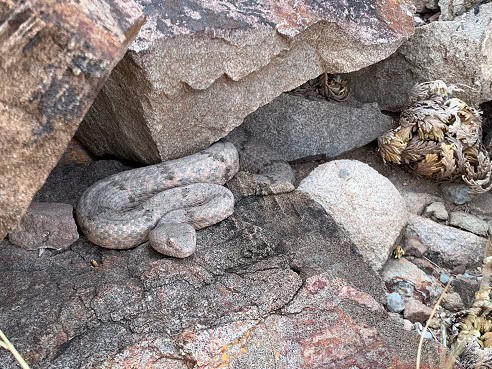
Rock rattlesnakes live at altitudes ranging from 600 metres to 2930 metres, reaching their highest point in northern Mexico. Rocky slopes within forests are their favourite habitat, with endless nooks and crannies they can vanish into. But rock rattlesnakes also appear in grassland not far from forests occasionally, where they disappear into dark burrows. On cool rainy days, they’re more likely to leave the safety of their dark rock cracks.
Rock rattlesnakes live in spots where they can alternate between rocky slopes and the forest floor at will, depending on temperature. On hotter days, they can lurk quietly in the darkest rocky outcrops, completely out of sight of chattering hikers and keen-eyed hawks. As the sun sets, they can use their nocturnal talents and scour the forest floor for prey. Sometimes, they don’t need to leave their rock crevices for meals, as lizards they enjoy such as Yarrow’s spiny lizards often inhabit them too.
The best time to spot a rock rattlesnake is at sunset or sunrise, as they switch between their two bases. Rock rattlesnakes are also less common on rocky slopes in forests during summer, due to the potential risk of sizzling heat death.
| 3 | One of the lazier rattlesnakes |
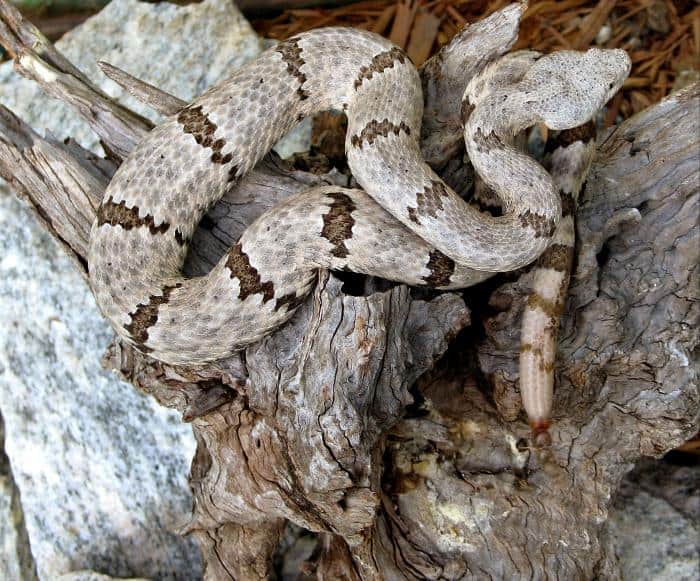
The rock rattlesnake is one of the lazier members of the Crotalus rattlesnake genus. Most individuals move just 10-20 metres per day, which is above the ridge-nosed rattlesnake, but close to bottom for rattlesnakes of the southern US.
According to a study from the Chiricahua Mountains of Arizona, the rock rattlesnake moved less than virtually all other rattlesnake species, including the tiger, black-tailed, twin-spotted, western diamondback, and Mojave rattlesnakes. The most active southern US rattlesnake of all is the sidewinder, slithering hundreds of metres per day.
Unlike the prairie rattlesnake, rock rattlesnakes don’t travel miles and miles to their summer feeding grounds, before returning during winter. Instead, they stick to a single sunny corner of the forested mountain wilderness all their lives. Rock rattlesnakes can operate during night or daytime, with temperature being the real key.
By late May, they switch on at around dusk, and return to their shelters by 9:30am, to avoid the burning heat. This also means that those at the highest altitudes are barely nocturnal at all. Heavy rains tend to bring them out of their shelters, and males are more energetic than females, due to their quest for mates.
Rock rattlesnakes rarely climb trees, but can reach 1.4 metres above ground occasionally. They’re also decent swimmers, despite rarely encountering water.
| 4 | Blends into different rock types |
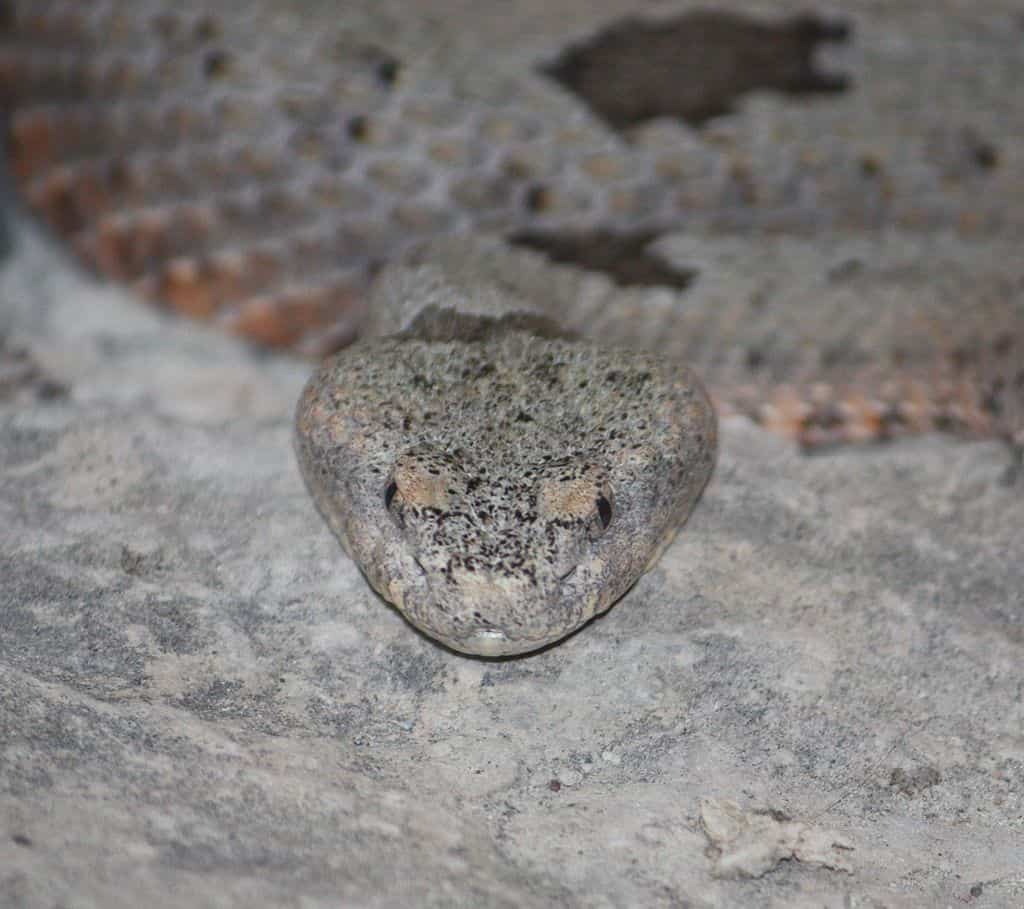
Crotalus lepidus spends its life blending into rock, but the problem is that there’s many types of rock. No worries – the rock rattlesnake can shift its superficial scale colour depending on the type of slope.
Western Texas is one rock rattlesnake hotspot, with a particular stronghold being the Davis Mountains, continuing southwards through to Big Bend. The soils here are darker and more volcanic, and therefore, the rock rattlesnakes have thicker, darker blotches.
Slightly further east in Texas, another base is the Stockton and Edwards plateaus, which have lighter soils mixed with limestone outcrops. The rock rattlesnakes here have the more typical pattern, grey with faded blue tinges.
These differences happen without being different subspecies, as rock rattlesnakes have an inherent ability to switch their colour depending on local soil type. In 2012, a study showed that these varying colours are designed against predators as well. Scientists placed models of rock rattlesnakes over rubbly slopes, painted carefully to match natural morphs. The models consisted of urethane foam, designed to withstand Texas temperatures of 38C. Some of the models matched the rock type, while others didn’t.
The mismatched models were swept down upon by birds far more, as they stuck out like a sore thumb. One rock rattlesnake model suffered a particularly grisly fate – its head was stomped on and destroyed, either by a deer or sheep.
| 5 | Symptoms: spontaneous bleeding |
The rock rattlesnake has a mainly haemorrhagic venom, with almost no neurotoxins (unlike the Mojave rattlesnake). Bites are extremely rare, but one reported in 2005 happened to a snake handler, who received a full two-fanged strike on the left thumb.
Within minutes, the victim’s thumb became swollen and painful. After 5 minutes, he had wrapped a rubber tourniquet around the wrist, and started driving himself to the hospital, which he reached one hour post bite. As he strode into the emergency room, his hand was painful and swollen, but his wider body was still spared, except for a heartrate of 103 BPM. The swelling soon reached his wrist, preventing him from touching his thumb and index finger together.
Over the next hour, the swelling reached the victim’s upper arm, and he spoke of a strange feeling that cold water was dripping on his lips and chin. The man was offered antivenom, but refused, allowing just a small dose of morphine.
The man was bed bound for the next 24 hours. The swelling reached his chest and neck, but the systematic systems were mere nausea and vomiting, which could have been caused by the morphine.
His arm began to haemorrhage slightly, but not severely enough to cause blood blisters. Nor did the skin turn necrotic and rot. The man was discharged on day 5, and at a checkup one year later, there was no permanent damage to his limb or skin.
| 6 | Venom curiosities |
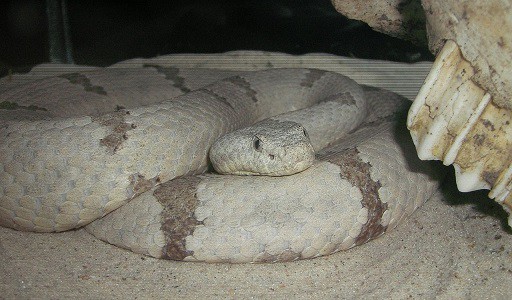
Rock rattlesnakes can cause different symptoms depending on country or even state. There are 4 subspecies, which have been separated by geographical barriers for millions of years.
Crotalus lepidus lepidus and Crotalus. l. klauberi are the two US subspecies, and are significantly deadlier than the two Mexican versions, Crotalus l. molurus and Crotalus l. maculosus. The US pair cause less local effects like swelling, but significantly more haemorrhaging. A bloodstream biomarker called creatine kinease, an indicator of muscle tissue destruction, was significantly higher with the two US subspecies.
The venoms also affect animals differently. Crotalus l. lepidus was far more toxic towards lizards, with an LD50 venom toxicity score of 0.17mg, The Mexican subspecies (C. l. molurus) only managed 6.68mg, but was significantly more toxic towards crickets. The rock rattlesnake can specialise itself to particular rocky outcrop ecosystems.
Consequently, the exact deadliness of rock rattlesnakes varies wildly in studies, and likewise for the venom yield. One rock rattlesnake spewed out 129mg in a single bite, but another produced only 24mg, 25mg and 34mg in three separate milkings.
| 7 | Their one weakness |
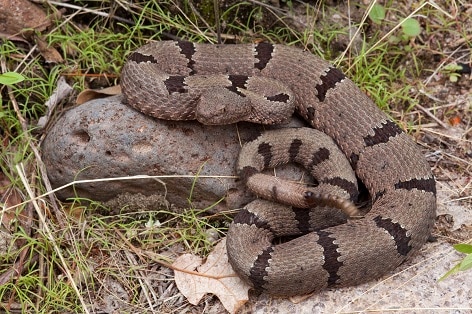
Rock rattlesnakes have weaknesses, as compared to their prairie rattlesnake cousin, they’re poorer at following mammal scents. They find it trickier to latch onto whatever chemicals mice and rats produce, and stalk them through their well-trodden trails. There’s a good reason for this though: rock rattlesnakes derive a much higher proportion of their meals from reptiles, unlike the prairie rattlesnake, which gets 90% of its meals from mammals.
A 2002 study analysed hundreds of individual rock rattlesnakes. It found the following diet breakdown: 55.4% lizards, 28.3% centipedes, 13.8% mammals, 1.9% birds, and 0.6% fellow snakes. The vast majority of lizards were one species: Jarrow’s spiny lizard, a high altitude species which often skits over rocks in the Chiricahua Mountains.
Two of their confirmed snake prey include the Chihuahuan night snake and western hooknose snake. Confirmed mammal prey include the plains pocket gopher and white-ankled mouse. The rock rattlesnake also has its own predators, including copperheads and collared lizards.
Like its venom, the rock rattlesnake’s diet varies by location. Another study compared two rock rattlesnake habitats in Big Bend, southern Texas. In one, lizards comprised over 80% of meals, while in the other, mammals made up over 60%. That said, lizards still averaged out on top.
| 8 | They don’t want to be found! |
As well as living far from prying eyes, rock rattlesnakes are rarely abundant even where they do live. You might find a single individual on one crumbling talus slope, after stumbling through a treacherous rocky forest which probably left you with bleeding legs. In one survey, Reynolds examined 40 individual Crotalus lepidus habitats. The most heavily populated contained 106, but only 6 contained more than 7 snakes.
Likewise, a study which drove up and down a Chihuahua highway for three years found just 3 rock rattlesnakes, among 418 snakes in total. This is a far cry from the prairie rattlesnake, which has complex social systems and sometimes lives in colonies of over one thousand. The Arizona black rattlesnake is another social species, but rock rattlesnakes are far more solitary.
If you do meet a rock rattlesnake, then you may just escape, as this is one of the calmer, more docile species. It prefers to rely on its supreme camouflage, hiding in a rock crevice. It’s possible to be on a rocky slope in a Madrean woodland, hear a rattle echoing around you, and have no clue where it’s coming from.
| 9 | How mothers hide their young |
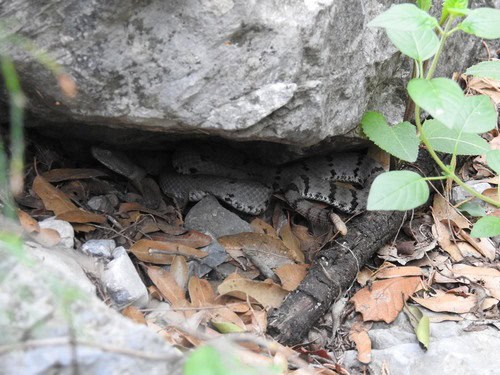
Despite being solitary overall, rock rattlesnake mothers still take the time to guard their young. Mothers know that the species’ future will be imperiled if too many juveniles are picked off by birds. On the plus side, newborns have venom, but on the downside, they don’t have any arms or legs.
So rock rattlesnake mothers do the smart thing, and take advantage of their environment, stashing their young in a rocky crevice, before sitting still and guarding the entrance. Rock rattlesnakes lay live young rather than eggs, in low amounts of 2-9. They only reproduce biannually, adding up to a low reproductive rate overall, meaning that they could become endangered if their habitat is absorbed by humanity.
Rock rattlesnakes enter hibernation in November. They’re intelligent about their spots, resting on rocky slopes, but always choosing those that face south, to maximise sun absorption during the chilly days of winter.
Another survival trick is licking droplets of rainwater from natural pools in rock surfaces, or even off their own scales. Rock rattlesnakes have a “least concern” conservation tag from the IUCN, but New Mexico’s state government considers them to be threatened.
| 10 | Terrified of kingsnakes |
Rock rattlesnakes actively search for their prey sometimes, but more often than not ambush them. They rest between rocks or vegetation in an S-shaped coil, with their head resting on the rocks themselves. When a lizard skits along the stony surface, they erupt from below, striking multiple times. Rock rattlesnakes hold onto their meal until it enters a coma, not swallowing until it’s fully immobilised.
As youths, rock rattlesnakes have a bonus weapon as well: a bright yellow tail tip, which they use to tempt prey. This fades completely to grey by adulthood.
The common kingsnake, AKA Lampropeltis getula, is one of the USA’s most notorious snake-eating snakes, even swallowing venomous copperheads. This news has apparently reached the forested outcrops of the rock rattlesnake, as when scientists placed kingsnake scents in front of them, they immediately acted defensively, placing their head in a shield of coils.
When their scent-detecting vomeronasal organs were taped shut, they didn’t react to the kingsnake scents at all. Rock rattlesnakes don’t overlap with the common kingsnake, but do share their territories with the Chihuahuan mountain kingsnake and Arizona mountain kingsnake, and the desert kingsnake at lower elevations.