
| 1 | Speckled racer |
Maximum length: 127cm.
The USA has many snakes which straddle the border with Mexico, but there’s also others which cover vast swathes of land to the south, and only just cross the US border into one or two narrow regions.
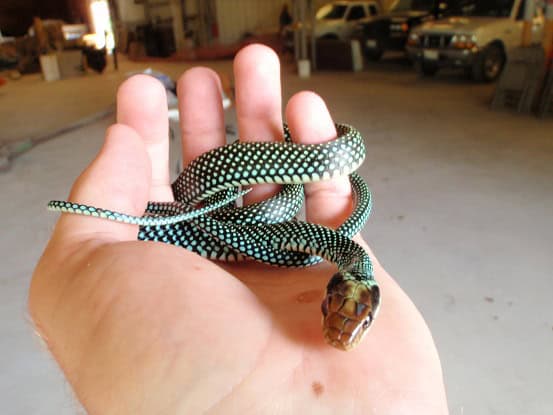
One of these is the speckled racer, AKA Drymobius margaritiferus. This easily recognisable species derives over 80% of its prey from toads and frogs, and is harmless to human beings. It can climb trees, but mainly sticks to the ground, in grassland, forests and villages alike.
The speckled racer has a huge empire, inhabiting all 7 Central American countries from Panama to Guatemala. It also covers much of Mexico. There are various common snakes like the Mexican boa constrictor (Boa sigma) which fail to reach the US border, falling short by around 100 miles. But the speckled racer just staggers over the finishing line. This snake occupies nowhere in the USA except the extreme south of Texas, where it has relatively high densities, yet disappears instantly when you travel further northwards.
In Texas, speckled racers have similar patterns to in Mexico and Central America: dark overlaid with hundreds of pale speckles. This species has a strong bluish tinge, with a creamy chin and black side of the head. In Texas, they’re known only from Cameron County in the extreme south, with one old and disputed record in southeastern Hidalgo County. The species is officially listed as threatened by the state government.
| 2 | Northern cat-eyed snake |
Maximum length: 100cm.
The northern cat-eyed snake (Leptodeira septentrionalis) is a semi-arboreal species, clinging to tree branches, with an agile, energetic nature. It inhabits the swarming forests of Central America, excluding Panama, reaching as far south as Costa Rica, and is also common in Mexico. This is an exotic snake, not a harmless back garden creature, yet the northern cat-eyed snake just reaches the USA, with a small population in the far south of Texas.
Northern cat-eyed snakes are officially listed as threatened by the Texas state government. They’re slightly more common than the speckled racer, appearing in most of Cameron, Hidalgo, Kennedy and Willacy counties. They also inhabit parts of Kleberg, Brooks and Starr Counties.
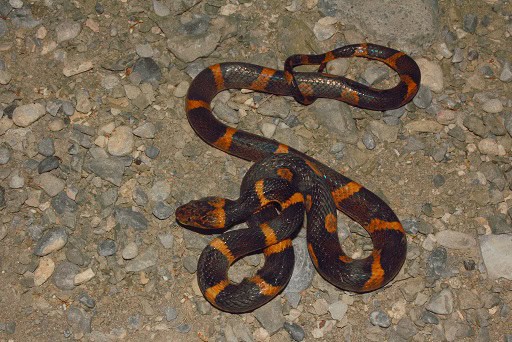
They can be rare, as some amateur herpetologists have spent decades searching for them in southern Texas and come up empty-handed. Many local Texans are completely unaware of them, and mistake them for vipers, which is understandable given their strongly brown and beige colours, which somewhat resemble a copperhead or rattlesnake.
In reality, northern cat-eyed snakes are only mildly venomous, and no serious envenomations are known. This snake lacks any hint of green, and its patterns are large and sweeping, with clear colours and no complex patterns and markings between.
The Leptodeira genus has 18 members, but this is the only one to reach the USA, and even then only barely. The southernmost is the annulated cat-eyed snake, which penetrates well into northern Argentina.
| 3 | Thornscrub vine snake |
Maximum length: 152cm.
Arizona is home to a high number of common Mexican species which only just stagger across the US border, partly down to the Madrean woodland ecosystems. These are spacious forests rich with grasses and more temperate life forms, which act as sky islands, avoiding the burning deserts lower down. They act as a continuation of the wide Sierra Madre plateau, which covers a huge swathe of Chihuahua state, Mexico, but gradually transitions to desert as the US border approaches, due to the declining altitude.
While many snakes are unable to cope with the sudden change of habitat, a few cling on in high altitude sky islands, in tiny pockets of territory, one of which is the thornscrub vine snake (Oxybelis microphthalmus). This is the northernmost member of the Oxybelis vine snake genus (11 members), and the only one to penetrate the USA. It was originally considered to belong to the brown vine snake species, but officially separated in 2000, meaning that some old descriptions on Arizona reptile websites still refer to the brown vine snake.
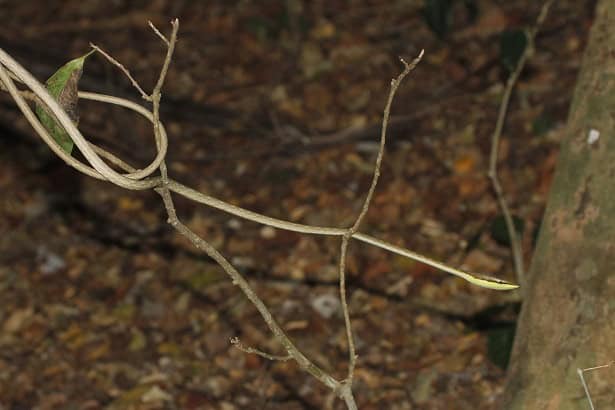
Thornscrub vine snakes appears in just three counties: Santa Cruz, Cochise and Pima. They possess a mild venom, but are harmless to humans. They have an exceptionally thin body, which allows them to weave through the most delicate thorny branches. To the south, meanwhile, thornscrub vine snakes occupy most of western Mexico, almost reaching Guatemala.
Thornscrub vine snakes are recognisable by a brownish body, contrasting sharply against a greenish-yellow underside. This delineation continues on their face. Their pupils are round, and they have a long, slender head, rather than thick and bulky like a rattlesnake. Due to their extreme thinness and love of branches, which they closely resemble, they’re one of Arizona’s hardest snakes to find.
| 4 | Black-striped snake |
Maximum length: 50.8cm.
The Coniophanes genus is one of the larger snake groups of the Americas which virtually nobody has heard of, with 17 confirmed members, all harmless to humans. The only one of these to reach the USA is the black-striped snake, AKA Coniophanes imperialis. Even then, it only crawls across the Texas border, inhabiting only the far south of the entire US. This is in spite of a large range which stretches southwards all the way to Honduras.
In Mexico, black-striped snakes hug the east coast, which is why their range comes to a stop in southern Texas. They’re known from 4 counties in Texas: Cameron, Hidalgo, Willacy, and possibly Kennedy county.
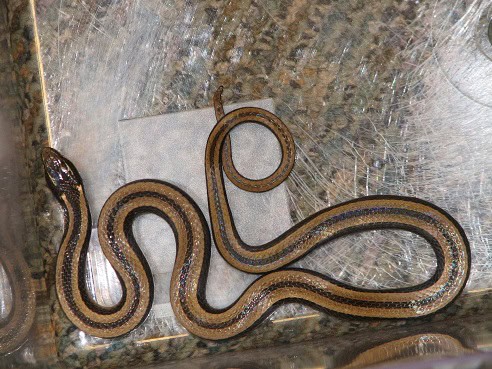
Black-striped snakes are recognisable by neat, orderly parallel stripes, with black contrasting against either a cream or red base. Their diet includes insects, birds’ eggs and amphibians such as veined tree frogs. They mainly stick to the ground, but are capable of hunting above ground on branches. Black-striped snakes are listed as threatened in Texas, but have still been found in towns and cities, including in swimming pools.
| 5 | Baja California ratsnake |
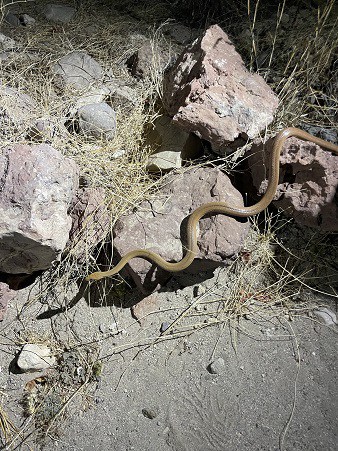
Maximum length: 152cm.
Baja California is the Mexican peninsular found immediately to the south of US California. Due to tectonic faultlines, it stretches southwards in a narrow finger for 775 miles, with no contact with mainland Mexico except in the far north. Both US and Baja California share many species in common, such as the California kingsnake, which is abundant in both, but Baja California also has the likes of cape garter snakes and cape thread snakes, which are endemic.
One common species here is the Baja California ratsnake (Bogertophis rosaliae). This non-venomous species prowls around the countryside calmly, swallowing mammals, digesting calmly, and mainly inhabiting relatively open areas such canyons and shrubland. It appears across the peninsular, from south to north, but officially, it fell just south of the US border.
That all changed in 1984, with a report of a Baja California ratsnake in Imperial County, just a few miles north of the border. It was found dead on a road, but no further reports emerged until 2017, when scientists found a new Baja California ratsnake, this time alive. It was just 2.24 miles south of the US border, and 7.6 miles away from the 1984 discovery. Most encouragingly, it was found in the same continuous rocky habitat, which ran across the border uninterrupted.
On iNaturalist, the closest dot of the Baja California ratsnake is about 10.4 miles south of the US border. Most signs suggest that they are present in US California, but of all 11 entrants on this list, this is the only one with genuine mystery surrounding it.
| 6 | Ridge-nosed rattlesnake |
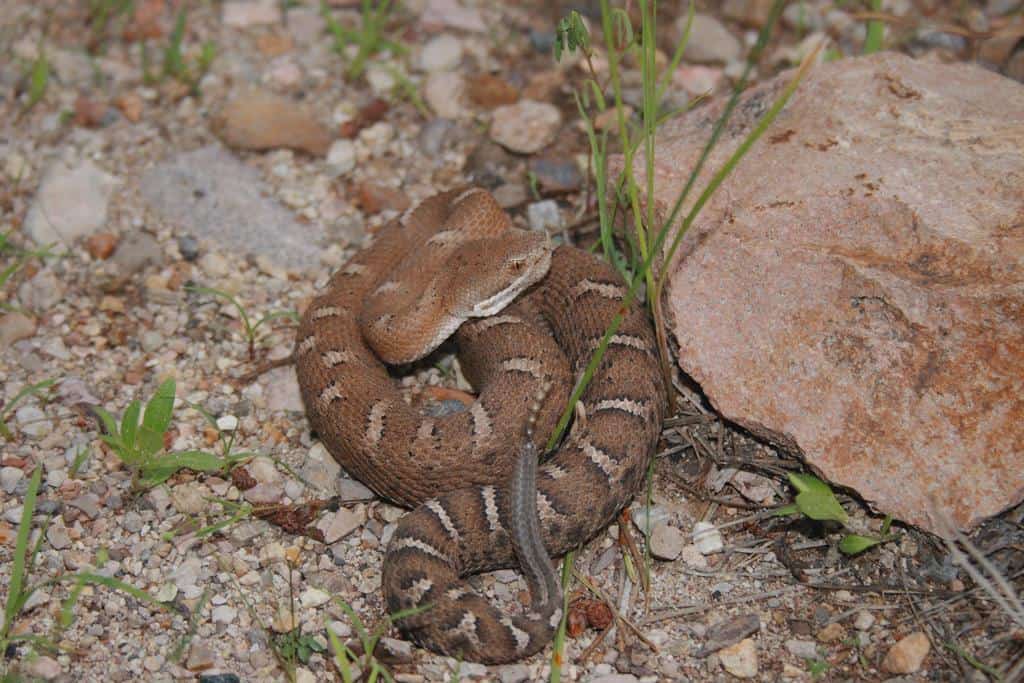
Maximum length: 67cm.
The ridge-nosed rattlesnake is a small species, with an all-time record of 67cm, and an average of 40-55cm. 95% of its territory lies in Mexico, yet the species has a small foothold in the US, split between Arizona and New Mexico, in just a few counties. Of all US rattlers, this species has the greatest imbalance between its large Mexican territory and tiny outpost in the USA.
There’s no way to escape rattlesnakes in Arizona. In the scorching desert lowlands, you have western diamondbacks to contend with, while if you go hiking in the mountains of the south, you might bump into the ridge-nosed rattlesnake. Within the US, this species is found in the Animas and Peloncillo mountains. It’s found only at altitudes of 1300-2800 metres above sea level, often in pine-oak forests or wooded canyons.
Ridge-nosed rattlesnakes have some of the smallest US territory of any rattler, yet to the south in Mexico, they cover far more land. It’s unlikely you’ll meet one without meaning to, but there’s still a chance if you’re hiking in remote places. In Arizona, they’re found mainly in Santa Cruz and Cochise County, plus southeastern Pima County. In New Mexico, they’re found mostly in Hidalgo County.
Ridge-nosed rattlesnakes eat over 50% reptiles, supplemented with mammals and centipedes. This species also has caring mothers, as newborns have been witnessed following adults obediently into dark rock cracks. Within Arizona, this species is protected by strict laws, as handling a ridge-nosed rattlesnake without permission is strictly prohibited.
| 7 | Green ratsnake |
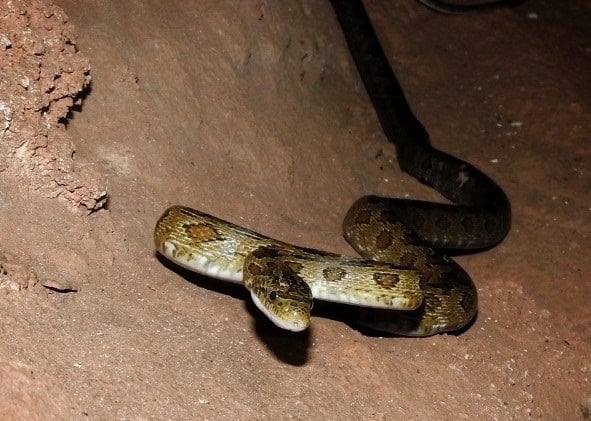
Maximum length: 160cm.
The green ratsnake is an unusual species, which undergoes a strong ontogenetic colour transformation, beginning life as brown before gradually blooming into fully green adulthood. It’s the only member of its Senticolis genus, but has a large territory, covering much of Mexico, Guatemala, Belize, El Salvador, Honduras, and Nicaragua. The species finally fizzles out in central Costa Rica, failing to reach Panama, and at the opposite extreme, they just spill across the US border.
Like the thornscrub vine snake, the green ratsnake is an inhabitant of high altitude Madrean woodland environments. It appears in areas safeguarded against the burning sand and cacti of the lower deserts, instead appearing in a biologically rich (and protected) area of tall grasses and pine-oak trees.
This is a very secretive species. Green ratsnakes have a strong tendency to hide in rock formations, even in Madrean woodland environments. They’re non-threatening to humans, and appear in the usual three Arizona counties: Santa Cruz, Pima and Cochise. They also spill into extreme southwestern New Mexico, in Hidalgo County. Despite being rare, new locations for the green ratsnake are still being discovered, such as Wet Canyon in the Pinaleños mountains, where they were only found in 2017.
Green ratsnakes eat a varied diet, sometimes including bats. People might encounter this snake in a humid Nicaraguan village and point and stare, believing it to be an exotic piece of wildlife, without realising that this snake is clinging onto a very small piece of the USA thousands of miles to the north.
| 8 | Thornscrub hooknose snake |
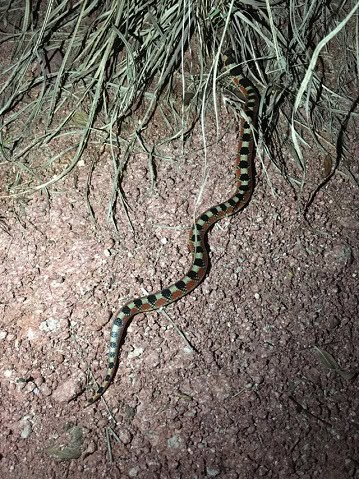
Maximum length: 160cm.
Another lover of high altitude oak savannahs, which is widespread in Mexico, and just trickles over the US border to exist in a tiny pocket in Arizona. Thornscrub hooknose snakes (Gyalopion quadrangulare) are non-venomous, and prey on a mixture of insects, spiders and scorpions. To the south, they reach as far as Nayarit state in west-central Mexico, but in Arizona, they’re found exclusively in Santa Cruz county, sharing terrain with fellow list member the thornscrub vine snake.
Only the most learned reptile enthusiasts can find this snake within the USA. The thornscrub hooknose snake effectively has a northern foothold in the USA, to spy on the local rattlesnakes and coral snakes, and report back to the main base in central Mexico. Like the thornscrub vine snake, they survive due to cooler woodland ecosystems at higher altitudes, well above the surrounding harsh deserts. They also appear in rolling semi-desert mesquite grasslands.
This species tends to appear on the ground, with strong burrowing tendencies. It’s a nocturnal snake, and within the USA, can be found at altitudes of 1000-1400 metres. It took until 1959 for this species to be discovered in Arizona. They’re usually encountered by normal people on roads.
In the lucky event that you find them in Arizona, thornscrub hooknose snakes are at least easy to recognise. They have a copper red colour, overlaid with black bands, which is in turn overlaid by a snowy white vertebral stripe. Their face has a black mask, with a red snout, and a black band covering each eye.
| 9 | Baja California coachwhip |
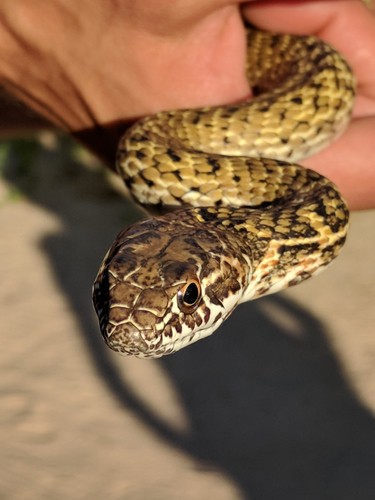
Maximum length: 184.5cm.
The Baja California coachwhip is a close relative of the US coachwhip, a fast-moving, extremely heat resistant species which charges down lizards and grabs them using sheer agility. It was originally a subspecies of the US coachwhip, but made independent in 2002.
Baja California coachwhips inhabit virtually all of their namesake peninsular, from the northern areas bordering mainland Mexico to the extreme southern tip, one of the more remote parts of the Earth. It’s a dry, dusty peninsular, with endless sweeping shrubland and patches of spacious woodland, and this is perfect terrain for any coachwhip. To the north, the species also crosses into US California, but only in a narrow area of territory.
Unlike the Baja California ratsnake, this isn’t up for debate, as dozens of observations of Baja California coachwhips have been made over the border. That said, they’re still restricted to an extremely narrow area: the outskirts of San Diego. They fail even to reach Los Angeles to the north, appearing only in San Diego and Imperial counties.
On this iNaturalist map, the dots for the Baja California coachwhip are plentiful in US California, but confined to an extremely small area. The US coachwhip also inhabits the San Diego area, but no further southwards.
The two species have a slight area of overlap, but the Baja California coachwhip tends to be darker, at least within US California. The US coachwhip is often pink or red in San Diego, or has a messier mixture of grey and black. Meanwhile, Baja California coachwhips near San Diego are virtually always some mixture of black and pale yellow.
| 10 | Mexican garter snake |
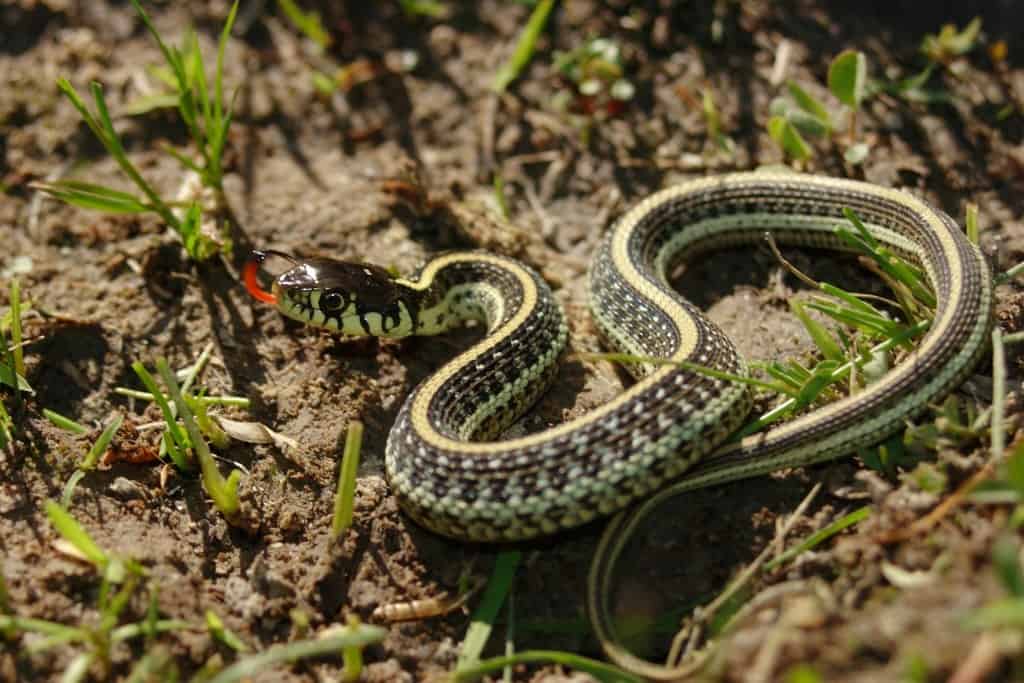
Maximum length: 130.7cm.
The Mexican garter snake is one of the most widespread of its kind in Mexico. While the USA has the almighty common garter snake, the Mexican garter snake (Thamnophis eques) stretches from the outskirts of Mexico City, all the way to Chihuahua. It has at least 10 confirmed subspecies, often confined to just one lake basin.
In the USA, Thamnophis eques is also found in a few pockets in Arizona. There’s populations in the usual extreme southern counties like Santa Cruz, Pima and Chochise, but also a central pocket in Yavapai County, which is isolated from the southern populations.
Again, the reason is sky islands with more temperate climates, where the garter snakes somehow became trapped, and unable to connect via the harsh deserts below. Mexican garter snakes used to be more common in Arizona, but their territory has shrunk significantly over recent decades. The appear often in sparse woodlands, and can even appear in semi-desert grasslands as long as a water source is nearby.
Nevertheless, most Arizona deserts are too harsh for them to spread, and therefore repopulate each other. Mexican garter snakes are listed as of “special concern” by Arizona’s Game and Fish Department, and it is now illegal to handle or collect them without permission.
The Mexican garter snake is harmless, and preys heavily on amphibians, including waterfrogs, and occasionally fellow garter snakes. This one of the few predominantly Mexican species to also cross into the USA. The blackbelly garter snake fizzles out in Chihuahua, while the Mexican wandering garter snake (Thamnophis errans) falls short of Arizona by a few hundred miles.
| 11 | Chihuahua black-headed snake |
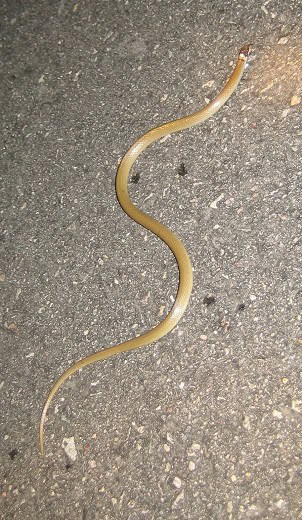
Maximum length: 36.4cm.
The Tantilla genus has 68 members worldwide, making it the 5th largest group of snakes. The Chihuahua black-headed snake (Tantilla wilcoxi) is mainly a Mexican species, covering a large swathe of the north. This species is recognisable by a pale, patternless body, contrasting sharply against a black head. Between the two lies a snowy white neck collar, with a slight black edge before the main body arrives. Their underside is bright red.
If you live in the US, there’s no chance of meeting this snake – unless you travel to southern Arizona or extreme southeastern New Mexico, and specifically the mountain ranges of Huachuca, Santa Rita, and Patagonia. The Chihuahua black-headed snake is a classic Mexican species which only just spills over the northern border, joining the green ratsnake and thornscrub vine snake. They’re tricky to find at the best of times, as all Tantilla members are shy and lurk under cover objects like logs.
Chiahuahua black-headed snakes only appear at altitudes of over 900 metres, in mesquite grassland or oak woodland. If they tried to coexist with a tiger rattlesnake, they would shrivel up and go crispy in no time. Chihuahua black-headed snakes therefore confine themselves to woodlands and shrublands, in slightly cooler regions. One confirmed location for this species is the ghost town of Mowry in New Mexico, which lasted until 1881, but is now ramshackle and abandoned.
Tantilla wilcoxi isn’t particularly well researched, but is confirmed to prey on desert centipedes, and possibly spiders. They’re completely harmless, and there’s no risk of death if you track one down in the Huachuca mountains in far southern Arizona. The only risk is if you bump into another Huachuca resident – the ridge-nosed rattlesnake.