
| 1 | Scrub python |
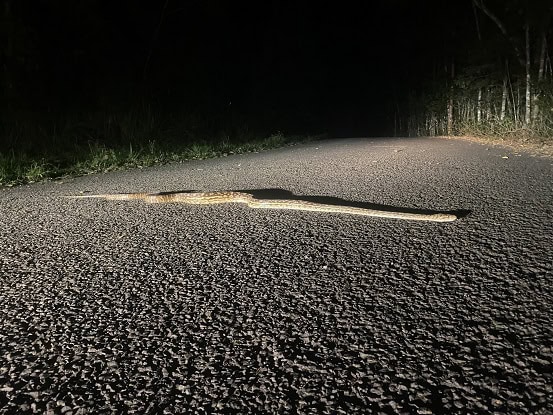
Maximum length: 565.1cm.
The scrub python is a species of Australia’s far northeast, appearing in Queensland and nowhere else. This is the official longest snake in Australia, often exceeding 4 metres. Its favourite habitats are rainforest and regenerating forests, yet it also has a disturbing tendency to block paved roads adjacent to forests, to the annoyance and possibly horror of speeding motorists.
Scrub pythons are relatively adventurous, preferring forests but also venturing to forest outskirts and grasslands near by. The green tree python, meanwhile, never leaves its forests at all. In fact, it almost never leaves its tree branches.
Consequently, the scrub python is by far the more likely of the two to appear on roads. If you’re unlucky, you may encounter two, perhaps in mortal combat. The scrub python is a notorious wrestling snake, with males battling for the attention of females. Adult males are often covered with grisly scars from these battles.
Because of their large size, scrub pythons can prey on large animals. Creatures you may see them hunting by the side of a road include brown bandicoots, striped possums, spectacled flying foxes and agile wallabies.
| 2 | Anchieta’s cobra |
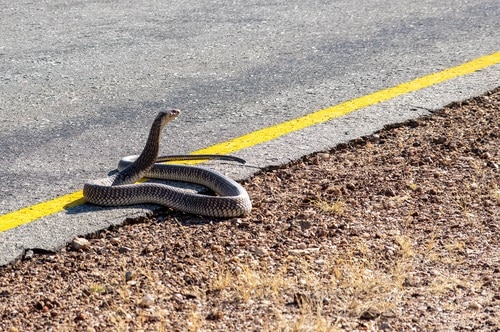
Maximum length: 241cm.
Anchieta’s cobra is a relatively uncommon species of northern Namibia, northern Botswana, and western Zimbabwe. It’s a creature of open areas such as dry savannahs, and as the image above proves, paved roads. Anchieta’s cobras (Naja anchietae) are fast-moving and adventurous, like many cobras, and to them, a road is probably equivalent to a large rock slab on a hillside. In other words, nothing to worry about at all.
Anchieta’s cobra is relatively dull in appearance, but some individuals have thick, encircling bands which cover their entire bodies. The actual bite of this species is poorly researched. Although many bites have doubtlessly happened, there have been few detailed case studies. But the evidence suggests that Anchieta’s cobra may be particularly neurotoxic.
A 2024 study analysed 13 species of cobra found in Africa, from the snouted cobra of South Africa to the red spitting cobra of Kenya. Generally in snakes, three-finger toxins (3FTx) are responsible for neurotoxic effects, blocking acetylcholine signals which bind to receptors in muscle cells.
The study found that Anchieta’s cobra had the highest proportion of 3FTx of all species tested, comprising 96.65% of total toxins in the venom. In 2nd was the snouted cobra (95.86%), while the fewest were found in black-necked spitting cobras from Nigeria (41.26%). If you meet Anchieta’s cobra on a highway, don’t run this snake over, but certainly don’t stop and pat it on the head.
| 3 | Western diamondback rattlesnake |
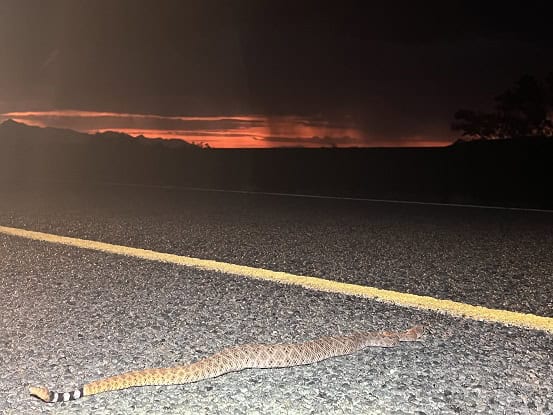
Maximum length: 233.7cm.
The western diamondback is the most common rattlesnake of the southern USA, ranging from California in the west to Arkansas in the east, and as far south as Mexico City. It causes a high total of bites annually, injecting up to 500mg of a severely cytotoxic, kidney-destroying venom.
Compared to other rattlesnakes, western diamondbacks are more likely to appear on roads because of their habitats. This species appears on desert flats far more commonly than its cousins, as well as mesquite grassland and walking trails in hills near busy towns. Meanwhile, the rock rattlesnake lives on rocky slopes in high altitude forests, miles away from busy roads.
Western diamondbacks aren’t especially fast, and have a high chance of becoming roadkill. Always remember though – rattlesnakes can bite after dying. A man from Texas discovered this the hard way in 2018, after decapitating a western diamondback in his Corpus Christi garden and being bitten by the severed head. He survived after receiving a large dose of antivenom.
Don’t run over the western diamondback rattlesnake, don’t touch any dead ones you find, don’t touch any living ones. In fact, it’s best not to interact with this species in any way.
| 4 | Gopher snake |
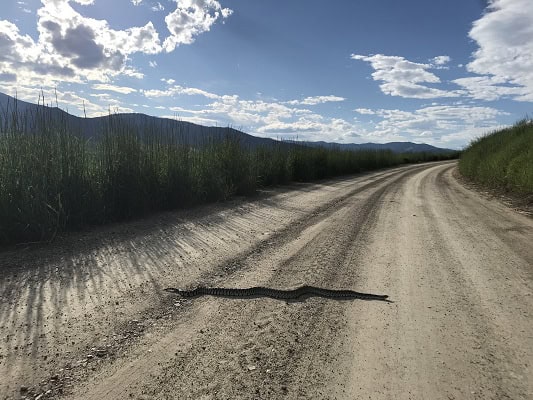
Maximum length: 267.7cm.
The gopher snake is a large constrictor of the western US which preys mainly on mammals. It’s particularly abundant in California, where it’s the single most common snake reptile controllers are summoned to deal with. Gopher snakes are everywhere in Colorado, Washington, Oregon and Nevada alike.
There’s also 6 different subspecies, including the Sonoran gopher snake of the south. Gopher snakes get around a lot, and their escapades commonly take them to roads. This isn’t a shy burrow dweller, although it does enter burrows to hibernate and swallow up families of mice. Gopher snakes are generally adventurous, appearing in a variety of open habitats, including grassland, shrubland, towns, parks, rocky slopes and prairies. Further south, they’re found in semi-deserts as well.
Encountering a gopher snake on a road is only a mildly impressive story. Swerving your car to perfectly avoid one would be slightly more impressive. Theoretically, a gopher snake could slither through your open car door, and snuggle up onto the seat while you’re arguing with somebody on your phone, shocking you as you turn around.
Fortunately, this snake isn’t strong enough to constrict your car, or long enough. This isn’t a dangerous snake to meet on a road; gopher snakes resemble rattlesnakes, but lack any venom of their own.
| 5 | Eastern tiger snake |
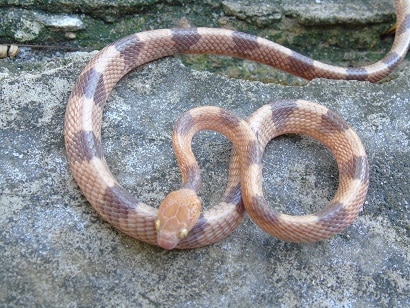
Maximum length: 105cm.
A South African snake measuring 75cm, which has an extremely mild venom. Eastern tiger snakes (Telescopus semiannulatus) are common in savannah areas with plenty of tree clumps, where they often hide beneath peeling bark strips on trees. They love to stash themselves away in safety, and with prowling hyenas and darting cobras nearby, who can blame them.
That said, eastern tiger snakes still have to eat. They prey heavily on lizards and geckos, not millipedes or woodlice. They have to get adventurous if they want to survive, and this commonly brings them to roads near savannahs or through them.
Roads are the most common place for a layman to find this species. If you’re deliberately searching for an eastern tiger snake, then driving down roads near savannahs would be the best option. While small, this snake stands out easily against the tarmac, with its beige-orange scales. Its bulging eyes are another ID sign.
Eastern tiger snakes act aggressive when confronted, gaping their mouths widely and making stabbing lunges. The one caveat is that their venom is barely researched, although it’s assumed to be very mild. This is one of hundreds of African snakes with vast gaps in the research.
| 6 | Texas indigo snake |
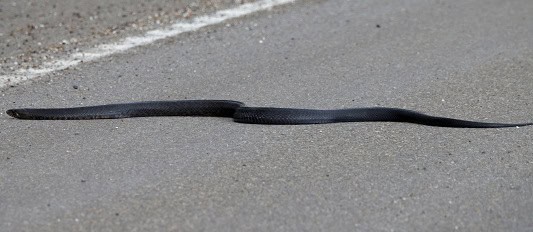
Maximum length: 254.6cm.
The Texas indigo snake (Drymarchon melanurus erebennus) is the close relative of the eastern indigo snake in Florida, with the two species diverging an estimated 5.9 million years ago. The Florida version is endangered, sticking to dark burrows in longleaf pine forests which are gradually being cut down. The species was extinct in Alabama until recently, when 25 were carefully reintroduced. Yet somehow, Texas indigo snakes are far more flexible in their habitats, and this sometimes brings them to paved road surfaces.
The Texas indigo snake is actually a subspecies of the Middle American indigo snake, which ranges from Texas, through all of Central America to Ecuador. Texas indigo snakes derive a huge portion of their calories from snakes, including our fellow list entrant: the western diamondback rattlesnake.
To find such prey, they cannot rest on their laurels. If they lazily waited in a burrow, then the occasional exhausted rattlesnake might take shelter down below, but there’d be no guarantees.
Hence, this species actively explores the surrounding countryside, performing strange actions such as trying to pull a fellow snake from a hole high up a tree trunk (photo). The Texas indigo snake appears in various habitats, including open grasslands, mesquite savannahs, areas with light vegetation, and scrubland, often with a lake or pond nearby. It avoids true deserts, but often appears in back gardens.
| 7 | Burmese python |
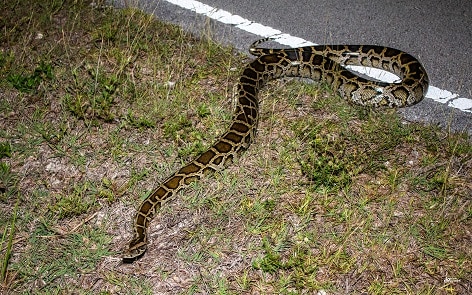
Maximum length: 579cm.
The Burmese python is the USA’s worst invasive snake, taking over the Florida Everglades, after captive pets escaped into the countryside and multiplied. It’s theorised that Hurricane Andrew in 1992 led to a huge escape of Burmese pythons, but regardless, this huge species has completely taken over southern Florida.
These giant constrictors now live in marshes, lakes, and are often found crossing roads. One of the largest ever was found by a roadside – a 5.79 metre python caught in Big Cypress National Preserve.
Drive around the Everglades for long enough, and you may not find a Burmese python instantly, but one is bound to turn up sooner or later. This species has incredible camouflage, with murky brown and yellow shades, yet this only applies in marshy wetland habitats. On a tarmac road, there’s no way you’d fail to notice this thick, bulky python.
All efforts to wipe out the 500,000 Burmese pythons have so far failed – organising annual hunts, radio-tagging males, cooking them in pizza (this actually happened). Burmese pythons have caused the numbers of local raccoons to fall by 99% and the local bobcats by 87.5%. All Florida citizens are encouraged to kill them on sight, but not by running them over – the recommended humane method is a shotgun blast to the head.
| 8 | Black racer |

Maximum length: 190.5cm.
The black racer is an adventurous species which inhabits 47 out of 48 lower US states, and moves extremely quickly. While other snakes take shelter in burrows, avoiding predators, the black racer slithers around the countryside freely, disregarding any threats. This species is something of a reckless maniac, and this also applies to busy highways, where the screeching tyres of traffic could easily prove lethal.
Black racers range from Florida in the southeast to Washington state in the northwest. They appear in a variety of open habitats, from fields to rocky plains to sparse woodlands.
They’re less common in thick forests, so unlike a copperhead, you probably won’t find one on a highway bisecting a thickly forested national park. Instead, you’ll find black racers crossing roads through sweeping prairie areas, in villages, and between open shrubland, perhaps near a car park for a popular weekend hiking route.
Black racers are less likely to settle in and block a road for hours, but they’re so active and energetic that there’s a great chance of spotting one. Their speed makes them eye-catching, and their 180cm length makes them a large target. Black racers are diurnal rather than nocturnal, and more than any snake on this list, they might actually be fast enough to dodge a car’s tyres.
| 9 | Boa imperator |
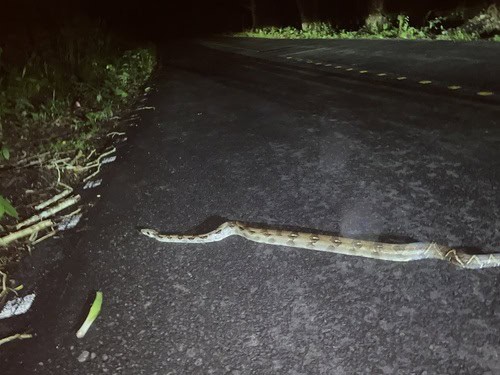
Maximum length: 3.7 metres.
The boa constrictor is an all-conquering snake, eating everything, going anywhere, and climbing anything in its path. It’s the most flexible boa in the world, and that’s why it’s the most widespread boa too, inhabiting all South American countries except for Chile.
The exact same is true of Boa imperator, its northern cousin. This species only became official recently, when scientific analysis determined that those from northwestern Peru to southern Mexico were actually independent, and had a 5-7% genetic separation.
Boa imperator is slightly lighter than its southerly cousin, but its habitats are virtually identical, conquering grassland, woodland, hillside, farmland, garden and bedroom alike. Consequently, this species crosses roads with ease. Its hunting style is another reason, as compared to the lazy emerald tree boa, Boa imperator is much more aggressive in exploring the countryside, and following the trails of scent particles.
A hungry Boa imperator may detect the presence of a rodent burrow with 20 hatchlings, based solely on one scent particle carried on a distant wind. Sometimes, to reach these bountiful feeding sites, it has no choice but to cross a busy highway and all its dangers.
| 10 | Cottonmouth |
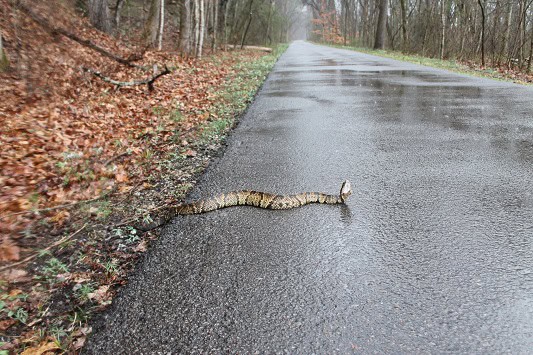
Maximum length: 189.2cm.
In Illinois, there exists LaRue Road, the most infamous snake road in the country, which each year is greeted by dozens of migrating cottonmouths. But any forest road in the southeastern US could potentially host a travelling cottonmouth, depending on the weather.
Cottonmouths are usually swamp lovers. They live among alligators, largemouth bass, frogs and toads, and other swamp snakes like brown watersnakes. They’re considered to be semi-aquatic, but they do venture to land sometimes, usually immediately after heavy rains.
The picture above is a great example. It’s clearly been raining, not just a minor shower, but the road is covered with shallow puddles, filling up the uneven tarmac. The cottonmouth is exploiting its chance to travel to a new location, moving while the landscape is more comfortable. Its goal may be to find a female cottonmouth, or a more bountiful swamp for its fish and amphibian prey.
If a road in Louisiana is covered with puddles, it’s much more likely to contain a cottonmouth. Be warned that cottonmouths are dangerously venomous, and while not usually hellbent on attacking people, they’re more likely to be aggressive in their adventurous phases such as this.
| 11 | Mole snake |

Maximum length: 210cm
A crushing constrictor of far southern Africa. The mole snake is named for its love of eating golden moles, and also preys on penguin eggs. It rests underground for large portions of the day, but also explores the countryside, crossing relatively open areas like grassland, hillsides, and apparently roads.
This species isn’t especially fast, unlike a cobra, and has a high risk of becoming roadkill. Mole snakes pose no threat to human beings, and won’t assault your car as you pass. This is no joke, as the black mamba is one species which has been rumoured to attack cars in the past.
South Africa is full of jet black snakes with virtually no patterns. There’s harmless blind thread snakes, which dwell underground, and there’s lethal stiletto snakes. However, none of these reach the 2 metres of the mole snake, or possess the thickness. If you see a large black snake trying desperately to cross a busy highway, a pure black rather than grey and patterned, then it’s highly likely to be the mole snake.
This species covers almost all of South Africa and Namibia, and is common in Botswana and Zimbabwe. Countries where it doesn’t exist include Kenya, Uganda and Nigeria.