
| 1 | Tentacled snake |
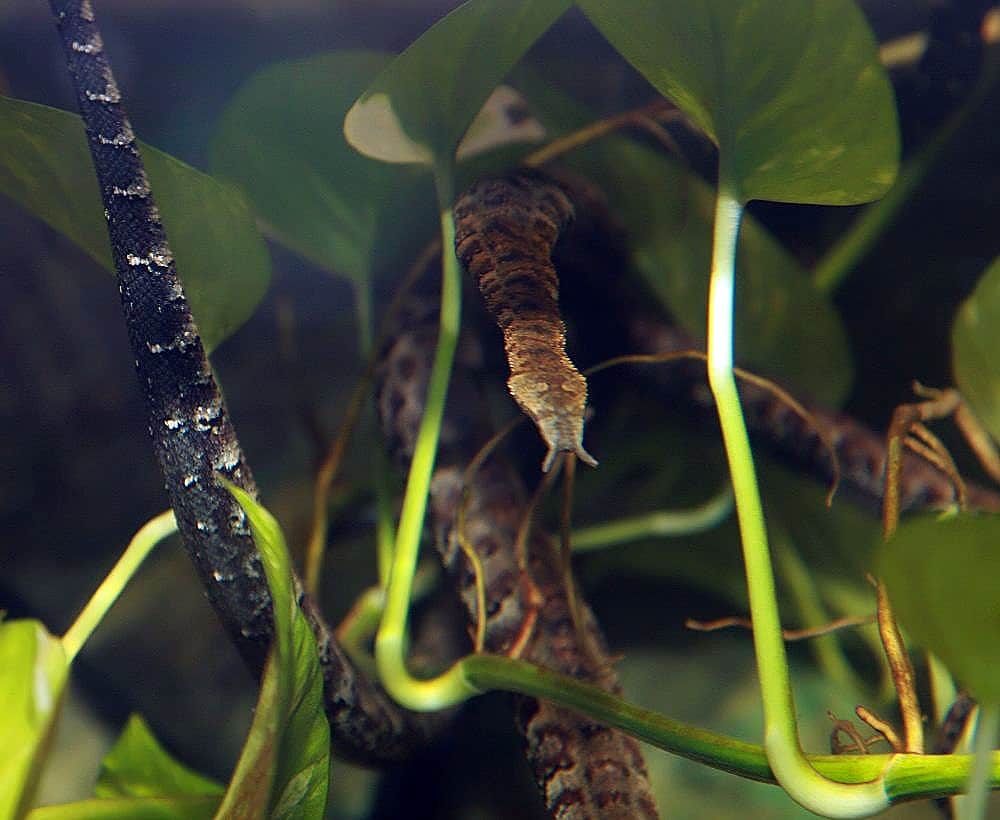
Maximum length: 77cm.
A bizarre snake, the only species of 3900 to have two fleshy tentacled appendages sprouting from its face. Tentacled snakes (Erpeton tentaculum) inhabit central and southern Thailand, as well as Cambodia and Vietnam. They inhabit inland water bodies within forests, such as streams, swamps and small lakes. Above all, they like murky water bodies with a high content of silt.
Consequently, photos of this bizarre snake are few and far between. Their “tentacles” are believed to have sensory properties, recognising water current alterations, which inform them that fish (their main prey) are on the way.
Tentacled snakes are highly skilled hunters, positioning themselves in a distinct J-shape, from which they explode. They anticipate a fish’s line of travel, by aiming not for the fish, but where it will be in several milliseconds. They even push the fish towards this point by propelling a pulse of water towards them, while underwater.
Tentacled snakes average at 50cm. Another weird anomaly is once being dubbed the world’s first herbivorous snake. Naturalist Albert Morice wrote an account in 1875 of algae and aquatic plant fragments being discovered in a tentacled snake’s stomach. He wrote how the locals informed him that the snake often ate plants. In various journals over the decades, it was repeated that Erpeton tentaculatum is occasionally herbivorous. But it’s now assumed that the plants were eaten accidentally, as a natural consequence of their complex boggy worlds.
As of 2023, Erpeton tentaculum is the sole member of the Erpeton clan, but the lakes it lives in are so murky that new ones could easily be hidden.
| 2 | Glossy marsh snake |
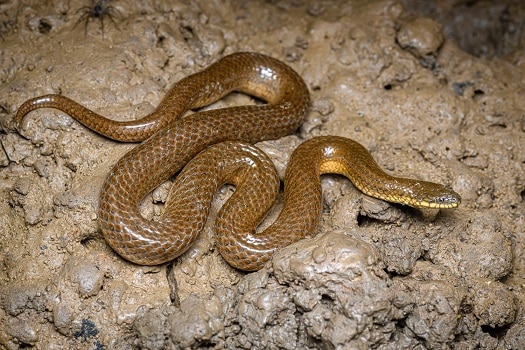
Maximum length: 58cm.
This odd snake is the sole member within its Gerarda genus. It has several alternative titles: Gerard’s water snake, cat-eyed fishing snake. Rather than rivers, this species is particularly fond of coastal mangrove habitats. While not commonly sighted, they’re extremely widespread, inhabiting India, Thailand, Malaysia, Indonesia and Cambodia.
Glossy marsh snakes look unassuming at first glance, with olive-grey tones perfect for blending with murky water, and escaping the eyes of birds. But this “humble” snake has a brutal hunting strategy: ripping large crabs into several pieces in order to swallow them.
Most snakes swallow their prey whole, but Gerarda prevostiana is a rare exception. A 2018 study proved that they target freshly moulted crabs, just 10-15 minutes after shedding their hard shell. Gerarda prevostiana threads a needle with this narrow time gap, and they begin by seizing the crab’s mid-section with their fangs.
After applying a tight coil, they force the crab’s individual body parts through the loop, severing them, and allowing them to swallow each piece one by one. Glossy marsh snakes can swallow crabs 5 times wider than their own mouth gape. Meanwhile, the identity of “Gerard” is unknown; scientist John Gray never revealed who he named the snake after before he died.
| 3 | White-bellied mangrove snake |
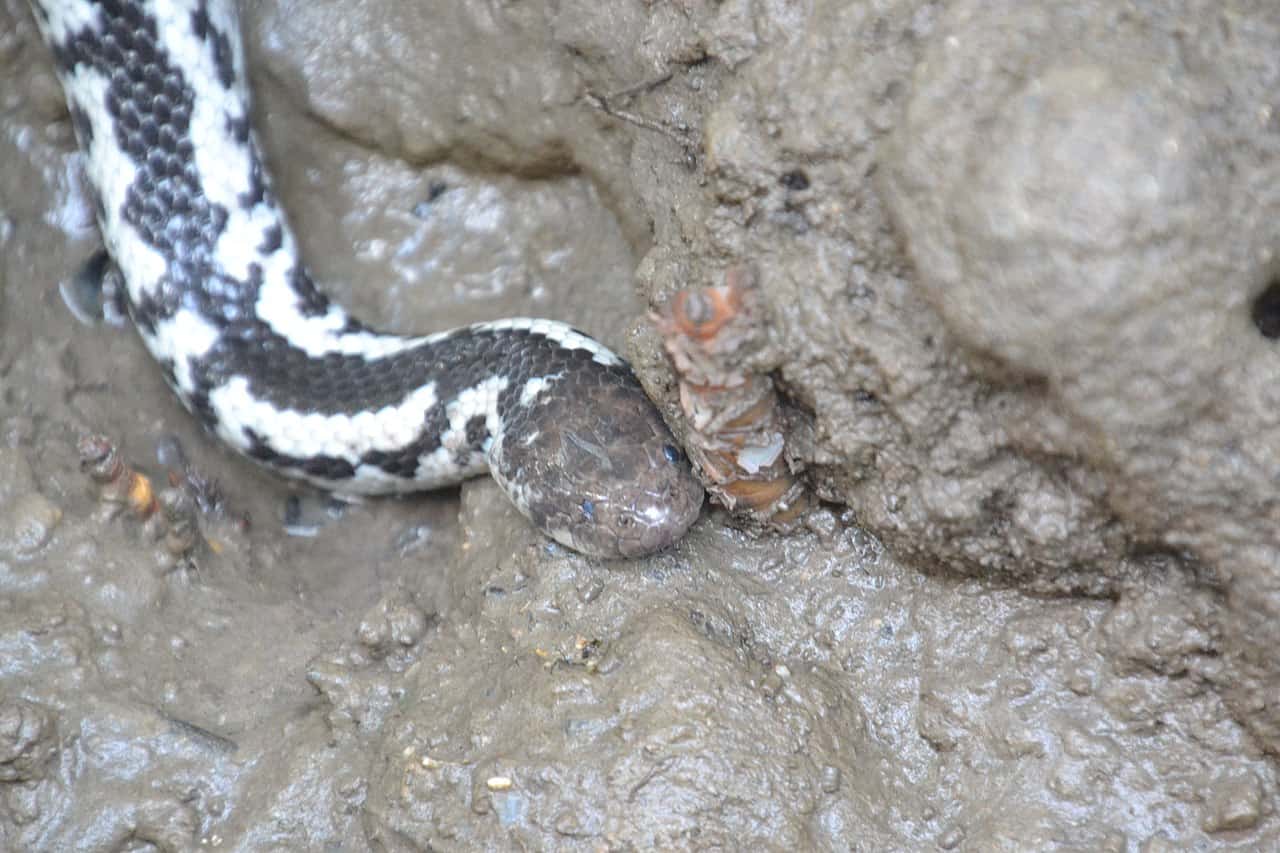
Maximum length: 95cm.
Another crab-eating watersnake, but this time focussing on hard-shelled crabs. White-bellied mangrove snakes (Fordonia leucobalia) inhabit western and southern Thailand, possibly further east as well. You’ll mainly find them in tidal marshes and mangroves, rather than inland swamps. They possess only a mild venom, which is barely studied.
The same 2018 study on the glossy marsh snake analysed this species, and found that they struck at crabs with a closed mouth, pinning them to the soft mud. They then applied a coil, and ripped off the crabs’ legs, swallowing bite sized pieces, before moving onto the body. Don’t worry – they lack the power or inclination to do this to humans, although they could evolve a giant cousin one day. Fordonia leucobalia also uses this technique to eat mud lobsters.
Like Gerard’s water snake, Fordonia leucobalia has classic semi-aquatic adaptions, such as eyes on top of its head, and a special nostril valve to prevent water infiltration. This species is also incredibly widespread. They range from northeast India all the way to Australia’s northwest coast. The white belly is all too real, and is an easy way to identify them.
| 4 | Triangle keelback |
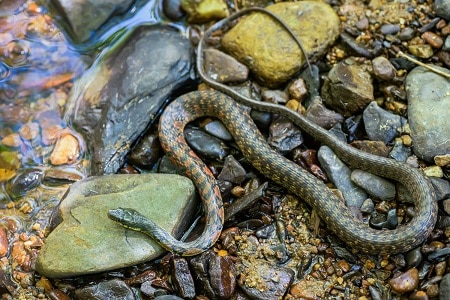
Maximum length: 135cm.
An inland watersnake, which is particularly common in streams or pools within rainforests. Triangle keelbacks reach a record of 135cm, and are recognisable by their triangular patterns, but also a gradual reddening towards the neck.
This species appears sparsely in much of Thailand, but in the south, beginning around Phuket, they suddenly become common. Further afield, triangle keelbacks appear in Malaysia, Cambodia, Singapore, Java and Sumatra – Thailand lies at the northernmost extent of their range.
Triangle keelbacks are harmless, and while they love streams, they also appear on large green leaves 1 metre above ground. They prey heavily on amphibians, and have been witnessed swallowing fanged frogs (Limnonectes group) in southeast Sulawesi. This took place 10 metres from the bank of a small river, and the keelback seized the frog by its left rear leg.
Another hunting event took place in Kirirom National Park, Cambodia. The victim was a Hongkong whipping frog (Polypedates megacephalus), which the keelback seized by its left rear leg (again), at the edge of a mountain stream at 580 metres in elevation. The two struggled for 1 minute, before the frog leapt into the stream heroically, taking the snake with it. The two floated away, and the frog’s distress calls were heard in the distance for another 10 minutes.
Triangle keelbacks are also found in Kaeng Krachan National Park, the largest national park in Thailand.
| 5 | Puff-faced watersnake |
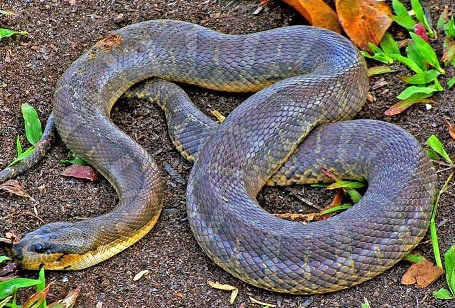
Maximum length: 140cm.
A snake with a confused family tree. Homalopsis currently has 5 members, and is the sister genus to the dog-faced watersnakes (Cerberus genus) which inhabit coastal marine habitats, near Phuket for example. Cerberus is adapted to brackish waters, while Homalopsis likes freshwater, in streams and humid swamps within inner Thailand.
Originally, the puff-faced watersnake (Homalopsis buccata) covered most of Thailand, but in 2012, it was split in two. The species in central, northern, and eastern Thailand (and Cambodia) turned out to be Merelcoxji’s watersnake, a new species, while H. buccata now only clung onto the far southern provinces of Thailand, near Pattani. Further afield, H. buccata inhabits most of Indonesia and Malaysia. They lay 2-20 live young, and mainly eat fish, supplemented with crustaceans and amphibians.
Puff-faced watersnakes are nocturnal and harmless to humans. According to the 2012 study, H. buccata has “more irregular bands with less contrast“. The new Merelcoxii’s watersnake from central Thailand has “high contrast, evenly spaced, pale colored bands” covering the dark body. Essentially, H. buccata is duller and less flashy.
Either way, this is a mildly venomous watersnake which you may stumble across in the inner streams of Thailand, with a thick body, and a love of muddy shores rather than deep lakes. There’s almost nowhere in Thailand where you won’t find one of these two species.
| 6 | Javan dragonsnake |
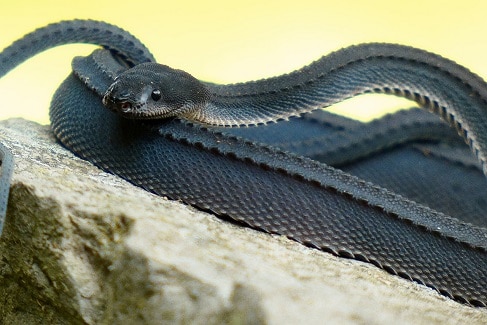
Maximum length: 65cm.
This bizarre snake is found in extreme southern Thailand, as well as Indonesia and Malaysia. Their dragon name originates from their jewel encrusted scales, which look like an impenetrable hide against a 12th century sword. Javan dragonsnakes inhabit wet forests, swamps and marshes, but also manmade wetlands in agricultural areas like rice paddies. This isn’t a shy, retiring species that lives in the heart of rainforests only.
This species is active at night, when they move from water bodies to rummage under leaf litter on the forest floor. An alternative name is the rough-backed litter snake, though Javan dragonsnake is far cooler.
In October 2014, a prey species was confirmed: the smooth guardian frog (Limnonectes palavanensis). In Ulu Temburong National Park, scientists spotted a Javan dragon snake in a manmade pool rich in tadpoles, and placed it in a terrarium overnight. The next morning, a regurgitated smooth guardian frog was discovered.
Due to their unique appearance, Javan dragonsnakes are much sought after by reptile enthusiasts, but they’re tricky to keep, typically dying within a few short weeks. Javan dragonsnakes are the sole member of their Xenodermus genus.
| 7 | Mekong mud snake |
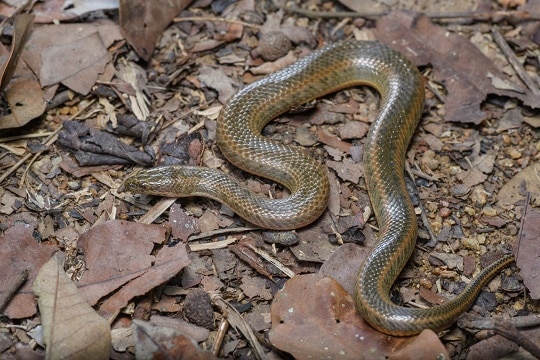
Maximum length: 87cm.
A water-loving snake of central and eastern Thailand, avoiding the south. This species has a simple habitat: it closely follows the line of the Mekong river, the world’s 12th longest, which passes through eastern Thailand, through Cambodia, and ends near Vietnam’s capital Ho Chi Mingh City. Outside of drainage basins of the Mekong, like the Khorat basin, it almost completely disappears.
Consequently, Mekong mud snakes (Enhydris subtaeniata) aren’t found in southern or western Thailand. This species measures 60-90cm, and has olive colours with blacker parallel stripes, but with low contrast. They live in muddy freshwater habitats, including streams near agricultural areas, marshes, and shallow, slow-moving rivers.
Mekong mud snakes prey on fish, and like other Enhydris members, are rear-fanged with a mild venom of unknown properties. In 2006, one was spotted in Thailand eating a silver barb on the shores of a muddy stream, so it’s likely that they drag prey to shores before swallowing them.
One place they’re confirmed in Vietnam is the large U Minh Thượng National Park, in the far south. In Thailand, they inhabit the Sakaerat Biosphere Reserve. Mekong mud snakes are no pushovers, and will bite if threatened. It’s rare to spot them away from water.
| 8 | Yellow spotted keelback |
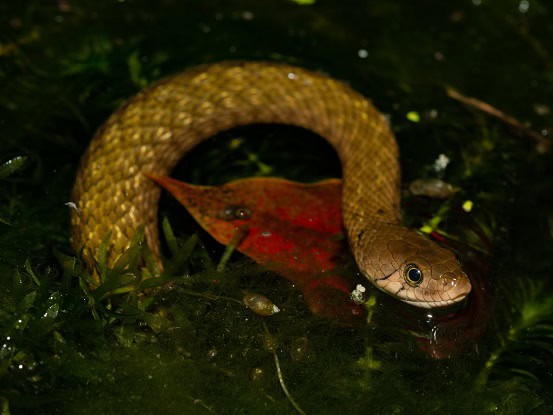
Maximum length: 97.4cm.
This is one of those species that is very common, yet has surprisingly little research conducted. The yellow spotted keelback (Fowlea flavipunctatus) is a semi-aquatic snake which hangs out in shallow swamps, streams and marshes. This species moves by day, and encounters with people are quite common.
Yellow spotted keelbacks can turn vicious if you get in their way, rearing up and not hesitating to bite painfully. Their teeth are sharp enough to draw blood, but fortunately, they’re not capable of killing. Because they seasonally flood, rice paddies are a top place to encounter this 1 metre, moderately thick species. They even appear in drainage ditches in towns.
Yellow-spotted keelbacks are found throughout Thailand, including near the cities of Bangkok, Pattaya and Phuket. They’re also common in Cambodia, where they’re found near the cities of Krong Battambang and Krong Siem Riep.
This species is closely related to the checkered keelback (Fowlea piscivator) of India, which is heavily-fish eating, so it’s assumed that this species also relies on fish. One of their ID markings is a series of vividly defined black markings on their face, contrasting against the yellow below. These travel diagonally from the mouth and eye.
| 9 | Burmese python |
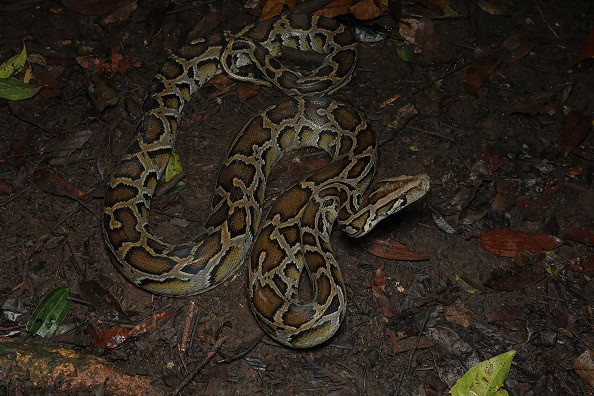
Maximum length: 579cm.
The second largest snake in Thailand, after the reticulated python. The Burmese python (Python bivittatus) gets most its attention nowadays as an invasive species in the Florida everglades, where it numbers at least 100,000. Yet their natural range in southeast Asia is huge, ranging from extreme northeast India, through most of Thailand, to Cambodia and Vietnam.
Like in the Everglades, Burmese pythons mainly inhabit watery areas, such as marshes and lakes. They’re far more aquatic compared to the reticulated python, which tends to stick to land. Consequently, Burmese pythons are also less likely to appear in urban streets, whereas the reticulated python occasionally enters supermarkets in Bangkok.
This brutish python is able to prey on animals over 100% of its own body weight. A python in the Florida Everglades weighed 31.5 pounds, yet was spotted preying on a 35 pound white-tailed deer.
The Burmese python is crushingly thick, reaches nearly 6 metres, and another giant record is its eggs. A female in the Everglades laid an egg clutch of 122 eggs. The only disadvantage is that because Burmese pythons are so abundant in the Everglades, there’s barely any research on them in their native lands.
| 10 | Checkered keelback |
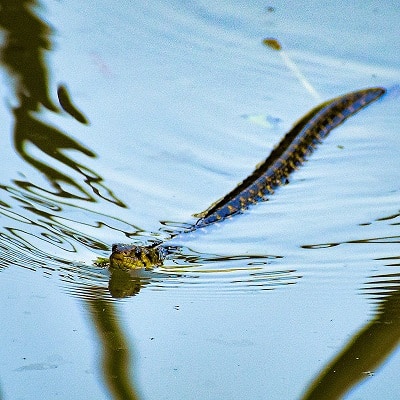
Maximum length: at least 140cm.
A close relative of the yellow-spotted keelback. The common keelback (Fowlea piscator) is far more common across southeast Asia, with its heartlands lying in India. In Thailand, they’re slightly less common than the yellow-spotted keelback, but still found across most of the country, excluding the south. This species reaches larger lengths, regularly exceeding 1 metre.
The checkered keelback is a snake with endless skills, the only one lacking being venom. They can flee into marshes at high speeds, seize fish in their jaws while swimming underwater, and fake death to confuse hungry birds and scientists. Checkered keelbacks are relatively aggressive if picked up, and even have the ability to jump, by simultaneously applying pressure at several body points.
This species can be hard to distinguish from its yellow-spotted cousin. Physically, the differences are only very subtle. The checkered keelback has an inverted V shape mark on its neck, while in the yellow-spotted keelback, this is a normal V. The yellow-spotted keelback has slightly fewer ventral scales – one study found 122-130 versus just 132-143 in the checkered keelback.
As the name suggests, the yellow-spotted keelback has a tendency to have yellow markings, although checkered keelbacks can also possess these. Overall, the two species have a small genetic distance of 4.8-7.3%.
| 11 | Schneider’s bockadam |
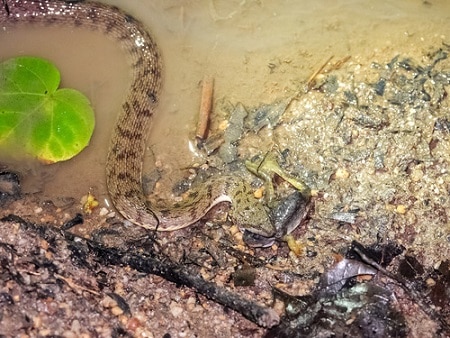
Maximum length: 127cm.
Part of the dog-faced watersnake clan, or the bockadams. These mostly harmless snakes live in muddy tidal flats along coastlines, rarely straying inland, except for a couple of miles into river estuaries. The “dog-faced watersnake” was originally one giant species ranging from Australia to India, but in 2012, the species was divided into five, with two being extremely rare, and two being tied as the most common.
The first is Cerberus rynchops, which covers the entire Indian coastline, plus Bangladesh, through to Myanmar. When Thailand arrives, this is replaced by the second über-common species: Schneider’s bockadam (Cerberus schneideri). This is abundant all over the Thai coast, from Phuket on the west coast to Pattaya closer to Bangkok.
Schneider’s bockadam has various adaptions to aquatic life. These include a valve-like nostril, upwards facing eyes, and the ability to sidewind over unstable mudflats, like how a sidewinder moves over Death Valley. They love to mingle with muddy coastlines, resting in shallow tidal pools, and slithering through swarming schools of fish and effortlessly grabbing them.
This snake can be highly abundant, if difficult to spot because of their subtle muddy colours. Schenider’s bockadams typically measure 80-105cm, and are also common in Singapore. The physical differences to the Indian version are very subtle, mainly involving variations in scale counts and slightly different scale shapes.
Schneider’s bockadam is a mildly venomous species, but is believed to pose no threat to humans.